A video of Paul R. Tregurtha having to do an emergency 360-degree turn because of issues with lifting the span of this bridge was my motivation for finally documenting this bridge. I've seen plenty of YouTube videos of boats passing under the bridge because the boats and the bridge tender generally "salute" each other. Saluting is sounding their horn.
In the above video, you can see the prop wash of the main propeller, but I could not see any prop wash for a bow thruster. The following photo confirms it has a bow thruster marking. So was it able to do that tight turn with just its rudder? That would explain why it maintained power and speed during the turn.
 |
| Interlake Steamship Company posted Hello Twin Ports! Our M/V Paul R. Tregurtha sails under the iconic Duluth Aerial Lift Bridge on her way to Superior to take on more than 60,000 tons of coal. It will take her 2.5 to 3 days to transport the essential cargo to the DTE power plant in St. Clair. #shippingmatters  : David Schauer |
 |
| Damian Entwistle Flickr, cropped; License: Attribution-NonCommercial 2.0 Generic (CC BY-NC 2.0) Duluth - Enger Tower, view to lift bridge |
 |
| Damian Entwistle Video, cropped; License: Attribution-NonCommercial 2.0 Generic (CC BY-NC 2.0) Duluth - Enger Tower, lift bridge and laker |
 |
| Bridges Now and Then posted 1909 postcard of Duluth, Minnesota's Aerial Transfer Bridge. (Perfect Duluth Day) |
 |
| Underestimated Arsenal posted "Picturesque 'flying' trips," The Christian Science Monitor called them in April 1929: the crossings of the aerial bridge ferry in Duluth, Minnesota. Look under the arched span of the Aerial Bridge in this 1925 photograph and there is no road. The dark box hanging over the middle of the canal is the ferry car. People, wagons and streetcars bound for Park Point rode in it, hung from a span 135 feet above the water. The reason was the canal itself. When Duluth cut it through Minnesota Point in 1871, the far end of the point became an island. A rowboat ferry carried people across until 1897, then a steam ferry. But every bridge put forward, a drawbridge among them, failed to win the approval of the War Department, which wanted a crossing that "in no way would impede the traffic through the canal." A tunnel was looked at too, and dropped for its cost. The Iron Trade Review claimed in 1905 that slightly more commercial tonnage passed through this canal each year than through the Suez Canal. So in 1899, when a ferry bridge at Rouen, France, was brought to the attention of the city engineer, Thomas McGilvray, he adapted the idea to Duluth. The Lake Carriers' Association fixed the height: 135 feet clear, enough for the highest masts. Below that span the car ran just six feet above the government piers, and when it stopped, the whole car rested over land, "not an obstruction or menace to navigation," as the Iron Trade Review put it. The car waited for the ships. It carried its own machinery. Electric motors under its floor turned two drums nine feet across, winding one-inch cables that ran up to the truss and through it to the towers, where they were made fast, so the car hauled itself from shore to shore. The carriage it hung from rolled on rails inside the truss's two lower chords, the box-shaped beams along the bottom of the span, each closed on three sides so snow and sleet could not coat the track. Each trip could take a streetcar, two loaded wagons with their teams, and 350 passengers in two glazed cabins, and it crossed in a little over a minute. On 9 April 1905, in its first spring, it carried 33,000 people. Seven men ran it once the city took it over: Superintendent Leonard Green and the operators Thomas White, John Hicken, William Maynard, James Murray, Urban Nehring and Frank Lampert. But one car could carry only so much. In 1925, the year of this photograph, Duluth had 17,340 automobiles and 2,600 trucks. In March 1928 a formal application went to the War Department for a permit to turn it into a lift bridge, and on the morning of 1 July 1929 the car made its last trip. James Murray started it back to the mainland one final time. "It was a good old car and I hate to see her go," he said. Then the Kansas City Bridge Company raised the 390-foot top span, so tall ships could still pass under a road deck lifted up beneath it. The towers were lengthened, and new steel built inside the old ones carries the weight of a deck that rises and falls between them. The Monitor had reported a design that "retains much of the appearance of the present span." It kept more than the look. The span the road deck rises toward today is the same one this car hung from in 1925. "The Eighth Wonder of the World" is what the typed caption on this print's mount calls the bridge. The mount also says the photograph was "Taken by McCook Field, during Mapping of Canadian Border, Oct. & Nov. 1925." It is held by the National Archives among the Records of the Army Air Forces, in the "Airscapes" series, number 18-AA-74-6. A note typed above it reads "Recopied 9/12/55, Neg. deteriorated." The haze that hides the lake and the far shore is in the print itself. The print's mount and a white plate number in one corner have been cropped off; nothing else was changed. The ferry car could still cross with its power gone. Its current came from two separate sources, and if both failed, the crew could work it across by hand, with lever handles geared to the drums on the car, the Iron Trade Review explained in 1905. It was a ride people remembered. The Christian Science Monitor wrote in 1929 that it had given thousands of tourists an experience they kept alongside shooting the rapids at Ausable Chasm in New York or a visit to the Cave of the Winds beneath Niagara Falls. Two parts of the story are told more than one way. The Monitor said a Duluth newspaperman, "it is said," suggested the design after seeing a picture of the bridge at Rouen. The Iron Trade Review of 1905 says the Rouen bridge was brought to the city engineer's attention in 1899, and Zenith City Press says Thomas McGilvray read about it. The design is credited to McGilvray by the 1973 National Register form, while the Monitor and Zenith City Press credit the Minneapolis engineer C. A. P. Turner with reworking it, and the Iron Trade Review says the steel company's own engineer drew the designs. That is why the post names no single designer. Sources: the 135-foot clearance, the car running six feet above the piers and resting over land, and the refusals of the earlier bridge plans come from the Iron Trade Review of 5 October 1905; the clearance and the car's load also from the National Register nomination. The Suez Canal comparison is the Review's own claim. The raising of the 390-foot top span is from the Proceedings of the American Society of Civil Engineers, January 1930. The words on the photo carry no numbers. The steel and the car were built by the Modern Steel Structural Company of Waukesha, Wisconsin, through the winter of 1904 to 1905. In October 1929 C. D. Weller, the resident engineer, gave the Duluth section of the American Society of Civil Engineers an account of raising the span. The lift bridge first operated in March 1930. It still stands over the Duluth Ship Canal at Canal Park. It was placed on the National Register of Historic Places in 1973, and in 2017 the American Society of Civil Engineers named it a National Historic Civil Engineering Landmark. |
 |
| Robby Gragg Flickr Phillip R Clarke The Phillip R Clarke ducks under the historic aerial lift bridge in Duluth, MN. |
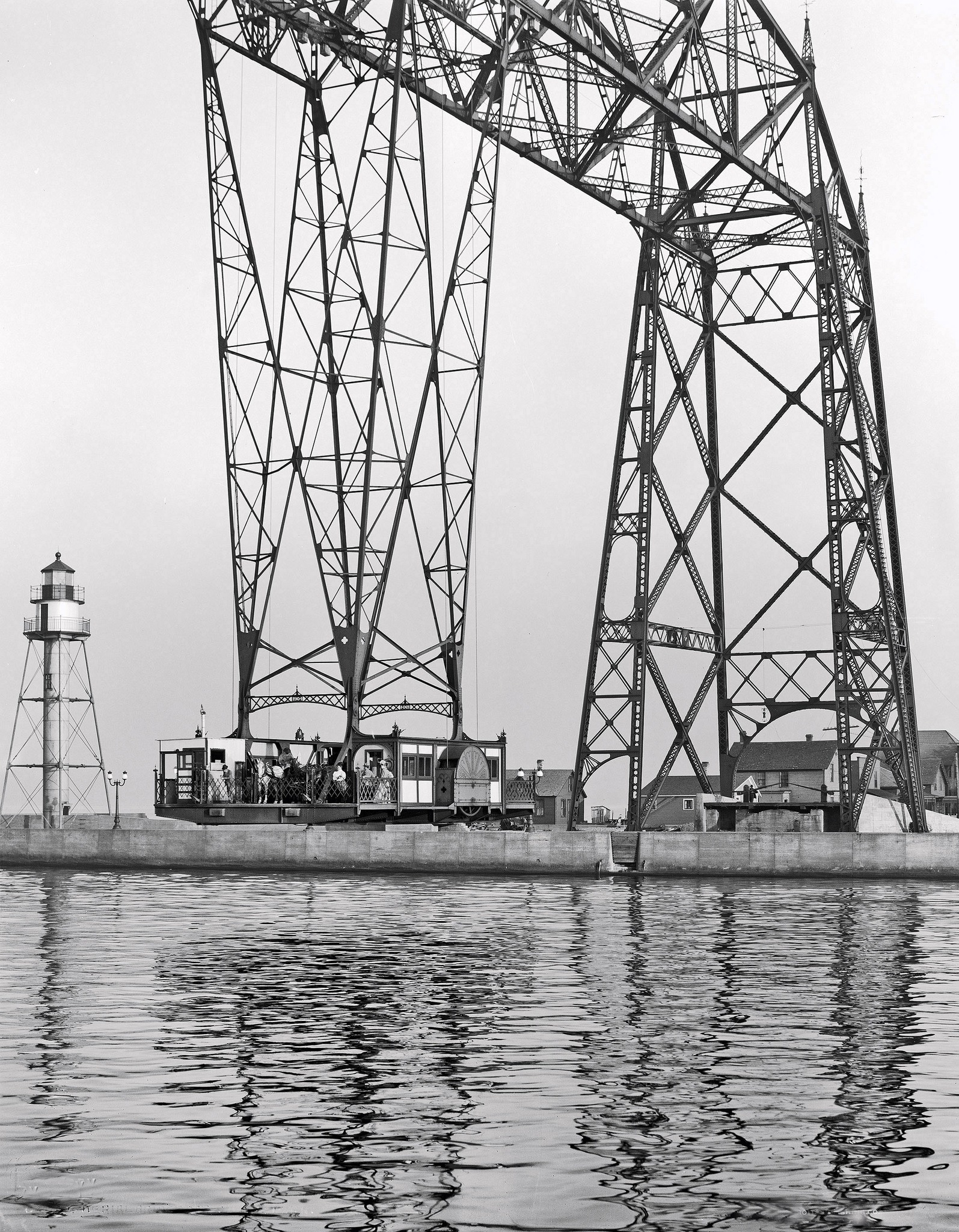
The reason for the two dates is that it was originally built in 1905 as the transporter shown in this photo. In 1930, after raising the transporter truss and reinforcing the towers, a lift span was added.
 |
Tom Wigley Flickr, License: Attribution-NonCommercial-ShareAlike 2.0 Generic (CC BY-NC-SA 2.0)Aerial bridge. Duluth, MinnesotaCirca 1905. "Aerial bridge. Duluth, Minnesota." Suspended Car Transfer over the Duluth Ship Canal. The gondola could carry 60 tons of cargo across the 300-foot channel with minimal obstruction of the shipping lane. After modification for service as a vertical lift, the span became known as the Aerial Lift Bridge. 8x10 dry plate glass negative, Detroit Publishing Company. Steve Vanden Bosch postedDavid Stack: This very unusual aerial ferry configuration of the Duluth canal bridge was in operation from 1905 to 1929. |
 |
| Bridges Now and Then posted Onlookers watch the gondola of the Duluth Aerial Transfer Bridge cross the Duluth Ship Canal, 1905. (Library of Congress) |
 |
| Jerry Bielicki updated Duluth.......1905 Jerry Bielicki shared Laura Jacobs: original by photographer Hugh McKenzie. Gordy Schmitt Detroit Publishing Company photo, they show a 1908 date on the photo. https://www.loc.gov/resource/det.4a23152/ |
 |
| Bridges Now and Then posted A vintage view of the Aerial Transfer Bridge in Duluth, Minnesota, from 1915, before conversion to a lift bridge. (Minnesota History Shop) Jim Ritchie: https://www.perfectduluthday.com/2020/12/22/aerial-transfer-bridge-circa-1905/ |
 |
| Association for Great Lakes Maritime History posted The freighter Francis L. Robbins with the Aerial Bridge in the background at Duluth, Minn., circa 1906 (Image Source: University of Wisconsin Madison Libraries Digital Collection – The Great Lakes Maritime History Project). The photographer was Hugh McKenzie (1879-1957). The image is part of the Kenneth E. Thro Collection of the Jim Dan Hill Library at the University of Wisconsin Superior. It was created from a glass plate negative. [The remainder of the description is a history of the freighter.] [The original description used the name "Aerial Lift Bridge." Thus the following comments.] Robert Porterfield: The bridge in the background is a transfer bridge. It does not lift. Instead a movable section of bridge deck is suspended from bridge and travels from on side to the other to carry passengers and vehicles across the water. Association for Great Lakes Maritime History: Thanks for the correction. As you noted, the name wasn't changed to the Aerial Lift Bridge until after the structure was modified to its current configuration and the gondola removed in 1929. |
 |
| HAER MINN,69-DULU,9--4, cropped 4. SOUTH ELEVATION OF BRIDGE, WITH THE 'ROGER BLOUGH' HAVING PASSED UNDER - Duluth Aerial Lift Bridge, Lake Avenue, across Duluth Ship Canal, Duluth, St. Louis County, MN |
The bridge spans the Duluth Ship Canal, which was dug in 1870 through the sand bar that routed the Saint Louise River further south and east before opening into the lake. The sand spit, commonly called "Park Point" by locals, named Minnesota Point, allowed ships to avoid Superior WI while still getting from the river to Lake Superior. This also turned the peninsula into an island. Ferries worked - but not during icy winter.
In 1892, John Low Waddell designed a high lifting vertical lift bridge. The War department did not approve so Duluth did not get to build it. But the design was modified and built in Chicago as the South Halsted Street Bridge. Thomas McGilvray, a city engineer, drew the plans for the structure that was built, apparently inspired by a similar traveler type bridge, the Rouen Transporter Bridge across the Seine.By the late 1920, the bridge was not keeping up with demand. The upgrade began in 1929, adding lifting span with a automotive deck. The fix span across the top had to be raised to allow room for the lifted span, so the towers straight vertical sections were added. In addition, significant structure was added within the towers to accommodate the counterweights and lifting mechanism. The rebuilt bridge first lifted for a vessel 1930 Mar 29.[Bridge Hunter Description]
So was the War Department afraid that the lift span would fall down?
 |
| LC-USF34-064038-D (b&w film neg.), cropped Aerial bridge. Duluth, Minnesota |
 |
| LC-USF34-064039-D (b&w film neg.) Aerial bridge. Duluth, Minnesota [Note that the ship has passed and the lift span is on its way down.] |
 |
| LC-HS503- 705 Credit line: Photographs in the Carol M. Highsmith Archive, Library of Congress, Prints and Photographs Division. Carol M. Highsmith's photographs are in the public domain. |
the lift span is already on its way back down.
 |
| David Schauer posted Blade Runner... M/V Ronnie arriving in nice light with wind blades for the port terminal. North Carolina with an assist. Duluth, MN - April 30, 2024 |
Al Miller posted three photos with the comment:
Edgar B. Speer departs Duluth in late March 1984 as the first boat to leave port that spring. She's bound for Two Harbors to load taconite pellets. G-Tug Vermont will accompany the Speer to assist with icebreaking and docking.I was working for the Duluth News-Tribune at the time and had just done a story previewing the shipping season -- always one of the most pleasant tasks of the year. The photographer assigned to shoot the first boat movement persuaded me to accompany him -- probably so he wouldn't have to write the two-sentence photo cutline himself. He knew the operators of the Aerial Bridge, so we were able to be on the span when they raised it to allow the Speer to pass. I don't remember why I had my camera with me that day, but I'm glad I did. I wasn't a big fan of the 1,000-footers but this turned out to be a series of photos I still treasure.
 |
| 1 |
 |
| 2 |
 |
| 3 |
A view of the underside of the lift span.
 |
| Bjornberg Photography posted Steaming by: It was a blue bird kind of day late as I captured a close up of the Alpena's smokestack when she passed underneath the Duluth lift bridge late last year. Amazing to see an 80-year-old ship (the oldest operating on the Great Lakes) in such great condition! 2023 Calendar: tinyurl.com/ShipsontheGreatLakes23 Prints: BjornbergPhotography.smugmug.com |
Because ship fans are normally after freighters in the harbor canal, this is the only photo I've seen with the span just part way up.
 |
| Rich Pedersen posted The Federal Seto anchored in the lake as the Aerial Lift Bridge raises for a couple of sailboats this evening. 5/27/22 Chris Mazzella: Not uncommon Lynn Theeck: It's been sitting there almost two days. |
Michael Rainaldo posted four photos with the comment:
Not exactly ship related but then again, I guess it is. Enjoyed watching the MNDOT crews inspecting the Aerial Lift Bridge in Duluth, MN yesterday. Not often you get a close up look as they are usually hanging under the Blatnik or Bong bridges at 120 ft over the water, under the roadway & unseen to traffic overhead.Interesting to watch was when a ship or boat came in & the bridge lifted as normal and the crew and equipment went up with it. I guess you just never know what you'll see on a morning bike ride.
Jeremiah Shoemaker: Ultrasonic and visual NDT! Love to see it!
Access the public interactive bridge map here: https://mndot.maps.arcgis.com/.../webappviewer/index.html...
 |
| 1 |
 |
| 2 |
 |
| 3 |
 |
| 4 |
John Harker posted ten photos.
 |
| 1 |
 |
| 2 |
 |
| 3 |
 |
| 4 |
 |
| 5 |
 |
| 6 |
 |
| 7 |
 |
| 8 |
 |
| 9 |
 |
| 10 |
Bob Hamilton posted five photos with the comment: "A few shots of Duluth's famous Aerial Lift Bridge."
 |
| 1 |
 |
| 2 |
 |
| 3 |
 |
| 4 |
 |
| 5 |
 |
| David Schauer posted The oldest on the lakes, steamer Alpena (1942), arrived this morning with cement for Amrize (Lafarge) in Superior. Duluth, MN - October 21, 2025 |
 |
| David Schauer posted The ultimate location identifier, Duluth's Aerial Lift Bridge, had a double transit on the same lift yesterday as the H. Lee White arrived just ahead of corporate cousin Indiana Harbor. Gus Schauer image. October 24, 2025 |
At 0:20, the Laker sounds a salute. Was that a long and two shorts (--.)? That is a "D" in Morse code. I wonder what it stand for. The bridge definitely returned a salute of a long and two shorts. At 1:10, the captain sounds another salute with an exaggerated long and two shorts.
 |
| 1:30 video "The boat is the H Lee White." [It still bothers me to call a big ship a boat. That is why I use the term Laker or freighter." |
Note the freight on the horizon on the right side of this video. That is the Arthur M Anderson doing a loop because the bridge tender asked him to slow down his arrival because he was expecting an ambulance to cross the bridge. Soon after this the bridge tender gave him an all clear. The rest of the video is a timelapse of the freight finishing the loop and coming in the canal. At 2:48 we get a new view and regular speed. At 4:27, we hear the salute. It sounded like three longs and 2 shorts. (---..) So, unlike trains for a crossing, the freighters don't use the same letter.
 |
| 7:01 video @ 0:39 |
No comments:
Post a Comment