Tuesday, February 2, 2016

Grasselli Tower: EJ&E vs. IHB(NYC) vs. B&OCT

Robert Barcus Photo from GrassilliTower-about
(CRJ, search for Grasselli; HVRMSatellite)

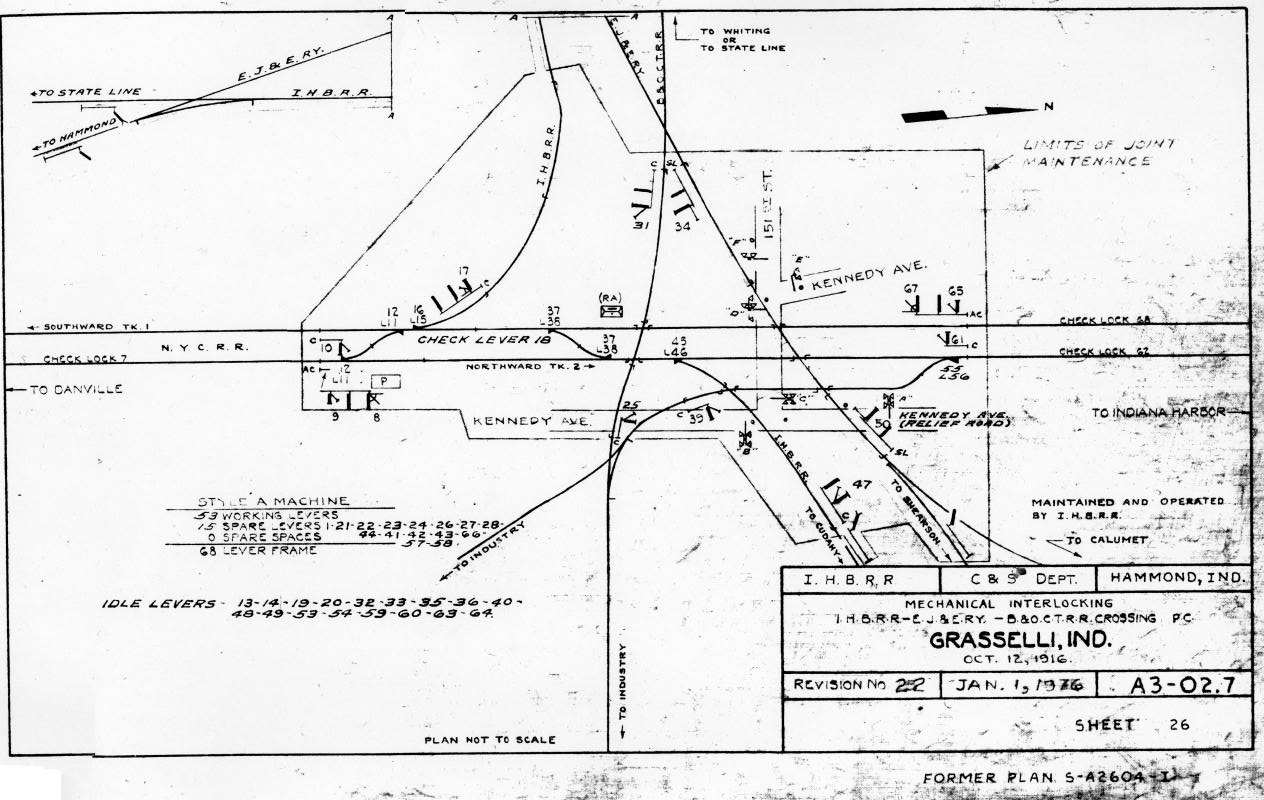
"Grasselli may have been built as early as 1906, but is confirmed to have been in place at least in 1916. A track diagram from 1916 for the interlocking plant shows that it was originally called RA Tower. The name 'Grasselli' came from a long-gone chemical plant located near the tower that was served by the IHB." (GrassilliTower-about)

It was decommissioned in late 2007 and moved in May of 2009 to the Hoosier Valley Railroad Museum in North Judson, IN for $55,000.
1916 Track Diagram from GrassilliTower
Please read CRJ for a summary of the railroad tracks that used to run through this junction. (GrassilliTower-move)

I need to visit that museum because I am more interested in the interlocking plant on the first floor than the levers on the second floor.
Mike Breski posted
Mike's comment:
Interlocking towers were once a common feature along area railroads. Towers were once located in North Judson, Knox, Hamlet, Delong, Wellsboro, LaCrosse, and many other towns. All of these towers are now gone. The Indiana Harbor Belt gave the Hoosier Valley Railroad Museum a great opportunity to preserve a key piece of American railroad history. Grasselli Tower faithfully served the IHB for nearly a century. After months of careful planning, Grasselli Tower was moved from its original home in East Chicago to its new home at the Hoosier Valley Railroad Museum in North Judson. The old railroad tower will serve as the centerpiece of our operational signal system.Grasselli TowerGrasselli Tower was once located along the IHB mainline in East Chicago, Indiana. Indiana Harbor Belt generously donated the tower to the Hoosier Valley Railroad Museum in North Judson, Indiana. HVRM members inspected the tower on January 17, 2008.Photo by Robert BarcusNow that Grasselli Tower has been moved to North Judson, the museum intends to make it into a working tower. The HVRM currently has a working signal system and a functional interlocking tower will be the centerpiece of a larger interpretive signal display. The tower will help visitors understand how railroads operated beginning in the late nineteenth century. 
Matt Lasayko commented on above posting
Restoration progress
Candy Lachman Birkenfeld That was the hardest tower to operate - when I crew dispatched, there was only a couple switch tenders qualified- difficult to fill the job if one of them laid off

Scott Griffith posted five images:

1, an overview
2, NYC Revision #8, 1925 or 1926

3
4
5
Bob Lalich commented on the above posting
Notice that the drawing indicates that the towerman faced away from the tracks. And notice the ownership lines west of the tower. When this interlocking was first installed in 1905, the Indiana Harbor RR tracks, later to become Chicago, Indiana & Southern (NYC) were west of the tower. Here is a drawing of the 1905 interlocking, courtesy of Hoosier Valley RR Museum.

Richard S Eule posted
Grasselli Tower interlocking bed. Date: 6/1996.

Joe Usselman posted two photos with the comment: "A difference of a few months in 2008. Grasselli tower in its original location at East Chicago. Today the tower sits safely in North Judson."
Jeff LewisJeff and 1 other manage the membership, moderators, settings, and posts for Chicagoland Railfan. Quite a difference a camera lens can make.

1

2
Mike Breski posted five photos with the comment:
Moving Grasselli
The Hoosier Valley Railroad Museum in North Judson, Indiana was given the opportunity by the Indiana Harbor Belt Railroad Company to acquire a very unique piece of railroad history - Grasselli Tower in East Chicago. The IHB decommissioned the tower during the later part of 2007 and promptly offered the tower to the HVRM. Grasselli was one of the last remaining railroad towers in Northern Indiana.
The Hoosier Valley Railroad Museum worked quickly to preserve this piece of American history and we couldn't have done it without the help of museum volunteers and many monetary donations! The total cost to move Grasselli Tower to North Judson and preserve this amazing example of early railroad technology was just over $55,000 (slightly above our original budget estimates of $50k).
Nickel Plate Road 765 rolls past Grasselli Tower with an members-only excursion train at the Hoosier Valley Railroad Museum in North Judson on Friday, May 22, 2009. The tower is currently being refurbished by museum volunteers and will become the jewel of the HVRM Signal Department.
Photo by Fred Boyer
Les Beckman and Mark Stanek Outside of Grasselli Tower
The work to move Grasselli Tower to North Judson coudn't have been completed without the dedication of several museum volunteers. HVRM members Mark Stanek (left) and Les Beckman (right) examine some plans for the IHB's Grasselli Tower on a cold spring day.
Photo by Mark Stanek
Share Your Tower Stories
We're looking for your stories about railroad towers and cabins. If you have a tower story, please share your experiences with us! Your story may be published on our website and will help all of our visitors better understand how railroad towers worked. Some of our visitors have already submitted their stories, so read their stories.
Link to the Grasselli Tower Website
If you provide a link to the Grasselli Tower website, we will return the favor by providing a reciprical link to your website. Your links will help us increase awareness of our preservation effort.
Inside Grasselli Tower
Shortly after Indiana Harbor Belt donated Grasselli Tower to the Hoosier Valley Railroad Museum, a group from the HVRM and IHB inspected the entire tower so that a plan could be formulated for the eventual move to North Judson.
Photo by Robert Barcus
Indiana Harbor Belt
We Wish to Thank the
Indiana Harbor Belt Railroad
for Their Generous Donation!
TrainNet.org Web Gem Award

1

2

3

4

5
Jerry Stack commented on a post
Here's a photo of Grasselli taken in February 2008. You can see the guides for the rods in this picture. Some of the rods were still in place near the tower.
Jerry Stack commented on a post
 Another shot, looking south of the tower. Grasselli got its name, btw, from the Grasselli Chemical Company plant that was located to the left or east of the tower. It was eventually purchased by Du Pont. I don't think much remains of the plant today.

Ken Schmidt posted
On a warm July day in 1992, IHB 8835 was in charge of the Bottle train for Acme Steel.
Going by Grasselli Tower, the conductor came out for a breeze and to wave at those taking photos.
Grasselli tower would operate til late 2007.
Jeff Vandergraff Grasseli is now at North Judson Indiana..rail museum

Mark Hinsdale posted
 Here is a merchandise train using the Indiana Harbor Belt at Grasselli Tower in East Chicago IN, as it moves compass north toward the junction with the Chicago Line at Indiana Harbor. The train will turn east there, and head for Elkhart. Grasselli Tower was saved, and now resides at the Hoosier Valley Railroad in North Judson IN. July, 1998 photo by Mark Hinsdale

Bill Molony posted
Conrail GE C40-8W at Grasselli Tower - 1991.

Ean Kahn-Treras posted
It may be hard to keep track of all the names and locations on the map in Northwest Indiana. Here's an aerial view to put a few things in perspective for those that might have a tough time memorizing the lay of the land.
Indiana Harbor Belt's 116 job is shoving north off the Kankakee Line and onto the East Chicago Belt at Grasselli. The Kankakee Line is the Harbor's mainline from CP 100/CP 502 south to CP Gibson and Osborn. The East Chicago Belt is one of the earliest portions of the IHB, built as the East Chicago Belt Railroad just before the turn of the 20th Century and ran between State Line then eastbound to a point somewhere on the upper right of this photo.
The wye at Shearson is on the middle left. This 116 job after shoving onto the East Chicago Belt, will organize his car cuts and proceed east towards Shearson and a connection with the former EJE Whiting Branch. Heading eastbound on the J will lead you to another junction, which is named Cavanaugh. This is also a wye, which connects the J's Whiting Branch (now known as the Calumet Spur) to the relocated and ever-busy EJE mainline between Kirk Yard and Griffith. 116's destination is the AMG scrap yard on the south side of the wye at Cavanaugh.
The B&OCT even had a small branch that crossed the East Chicago Belt and Kankakee Line as well at this location. On the east side of the Kankakee Line nowadays, the Harbor still switches out Grace, which is the facility just barely in view on the right. I've seen timetables from many decades ago refer to that spot as the Cudahy Lead. Going even further back in time, the South Shore would have cut across west to east in the background of this photo as well. Nowadays, they have been rebuilt to parallel the Indiana Toll Road, which is about a mile south of my location.
April 13th, 2021
East Chicago, Indiana.

CRL Burr Oak Yards

(Update:  If you are here because of "Irondale Yard," that information has been moved to its own set of notes.
I've already described the Burr Oak roundhouse. I'm still confused about the difference between Burr Oak and Blue Island Yards and thus currently have some redundancy.)

Metra took over Rock Island's commuter service in the Chicagoland area and Chicago Rail Link took over the freight service.

2011 Yards
The former Rock Island Burr Oak Yard is just north of the former Rock Island Blue Island YardA Nov, 2009 TrainOrders answer describes Burr Oak:
Burr Oak Yard had two sides, the "Infreight" on west side of yard, tracks 1-22.  "Outfreight" tracks 24-47.  I recall some old times saying it had a 48 or 49 track at one time.  Track 23 was accessed from both leads and had track scale under 127th St bridge.  Tracks 1-5 were the long receiving tracks for road trains and departure for long transfers going north (such as Clearing or South Chicago) and/or west to GTW, B&OCT, IHB with crossovers just north of 127th St all the way across,  Tracks 43-47 were the long Outfreight receiving (Transfers) or road train departures and had crossovers all the way across.  The infreight yardmaster's office was ground level in the Prairie St building, trainmasters, superintendent, clerks were on 2nd floor. Outfreight YM was elevated on 127th St bridge, switchman's shanty and clerk were located right under him connected by the pneumatic tube or yell real loud system.
The infreight lead job switched from the south (west) end and outfreight lead from the north (east) end.  The whole yard was slightly descending to the west, so the outfreight field man had to be vigilant keeping his tracks tied down to prevent roll out.  Outfreight also had another engine switching at west end of 24-47 called the "York St".
Burr Oak also had a Rip Track north of Prairie St to about big storage tank at roundhouse that ran parallel to eastward suburban line main track.  The wrecker pocket was next to rip track under bridge and coach yard was between Prairie St and York St next to suburban line.
The infreight yard classified inbound cars destined to connections (GTW, IHB/NYC,B&OCT) and those served by other transfer jobs such as:
 Westside job handled traffic to 47/51st St, CR&I/CJ at Ashland Ave Yd, Chicago Produce Terminal, Wood St Produce Terminal (spuds, onions). The day job retraced it's steps and picked up at same places, the night job went straight to CPT and Wood St to make the morning auctions, then often made it's way from Wood St to 12th St and brought a piggyback pull to Blue Island to be added to the westbound morning fleet.
South Chicago transfer: took train to S Chgo and returned with train. Other transfers were Englewood job 1159PM which went first to Gresham Yard located just north of 95th St extending to the south leg of So Chgo wye at Gresham.  There were several industries there plus it did both sides of main line and Team track at Englewood, there was an occasional car interchanged to PRR.  This job also interchanged freight with the (very seldom) CWI at 81st St.
The Outfreight classified cars received from GTW, IHB/NYC, B&OCT, Clearing, So Chgo, West Side, 12th St, etc for outbound road trains, plus made up fills to be added to both ends of road trains originating at South Chicago. Trains originated here were "Redball Pickup" (thru local to Silvis), No 45 to Peoria, No 97 hotshot for Texas, No 93 deadfreight to Texas, and "Kansas City Star" (started in '66 was auto parts to KC) which became "The Big Train aka #57" to Omaha in later years.
The piggyback road trains from 12th St did not normally stop at Blue Island to get a fill.  When #55 was running they often stopped for the Special Agents and Rin Tin Tin to capture the looters picked around 22nd St.
Forgot to mention when I started in '66 some of the freight house tracks (just east of roundhouse) had been converted to piggyback loading. this didn't last but a few years.
Burr Oak Yard was always busy! (TrainOrders)
Update:
Steven J. Brown posted
Rock Island Alcos and ex-Alcos at Burr Oak Yard in Blue Island, IL - June 12, 1978. Present: C415 454 (smoking!), RS2m 454, C415 421 and RS3m 456.
Fred Van Dorpe posted
IAIS 513 shoves out of Burr Oak yard with its 120-ish car train across the Calumet Sag Channel and towards Metra Robbins station, where it will eventually pull forward on the IHB mainline, and shove again back into IHB Blue Island yard on 3/18/17.
Steven J. Brown posted
Rock Island GP10's at Burr Oak Yard in Blue Island, Illinois - February 12, 1977.
Stuart B. Slaymaker Roof of the freight house. Remained there for many years, after shutdown.
John Biskup The building is the terminal superintendent and train master offices upper floor, lower floor was in freight yardmaster and locker room for switchmen and brakemen/conductors.
Scott Malec posted
One of the few times I caught the Rail Link in action on 10/27/2006 at Burr Oak Yard in Blue Island.
One of several ALCO photos posted by Michael Riha
Rock Island 421 and 420 are C415s working Burr Oak Yard in 1975.
[Judging from the second unit, I guess ALCOs don't always smoke.]


Monday, February 1, 2016

Wabash Central RR, a NKP (Cloverleaf) Remnant

Alan Cully posted
Alan's comment:
The Cloverleaf main in Warren, IN now operated by the Wabash Central RR out of Bluffton. They have trackage to Van Buren, but it looks like this is as far as they come these days judging by the tracks west of here.
A major customer was Weaver Popcorn on the Van Buren end of their line. But this posting suggests that Weaver no longer uses the WC. I did some research on Weaver Popcorn. The plant seems to still be viable, so I guess they switched to trucks. Did NS crank up their interchange rates with WC at Bluffton, IN?

If the trains no longer go west of Warren, IN, that means the Salamonie River Bridge is no longer used.

Update:
Alan Culley posted
I was in the area, so I went to find the end of track on the east side of Craigville. I could not get to the actual end, but did find a Wabash Central GP10 and a couple of covered hoppers near the end of track. The track is barely visible in the foreground.
[
According to a comment, the engine is a GP10.]

ComEd Taylor Street Substation

Satellite
This was the use of the land after the Pennsylvania Freight House was torn down. (I'm still working on the freight house posting.) It would seem that ComEd could have figured out how to use some rooms in that big, substantial bulding for their equipment and then rent the rest of the building for other uses.

I've noticed that the substation shows up in the background of some pictures of cab units going to/from the Chicago Union Station. So this topic gives me an excuse to save these neat photos.
Lou Gerard posted
Conrail E8 4022 leads the Broadway Limited out of Chicago, April 1977.

Bob Helling posted
One of BN's rebuilt E9ms pulls a commuter out of Union Station in Chicago while the ex Wabash- NW commuter for Orland Park backs into the station. June 10, 1979. Bob Helling Photo.
Leon Batman posted
Amtrak 420 + 214 being hauled out of Chicago Union Stn by an RS3 September 29 1976

Railroad Yard Tax Status

Dennis DeBruler shared Mark Llanuza's photo
When I asked if the piggyback yard was B&OCT's, I learned that it was Rock Island's facility.

I also learned that the platform tracks at Grand Central Station were filled with freight cars in storage to maintain their tax status as a rail facility. (William Shapotkin) Bill also explained:
For years the C&WI (until circa 1990(?)) kept two reefers stored on a disconnected piece of track in its cut west of the ROCK tracks at 16th/Clark. This allowed the railroad to claim that the land was still being used for rail operations. There are other instances of railroads doing this to maintain their rail status -- even years after the railroad was not actually using a facility.
Bob Lalich comment on above posting.
Here is a photo that I took in 1981 of the C&WI wood refrigerator cars.
They were there until the CTA Orange line was built.
Bob Lalich provided a picture of those two refers.

1831+1840s+1904,1994 Washington Crossing Bridge over Delaware River at Washington Crossing NJ and PA

If you are here because of "Rock Island's Roosevelt Road Intermodal Facility," then you need to go there.

(Bridge Hunter? (I can't find bridges in the new version); Historic Bridges; Satellite)

This 877' (267m) long bridge has six double-warren truss spans of 143' (43.6m). The width is notable because it is onely 14' (4.75m). Trucks are banned from using this bridge. [HistoricBridges]
lll
drjtbc
The piers are from the original construction in 1831. The cantilevered, wood-planked pedestrian walkway was added in 1926 on the downstream side.

Since the bridge is rather old, I wondered if it is pin-connected. This view clearly shows that it uses gusset plates for the truss member connections.
Street View, May 2015

Metrotrails posted two photos with the comment:
Metrotrails Then and Now Series: Historic postcard image of the Washington Crossing Bridge, from Washington Crossing State Park NJ, compared to the same scene on our 2023 hike.
The original bridge at this location was a covered structure built in 1834. It was washed away in a flood in 1841, and replaced by a second covered bridge.
That bridge was washed out in the Pumpkin Flood of 1903, so named because it happened in October, and pumpkins were floating all down the Delaware.
The current bridge was built in 1904 by the Taylorsville Delaware Bridge Company, a through truss design. It has withstood floods since, and occupies the original piers from the first covered bridge.
Many rear view mirrors are sacrificed on the bridge due to narrow clearance. There is plenty of room, but many are afraid to get too close to the edge.
The bridge is very popular during the annual reenactment of General George Washington's Christmas Day 1776 crossing of the Delaware.
Metrotrails shared
1

2

Chris Manz commented on the above post
Ice at the Washington Crossing Bridge this weekend. [late Jan 2025]

This was the first street view I found. Fortunately, I found the better one that is at the top of these notces because I could not see gusset plats along the bottom cord in this view.
Street View, May 2015

"The bridge is currently restricted to a 15-mile per hour speed limit, a 3-ton weight limit, and a 10-foot vertical clearance.  It is the only Commission bridge outfitted with stop lights to control passage of oversized vehicles." [drjtbc]
Street View, Oct 2023

Christopher R Hernandez posted eight photos with the comment: "Washington Crossing Bridge, Delaware River, Hopewell, NJ-Upper Makefield, PA.  Originally opened in 1831, parts of the bridge's substructure are from the 1831 bridge.  Bridge was rebuilt 1841and in 1905."
1

2

3

4

5

6

7

8