Saturday, February 10, 2024

1936 US-101 Siuslaw River Bridge at Florence, OR

(Bridge Hunter broke Mar 22, 2023; Historic Bridges; HAERSatellite, 817 photos)

This is another WPA bridge along the western coast.

The 1,649.4' (502.7m) long bridge has a 154' (46.9m) main span. [HistoricBridges]

HAER ORE,20-FLO,2-
OBLIQUE VIEW FROM LOTUS SEAFOOD RESTAURANT - Siuslaw River Bridge, Spanning Siuslaw River at Oregon Coast Highway, Florence, Lane County, OR Photos from Survey HAER OR-58

"The Siuslaw River Bridge is the only one of the five PWA coastal bridges with a bascule span. The bridge is also representative of the innovative designs by State Bridge Engineer Conde B. McCullough, a pioneer in American concrete bridge design. The Siuslaw River Bridge is an early example of McCullough's use of tied arches and Considere-type hinges." [HAER_data]

Boat View, Nov 2015

Haley Johnson, Mar 2019

I Mooser, Jun 2023

These are the fanciest bridge houses that I have seen.
Street View, Aug 2012

Phil Block posted
Siuslaw River Bridge
Opened in 1936 it's 1,568 feet long carrying traffic on US 101.  The bridge is listed on the National Register of Historic Places
 
thesiuslawnews, Photo by Tony Reed/Siuslaw News
"Florence’s landmark bridge over the Siuslaw River will likely see some preservation work, but it won’t likely happen for a few years. According to the Oregon Department of Transportation website, a project to repair areas of the bridge is in the design phase, which is expected to cost $575,000....The design phase is expected to happen from 2024 to 2026, with work following in 2027. Funding for the repairs has not been estimated or secured."
The controls were updated in 2011.

HAER ORE,20-FLO,2-
10. Bull gear and trunnion

Friday, February 9, 2024

GAP Trail + Western Maryland Scenic Overpass near Cumberland, MD

(Bridge Hunter broke Mar 22, 2023; no Historic Bridges; Satellite)

GAP = Great Allegheny Passage

Street View, Sep 2019

I don't normally do overpasses, but the trusses on this bridge are heavier than a lot of river bridges. However, the real motivator for noting this bridge is that a railroad is willing to share the bridge with a trail. In this case it is the GAP Trail and Western Maryland Scenic Railroad.
Western Maryland Scenic Railroad posted
It was another great weekend on the Allegheny Winter Express! We served over 125 meals off of our Brunch & Munch menu while our passengers enjoyed the snowy views of Allegany County!
The train will be operating next Saturday & Sunday with departures at 9:00AM & 1:00PM. 
Make your reservations now at https://wmsr.com/alleghenywinter-express
📷 Ian Hapsias
Dennis DeBruler: I think I found this bridge: https://maps.app.goo.gl/oFpM2QXi2BaiiKM8A
Dennis DeBruler shared
Almost any photo taken the past few days is a snow photo.

Thursday, February 8, 2024

1928 NS/Southern Bridge over Ocmulgee River at Lumber City, GA

(Bridge Hunter broke Mar 22, 2023; no Historic Bridges; Satellite)

Street View, Jun 2022

I like both street views. Since electrons and magnetic domains are cheap, I included both views.
Street View, Dec 2018

Paul Bridges posted 11 photos with the comment: "Ocmulgee River Train Swing Bridge in Lumber City, Built 1928 by the Virginia Bridge & Iron Co., Telfair County Georgia."
Dennis DeBruler: The railroad is NS/Southern.
1

2

3

4

5

6

7

8

9

10

11


Wednesday, February 7, 2024

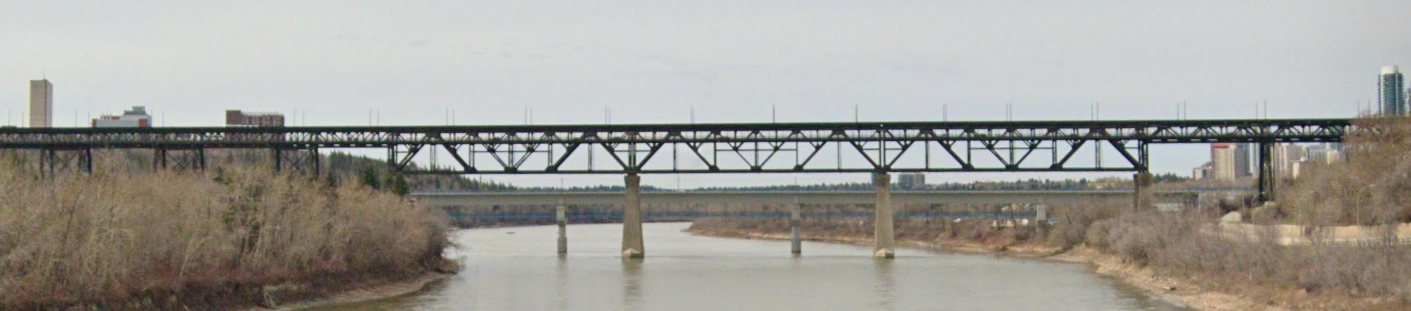
High- and Two Low-Level Bridges over North Saskatchewan River in Edmonton, AB

1913 High-Level Bridge: (Satellite
New Low-Level Bridge: (Satellite) Dudley B Menzies Bridge
1900 Low-Level Bridge: (Satellite, 152 photos)

The High Level Bridge with the New Low Level Bridge in the background.
Street View, May 2023
 
The south approach to the High-Level Bridge is a non-trivial trestle because this bridge is bluff-to-bluff.
Street View, May 2022

The new bridge has a non-vehicle deck suspended from the track deck. This deck would be easier to access than the deck on the High-Level Bridge. The upper deck looks like light rail, and it tunnels into the bluffs on both sides.
Trail View, Aug 2016
 
It looks like the new bridge is a concrete box girder bridge.
Street View, Oct 2016
 
Tanweer Malik posted four photos with the comment: "Dudley Menzies Bridge over the North Saskatchewan River in Edmonton, Canada. The single-column lollypop-shaped piers have openings through which the blue pedestrian deck passes. The top of the pier supports a large box girder that carries light rail transit. The pedestrian deck also hangs down from the soffit of the box girder."
1
 
2

3

4

The High-Level Bridge has a lower deck for vehicles and pedestrians.
Street View, Apr 2021
 
Steven J. Brown posted
VIA Rail Canadian #1 crosses the North Saskatchewan River in Edmonton, Alberta - March 2, 1998.
Stan McFaull: Clover Bar trestle,built in 1910.I actually have a picture when it was being built in my wallet,cut it out of a magazine.
Steven J. Brown shared

Tanweer Malik posted four photos with the comment:
The High Level Bridge over the North Saskatchewan River in Edmonton, Canada. Constructed in 1913, this large truss bridge has two decks. The lower deck is for vehicles and pedestrians. The upper deck used to carry railways, now it is used for sightseeing trams.
The steel members have the stamp of Dorman Long and Co, Middlesborough – the famous UK steel producer that also constructed the Sidney Harbour Bridge (Source: Wikipedia)
1
 
2

3

4

The 1900 Low-Level Bridge.
Boat View, Jul 2023

Note all of the utilities that are between the trusses.
Street View, Jul 2023

Jeff Wallace Flickr, License: Creative Commons Attribution-NonCommercial (CC BY-NC) 
Waiting for Night
Long exposure along the shores of the North Saskatchewan River, once the super highway of trappers and explorers as they opened the west.


Both the 1913 Bridge and New Bridge appear to be light rail bridges. I checked that out when I noticed this photo looked like a streetcar bridge.
Bridges Now and Then posted
The High Level Bridge, Edmonton, Alberta, 1913. (Photo found on eBay)
Brian Geidt: Granny Joyce could remember a flood when they parked trains on the trestle to hold it in place, the water was at the level of the tracks
Mark Kirwin: Brian Geidt That happened. It was on the Low Level bridge though.
 https://edmonton.skyrisecities.com/news/2016/12/1915-flood-and-rescue-low-level-bridge.24067

skyrise, image via City of Edmonton Archives
The Low-Level Bridge was the first bridge built across the river. It was opened in 1900 and the High-Level Bridge was opened in 1913. The southern span of the Low-Level Bridge was opened in 1948. The railroad track on the 1900 span was removed in 1954. "On June 28, 1915, the city of 60,000 people was hit with heavy spring runoff and several days of rain, causing the North Saskatchewan River to rise more than 10 metres [66']....The Canadian Northern Railway parked multiple train cars loaded with sand on the bridge to weigh it down, preventing the dislodging of the bridge deck. Powerful engines on each side were ready to pull the cars off the bridge at a moment's notice if the structure began to destabilize."

Tuesday, February 6, 2024

1907-34 Moline Lock on Mississippi River

(Satellite)

Retro Quad Cities posted
excerpt from the above Quad City Times Story.
The Moline Lock was authorized by Congress in the River and Harbor Bill of March 3, 1905. The project called for a channel 250 feet wide and 4 feet deep from the Moline waterfront to the main channel of the Mississippi River by means of a lock and dam at the foot of Benham’s Island.
The lock project marked a major shift in the method of improving the 14 miles of rapids from Davenport to LeClaire. Before this, the U.S. Army Corps of Engineers had used underwater blasting to cut off the chains of rock that reached into the river from both banks, the method first recommended by Capt.  Robert E. Lee in 1837 when he arrived in Davenport to map the rapids. Over the next 70 years, the Corps had widened, deepened and straightened the natural steamboat channel.
By 1905, however, the rapids were once again an obstacle to navigation. In 1878, Congress had authorized a new four-and-one-half-foot channel for the entire Upper Mississippi. This was accomplished between 1878 and 1900 by the use of wing dams and other means. On the Rock Island Rapids, that would not have worked.
And so in 1905, Congress authorized the Moline Lock, the first lock on the Mississippi River below Minneapolis. Moline was chosen for this project for several reasons. Access to the Moline waterfront was blocked by Arsenal Island, especially for steamboats coming upstream. In addition, two of the worst chains on the rapids, the Moline and Duck Creek chains, gave Moline the swiftest and steepest current on the river.
At Moline, a rapidly growing farm equipment and manufacturing industry heightened the need for better shipping.
The 1905 River and Harbor Bill called for a lock chamber 325 feet long, 80 feet wide and 5 feet deep. Before construction could begin, the depth was changed to 6 feet in anticipation that Congress would soon authorize a new 6-foot-deep river channel.
The bill also specified that the lock walls would use poured concrete, a new construction method first developed on the Hennepin Canal near Milan in the 1890s. Until that time, the standard method of lock construction used cut stone. In 1891, Capt. William L. Marshall, the Corps officer in charge of the canal project, requested permission to experiment with concrete. He believed such construction would be cheaper, stronger and more durable than stone.
The Hennepin Canal and the Moline Lock represent the first such use of concrete in the United States. For the project, Capt. Marshall had to design the forms for the lock walls, and invent cement-mixing equipment large enough to pour an entire wall at once.
These experiments with concrete on the canal and lock proved successful, and shortly helped revolutionize the American construction industry. They also helped facilitate construction on the long-stalled Panama Canal, which the American government had taken over in 1904.
The Moline Lock was complete enough to open on Dec. 23, 1907. The United States steam launch Emily became the first boat through the lock.
For the next few years, statistics on the use of the Moline Lock were impressive. During June, July and August in its peak year, lockages at Moline surpassed any single month of the famous Soo Locks, and probably surpassed any other lock in the world up to that time.
Statistics, however, are deceiving. The Moline Lock was completed just as a long decline in river traffic had set in. Nearly all the boats through the lock were Corps of Engineers work boats and a single ferry service. In 1908, the ferry steamer, B.B., began service between Moline and Bettendorf. In May 1908, the B.B., carrying 17,308 passengers, accounted for 612 lockages. Meanwhile, commercial freight through the lock that same spring amounted to a mere 182 tons.
In 1930, Congress authorized a 9-foot channel on the Upper Mississippi from St. Louis to St. Paul to be achieved by a series of locks and dams. By 1934, the Rock Island Rapids had disappeared behind Lock and Dam 15, the first lock and dam in the project, and the Moline Lock was obsolete.
Next year is the 100th anniversary of the Moline Lock. Its story will be celebrated Feb. 22 at the fourth annual Henry Farnam dinner, an event that celebrates the accomplishments of the Quad-Cities and its strong ties to the Mississippi River.
The On the River desk can be contacted at (563) 383-2286 or lwatson@qctimes.com.
[I was not aware that there used to be a 4.5-foot channel on the Upper Mississippi before the 9' channel was built during the depression. Nor did I know that the Hennepin Canal pioneered concrete locks.]
Retro Quad Cities shared

Retro Quad Cities
The "Emily" was the first to pass through the new Moline Lock on the north side of Arsenal Island in 1907. The chamber was 80x350 feet.

1949 Davenport Quad @ 24,000

AmericanCanalSociety, p2


Monday, February 5, 2024

1929,1985 Mount Hope Bridge and 1855 Bristol Ferry Lighthouse near Portsmouth, RI

Bridge: (Bridge Hunter broke Mar 22, 2023; Historic Bridges; Satellite, 353 photos)
Lighthouse: (Satellite)

The Claiborne Pell Bridge is another suspension bridge that helps connect Newport with the mainland.

Looking North from Portsmouth. The lighthouse is peaking out on the left side of the cable anchor.
Street View, Jul 2021

Looking South from Bristol.
 Tokuyuki “TK” Komiyama, Feb 2021

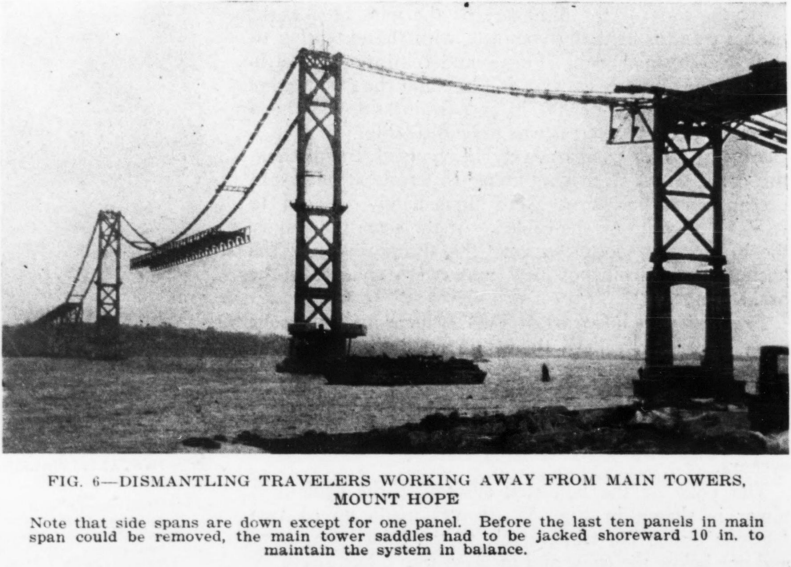
It has a length of  4,7858' (1481m) with a main span of 1,200' (366m). This is a David Steinman designed bridge. "During its construction, the contractor, McClintic Marshall, wanted to use a new heat treated suspension cable for the bridge, rather than traditional cold-drawn wire. David Steinman was reportedly against the use of this very new type of cable, but was convinced to use it by his company partner Holton Robinson. Unfortunately, this type of cable quickly proved to be unsafe for use as the wires started breaking after the stiffening trusses of the bridge had been erected on the bridge, proving that Steinman's hesitation was wise. Steinman condemned the wire and ordered it replaced with cold-drawn wire at the contractor's expense. The work required removing the newly installed stiffening truss, changing the cables, then re-erecting the new stiffening trusses." [HistoricBridges]

This is a deconstruction image because of the need to change the wire.
Article from HistoricBridges
 
Bridges Now and Then posted
"MOUNT HOPE BRIDGE, 1928." Constructing the Mount Hope Bridge, connecting the towns of Portsmouth and Bristol on Narragansett Bay in Rhode Island. Photograph by Avery Lord, 1928.
Bridges Now and Then posted again
Spinning cable for Rhode Island's Mount Hope Bridge, 1928. (Granger)

It was the longest suspension bridge in New England until 1969 when the Claiborne Pell Bridge was built. The deck is 135' (41m) high. [OnlyInYourState]

The towers are 285' (87m) high. [OnlyInYourState_history] This source specifies a length of 6,129' (1,878m).
Street View, Aug 2022

Lerro Photography posted
Bristol Ferry Lighthouse, Rhode Island

historic-structures
It started operation in 1855. "It is one of three early surviving lighthouses in the state of the type which features a keepers dwelling with an attached light tower...The most significant change to the lighthouse during its active period occurred in 1918 when the original wooden lantern at the top of the light tower was removed, the height of the tower was increased by six feet, and a new cast-iron lantern, gallery deck and balustrade were installed." It became obsolete in 1929 when the bridge was built because the bridge was a more visible navigation aid. It is now a private residence.

whatsupnewp, Photo Credit: Mott & Chace Sotheby’s International Realty
It was for sale for $750,000 in 2022.
(It sold for $805,000 in Sep 2022. [RhodeIslandLightHouseHistory])

LighthouseFriends, Photograph courtesy National Archives
"Bristol Ferry Lighthouse in 1884 with Keeper Edward Hoxie and original wooden lantern room"
"The structure is similar in design to other lighthouses such as Rhode Island’s Nayatt Point Lighthouse as well as Sand Point Lighthouse in Escanaba, Michigan....A ferry, known as the Bristol Ferry, commenced operation between Bristol and Portsmouth around 1680 and afforded the most direct route between Newport and Boston by way of Providence. The ferry ceased operating in 1865, when a railroad line opened between Fall River and Newport, but the name Bristol Ferry remained associated with the narrow passage linking Narragansett Bay and Mount Hope Bay."

LighthouseFriends, Photograph courtesy U.S. Coast Guard
"Lighthouse in 1918, sporting its new metal lantern room"