Monday, January 4, 2021

Larry Cars in Steel Mills


On the morning of Jan 2, 2021, I saw "larry" used as part of the description of how a Huelett iron ore unloader works. Then that afternoon I saw the term "Larry Car" in some comments about a coke oven. (More on coke ovens below.) So this exceeds my "same topic mentioned twice in two days" rule. Then the next day I saw the following post. "Transfer car" is another term used for "larry car."
Steel Plant Museum of Western New York posted
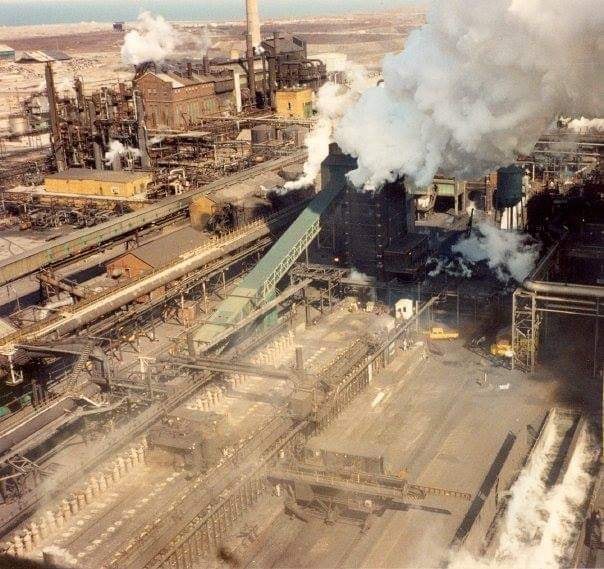
An image of a blast furnace transfer car at the Republic Steel Buffalo Plant.

Another view of a transfer car on the high-line. It appears that they could also dump directly from railroad hopper cars into the storage bins.
Steel Plant Museum of Western New York posted
An image of the blast furnaces at the Republic Steel Buffalo Plant in 1978.

A photo of a Larry Car dumping its load.
Jeff Arthur Knorek posted
Pennsylvania R.R. iron ore docks, Cleveland. "After the ore is weighed in the Hulett unloader it is dropped in the waiting hopper cars below." 4x5 Kodachrome transparency by Jack Delano for the OWI. May 1943.
Jeff Knorek note: Those Hulett unloaders were massive machines like everything else in the Steel industry.
Dennis DeBruler: This is the best view that I have seen of the Larry Car on a Hulett.

I found an explanation that a larry is a self-propelled car for transferring materials. 

Please follow this link to a photo. It shows that they could be quite big. robertjohndavis called those big cars "charging larries." and Mike Piersa explains. [rypn]
The cars still exist, and might run again. The cars are seven foot, ten and a half inch gauge. In company literature, they are referred to as ore transfer cars and there are two types, side dump and bottom dump. The side dump cars were used near the ore bridges, underneath the furthest working position of the bucket, on tracks running parallel to the bridge tracks (the 574 foot long bridges, one of which survives, ran on standard gauge tracks 247 feet away from each other, from the center of each track). The other cars were bottom dump cars (pictured at the link on the 1st post) that took loads of iron pellets on the highline (also referred to as the Hoover-Mason trestle for its designers), and dumped them into the Hoover-Mason system of stock bins. The bins fed Atlas Car & Manufacturing Company built electric (trolley) powered scale cars that moved, weighed, and dropped the material into skip buckets that were hoisted to the top of the blast furnaces. All of these items still exist.

The broad gauge transfer cars are parked atop the trestle and can be seen from one spot on Daly Avenue between buildings just west of the Minsi Trail Bridge. The sidewalk on the bridge itself also offers views of the equipment. Under Bethlehem Steel, who originally planned the redevelopment of the historic steel mill, the transfer cars were intended to be restored to transport passengers from a parking area to the retail/entertainment/museum area of BethWorks. The new owners, BethWorks Now, intend to preserve the trestle as it is in very good condition.
We can see at the bottom of this image that at least five of those larries have been preserved at the preserved Bethlehem site.
Satellite

The term seems to have been coined by the coke industry back when they were still using bee hive ovens. Back then, they were not self-propelled.  The larries were shoved across the top of the ovens and dumped coal into the ovens.
LegacyStation

In the bottom image of this blog extract, we see that the length of the car was the same as the spacing between the ovens so that multiple ovens could be loaded at the same time. 
DeBruler

I found several descriptions of how to make coke, and they all said that a larry car was used to charge the ovens. For example:
This pulverized coal mixture is introduced into coke ovens, or “charged,” by a “larry car.” The larry car is akin to a railcar that moves across a track that runs along the top of a coke oven battery. Each individual oven has a “charging port,” a door with a lid, that is removed when the larry car is positioned above the oven in order for the pulverized coal to be charged. [PaCokeOvens]
And Walthers shows us what a modern coke oven larry looks like. However: "BTW - some people on the above forums (who have worked in steel mills) say that the Walthers HO model doesn't resemble any known prototype..." [CSX_road_slug comment in trains]
Walthers

Note the man in front of the larry car in this photo to provide scale as to how big the car is. 

Anthony Wheeler posted, cropped to Facebook resolution
[Some comments indicate an oven at Burns Harbor can hold 32 metric tons, which is 35.274 US tons. Below are the comments I read during the afternoon of Jan 2.]
Comments on Anthony's post

Thomas Boswell posted
Late 1980's view of Gary Works #7 three-meter coke battery. Seen is top side and pusher side. Bi-products dept. In the background.
Coal was loaded into the Larry Car shown topside, from the coal bunker, and then the Larry Car would charge the oven through several charging holes.
  
David Holoweiko posted via Dennis DeBruler

Jordan Harmon commented on David's post above
2024 burns harbor
 
Stelco Rod and Bar Hamilton posted via Dennis DeBruler
1948 - Stelco Coke Ovens > Larry Car on #3 Battery > Hamilton, Ontario, Canada. (There's actually 3 men in this photo - can you find the 3rd??)
Peggie Popowich: The 3rd Man on the right side, where clothes are.
D Eric Davis shared
Larry Haynes: Standing facing the Sandpipe, been there done that years ago ...

Stelco Rod and Bar Hamilton posted via Dennis DeBruler
1930's Steel Company of Canada, Hamilton, Ontario > Larry Car on Stelco's #2 Coke Oven Battery. Of the seven Coke Oven Batteries that Stelco had in operation over the years, only one is left today (#7 Battery.)
D Eric Davis shared
Tom Ray shared
Daniel Lajambe: First battery I’ve seen with 4 charge holes!!

Most material transfer applications of larries have been replaced by conveyor belts, but they are still used to charge coke ovens because of the additional functions of unsealing, removing, replacing and resealing the lid. In fact, judging by Anthony's photo, each oven has four lids.

One function of a larry car is to be able to accurately dump its contents. Another function in some applications is to be able to weigh the contents so that it can dump an accurate amount of material. Both of these functions is why a larry was added to the design of Hulett iron ore unloaders. In this diagram
we cans see the larry hanging from inclined rails at the bottom of the gantry.
ASME, p11

Here I cropped the diagram to get the full available resolution and highlighted the larry in red and a hopper in blue. The rails are inclined because the larry used a rope hoist to pull itself to the right and gravity to pull it to the left.
Digitally Zoomed plus Paint


BGSU
View underneath 17 ton unloaders

The travelling bucket would dump its load into the hopper. Since the hopper is on the ship's end of the gantry, this minimized the distance that the bucket had to travel. And it gave a bigger target for the bucket operator to dump into than a railroad ore hopper would provide. The hopper could hold about three bucket loads. The larry operator would then load his car from the hopper, travel over to the correct ore car and deposit the correct amount of ore into the ore car using its on-board scale. Since a railroad charges by the carload, you want to get as much into a car as possible. But you do not want to exceed the rating for the route the ore car will take to its destination. For a long time the max weight was 263k pounds for a 4-axle car. The railroads have been upgrading to the new standard of 286k. I was curious about the implementation of that new standard so I found this CSX map. The red routes still have the 263k max rating. But ore cars are short because ore is dense compared to coal, grain, etc. I wonder if those cars have a lower rate because short cars would allow more weight to be placed on a bridge span. 
CSX Map

The Republic Steel Buffalo Plant photo at the top of these notes and the Bethelehem photo show a steel mill design that Sloss Furnaces helped pioneer. Specifically, a high-line would be built on a trestle above several storage bins. Larries would transfer iron ore, coke and limestone from the storage yards to these bins. These larries probably did not have to weigh their product. And there was a tunnel under the storage bins that would allow a larry with a scale to unload a specific amount of material from a storage bin and transfer it to the skip hoist pit. Sloss called this car a scale car. Before the use of skip hoists, a blast furnace was charged with wheelbarrows going up an elevator and being shoved over a bridge to the top of the blast furnace where the contents of the wheelbarrow was tipped into the furnace. I remembered when I attended a tour of the Joliet Iron Works Ruins that the guide said the "bridge" wasn't much more than wood planks. They didn't worry about handrails in the 1800s. And sometimes a worker would fall into the blast furnace. Management didn't care because they only had to walk out to the front gate and pick someone from the throng of men that wanted a job. And there was no worker's comp back then.
DeBruler

A good view of the larry car in a Hulett.

So I have found four applications of larries in a steel mill:
  • Part of a Hulett iron ore unloader's design
  • Transferring material from storage yards to storage bins
  • Transferring material from storage bins to skip hoists
  • Transferring coal to coke ovens
It never occurred to me that conveyor belts were disruptive technologies until I wrote these notes. They not only made the first three applications obsolete, they made Huletts themselves obsolete because ore boats were converted to self-unloaders. They also made ore bridges and skip hoists obsolete.


Sunday, January 3, 2021

IA-136+IL-136 1891,1975 Bridges over the Mississippi River between Clinton, IA, and Fulton , IL

1891 Lyons-Fulton: (Bridge HunterIowaDOT) "wagon" or "high" bridge [Mark Kaspar comment on a post]
1975 Mark N. Morris: (Bridge Hunter; John A. Weeks IIISatellite)

This was the original route of the Lincoln Highway. It is now IA-136/IL-136. I presume the rerouting of US-30 is why both states managed to pick the same state highway number.

The original bridge strikes me as rather spindly looking for lasting all the way to 1975.
Photo provided by Hank Zaletel via Bridge Hunter
License: Creative Commons Attribution-NonCommercial-NoDerivs (CC BY-NC-ND)
Vintage Photograph via Bridge Hunter
K. A. Erickson commented:

The vintage photograph (#1) with the bridge title across the top right comes from a postcard that was given out at Conoco stations, possibly nearby.

The back reads on the bottom:

P.S. We are seeing all the sights traveling with a Conoco TOURAIDE. It's wonderful! Your Mileage Merchant at his Conoco Station will tell you how to get one.

I know this to be true as I have in my possession now said postcard.


Nation Holth, the Historic Bridges guy, commented:

The K-truss deck truss approach spans on this bridge seen in the photo on this page are not original.  

This link has a photo showing original Baltimore deck truss spans. http://iagenweb.org/clinton/history/1bridge.htm [Unfortunately, the link is now broke. And I could not find a search option on their home page.]

The K-Truss truss configuration was invented by Phelps Johnson, president of the Dominion Bridge Company of Montreal, Quebec, Canada, as part of the design effort for the second (existing) Quebec Bridge. Phelps was born in 1849 in the United States and worked for the Wrought Iron Bridge Company for a time.

For this reason, one would not expect to find a pre-1914 K-truss.


John Weeks

This is the photo that motivated my research of this bridge.
safe_image for Old railroad corridors near Chicago transformed into all-weather trails for hiking, cycling and cross-country skiing
It looks like that bridge may be at Fulton, IL.
It is good to know that Illinois has not yet torn down all of its cantilever truss bridges.

Darel Maden posted
Mississippi River between Fulton Illinois and Clinton Iowa

On a satellite image, I marked the location of the 1891 bridge.
Satellite plus Paint

On a comparable excerpt from a 1939 aerial, I marked the location of the 1975 bridge. Note that CB&Q used to have a big yard. Today a grain elevator occupies the engine servicing facility.
1939 Aerial Photo from ILHAP plus Paint

I zoom in on the satellite image to record that Illinois is evidently doing some maintenance on its truss bridges.
Satellite

Dewayne Bohannon posted
M/V Randy Anderson
That is this bridge in the middle and L&D #13 in the background.

A.J. Bertin posted two photos with the comment: "From June 2020, here's a couple photos I took of the Morris Bridge, which carries IA/IL 136 over the Mississippi River around Clinton IA and Fulton IL."
1

2

Saturday, January 2, 2021

1940 Main Avenue+OH-2 Bridges over Cuyahoga River in Cleveland, OH

1860 swing: (Bridge Hunter)
1940 high clearance: (Bridge Hunter; Satellite)

The official name of the 1940 bridge is Harold H. Burton Memorial Bridge. It is 100' (30m) high and is Ohio's longest elevated structure at 8,000' (2440m, 1.5 miles). [case]
Google Maps labels it Cleveland Memorial Shoreway.

Bill Kloss posted
Homer D. Williams inbound on the Cuyahoga River in Cleveland. c.1974 Chuck Drumm photo from my collection.
Dennis DeBruler: I never realized that the bridge had such an interesting support structure until I saw this photo.  https://bridgehunter.com/oh/cuyahoga/1800035/

Cleveland Public Library Photograph Collection via Bridge Hunter

Ray tomecko posted
Main Street Swing Bridge, 1933.
Douglas Butler shared
Credit to Ray Tomecko An old Main Street Swing Bridge is removed and the new Cantilever Arch Bridge is in place Cleveland, OH.

Photo taken by C Hanchey in July 2012 via Bridge Hunter,
License: Creative Commons Attribution-NonCommercial (CC BY-NC)
Main Avenue Bridge

Association for Great Lakes Maritime History posted
The tug Nebraska of the Great Lakes Towing Co. towing the freighter Harpefjell of the Fjell Line in Cleveland, Ohio, circa 1939 (Image Source: Cleveland Public Library Digital Gallery). 
The ship is being towed down the Cuyahoga River towards Lake Erie. The Main Avenue Bridge and Terminal Tower can be seen in the background. The name of the photographer is not included in the notes for the image, which was created from a silver gelatin negative.
One source indicates the photograph may show the ship’s arrival at Cleveland on June 30, 1939, during its maiden voyage to the Great Lakes. Note the word “Norge” on its side to identify its neutral nationality, which became meaningless after Norway was invaded on April 9, 1940. 
Information Source:
William Lafferty
[The description continues with a history of the freighter.]

The replacement bridge is long because it must be high over the river to clear the ships that use the river.
Photo taken by Jann Mayer in September 2019 via Bridge Hunter, 
License: Creative Commons Attribution (CC BY)
South approach

Street View
[Note the NS/NYC Iron Curtain Bridge on the left and the Aban/B&O #464 Bridge peaking through above the first pier foundation.]

Bill Gagliano posted two photos with the comment: "Here are a couple photos of the Main Avenue Bridge under construction in Cleveland in 1939. Two little, or at least lesser, known facts about the bridge: (1) it was the highest elevated bridge in Ohio until 2007 and (2) its official name is the Harold H. Burton Memorial Bridge, so named in 1986 in honor of the 45th Mayor of the City of Cleveland."
Jim Raden: What surpassed it in 2007?
Bill Gagliano: Jim Raden The Glass City Skyway in Toledo.


David Schauer commented on his post
In Cleveland on July 8, 2022.

Lance Aerial Media posted
Almost captured this pano of American Courage making this impossible turn on the Cuyahoga.
Dennis DeBruler: And that is a nice view of the Main Avenue Bridge.

Carl Mottern posted
Photo looking North-West from the Terminal Tower.

Carl Mottern commented on his parent post
Also visible in my photo, are two sets of the monstrous Hullett Ore Unloaders.

Phil Mccarthy posted
Probably my favorite pic I’ve ever done


Friday, January 1, 2021

Lost/NYC/Big Four Bridge over Cuyahoga River in Cleveland, OH

(no Bridge Hunter; Satellite, but a pier remains)

While studying the Hope Memorial Bridge, I came across the following photo. Of course, I could not find it because it no longer exists. 

HAER OHIO,18-CLEV,39--2 (CT)
Significance: The American Institute of Steel Construction praised the Lorain-Carnegie Bridge as one of the most beautiful bridges of 1932.
 
Jonathan Konopka posted
1970’s - A Penn Central train is seen crossing over the Cuyahoga River via a former Big Four bridge near Downtown Cleveland. This was an industrial spur that came off the NYC Clark Branch. This train is heading westbound back to the Clark Branch, which is currently Flats Industrial Railroad trackage. Today, the Towpath runs through this area, which is known as Scranton Flats. Photo credit belongs to Dave Hopson.
[Some comments talk about taking sand trains to Ford's Engine Plant.]
Geoffrey Moreland shared
 
Mark Schwinn commented on Jonathan's post, cropped
Almost same view on March 5, 2022.

Zach Michael commented on Jonathan's post, rotated
Found the ZTS charts for the other side of the river
 
Zach Michael commented on Jonathan's post, cropped

Jonathan Konopka posted
Photo is from 1972. Looking north along the Cuyahoga River at the bascule bridge for the spur that came off the Big Four (now Flats Industrial Railroad) near the south end of DK Yard. Unknown photographer.
Dale Pohto: Though the bridge is long gone, the concrete abutments on the west (left) bank still remain, making this the narrowest point of navigation on the river.
 
Douglas Butler posted
Cleveland Columbus Cincinnati & St. Louis Railroad Strauss Bascule Bridge was used also by the New York Central Railroad in Cleveland, Ohio was gone since 1988.
Dale Pohto: The concrete abutments still remain, making this the narrowest point of navigation in the river.
 
Thomas Ditty posted
River Bed Yard, Cleveland Ohio. I don't know the name or number of that bridge, but it has since been removed. The rail lines no longer exist as well. Taken April 1962. No photographer credit on slide.

Frank Persona commented on Thomas' post
The bridge location is circled below - snip from map available on Rails and Trails

Bryan Toaz: I have a piece of the lift bridge in the photo. Pulled it out of the Cuyahoga while doing some dredging a few years ago. The bridge was a Big 4 bridge.

Douglas Butler posted
Source from MutualArt.com CCC&St.L Strauss Railroad Bascule Bridge in Cleveland, Ohio was removed in 1988 was next to the Lorain- Carnegie Hope Memorial Bridge. This bridge was constructed in 1920 and fabricated by the American Bridge Co.
Geoffrey Moreland: Group expert in Civil Engineering Part of the Clark branch

Thomas Ditty commented on a post
 don’t know the number or name of this bridge, but it was at river bed yard in Cleveland. This photo is from 1962, and was one of the bridges that was later removed. No photographer credit on the slide.

Jonathan Konopka posted
This is the same bridge that I posted a few days ago (the spur off the Big Four near DK yard) but looking south instead of north. Photo dated 1972, photographer unknown.
 
Douglas Butler commented on Jonathan's post
The operator's cabin is located on the bridge tower and this Strauss Heel Trunnion Bascule Bridge was constructed in 1920 by the Strauss Bascule & Concrete Co. And fabricated by the American Bridge Co. The bridge was taken down in the year of 1988.

Bill Kloss posted
Kinsman's Chicago Trader laid up in Cleveland. A Chuck Drumm photo from the early 70s.
Fred Bultman: Getting ready for fit out. [Unfortunately, I don't know what that means.]

While studying the iron ore and coal docks of the Erie Railroad, I wondered if this mystery bridge was the lost Erie bridge. It is not. This bridge is downstream from the Erie bridge. I used this excerpt from the 1953 topo because it labels the tracks NYC. David's two maps (referenced below) indicate that this route was actually the Big Four, which was purchased by the NYC.
1953 Cleveland South Quadrangle @ 1:24,000

David Sharp left the following comments on the Hope Memorial Bridge post:
  • Dennis, In reference to the picture "HAER OHIO,18-CLEV,39--2 (CT)" that was shot on Kodak Safety Film which is from at least 1938 forward. I live in Cleveland, Ohio and I have gone through old maps. etc... My only speculation is that it is a line that diverged off the Erie transfer track to the Big 4 on the west side over the Cuyahoga River to an NKP transfer yard on the east side of Cleveland. I found it on this map. The track in question is just south of "DK" yard. Here's the address of the map. That track is long gone and now seeing this picture, it opens up all kinds of new ideas about what was going on in that area of town. BTW, In Cleveland, west side is west of the Cuyahoga, east side is east of the crooked river.
  • https://railsandtrails.com/Maps/Cleveland/ClevelandRRMap-100.jpg
  • It is actually NYC. Another map shows the the line next to Lorain Ave.  https://railsandtrails.com/Maps/Cleveland/CleveMap-100a.jpg
The bridge appears on the 1963, 1970, 1979 and 1984 quadrangles. But it does not appear on the 1994 quadrangle. Naturally, the industrial trackage to which this bridge provided access is also gone.
1994 Cleveland South Quadrangle @ 1:24,000

It is worth noting that the bridge for the Big Four industrial spur that went West still stands, but it is now owned by the Flats Industrial Railroad.