Thursday, July 4, 2019

CN/GTW Derailment in St. Clair Tunnel

For the location of the tunnel, either of my duplicate set of notes, 2017 or 2019, will provide basic information such as location.

Early on June 28, 2019, CN derailed 40 cars in their tunnel under the St. Clair River, tore up a lot of track, and one car leaked roughly 53,000 litres of sulfuric acid. The tunnel under the Detroit River had concrete removed in the mid 1990s so that it can clear double stacks of international containers, which are 8.5' high. But only this tunnel can clear domestic containers, which are 9.5' high. About six freight trains a day will be rerouted through the Detroit Tunnel using Via's Chatham subdivision.  The freight traffic on the Via route is expected to run until July 6. The sulfuric acid spill is expected to be cleaned up by July 8. The tunnel itself is structurally sound. [CrainsDetroit, CBC]
CBC
They started the cleanup by taking a boom off a sidewinder and pulling out the cars that were still on good track.
One of five photos posted by James Freed
[James Freed is the Port Huron City Manager. [CrainsDetroit]]
Then they tore out the track and used five tracked vehicles to drag the cars out. The vehicle next to the freight car is an excavator so at least that end of the car has its axles lifted out of the ballast.
Seventh of fourteen photos posted by Leo Houston
[Since the old tunnel is on the left, this is the Canadian side.]
CBC
The freight cars, and their contents, are then scrapped in place by a couple of excavators with metal shear attachments.
Eighth of fourteen photos posted by Leo Houston
Even if a van was in good condition, it is crunched down so that several can be loaded onto an off-road dump truck. To avoid the employment of lawyers later (i.e. lawsuits), any product in a wreck is scrapped even if it looks good. Since it is going to be scrapped anyhow, the excavator operators don't have to worry about damaging the product.
Thirteenth of fourteen photos posted by Leo Houston

Paul Morden/TheObserver
The dump trucks haul the scrap to...
Fifth of fourteen photos posted by Leo Houston
...a local railroad yard where the Sarnia fire crews then have to fight fires.
Though crews are crushing these vehicles to remove them from rail cars more easily, Sarnia fire platoon chief Bill Sheane said that each vehicle contains approximately five gallons of fuel, as well as an intact battery.
"As they're unloading them into the staging area, they catch fire," said Sheane.
[CBC]
Brad Jones commented on the last photo posted by Leo Houston

Roy Badgerrow posted
Rob A Richards whoever took this photo is probably in trouble.
Linda Dombrowski I was thinking the same thing Rob.
Sheila Green-Dickinson Anyone no how it happened.
Peggy Wilcox They aren't saying.
Roy Badgerow Sheila Green-Dickinson 12 to 18 months before we know why.
Doug Decker It happened because the guy who was in charge of loading the cars loaded them in the incorrect order, causing a flatbed car right behind the engine to fork and send all the rest behind it off the tracks. I heard oh... nevermind... we're not supposed to talk about that part.
.
Roy Badgerow posted
Bill Heinen getting the mid-train locomotive out will be a heavy lift !

William Brown posted
Roy Badgerow posted this photo of the CN Derailment in the Windsor Tunnel.
William Brown https://www.thetimesherald.com/.../cn-rail.../1660209001/ (countware)
July 5, 2019: "CN rail crews are reportedly removing the last train car derailed a week ago in the international tunnel between Port Huron and Canada." The derailment was on the Sarnia, Ontario, side so NTSB will have a support role for Canada's investigation.

Don Bartlett posted
One year ago today. [July 4, 2020]
[Three videos were posted as comments.]

Chris Dayss commented on Don's post
David Sebastian Bartholomew Adams Chris Dayss that’s my tractor I believe on the left cut out the picture

Tim Twichell commented on Don's post

Tim Twichell commented on Don's post

Tim Twichell commented on Don's post

Tim Twichell commented on Don's post

Tim Twichell commented on Don's post

Anthony Kobesky commented on Don's post

Anthony Kobesky commented on Don's post

Anthony Kobesky commented on Don's post

Jeremy Benassi commented on Don's post

Jeremy Benassi commented on Don's post

Jonathan Meyers commented on Don's post

Jonathan Meyers commented on Don's post

David Sebastian Bartholomew Adams commented on Don's post

A video of the cleanup operation

A video of a bunch of dozers pulling an autorack car out of the tunnel I didn't have the patience needed to count the number of dozers that were pulling. Actually, the dozers were sidebooms with the booms removed because they left the counterweights on.
Pete Relich That excavator will be junk after. Those final drives will be about toasted.
Tim Twichell We did use it for steering and helping to keep some weight off the drawbar, but when the big tracked derrick came over from Manitoba, that took its place. No other way but brute power to pull those cars out. Not much room in a tunnel like that one. The removal of the locomotive was a real task....210 ton SD-70M six axle pulled nearly 3,000 feet in granite ballast with concrete ties jammed up under it...

The tunnel was built with containment cisterns, and they did contain the sulfuric acid leak. As of July 1, they still had not determined if the derailment occurred on the American or Canadian side of the boarder. "The Transportation Safety Board of Canada and the U.S. National Transportation Safety Board each sent investigators. The location of the point of the derailment would determine which would become the lead agency for the accident investigation." They are pulling cars out from both sides. It has been going slowly on the American side because they have to do more spraying to neutralize the acid and because one car took a long time, but they are averaging one car every four hours on the Canadian side. [TheObserver]

As of Noon, July 3, "CN crews have removed more than half of the derailed cars from the tunnel as environmental and dangerous goods experts continue to pump and neutralize the spilled sulfuric acid. The product remains contained to the tunnel and adjacent tanks and test have confirmed that it does not pose any risk to public safety, the environment or drinking water sources." [CN message to James Freeed]


Justin Bradley posted eight photos of the cleanup.
Mark S. McCollum: Where was the freight re-routed?
Justin Bradley: Mark S. McCollum a lot went through CP tunnel in Detroit and some went east through Buffalo and around.
Isaac Bryson: I remember catching a detour from this derailment that went all the way around the lakes via Winnipeg. It was a crazy catch for sure!
[The tunnel was closed for 11 days and the cause was the collapse of the A-end of a bathtub gondola.]
Joe Dockrill shared
[The comments include some videos, as well as photos, of the cleanup.]


Wednesday, July 3, 2019

RORO and LOLO Ships

RORO = Roll-On/Roll-Off
LOLO = Lift-On/Lift-Off
Upper Lakes Shipping from Jenish, p100
A typical short-sea shipping vessel with ro-ro, lo-lo capabilities — that’s short for roll on, roll off, load on, load off. Trucks can use the ramp at the stern to drive onto the cargo deck, while the two big cranes are used to lift cargo.  

Pure RORO Ships


Justin Andress shared four photos posted by Tadano.
Hoegh Trotter, one of the world's largest Pure Car and Truck Carrier (PCTC), arrived at the Port of Takamatsu to load our rough terrain cranes purchased by our North American customers!

1

2

3

4
This photo makes you appreciate the fold-down ramp at the stern of today's RORO's.
Richard Gebhart posted
Mike Harlan shared
Michael Mierzwa I always wonder if any cars went overboard.
Dale Pohto From the pics I've seen (more than a few), McCarthy and Nicholson boats lashed their auto cargoes down quite securely. Those transported atop closed hatches of 'flat-back' haulers, on the other hand, seemed less... stable.
Fred Bultman It was known to happen but I doubt that it would happen on a boat like this with a flight deck.

Jesse Pontorno added three photos to the share with the comment: "They've been rolling them off the boat today in port Newark, NJ"
1

2

3
Screenshot @ -0:35
[When one of these 70m units arrived in Australia, it was the largest in Australia.
It is nice to learn that some neat things are still manufactured in USA.]

Screenshot @ -3:05
NateGawd posted

(new window) "World's largest"  At 11:31 it leaves port sideways. So does it have Z-drives as well as bow thrusters?  When I watch these types of shows, I have to wonder if the producers arrange to have problems. For example, why didn't the port master know the height of the dump truck bed? And at 39:49,  did they deliberately move the ship too close to the lock wall to get that video? I find it hard to believe that they would normally let the ship get that crooked.


U. S. Coast Guard via CarAndDriver
[4,200 cars were on board. All crew members have been rescued, but according to a 9-10-2019 Chicago Tribune report, the Coast Guard had to make two different cuts in the hull to get the last four members out. It was built in 2017 and has a capacity of 6933 vehicles. The Tribune also reported that the Golden Ray is blocking the shipping lane for one of the busiest automotive ports in the US. Already, one outgoing and four incoming ships are blocked.]
Georgia Department of Nautrual Resources via CarAndDriver
[It rolled over even further after the Coast Guard arrived.]
Georgia Department of Nautrual Resources via CarAndDriver

Georgia Department of Nautrual Resources via CarAndDriver
Screenshot


Pure LILO Ships


Paul R Murray posted
MUNTGRACHT - Upbound Port Huron, Michigan 5-14-2017
I have seen photos of ships with their own cranes in transit. But they are folded up in transit. I didn't realize that they can unfold into such long booms.
BigLift Shipping posted
Happy Ranger carrying 8 straddle carriers
Jens van Weele With fly-jib!
[I believe the fly-jib is the last section of this boom. Evidently not all ship cranes have such long booms.]

Screenshot
Happy Dragon discharging crewboat

See Transport Wind Turbine Parts by Ship for several more examples of LILOs.


Multipurpose that includes RORO


Ben Stalvey commented on his posting
[Back when it made its cranes on the peninsula, it could easily ship its big ringer crawlers using a boat. (Probably on a boat it made because they started as a boat company and became a crane company.)]

Steve Robinson posted
A heap of Manitowoc Crawlers either going somewhere or coming back from somewhere.
[The comments indicate these are 4100s with counterweights.]
James Long John Blake it could have been the maitowoc docks. The WIL lines went most every where, but mostly houston, florida, south america and the virgin islands. My dad was the superintendent at the jacinto port yard in houston for wil.

Ben Stalvey posted
A little bit of blast from the past Manitowoc Wisconsin style. Back when Manitowoc Cranes would be shipped out by ocean going vessel. At the old plant along the Manitowoc River. Just a neat photo from my collection I wanted to share with everyone. I believe the oil/ fuel tanker acrossed the way by Wisconsin Fuel and Light was the SS Meteor.
James Long The Pilot was the biggest ship in the West Indies Shipping line. I worked on them for 3 summers in high school on the docks in Houston.
Vincent Umstot Full counterweight with no boom, that's touchy !

Ben Stalvey posted
Blast from the past some 4100 Ringers loading out of Manitowoc WI.

Screenshot @ 2:45

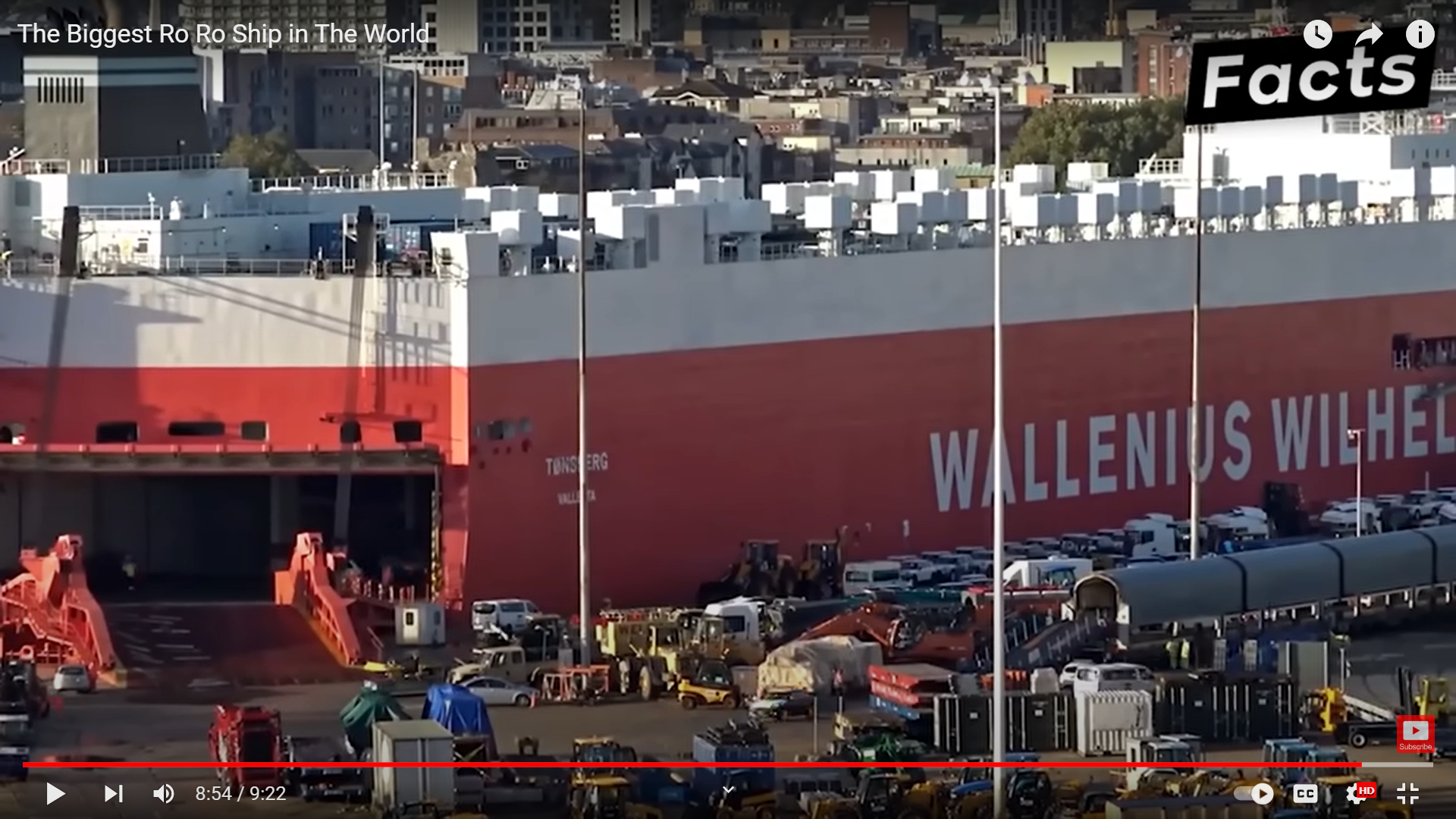
This 2012 ship is still the largest RORO.
9:22 video @ 8:54

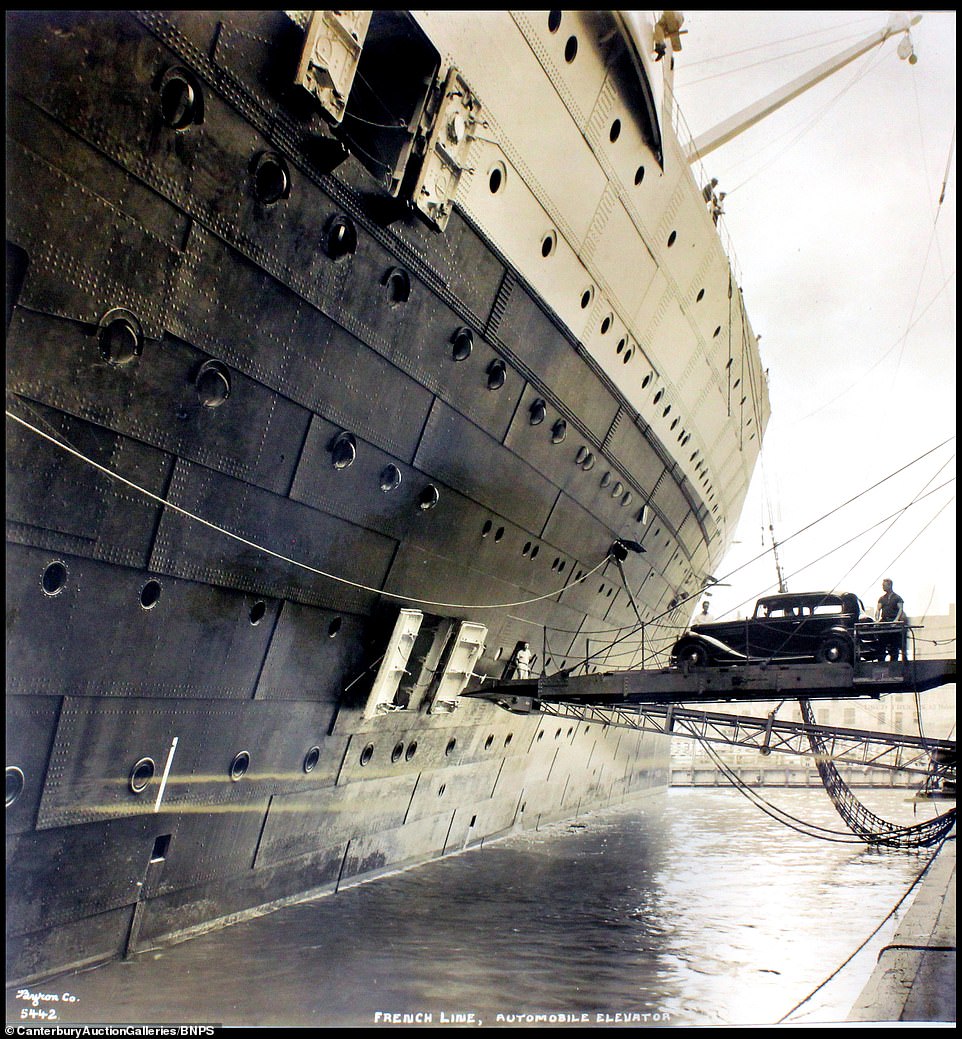
Milan Krstic posted
An automobile elevator is used to load a car onto the hulking ship at the dock in Le Havre car is loaded onto the huge ship. The SS Normandie made 139 crossings before she was confiscated by the Americans at the advent of World War Two. After Pearl Harbour was attacked by the Japanese, she was renamed USS Lafayette and converted into a troop ship.
[There are a lot of comments about the war in France and the USS Lafayette conversions. Specifically, the ship caught on fire during the conversion and never made it out of the dock.]

Tuesday, July 2, 2019

Floods of 2019: Water going up and earth going down (landslide causes derailment)

Channel3000
3D Satellite
You can see on Google's 3D Satellite image (on the right) that there is a river bluff right next to the tracks.

Fifteen "train cars" were involved. but the environmental assesment did not find any issues. (I put "train cars" in quotes because they probably mean platforms. Most deep well cars are articulated and have three or five platforms in one freight car.) The boat landing at Glen Haven is the only thing blocked by the train being stuck on the tracks. "The apparent cause of the derailment was a rock and mudslide." [Channel3000]

The Midwest hasn't had the Bomb Cyclone and other "gully washers" that the Great Plains have had, but they have had a lot of "soaking rains" and some thunderstorms. In the Chicagoland area, I think we set a new record for the number of days in May that had rain. A lot of farmers could not get into their fields to plant corn in May because, about as soon as their fields got dry enough, another rain would come through.

Unlike California, a big rain is not going to cause landslides in the Midwest. But we are learning that if you have a lot of rain for a few months, that is enough soaking that even hills stabilized by trees will "slump."

I saw photo recently of the side of a hill that was exposed because the outer part of the hill is sliding down at a rate of 7" per day. I didn't save it because it was rather far away and, at the time, I didn't know it can happen in the Midwest as well.

Since it is a container train, I'm not surprised there was no hazardous material. But containers do carry high value cargo. Can you imagine what a container full of iPhones would be worth? Also, there is no access to either side of the track, so it is going to be hard (slow and expensive) to clean it up.


Monday, July 1, 2019

Aban/ICG/IC RR Bridge and Coal Mines south of Zeigler, IL

(Bridge Hunter, Satellite)

This is in what the SPV Map calls the Southern Coalfield. I learned when I investigated the BN overpass on I-57 near West Frankfort, IL that there were a lot of coal mines in this area. And several railroads built several spurs to get to those mines. Since the mines are abandoned, those railroad spurs are also abandoned.

Michael Write shared
Old abandoned railroad bridge In Southern Illinois. Some hunters are actually still using this to drive across. There is no way I’d drive my car across it.
This bridge was on the ICG/IC Ziegler District between Christopher and Herrin. It was abandoned by ICG. The following shows part of this route (yellow), the location of this bridge (yellow square), the Johnston City District abandoned by ICG (orange), and a joint IC+CB&Q spur abandoned by those railroads (blue). Old Ben #20 was about half way between the two east/west spurs (red).
Satellite plus Paint

Looking at a 1938 aerial, it appears the SPV Map is wrong. the IC+CB&Q spur to the west appears to go to a mine that was east of IL-148 and between Pond Creek and Big Muddy river. That mine continues north past the mine then curves back east to join the north/south spur. This mine is not identified on the map.
1938 Aerial Photo from ILHAP
Looking at the north end of the SPV Map trace, we see the spur did not go very far south. And there
is a landscar southwest of Zeigler and vacant land northwest of Zeigler that shows where another joint IC+CB&Q spur existed. Near where the spur joined the UP/MoPac/St. Louis, Iron Mountain & Southern route was Zeigler Mine  #2. At the south end of the spur off the spur was Freeman Mine #3. The was obviously a coal tipple in the middle. There were railyards by the tipple and on the northwest side of town. The red line indicates that CB&Q continued on over the IC and SIMS tracks to go east along the north side of the SIMS route until it reached its own tracks a little over a mile to the east. It is interesting to note that Railroad Street in Zeigler does not parallel either of the two railroads that went through it.

1938 Aerial Photo from ILHAP