Saturday, October 12, 2019

Amtrak wants to convert Union Station's Powerhouse to a parking lot

(3D Satellite)

I have already discussed the powerhouse. These notes focus on the issue of tearing it down.

20180615 2140c


I have to up my priority of getting better photos because Amtrak wants to tear it down for a parking lot. [SunTimes]

Eric Allix Rogers/Preservation Chicago via SunTimes, cropped
I copied the Preservation Chicago information because I could not get a direct link to this information and their .pdf link did not work.

Address: 301 W. Taylor Street
Architect: Graham, Anderson, Probst & White
Date: Designed in 1931 and built in 1932-33
Style: Art Moderne
Neighborhood: South Loop
OVERVIEW:
Visible from the Roosevelt Road Bridge, the iconic and austere Chicago Union  Station  Power  House,  with  its  streamlined Art  Moderne  facades and smokestacks, exemplifies the story of Chicago’s growth as a railroad and transportation center beginning in the pioneering days of the 1850s. The  Union Station  Power  House  is  part  of  a  network  of  buildings, systems, and rail tracks constructed in the 1920s by the architectural firm of Graham, Anderson, Probst & White, which included Chicago’s Union Station,  its  Great  Hall  and Grand  Waiting  Room,  along  with  the  separate Concourse Building. The Chicago Union Station Power House has been out of  service  since  2011,  is  currently  mothballed,  and  is being  considered for demolition. When designed in 1931, it was referred to as the “boiler plant.”
HISTORY:
Chicago’s central role in the national rail network was unparalleled by any other city in the nation, with the highest amount of passenger and freight traffic. This allowed for early industries to flourish, ranging from coal and raw products for manufacturing, to agriculture including wheat, corn, grains, and even meat-packing. Chicago’s robust rail system also affected the city’s residential population. As industrial business expanded in Chicago, its population also expanded as laborers and their families came to the city to work and live. Chicago’s location at the hub of the national railroad network established Chicago as the capital of the Midwest.
In contrast to the more Classical-Revival style Union Station complex, the Power House is in the Art Moderne and Art Deco styles, reflecting the streamlined style of the time and the “industrial might” associated with generating and supplying power to operate a system of trains and buildings.
The architects of the Union Station Power House were Graham, Anderson, Probst and White, a firm that descended from the architectural firm of Daniel Burnham. They designed many of Chicago’s most iconic buildings, including the Wrigley Building, the Field Building (both Chicago Landmarks), the Merchandise Mart, and many other notable structures, both in Chicago and across the United States.
The strong verticality of the Power House, from its linear groupings of parallel window bands to its tall chimneys, emphasize the building’s strength. Its massive cream-colored brick walls, horizontal stone banding and austere ornament create additional visual impact. Unique in form, this is a rare example of power house industrial design by Graham, Anderson, Probst & White.
THREAT:
Amtrak is the current owner of the building and has determined that this structure may no longer be necessary for its operations. Therefore, they are conducting federally mandated “Section 106 Hearings,” to determine if it may be eligible for listing on the National Register of Historic Places. However, these hearings do not rule out demolition of the structure in the future. Demolition would be an expensive option, costing millions of dollars of taxpayer funds, to create a paved asphalt parking lot adjoining the Chicago River.
RECOMMENDATIONS:
Preservation Chicago recognizes the limitations of the site, with railroad tracks to the west and the South Branch of the Chicago River to the east. However, we would encourage a clever adaptive reuse of the building and site by either another service utility, like the nearby ComEd facilities, or another user. The idea of a third-party use could stimulate long-range plans for addressing the riverfront along this stretch of the South Branch and could catalyze the creation of riverfront access, riverfront green space and perhaps even a future riverwalk. This would serve as an amenity for the many nearby residents and commercial enterprises.
We believe that the Union Station Power House’s connection to Chicago’s incredible railroad and architectural history makes it a prime candidate for a Chicago Landmark Designation. A Chicago Landmark Designation for this unique building would ensure its preservation and reuse. A preservation outcome for this building would be a win-win for Chicago, Amtrak Rail Systems, and future generations of Chicagoans.
Eric Allix Rogers/Preservation Chicago via SunTimes
I was surprised that Amtrak was using it as late as 2011. It would cost $13m to turn the land into a parking lot. Amtrak solicited proposals for reuse in 2018, but no ideas have been presented. "Amtrak said other issues with the building include water infiltration in the basement, its proximity to ComEd facilities and a damaged river bulkhead that will require repair." [SunTimes]

Because of the big encolsed space, powerhouses make great event spaces (e.g. Sears original campus) or theaters (1869 water supply pumping station) But there is currently no public access to the area. The following sign ("Amtrak Personnel Only") confirms that the public is not supposed to go down to Lumber Street from Roosevelt Road.
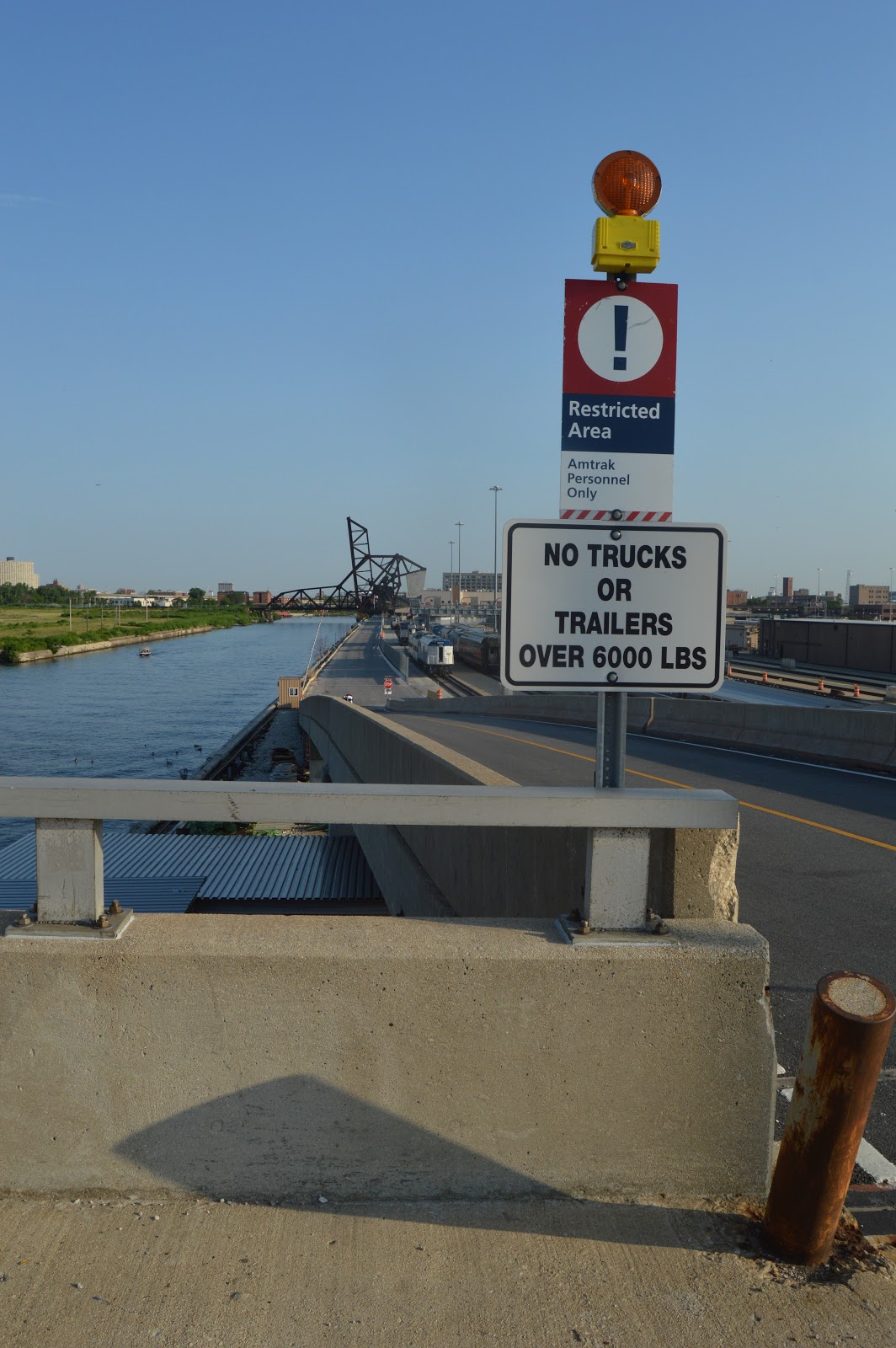

But the development plans for the land across the river is supposed to include the extension of Taylor Street across the Chicago River. So they could build an elevated parking garage south of Taylor that has an entrance from Taylor. And they could build an elevated, enclosed walkway between that garage and the power house. Amtrak could use the ground floor of the garage for their parking and the upper floors could be public parking. As for the leaky basement, just don't use it.


The twin smokestacks of the Union Station Power House, a defunct coal-fired power plant that once provided electricity to Union Station and its surrounding infrastructure, frame Willis Tower.
 Eric Allix Rogers/Preservation Chicago
I quoted the SunTime's caption for the above photo because I think it is wrong. I think the purpose of this power house was to generate steam. That is, it has boilers, but no generators. Back when it was built, steam locomotives still dominated. All of the passenger cars, commuter and intercity, used steam heat. And steam radiators where common in buildings. So I presume that this power house provided steam to the coach yards as well as the Union Station buildings.

In this 1938 aerial photo, the Union Station buildings are in the upper-left corner whereas the powerhouse is near the lower-right corner. (Roosevelt Road is along the bottom.) Note that the powerhouse is several blocks south of Union Station.
1938 Aerial Photo from ILHAP
In this aerial photo, the powerhouse is near the upper-right corner. Note that CB&Q (left) and Pennsy (right) has their coach yards next to and south of the powerhouse.
1938 Aerial Photo from ILHAP

Today, there is still a lead to Amtrak's coach yard next to the powerhouse and...

...more coach yard tracks south of Roosevelt Road. But now the cars are heated, and cooled, with electricity. Those gantry's above the tracks hold "extension cords" to power the coaches when they are parked.

In this photo we can see there used to be pipes along the south side of the old Taylor Street viaduct. I presume one of them was a steam pipe that delivered steam to the Union Station buildings.
Phil Gosney commented on the fourth photo of Marty's share
Here is GN Dining Car 1254, named Lake Minnetonka, also in the green Pre Merger livery, on the Empire Builder in Chicago on Sept 28, 1968. Photo by Gary Zeitler.
Here is a closeup of the pipes. The proximity of the pipes to the viaduct explains why I can't find the pipes in the 1938 aerial photo. The resolution of the aerial photo is not good enough to show it.
Digital zoom of the above photo
I've seen photos of a pipe going across the railyard by itself. They were probably taken after this Taylor Street viaduct was torn down. Unfortunately, I can't find any of those photos right now.


Update:
Although site access remains an issue, Ward Miller of Preservation Chicago tells Curbed that he could see the structure repurposed. Its proximity to electric and fiber optic infrastructure, downtown’s trading exchanges, and the cooling water of the river could make it an ideal spot for a data center, Miller says. The site’s inaccessibility would provide an extra level of security.
Miller also suggests turning the building into a refrigeration facility to cool nearby buildings, similar to the massive chilling plant at nearby 300 W. Van Buren Street. Additionally, the easy-to-spot, 115-foot-tall structure could bring in advertising revenue—if done tastefully, Miller adds.
[curbed]
Both a data center or a chilling plant would require a lot of electricity. Since ComEd has a major switch yard just north of Taylor Steet, there should be plenty of power. And ComEd should be feeding that switch yard with multiple power lines so providing a redundant supply like the Microsoft data server building has would be easy. And the isolation of the area from the public would be an asset because it enhances security.

safe_image for These are Chicago’s most endangered buildings in 2020
The preservation of our heritage is how we maintain our individuality. It is how we assure future generations that we a defined city unlike any other place on earth. Nothing against some of our great cities across America, but they are not lucky enough to have our architecture or our history. Some cities all look alike, with undistinguished and uninspired buildings all around. Let us not allow the same to happen here, to our beautiful city.
Noel Rivera: The power station was built when asbestos was widely used in the electrical industry. It will be very expensive to demolish or rehab. I hope it will be saved.

Paul Webb shared a Devon Neff post of drone photos.
Today's subject, Union Station Steam Plant, built in 1931. Providing power to Union Station train station, and the old Post Office Building for decades, it's been closed since the 1990's.
Here's some more information. Sounds like Amtrak wants to tear it down unless they can find someone to develop it for another purpose. That's a difficult problem and would probably involve some hazardous waste disposal which can get very expensive.

Friday, October 11, 2019

Demolition with a clamshell bucket

(3D Satellite)

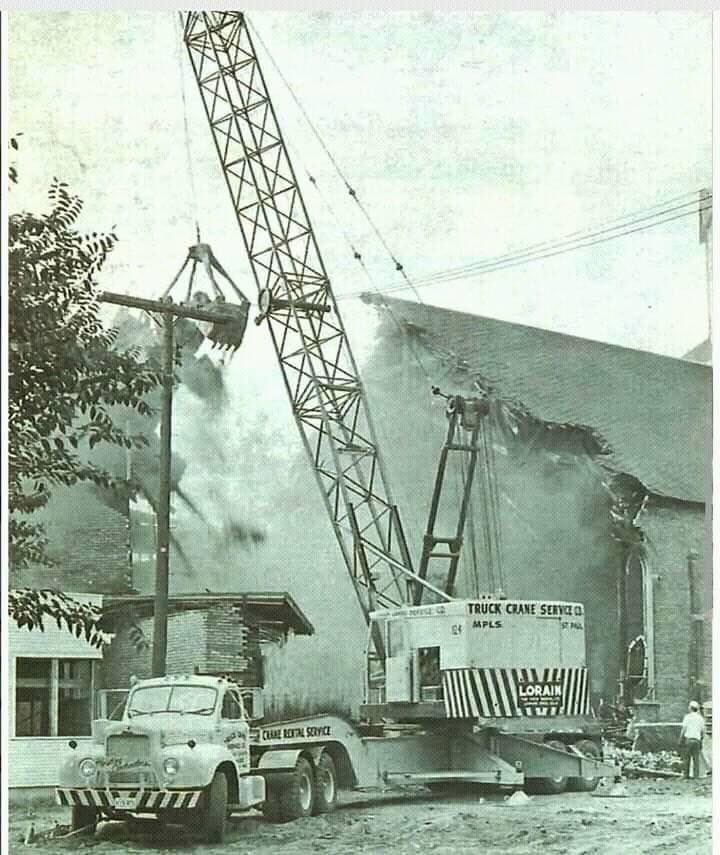
I have notes on using a wrecking ball for demolition work. I've learned that some operators prefer a clamshell bucket because it can be used as a wrecking ball and so much more.

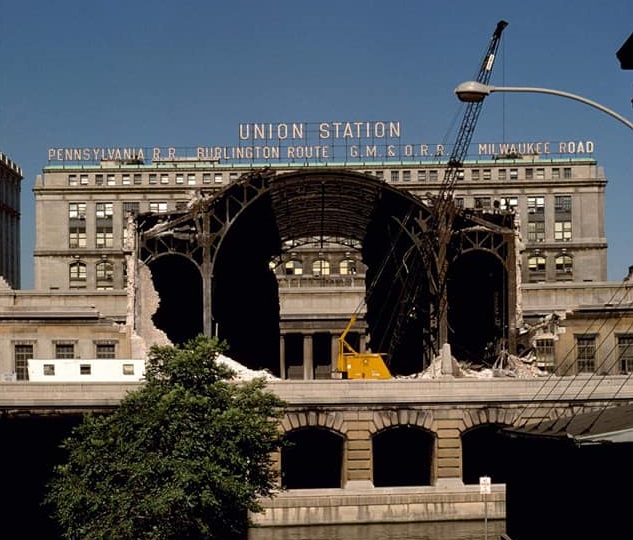
This photo shows that a clamshell bucket was used to remove the Concourse Building of the Union Station.
Michael Morris posted, cropped
Patrick McNamara Photo by William Brubaker from the UIC Archives at the School of the Art Institute.
[This operator is using a clamshell bucket on his crane.]

Barry Thornberry posted

Big Machine posted

 BOE DOEPPERS/THE NEWS via IndyStar via Dennis DeBruler
Demolition of the Indianapolis Traction Terminal in 1972.

Eric J. Nordstrom posted
1960 john vinci kodachrome slide provides a rare glimpse at chicago's "land clearance" or hydepark-kenwood urban renewal project in full-swing.
vinci labeled the slide with simply one word - "destruction."
lindahl brothers, which is still around, is seen here wrecking a building with the crane's clam bucket pounding it into oblivion.
courtesy of john vinci collection.

I knew McDonald's had a corporate campus in Oakbrook, IL south of I-88. A couple of weeks ago, I drove through the part of the campus that did not have its roads blocked, but I could not find their headquarters building that was being torn down. Recently, I learned it was just north of I-88. I read that the windows look like a bunch of french fries lined up in their package. That clue allowed me to find this building.

Street View

Since McDonald's has moved their headquarters to the West Loop, this property is being redeveloped. (Update: A friend of a daughter is an employee at McDonald's. She explained that the narrow windows are now a violation of fire codes. People can't fit through the openings so they can't be rescued using a hook-and-ladder truck. The need to widen the windows was one of the reasons that McDonald's decided to rebuild in the West Loop. (A more attractive location for Millennials to help hire young people is the reason I have heard for the move.))

3D Satellite

3D Satellite, accessed Oct 2020
[No more employee cars in the parking lot. I assume the holes in the wall is to allow the disposal of debris from interior demolition.]

To help celebrate some great fall weather, I made a trip on Oct 7, 2019, to check out the demolition. It was obvious they were using a clamshell bucket. And I could get a good view from an adjacent parking lot. Below is the video I took of the demolition.

With my lens at 200mm, I got the following photo when it slewed to its right to dump a load.
20191007 9573
Fortunately, the contractor included the crane information in its paint job: "Link-Belt LS-518."

Discontinued in 1988 the 150-ton capacity Link-Belt LS-518 crawler crane is powered by a 245 HP NT855 diesel engine with 3 stage tourque converter. Comes with 90, 000 lbs conunterweight and has 290' tip height with full boom and jib. [CraneMarket]

new from the factory 1981, powered by Cummins 855 with TD converter, pll 2 drums, 3rd drum, independent swing, mast, 180' tube boom, 44" pads, block and ball, ICW and Miss river access able. [MachineryTrader]
I plan to make more trips to get additional video so I'll organize the videos by day.

Videos from October 7, 2019


(new window)
Starting a new section of tearing down McDonald's former headquarters

As I walked to a viewing location, I saw a two-story column fall from the building. The crane then started on a new section. (You can see the hoses still watering down the old section. Someone finally goes on the roof and moves them a little later.) Since I caught them starting a new section, I hand held it so that I could start videoing this action. Some highlights.
 - 0:43 He gets the boom bouncing rather impressively. The crane is a Link-Belt LS-518
 - 2:00 He will soon knock the ceiling down.
 - 3:00 An excavator (at ground level in the center) picks up a column and carries it off.

(new window)
A Wall Slab Comes Down

Evidently a building comes down the same way it went up ---- one wall slab at a time. At 1:00 is when he starts on a slab. At 0:27 did he slew to his right to stop the clam bucket from turning? At 2:56 did he drop the chunk of a column that he removed in a certain spot to help break up something left in the old section? At 3:29, you can hear the diesel engine "work" over the noise of I-88 traffic and wind noise. In the real life, I could hear the diesel engine rather often. I've watched several cranes do lifts, and I very seldom hear the diesel engine. Between the boom bouncing and the engine frequently "working", wrecking buildings has to be hard work for a crane.


(new window)
Diesel Noise, Boom Rocking, and a Chunk of the Roof

Link Belt LS-518
This is one of the times that I could hear the diesel engine work over the traffic noise of I-88 and the wind noise.

(new window)
Trying to pull a cable out of the roof

I'm far enough away that the sound is delayed. That is why you hear the diesel engine roar when the bucket goes down instead of up.

(new window)
Using a closed clamshell bucket as a wrecking ball

Most of the time that I watched this operator, he used the clamshell bucket as a clamshell. But to take out a beam, he closed the clamshell and dropped it like a wrecking ball on a beam. The first drop missed, but he nailed it on the second drop.

(new window)
Removing columns

The first clip shows how he removes a reinforced column one clamshell bucket length at a time. He uses the teeth of the bucket to shatter the concrete a little at a time.

The second clip, 2:05, is a continuation of the beam removal segment shown in https://www.youtube.com/watch?v=ZPI4A.... He can just pull out the middle column. For the end column, he starts the same "chomping" technique that he used in the first clip. Since we have already seen how that works, I didn't record the full sequence for this column. The third clip, 2:50, starts when he was approaching the end of the column that he started in the second clip. This clip ended up being longer than I expected because the rebar got caught on the bucket, and he had a hard time shaking it loose.

(new window)
Five chomps into the building

As you would expect with a clamshell bucket, the main activity was chomping into the building and pulling a "bite" out of the building. The first two clips follow the crane until the load is dumped. The remaining three clips just follow the crane until the load is pulled free from the building.


A clamshell was used to remove some old wood grain elevators in Dawson, MN.


Thursday, October 3, 2019

Sharon/H. Lee White/Joseph S. Young/Archer's Hope Freighter

I don't normally do posts about individual freighters because there are other web sites that do a far better job than I could. But the journey of this freighter up the Mississippi River and the Illinois Waterway makes it special. It was almost 600' long when two tugboats helped it travel the Chicago River.

Bev Shaw posted
The 3200-bhp towboat Gene C. Hutchinson, built 1952 by the St. Louis Shipbuilding & Steel Company for the Hutchinson Barge Line, Inc., of Chicago, pushes the Joseph S. Young beneath the MacArthur Bridge at St. Louis on 7 January 1957, along with the towboat’s usual complement of oil barges it towed between New Orleans and Chicago. The tow had to wait at the Alton, Illinois, lock until 28 January 1957 to lock through because of low water at the Alton pool. The Young arrived at Lockport on 14 February 1957 where the Hutchinson relinquished the tow to the Great Lakes Towing Company tugs Montana and Wyoming for the twelve hour journey from there through the Chicago Sanitary and Ship Canal, South Branch of the Chicago River, and the Chicago River to Lake Michigan. 
Note how high the freighter is floating. That is because the inland waterways have just 9' of draft. At least they don't have any big waves!
Built at Mobile AL by Alabama Dry Dock & Ship Building Co., Hull 346
Launched June 30, 1945
Built as Archer’s Hope for U. S. Maritime Commission during World War II as Class T2-SE-A1 tanker.  Originally enrolled at 504.0 x 68.2 x 39.2, 10172 GT, 6134 NT.  Operated by Cities Service Oil Co. and purchased by their subsidiary Ships Inc. in 1948.
Sold 1956 to owners below.  Renamed Joseph S. Young   (1) 1957.
Converted to bulk freighter at Baltimore MD by Maryland Dry Dock Co. with new forebody.  Towed into the Great Lakes via the Mississippi and Illinois Rivers to Manitowoc WI, where her self-unloading equipment was installed by Manitowoc Shipbuilding Co.
588’10” LOA, 572’ LBP, 68’ beam, 39’3” depth
1 deck, arch cargo hold construction, hatches @ 24’, oil-fired boilers, steam turbine engine, 6000 SHP
Enrolled at
572.0 x 68.2 x 39.2, 12489 GT, 8820 NT     US 248326     to:
American Steamship Co., Buffalo NY, Boland & Cornelius, Mgr. (home port Buffalo NY)
Entered Great Lakes service June 28, 1957
Lengthened 1966 at South Chicago IL by American Ship Building Co.
Remeasured to 656.0 length and 14452 GT, 10783 NT
Renamed H. Lee White  (1) 1969
[GreatLakesVessel]
Not only can the same freighter have multiple names, but the same name can have multiple freighters. This freighter was renamed H. Lee White in 1969 because a different freighter got that name in 1969.

Wednesday, October 2, 2019

MoW: Flood of 2019: NS/Wabash 1913 Bridge over Grand River near Brunswick, MO was Destroyed

(Bridge HunterSatellite)

<update>
NS replaced the bridge in 27 days. (source)
An example of what NS should have been doing long before the debris pile got so long. (The NS press release implied that the debris quickly piled up. But a newspaper report said the local residents watched the pile build up with dread.)
</update>
The year of 2019 just keeps on raining. I labeled these notes with "wwMou" because the bridge is close to the mouth of Grand River at the Missouri River.

Massman Construction Co. posted two photos with the comment:
The
Norfolk Southern Corp
Railroad Grand River Bridge Emergency Repairs project recently earned
Engineering News-Record
Midwest Awards of Merit for Best Small Project and Safety on a Small Project.
Following the destruction of the existing Grand River Bridge due to historic flooding and water-borne debris, Norfolk Southern needed to repair the critical river crossing as quickly as possible. Massman rapidly mobilized and lead the safe construction of the replacement spans, working around the clock to restore rail service in just 27 days – weeks ahead of the originally estimated schedule.
Congratulations to the project team!


1

2

This photo shows that the river is no stranger to floods.
Photographer unknown, License: Creative Commons Attribution-NonCommercial-ShareAlike (CC BY-NC-SA)

After a logjam had shoved a pier out of alignment, NS crews cut the rails so that adjacent good piers and spans would not be damaged. "Norfolk Southern sent out a service alert for the bridge Tuesday saying, 'train service has been suspended between Moberly and Kansas City, Missouri, due to debris (caused by heavy rains).'" [KOMU] This is on NS's mainline to the Kansas City gateway market. After they cut the rails, the river removed the damaged part.
Screenshot @ 1:03
The river was not near as full as it was when the steam engine shot above was taken. But the video below shows that the logjam was huge. I normally avoid profile videos of horizontal subjects, but this one is just too informative to pass up. The caption claiming BNSF is wrong, it is NS/Wabash.

Screenshot @ -0:33

Screenshot @ -0:31

Screenshot @ -0:22
After a significant amount of logs flowed through the gap, there was still a lot of logs upstream.
Screenshot @ -0:06

Building a pier down to bedrock won't help it resist lateral forces. But it is good to know that it took a massive logjam on a fast flowing river to generate enough lateral force to displace a pier. Dirt can be rather strong. Some railroads will use a crane on the bridge to remove logs stuck against a pier so that such a large logjam doesn't have a chance to develop. The crane just lifts the logs from the upstream side and swings them over to the downstream side. (Update: according to the podcast reference added at the top of these notes, this logjam came down the river already formed. They did try to use cranes to save the bridge, but the jam was just too big. They later determined the jam was 2.5 miles long! But this news report indicates the jam slowly built up at the bridge.)

Another video  Unfortunately, it also has a profile format. But it includes audio so you can hear the pops as the bridge breaks apart.

Josh Grider posted three photos. But between the time I saved the post and the time I looked at the post the next day, the post had been deleted.
I found my notes about the May flood around Brunswick. This NS route was out of service back then because water was on the tracks!
(new window)


Update:
Aaron Bryant posted three photos with the comment: "NS Hi-rail crane truck with a clamshell attached, sits on a wooden trestle, on the Coal Creek Branch, cleaning debris from around the wooden piers. Photos taken in Raven, Va. 10/2/19."
Jeff Coburn That's me !
Tony Gee Whaaaaattttty NS allowing preventive maintenance!!!! Something must’ve happened recently.
Dennis DeBruler The expensive lesson near Brunswick that taught some management that preventive maintenance is cheap:
https://www.facebook.com/mitch.adams.758/videos/1421517684665532/
They deliberately cut the rail. I wonder how bridges that are downstream from NS will deal with that pile of debris that NS created.
Blake Boeckman Cleaning drift around bents isn’t standard procedure for NS? That’s a class 1 call via FRA. That’s mandatory 30 day repair to avoid being fined.
Blake Boeckman Not to mention the scouring drift accumulation causes. But after watching the bridge they let get carried away I’m not surprised. Hey NS if you guys need a consultant for structures and superstructures give me a shout. Not looking good in that department.
Art Peine Crane with clamshell bucket can do wonders for those type of problems. Drop the bucket break it up or lift it over not a fast job but beats replacing bridge.

1

2

3

Jim Morris posted two photos with the comment: "The NS bridge in Mo. that washed away is being rebuilt."
1

2

safe_image for NS Missouri bridge to return to service Monday night
On October 1st, [2019] the
Norfolk Southern Corp
Grand River Bridge in Brunswick, Missouri, was washed away by debris and high waters. On October 28th, we completed our emergency repairs to the bridge and train service was restored. Congratulations to our project team for their quick work on this emergency project.

Dave Durham posted the question: "Haven't seen much action on the NS Hannibal line the last 2 times I was at Valley City/Griggsville. Does anyone know of a slowdown in business that would cause this?"
Adam Taylor A bridge at Brunswick, MO, was washed out. Traffic is detouring via Saint Louis.
Dennis DeBruler Let us know when the trains return to the Hannibal line. It will be interesting how long it takes to fix the bridge.
https://industrialscenery.blogspot.com/.../flood-of-2019...

Sunday, September 29, 2019

The parts of a lattice crane and bent boom stops


Chris Evans posted
Basic lattice boom crane components
Will T Henson 3900 t
At first, I skipped the above parts diagram as not worthy of its own post. But on the same day I came across a closeup of the boom stops because they were damaged. Judging by the comments on the post below, some of the things that might cause the boom to come back too far:
  • the boom was high with a heavy load and the load was suddenly released
  • the operator had the boom too high when he traveled up a "hill;" e.g. onto some mats
  • the crane is old and doesn't have a high boom kick out, or the kick out is adjusted wrong, or the operator was in kick out override mode. And then the operator raised the boom too high.

Jonathan Mark posted

Wayne Hill commented on Jonathan's post
Ours was a little more back!


Saturday, September 28, 2019

That Sucks! (Tank Car Vacuum Implosion)

"That sucks" because of the vacuum and because an employee made a lot of scrap metal.

Les Baldwin posted three photos with the comment: "Tank car cleaning gone bad, steam injection through dip tube to heat car to boil off residual material in preparation for sending car to shop, Steam shut off, valves closed, car cooled off, pulled vacuum and this was the result."
Joe Dockrill shared
Russell Baucum And those tankers are built with heavy-duty steel in case of derailments to contain the fluids!🤔
Wes Garland It didn't perf......bendy is stronger than rigid...milk comes in plastic bags in Ontario.
1

2

3

It appears the placard is 1993. That would be fuel oil.

Stanley Silva posted
Tank car collapsed by internal vacuum. This was accomplished by actually removing the air with a vacuum pump to show what can happen if tank car is steam cleaned and vent vales left shut and not allowing the air pressure to equalize as the tanker cools.
[I did not dig through the 134 comments, but my did catch a couple of interesting comments.]
Lang Thompson: That happened to a 750000 Gal Stainless Steel tank that was being steamed where I worked. Steam and a cold rain shower form a powerful force. Thankfully my finger prints weren't on that disaster.
Chris Vieira: Happened in a transload yard up in montreal once but for plastic resins. One hopper was totally like that, crushed cane. [I didn't realize that covered hoppers sealed will enough to hold a vacuum.]

David Buccolo commented on Stanley's post
I had to respond to a customer track one very early Sunday when they failed to vent a tank car of ethanol luck would have it no leaks.

Anonymous member posted six photos with the comment:
Whoops!
Recent [Feb 2025] incident locally in SE Washington
GAT(eX) 95971
D Eric Davis: Don't forget to vent your car! 5 lbs vacuum will do this!
Jeff Davis: D Eric Davis takes more than that. Go watch the episode of mythbusters where they show what it takes to do this.
D Eric Davis: Jeff Davis well I built them like 10 years ago and they could implode at as little as 5 lbs if not vented properly.
1

2

3

4

5

6