 |
| 1 Sperry New Holland launches the first self-propelled forage harvester in 1961 |
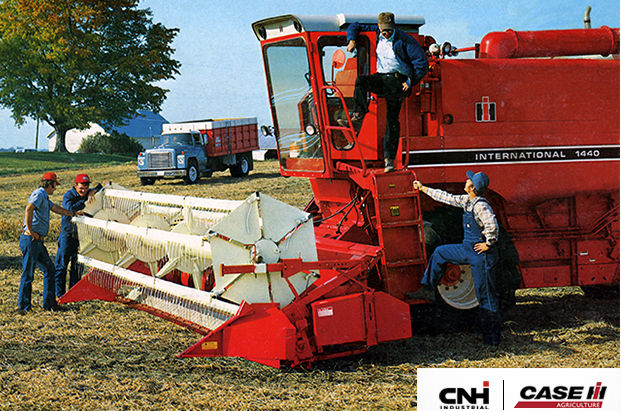 |
| 2 International Harvester introduces the revolutionary Axial-Flow combine in 1977. This greatly improves harvesting efficiency through its revolutionary rotor design |
 |
| 3 New Holland invents the first self-tying pick-up baler in 1940 . |
 |
| 4 A part of New Holland Agriculture history: the first mass produced tractor, the Fordson Model F, is built in 1917. |
 |
| 5 Case produces the first steam-powered tractor in 1869. |
Because the pictures might be temporary, I'm saving the other three they posted.
Update:
Some of the video links they posted about the announcement: 8:00 min, 2:26 min, 2:27 min, 2:24 min. A web page about driverless technology. They do expect farmers to build private paths on their farm so that it can get from the barn to the fields.
CaseIH "high-efficiency farming" topics other than autonomous tractors.
Octane Press posted four photos with the comment:
 |
| 8 |
 |
| 7 |
 |
| 6 |
 |
| Horsepower posted |
CaseIH "high-efficiency farming" topics other than autonomous tractors.
Octane Press posted four photos with the comment:
In a secret garage, IH engineers started working on the new project. The team began in the late 1950s, thinking they’d need a few years to design the combine. In the end, the machine was released almost 20 years later!Tap the link to learn more about the Axial-Flow Combine!📷: Lee Klancher and Wisconsin Historical Society from 📕: "Red Combines"
Seth Wengert: I've been told that when they demo one at Farm Progress show, they had locked doors that closed off the rear so the no one could see in the new threshing system.
When you think about it, these were so far ahead of everyone else it wasn't even close. It's shocking since IH was usually ten years behind or more...
Christopher Richter: The old Minneapolis Moline corn shellers were rotary so the technology existed for almost 50 years before it made it to a combine.
Steve DeArmond: I didn’t understand why it didn’t have separate hydraulics for the drive wheels blow a small hose on the thrashing equipment you don’t know it till the machine stops the John Deere had it separated.
Rick Butler: Much of the early Axial Flow development was done in Fort Wayne at the IH truck plant.
Don Amber: Rick Butler and wasn't it painted blue?? I remember hearing a story about that from a guy that worked in the engineering area.
Rick Butler: Don Amber IDK about that, but anything is possible. I stumbled onto a great YouTube video about the history of the Ft Wayne plant and the combine development was mentioned.
[And there are some comments about IH (red) vs. JD (green).]
 |
| 1 |
 |
| 2 |
 |
| 3 |
 |
| 4 |
 |
| Comments on the above post |
 |
| Steve Walters commented on the above post |
And a Massey-Ferguson "rebuttle," 3:15 min.
Massey-Ferguson's review of their history: 4:07 min
Another CNH video: 8:00. Starting at 6:10, it presents some history. At 6:12 is "grampa's" baler.
A Facebook posting where the comments discuss which year the other manufactures introduced their axial rotor design, including:
Justin Hiner Jared, Case never built a rotary, International did. Sam, international wasn't behind everyone else as tractor house will show you. New Holland had rotaries on the market in 1975, Gleaner in 1976, International in 1977, White in 1978, John Deere in 1998.
Linda Chamberlain White was in 1979, but marketed in 1980.
10 Significant John Deere Milestones, note that John Lane is the inventor of the self-scouring steel plow.
175 Anniversary CaseIH video of its history
John Deere video with tractor timeline and PR (I wonder if JD saw the CaseIH video and decided they had better get something on Facebook also.)

No comments:
Post a Comment