Now that I found my dial phone, I can write the post. And a Copyleft picture of a dial phone is now available for student projects on the history of the phone. (Students, be sure to search the web for "Strowger". It is the original central office equipment that caused the invention of the dial-pulse phone. See this Video for an example of a switch in operation. If automated switching equipment had not been invented, there would not have been enough women to fill the needed operator positions. And another tidbit is that operators were originally men, but the industry soon learned that women did not spend as much time fighting with each other. Oh oh, I'm going stream of conscience -- one thing we learned at the Caterpillar visitor center in Peoria, IL, is that mining companies now hire women instead of men to drive the huge trucks in mines because they don't tear them apart with their driving. I wonder how many men have tried to pop a wheelie with a two story dump truck.)
In addition to a dial-pulse 500 desk set, I included a touch-tone 500 and a more modern phone that still needs a cord. If I ever see a payphone again, I need to grab a picture of it also. The beige wire was the standard 7 feet. The green wire was originally the wall phone in our kitchen, and it would stretch to 13 feet so you could reach the refrigerator and counter while you talked.
 |
| 20140907 0033c |

So the "alert tone" of an older phone was metal mechanically hitting metal. Not some microprocessor playing a tune with a speaker. The yellow cylinder is a solenoid that responds to the 48-volt AC ringing current to create a magnetic field that moves the clapper.
Since the easiest way to make an audio recording in the 21st century is to make a video, that is what I did. I had to use two phones in the video because I discovered that the dial-pulse phone will no longer ring. And it is not because someone taped some padding on the bells. I had removed that before making the video.
While making the video, I discovered that I can't make a call with the dial-pulse phone. I was surprised because the phone company used to maintain upwards compatibility. Then I remembered that I now get my phone service from the cable company instead of the phone company.
I've always wondered what kids think when they hear someone say "dial the number." When I tried remembering if I have ever heard someone use that phrase, it occurred to me that kids don't even make phone calls. They text instead.
(Update: this post of two photos of dial phones includes a comment that provided a YouTube video of two 17-year old kids trying to make a call with a dial phone. I quit in the first minute because they were dialing without taking the handset off the hook.)
 |
| Ryan Szimanski posted One of the funnier artifacts in the collection, it's still plugged in even! [Ryan is the curator of the USS New Jersey battleship museum. So this would be in that battleship.] |
 |
| Dennis Popiela posted |
At one of the Illinois Rest Parks along I-57 I noticed an Illinois Bell sign about a payphone. So I looked for it on the inside:
 |
| 201560804 4067 |
Unfortunately, it did not occur to me until I wrote this that the sign itself, "Illinois Bell" is also history. I wish I had taken a picture of the sign.
 |
| Doug Downey posted This is in Monroe County [Illinois] by their Courthouse and the phone still works. Angela Asselmeier Gilbert Ruma Illinois too. Actually So. Illinois has numerous dead zones. Behind my house is one. |
 |
| Donnie Vaughn commented on Doug's post |
 |
William A. Shaffer posted Payphone at Temple, TX. (12.20.12). (Photo by William A., Shaffer) |
While waiting in the grandstands at the 2016 Sycamore Steam Show for the Parade of Power to start someone commented about an old phone. And then I saw what they were talking about (below). Someone had probably just bought it at the flea market and was carrying it back to his car. I assume the ear piece and cord is in the bag he is carrying.

Ryan Sisson posted three photos with the comment: "Interesting find today... tried looking up by patent numbers.. got nowhere. .. anyone one on here have an idea? Patented oct. 31 1883 and April 30 1907"
Douglas Kephart provided three comments on the above posting:
 |
| 20110811 4092 |
 |
| 20140811 0490 |

 |
| Bruce Edwards posted
I'm getting rid of old desk phones at work and put out a building-wide call for any old phones sitting in cubicles. I had over 20 old phones show up, including this one. Man, does it bring back memories.
I had to play with it for old time's sake.
[I believe this was called a "key set." The buttons on the bottom allowed you to connect to different phones in the office.] |
 |
| 1 |
 |
| 2 |
 |
| 3 |
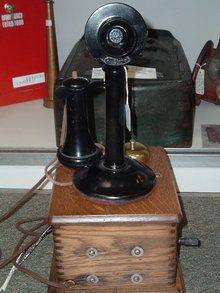 |
| 1, Something like this, but this has the hand-crank. I think the four screw heads secure the base of the alternator. |
 |
| 2, Just the desk unit, again a hand-crank model. |
 |
| 3, Again, but with a later style handset. These all look like the lid hinges for the other side. But as I said, they made these for decades and there are bound to be a lot of variations. |
I was thinking just the other day that I have never seen a photo of a "wall phone." In the house I grew up in, a wall phone hanging in the kitchen was the only phone in the house. And when we first moved in we were on a party line with 10 houses. And it was dial pulse. When we first moved in our current house (over 40 years ago), we had a wall phone in the kitchen. But we found a 15-foot coiled cord for it so you could work at the kitchen counter or raid the refrigerator while you were talking on the phone. And we had other phones in the house. Now we have a base station plugged directly into our cable modem. The base station supports five cordless handsets so we no longer use any of the phone wires that are in the house.
I've course, a dial phone was modern because it replaced the local operator with automatic switching.
 |
| Kara Beth shared |
I've course, a dial phone was modern because it replaced the local operator with automatic switching.
 |
| Charlie McCarty posted This phone came out of the phone booth at Sun, LA. GM&O RR. It is all complete. [Charlie mentions three antiques: the phone, a phone booth, and a railroad passenger station.] |
A hand-cranked phone and a Remington typewriter.
 |
| Melody Reed, Sep 2025 via Dennis DeBruler |
 |
| Paul Jevert posted [There are more photos of dial phones in the comments.] |
I post another picture of a touch phone because the posting has a lot more photos in the comments. And the comments also have animated gifs of phone dialing.
A video on how to use a dial phone from Patti Garland. |
| Bob Eqaniuk posted It was 54 years ago today when Bell System officially introduced its Touch-Tone telephones, the first push button telephones available to consumers, in 1963. What kind of telephone did you grow up with (share a pic in the comments)? |
On the other end of the dial pulses were step-by-step switches:
If automated switching had not been invented, then eventually every women in the US would not be enough to handle the call load.
 |
| Hayden B. Baldwin posted Back in the day when you actually talked with some at the telephone company! 1913 |
 |
| Ancient Threads posted Before digital dialing and computerized systems, businesses depended on manual switchboards and skilled human operators to connect calls. Shown here, Southwestern Bell operators work the lines in Houston during the early 1960s. |
 |
| Old American Life posted The Switchboard Sentinels, San Francisco, April 18, 1906 When the earthquake hit at 5:12 AM, most of San Francisco fled. Emma “Emmy” Doyle and seventeen operators at the Pacific Telephone exchange stayed. With walls cracking and plaster falling, they plugged in every call — fire crews, hospitals, families — by memory. Emmy knew the whole city’s numbers by heart. When the chief ordered them out at 11:00 AM as fire approached, she sent the younger girls down the rope ladder first. She stayed until the final cord melted, connecting a doctor to a collapsed school. She walked out with burns on her hands and a switchboard key in her pocket. The building was ash by noon. For three days, she slept on the ferry and still gave numbers to refugees from memory. |
 |
| Andrew Henderson posted "Defense Telephone operator at Aberdeen proving grounds, Aberdeen, Maryland," John Vachon, photographer, 1941 Dec. From LOC safety materials; 3 1/4 x 4 1/4 inches or smaller. |
 |
| History Season posted Why were telephone operators all women? In the 1870s the telephone was introduced to the world. In the early days of the telephone, every call had to go through an exchange, or switchboard. A person sat there and manually connected you to the person you wanted to reach. When you picked up the phone a operator would say, “Number, please,” then “Hold the line, please.” They would plug and unplug wires to connect your call. At first, teenage boys did this job - but they were often rude and impatient. Worried about customer service, telephone companies replaced them with young women, who were seen as more polite and dependable. These women became known as “Hello Girls,” and the job soon became an almost completely female-dominated profession. The job gave many women new independence and better pay than factory or domestic work. By the early 1900s, about 80% of all telephone operators in the U.S. were women. As telephones spread, the demand for operators exploded. In big cities, hundreds of operators worked side by side. But the job wasn’t easy. Operators needed quick hands, sharp hearing, good eyesight and had to be tall enough to reach the top wires. They had sit for 8 hours in straight-backed chairs and were not allowed to talk to their coworkers while working. Some handled up to 120 calls per hour and were often scolded by the caller if a connection wasn’t clear. From the early to mid-1900s, automatic exchanges began replacing manual ones, and by the 1970s, switchboard operators had mostly disappeared. Sources: Latson, Jennifer. 2015. “The Woman Who Made History by Answering the Phone.” TIME, September 1. Science Museum Group. 2018. “Goodbye to the Hello Girls: Automating the Telephone Exchange.” October 22. Singh, Akanksha. 2023. “Hold the Line.” JSTOR Daily, July 3. [I worked at Bell Labs, and the reason I heard, more than once, for the switch from men to women is that the men kept getting into fights.] Byron Reinecker: Read about this years ago , boys were too easily distracted. Margaret Henderson: Men don'ts have the patience, before it was completely replaced there were male operators. It was a shock when you heard their voice. I was a PBX operator in my 20's and it was not easy, you had to learn a "phone" voice, how to handle everything lighting up at once, and where each of those hole connected to. I was very good at it and loved the job. Peg Oberg Burke: In 1966 I started working at a large insurance agency. The switchboard was right by the entrance so she did phone call connections 95% of the time & 5% reception! Every incoming call was answered by her & then she put it thru to the extension! She was out 1 day & her replacement gal said doing it was "like juggling raw eggs while riding a bicycle!" Kathy Hill: My aunt, born in 1899, became a telephone operator. They were taught how to sound and how to pronounce words. I was a kid when she retired and she told me that they had to say, “The lion is busy.” Many times people would retort, “What is the lion doing?” We thought it was so funny. Carly Sommerstein: Kathy Hill the operators had to say "nion" instead of "nine" because over the line, it would sound too close to "five," hence the "lion" training here. Julus H. Moore: Carly Sommerstein In the military, nine was pronounced ”niner.” Carly Sommerstein: Julus H. Moore yes, same reason. [I don't think "nine" and "five" sound similar.] Ellen Anthony: Operators were not supposed to listen in on calls but one operator did. By the time the caller asked her to connect them with the ambulance, she had them on standby. She also alerted the hospital to expect a patient. She did ask the caller not to tell that she had broken the rules to help them. They never mentioned it. June Adams Fiske: Ellen Anthony We operators were the 911 of the day. It was not unusual in an emergency situation to be sure the customer was connected and able to communicate. Many times I announced the call this is the operator. I have a customer at phone number. I will stsy on the line for a minute in case he/she needs assistance. David Crass: My hometown, Sulphur, Oklahoma, had all operator assisted phone calls until the mid 1960's. One of the phone operators was 19. She dated the youth and music Minister at my Baptist Church for several months. When they broke up, he got a lot of wrong numbers for several weeks. Peter Milne: The maximum number of lines for an exchange/office was generally 10,000. There would generally be 10,000 sockets spread across three operators' positions then they were repeated. There was another set below these ones with indicator annunciators or lights for incoming calls, but these were not repeated. So the operators had to reach across each other to connect calls. They also needed to touch the tip of the plug on the face of the socket, if there was a click in their earpiece (or similar) it meant the line was busy and the operator would tell the customer that the call could not connect. Greg Weber: Supposedly catholic high school graduates were given preference for operator positions. Higher tolerance for taking crap from customers. Shelley Francella: In NYC, job with Bell Telephone was highly coveted and the standards were extremely high. To be a telephone operator in the early days was quite prestigious. Bill Tyree: It must have been back in the 1950s or 60s that I called my home town was about 400 miles away. I asked the operator there to connect me with my cousins house by name. The operator replied with, she’s at the hair dresser, i’ll connect you there. Small town operator. Mike Cross: I was one of the first male operators in San Diego 1974 and it was on a cord board. We handled hotels coin phones ship to shore and O operator calls. Barbara Behrle: My mom was an operator in the late 40’s and early 50’s. When They got tired of saying “number please “ they said “ bumblebees”. No one knew the difference. Janet Ross: My mother was a telephone operator in the 30's, before marriage and children, then years later when kids were all in school became a supervisor of the "Information" operators (411) in the Chicago area. I became one of them as a part-time job while in high school, using massive volumes of directories to find the numbers for a huge suburban area of people and businesses. It was my first realization of how rude people could be when anonymous. "What do you mean, spell Szczęsny?! Just like it sounds, you idiot!" Click. But it paid very well in the day. Stella Armstrong: Even in the 1970’s the operators had to put their hand up and wait for a supervisor to come and give them the key to the toilet. I worked for the Telephone Manager as an accounts clerk but I wouldn’t have been a switchboard operator for a gold pig! Christine Dombourian Rinck: You had to be right handed. Anne Dowbnia: Wow, reminds of of first rousabouting in shearing sheds. The (all male) shearers in those days (as recently as the 1980s, I might add, didn't like " ducks in the pond"...code for females in their domain. However, farmers soon realized that we too were more patient (no harm done to sheep) , quicker, cleaner, and with much better eye for detail than the fellas. Ha! So the misogynists had to adapt. Marty Griffin: Worked at Illinois Bell in '56. When you got a customer from a pay phone you had to listen for the different sounds as the money was dropped in. One guy told the operator he had put all the money in - she knew differently so she told him if he didn't put the rest of the required money in she would lock him in the phone booth! He believed her and put the rest in! Nancy Christy: Along with 5 or 6 other students, I worked General Telephone Co. manual switchboard downtown during summer vacations from college in the early 70s in Ft. Wayne, IN. Cords, plugs, time cards for long-distance calls. We covered for full-time operators who had time off for vacation with their families. Fun and interesting job, but i was glad to go back to school in August! I do, however, still flip my pencil in my hand like I was trained to do. IYKYK! Diane Robinson: Women can multitask men can’t June Adams Fiske: Diane Robinson Yes, we called it overlapping. It was pay with benefits like medical insurance, vacation pay, sick time, holidays, shift differentials. All very rare for women's jobs. I made $47.50 a week in 1962. Five years later the central offices were closing. We did long distance and this was when long distance dialing took over those jobs. Matthew Gaskin: The automated telephone exchange that put all of those women out of work was invented by a man who ran a funeral parlour, and was annoyed that the local operator would divert his customers to her own husband's funeral parlour instead. [The story I heard was that the jack for the other funeral parlor was above his, and the operator kept connecting to the first one available, the top one.] Ryan Cornell: The real reason is they could pay them far less than men and still get a high level of productivity and professionalism. [Several other comments also mention the pay discrepancy.] Rhonda Bruchu Bentley: I was a switchboard operator for the American Military Hospital in Berlin, Germany, during the first Gulf War. We were called "Maggie's" (After a long time operator who had retired). We were all referred to as "Maggie" when we were on duty. Was anyone else a Maggie? We were well paid in DM by the Mayor of Berlin. I had studied Public speaking and have a nice voice, Also had to be the 911 Operator, so experience with emergencies and grace under pressure was important too. I was on duty when the hospital was evacuated for a bomb threat, everyone was leaving the building after the bomb dogs had been through, then I was informed by the Hospital Commander that as the 911 operator, I could not leave my post and had to remain inside the building. I had to make peace with God at that moment, thankfully we are acquainted, and more so since that night!! There was so much more to being a telephone and switchboard operator than people know. Leslye Schoenhuth: That kind of switchboard was still in existence when I became a "Long-Distance Operator in Great Falls Montana in about 1970.. (or '71).. Only the Dresses had changed.. I wonder how many years it took them to update?? I Quit after abuse by alcoholic boss slugged me in the arm.. That was the only option for physical abuse in a workplace. Times have changed.! ~ It's funny that they put the photo in a museum as "Ancient History" Not in Montana it wasn't.!.! 23h Reply [Some of the other comments remind me that private branch exchanges (PBX) got automated significantly later than the central exchanges were automated.] |
 |
| Bill Molony shared South Shore Line car #32 makes a station stop at the small depot in Hammond, Indiana on the afternoon of January 27, 1964. Roger Puta photo. Jeff Lackman: Look at the phone booth. |
 |
| Bill Amore commented Bill Molony's post This one is still there on Broadway in Wisconsin Dells, Wisconsin. I walk by it every summer. [The door is gone, but at least it will block some of the rain and snow.] |
 |
| Edwardo Ziggy posted How many of you remember these when they were the only option you had to phone home back in the day 🤔 |
Note the booth on the left side of the restored gas station.
 |
| Kansas Travel at KansasTravel.org posted via Dennis DeBruler |
A booth preserved as an oddity in a train museum.
 |
| Phil Martin Photography posted |
I spotted at least three old gas pumps in that museum.
 |
| Street View, Aug 2022 |
This is in a hardware store in Amish country, so maybe it is still used.
 |
| Lisa Burton, Oct 2025 via Dennis DeBruler |
And this is the payphone that is in that booth.
A 1940 video that teaches people how to use a dial phone (source)
4 photos of different payphones
Dale Roger: Do you remember phone booths and payphones. Some had seats and a fan with a rubber blade. On most of them back in the 50's and 60's I could "pull a Fonz" on the payphone and get the 10¢ call for a 5¢. Drop the 5¢ in and at the right moment hit the side of the payphone with your first. The 5¢ would jump and make the sound twice. Also kudos go out to the operators who had to listen to those coin tones as you dropped in $1.85 for a long distance call. Then she had to come on with a warning, "please deposit $1.00 more for another 5 minute. Do you remember? What's your story?
 |
| Carter B Morris Sr. posted FOR SALE $500 + S&H Telephone/telegraph equipment my late father got from the B&O station Tuscola, IL 1950s. Western Electric Telephone Phone Relay Selector Western Electric Railroad Scissor Candlestick Telephone W/HEADSET (microphone on headset missing) Station Agent Bell System/Western Electric #2 Telephone Western Electric 386C telegraph jack box with cables and pins Vibroplex telegraph key Telephone Operators Headset $500 plus S & H |
 |
Bruce Elliott Railroad Slides Inc/Pocahontas Co. Society of Model Engineers commented on Carter's post My wife bought this for me for our 2nd wedding anniversary. It had been converted to AT&T status. It is the oldest operating telephone in Pocahontas County, W. Va. and maybe in the state. My father made the base so that it could be mounted on the wall. |


Ah, the nostalgia of dialing phone numbers and pay phones! If you're seeking modern phone system solutions, don't hesitate to explore TelcoQuotes. You can easily request phone system quotes tailored to your needs, ensuring seamless communication. Visit request phone system quotes and discover how they can elevate your communication experience.
ReplyDelete