See Skip Hoist for more photos of coaling towers.
Most of the coal towers I have seen have been stripped of their wood and metal parts. So sometimes it is hard to imagine what they used to look like. For example, these towers north of Gillman, IL looked quite differently when they were being used (see below).
The comments for this posting taught me about some coaling towers I had not heard of before, some of which still had metal parts. I include some of the existing towers with metal still on them at the end of these notes because they are so rare.
But the motivation for this posting is the comments by Allan MacDonald and Brian Westhouse that taught me that these towers also stored sand. And some of them also stored water. Note that a diesel, as well as a tender, are parked at Gillman's towers above. That indicates the tower contains sand as well as coal. Like steam locomotives, diesels use sand for extra traction.
Special sand towers, along with huge diesel fuel tanks, have been developed for the facilities that service diesel engines.
The above photo shows that large coaling towers were also made of wood. But of course we don't see them today because wood doesn't last that long. In fact, before they used towers, they used coaling docks made of wood. C&NW in Nelson, IL provides examples of all three generations of coaling stations. First, a couple of photos of the coaling dock from the C&NW Historical Society.
This Jack Delano photo shows the wood tower that was at Nelson, IL. Since it is labelled OWI (Office of War Information), it is one of the many photos of railroading that Jack took during WWII.
Since C&NW built their concrete tower after WWII, it would have been built soon before it was useless. I see it does have some metal parts on the other (east) side. I drove east of the tower on the south side looking for a gap in that treeline to get a photo of the other side. But the only gap I could find was on railroad property.
Back in the steam era, there was a lot of variety among the railroads. So you can find exceptions to almost every convention. For example, EJ&E had separate sand and coaling towers in their Joliet Yard. And the coaling tower was made of metal, which is quite rare.
When constructed correctly, reinforced concrete is so strong that even using explosives to take them down is problematic. When the Rock Island took one down with explosives, the plan was that it would fall to the side. But it dropped down onto the mainline tracks. Kyle McGrogan commented on a posting: "The one in Decatur, Il is still there as the Wabash used old railroad rail for the rebar. N&W tried to blow it down....No luck. To the railroads, they meant these to go 1000 years at the time they built them."
Every town that had a coaling station would also have had a water tower. Although they were not necessarily across the tracks from each other.
And there were water towers between coaling stations. So there were more water towers than coaling towers. The reason we don't see more today is that most of them were made of wood, and they have disappeared. One that does exist, and is easy to access if you are ever taking a trip on I-57, is in Kinmundy, IL. In fact, IC built a dam to create a little lake to help supply water for this tower. Note how the metal bands get closer together as you go down the sides. That is because the water pressure is increasing. They have roofs because the water is treated with chemicals to help reduce the buildup of scale in the steam boilers. They don't want rain water to dilute the chemical treatment.
For tracks that were used by high-priority passenger trains such as NYC's 20th Century Limited, track pans were used to avoid having to stop for water.
Brian Westhouse provided some specifics concerning the spacing of coal and water towers:
Since Champaign, IL, was a division point, the coaling facility that we see at the top of these notes that was in Gillman, IL, is an example of a coaling station that is about halfway between division points. The Kinmundy water tower was probably an example of an intermediate town that supplied just water.
Sometimes they incorporated water storage in with the coaling tower.
Sometimes the train crew improvised to get water.
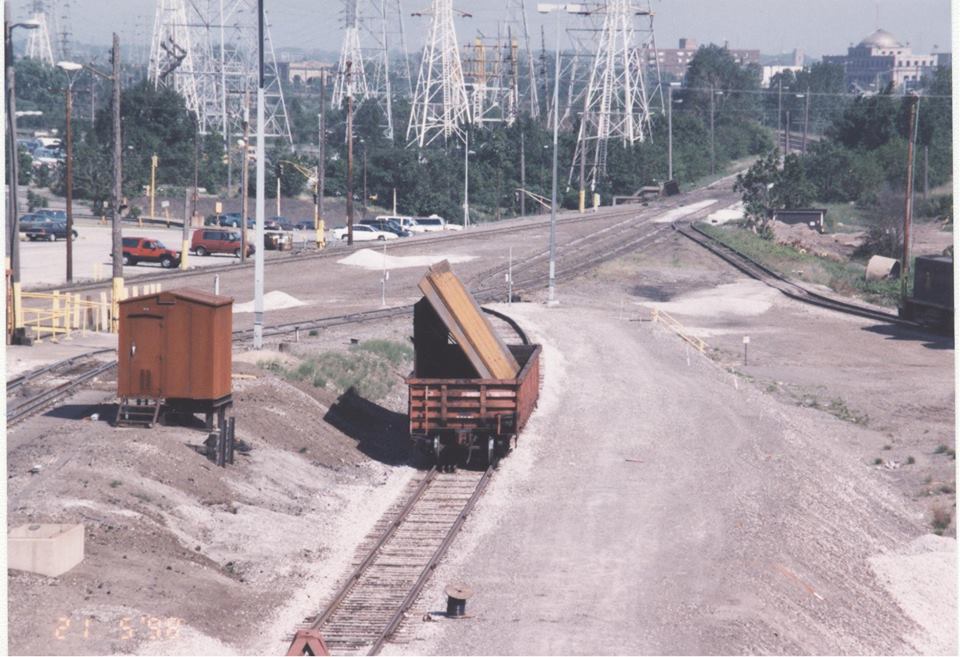
Since the metal parts are tracks, the tower would have used a skip hoist instead of a bucket elevator.
(Update: closeup photos of a preserved skip hoist)
A standing tower that still has parts of its skip hoist.
Normally, they remove the wood parts before they become a falling hazard.
 |
| Dennis DeBruler, Gillman, IL |
The comments for this posting taught me about some coaling towers I had not heard of before, some of which still had metal parts. I include some of the existing towers with metal still on them at the end of these notes because they are so rare.
 |
| pinimg, Gillman, IL |
But the motivation for this posting is the comments by Allan MacDonald and Brian Westhouse that taught me that these towers also stored sand. And some of them also stored water. Note that a diesel, as well as a tender, are parked at Gillman's towers above. That indicates the tower contains sand as well as coal. Like steam locomotives, diesels use sand for extra traction.
 |
| Dennis DeBruler |
 |
| Dennis Corso commented on a posting Collinwood Yard. NYC on the East side of Cleveland George L Hoppert It stood just out infront of the roundhouse but could be entered by a laborenth of track from the mains. Brought loaded coal cars through the tunnel on the far riht side to dump the coal into the pit below. they didn't fill or cover the pit for decades after they stopped using it . It was filled with black water to the top of the pit. Many trainman fell into the water filed pit while taking a short cut while switching the ajacent tracks. The elevator is just to the left of the pit.George L Hoppert Dennis Corso I was firing a job, and I got out to help with a move. I was going to take a shortcut through the pit. It was black flat and level just like all the rest of the area. if it wasn't for an old crusty brakeman , I would have gone in. [This was on the mainline between Chicago and NYC, and it is the largest of which I remember seeing a photo.] |
I feature another NYC coaling tower on their Water Level Route because it had four small silos for passenger train coal and one big one for freight train coal. "The coal for passenger trains was more refined egg-sized for a cleaner more efficient burn consumption." [comment by Philip A. Edwards]
Fernando Luna posted four photos with the comment:
 |
| Dennis DeBruler |
Fernando Luna posted four photos with the comment:
COALING TOWERS;Some of the last towers ever built were from reinforced concrete and stood hundreds of feet tall. Today, of course, the structure's purpose has long since ended.However, several of the last towers constructed were so well built that several still stand to this day, over a half-century since they were last used! Until the 20th century virtually all steam locomotives coal as their primary fuel source (although very early locomotive designs, like 4-4-0 Americans used wood) with large tenders of water to produce the necessary steam.The workings of a coaling towers are relatively simple. They were always gravity fed with the steam locomotive sitting below or nearby (if the tower employed chutes) and an operator would feed coal into the tender until it was topped off.To refill the towers they usually had a staging track or an area where loaded hopper cars could be unloaded and a pulley/belt driven system would pick up the coal and load the bin.Early systems were rudimentary using straight chain and pulley buckets but later systems used conveyor belts to efficiently load the coaling towers.At their peak coaling towers were impressive structures with the develop of bigger enines ,standing multiple stories high and looking more like massive grain bins . Unfortunately, these newer coaling towers were so well built that many have proven too expensive for railroads to demolish and several can still be found dotting the landscape across the country, abandoned sentinels of a bygone era of railroading. (shared information of american rails address basically)
[Fortunately, he posted in a public group because there are several comments that document coaling towers that still exist.]
 |
| 1 |
 |
| 2 |
 |
| 3 |
 |
| 4 |
 |
| Brian Westhouse commented on a posting On this wooden coal tipple (at South Parry, On.) can you see the sand delivery pipes on the corners with supply pipes from near the top. The longer diagonal pipe at the top, delivers the sand to the tower. |
 |
| C&NW Historical Society from Dennis DeBruler |
 |
| C&NW Historical Society from Dennis DeBruler |
 |
| Dennis DeBruler, LC-USW3-014097-D, part of lot 227 |
 |
| Dennis DeBruler, 20150913,16 4804 |
 |
| Michael Bachmann posted |
 |
| Dennis DeBruler |
 |
| Dennis DeBruler |
Every town that had a coaling station would also have had a water tower. Although they were not necessarily across the tracks from each other.
 |
| Dennis DeBruler, Garrett, PA |
 |
| Dennis DeBruler |
For tracks that were used by high-priority passenger trains such as NYC's 20th Century Limited, track pans were used to avoid having to stop for water.
Brian Westhouse provided some specifics concerning the spacing of coal and water towers:
On CNR through Northern Ontario, the divisional points averaged 150 miles maximum with coal and water at each end. Another combined Coal and Water stop was made a the 75 mile mark and two or three water towers between coal stops.I've read that some railroads had a division point every 100 miles, and travelling to the next division point was considered a days work for the train crew. I know that the town of Garrett, IN was created by the B&O to be a division point. Even though trains are no longer serviced there, they are still very proud of their railroad origins. In fact, trains to Chicago were crewed from Garrett long after the conversion to diesel locomotives. They would be cabbed to a motel in Chicago, and then the next day they would run a train back home.
Since Champaign, IL, was a division point, the coaling facility that we see at the top of these notes that was in Gillman, IL, is an example of a coaling station that is about halfway between division points. The Kinmundy water tower was probably an example of an intermediate town that supplied just water.
Sometimes they incorporated water storage in with the coaling tower.
 |
| Harold Hoskins commented on a posting [On this side of the two coal chutes, there appears to be a water spout. So the silo is probably a water tank and the coal bins are behind it. Note that they have a separate sand tower in front.] |
Sometimes the train crew improvised to get water.
 |
| Brian Westhouse commented on a posting I took this picture in 1970 about 98 miles north of Toronto. The coal tipple still standing has been long out of service. The 4-8-4 at the head end of this consist is taking on water from the river, being pumped by the local volunteer fire dept. |
 |
| Peter Dudley shared Looking for answers (this might be Windsor ON): Ken Borg Windsor, Ont. Had that big coal dock at Riverside Yard. |
Examples of towers that have at least some of their metal parts left
 |
| Dennis DeBruler, New Haven, CT |
(Update: closeup photos of a preserved skip hoist)
A standing tower that still has parts of its skip hoist.
 |
| Dennis DeBruler, Flomation, AL |
 |
| Dennis DeBruler, Buffalo, NY |
I had a hard time finding the town, let alone the tower.
 |
| Chris Ciesla posted Mainline coaling tower in Oakland, PA. As far as I know, this is still standing. Years ago we used to walk our there to pick up pieces of coal, put them on top of the rail and shoot them. The coal would explode into a cloud of black dust if you got a direct hit. If you were too low, you'd hear the bullet ricochet off the rail. Times have changed, |