Port of Ludington Maritime Museum posted
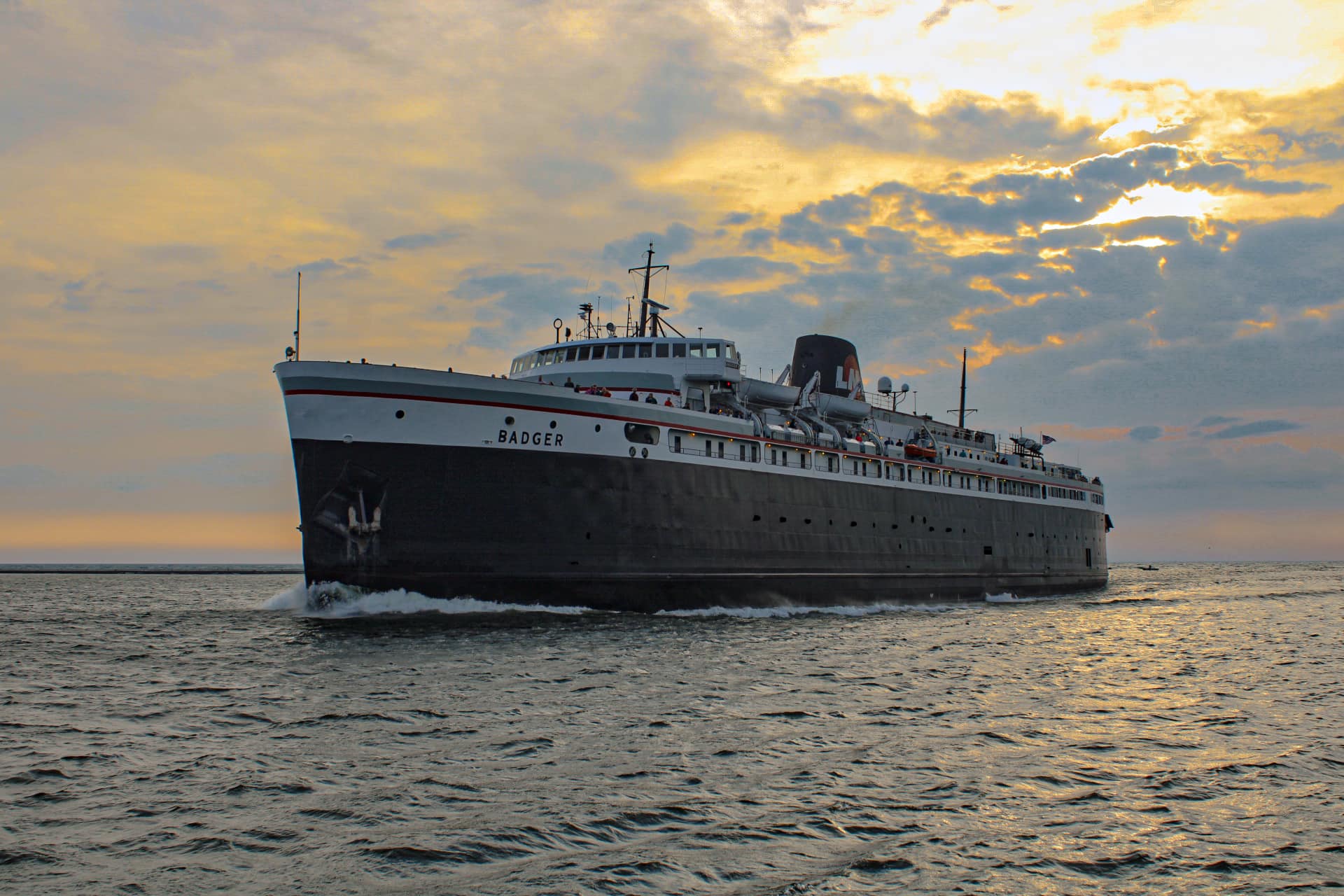
In Ludington, nothing marks the coming of summer quite like the first sailing of the S.S. Badger. The 70-year old coal-fired ferry helps make Ludington Michigan and Manitowoc Wisconsin known across the Great Lakes region, since travelers moving east and west regularly look to it for time savings, and an enjoyable cross-lake cruise. One of the last commercial coal-burning ships ever built, the Badger is a true survivor, enduring changes in ownership, changes in purpose, bankruptcy, and abandonment. This Ferry Friday, we look back on the S.S. Badger’s story, the last Great Lakes car ferry. When the Chesapeake and Ohio Railroad fully took over the Michigan-based Pere Marquette Railroad in 1947, there were some concerns that they were not interested in continuing the Pere Marquette’s cross-lake car ferry service. The ferries after all had been in service since 1897 and were an integral part of the coastal communities they served. Those worries were put at ease when the C&O announced that it was expanding the ferry fleet. In 1952, Christy Corporation of Sturgeon Bay WI delivered the first of two ferries. The ship was named S.S. Spartan in honor of Michigan State College, its sistership would follow the next year. S.S. Badger, named in honor of the University of Wisconsin, was launched and christened in a double ceremony with S.S. Spartan. While the C&O had officially ended the long-running naming scheme of numbering the ferries, the Spartan and Badger were both unofficially referred to as the “42” and “43.” The Badger was built almost identical to the Spartan. The ferries’ hulls measured 394ft long (410ft overall) and were 60ft wide. Like the Spartan, the Badger is driven by two Skinner Compound Unaflow Engines. These engines are both efficient and responsive (responsiveness refers to how quickly they can change direction) and are widely considered to be the pinnacle of reciprocating marine steam technology. To this day they are still more responsive than many diesels of similar size and are significantly more responsive than reduction-geared turbines. Feeding these engines are 4 water tube boilers made by Foster-Wheeler. When the Badger entered service in 1953, it was the 7th active ship in a fleet that was enjoying a decade long “golden age.” In addition to a favorable post-WWII economy, the C&O Railroad was heavily promoting the ferries to shippers and potential passengers. This golden age lasted all through the 1950s, but in the early 1960s, the C&O Railroad’s attitudes were shifting. While they were no longer as enthusiastic about the ferries, they did not see any need to end their operation. By the middle of the decade though, attitudes and fortunes would shift dramatically. The Ludington car ferries had long existed as a means to send valuable cargoes quickly around the terminal bottlenecks of Chicago, but that usefulness was wearing out. Several long-term factors were eroding the profitability of the ferries. Since the development of interstates in the 1950s, shippers had largely adopted commercial trucking to ship time sensitive cargoes that used to travel by rail, the same cargoes that had benefited most from the ferries. To make matters worse, freight trains had nearly tripled in size over the last decades, from 25 cars to more than 75 cars in a single train, which would have to be broken up on several ferry trips since the ships had a fixed size. The ferries were also becoming increasingly more expensive to operate. While the Badger might have been less than 20 years old, the oldest members of the fleet were built in the 1920s and were becoming more expensive to maintain. The coal burning ships also required massive crews compared to their diesel and oil-burning counterparts, requiring crews of around 50 people. With increasing costs and reduced demand, the railroad’s opinion of the ferries quickly soured. In 1967, the S.S. City of Flint 32 needed major engine work. Rather than have the ship repaired, the railroad had the ferry decommissioned without plan for replacement. Just four years later in 1971, only 3 ships out of the fleet of 7 remained. The C&O railroad announced that it could see no prospect for the ferries after 1975, alarming the many people who depended on them for work. In addition to the income the ferries provided, they also had an enormous economic impact on the tourism industry in the communities they served. While the rail car shipments had declined, the tourist and automobile numbers had remained high. It was predicted that a complete shutdown of the ferries would have disastrous consequences on local economies, prompting the beginning of numerous campaigns to save them. For over a decade, an alliance of businesses, unions, local governments, and other activist groups fought for the ferry’s continuation in a series of ICC abandonment proceedings. Several alternative plans were proposed during this time, ranging from subsidies for the C&O to a complete state-owned system of ferries on Lake Michigan. By 1983, the C&O (now formally called the Chessie System) was given approval to abandon their Ludington car ferries. For the Badger and its two remaining fleet mates, it looked like their end had come. It could have been too, if it were not for a last-minute agreement to sell the ferries to a new operator. Glen Bowden and George Towns spearheaded a new company called MWT, Michigan/Wisconsin Transportation Co. This company continued to operate the City of Midland 41 and later the Badger during the 1980s, running year-round and continuing to haul rail cars. While the new company kept the ferries alive, it did not solve the fundamental problem that had triggered their abandonment. Rail traffic on the new service was still chronically low, the majority of it belonging to regular firms near the ports. The new company was in dire financial straits, and by 1990 it had gone bankrupt. Once again, it looked like the Badger’s time was up. Car ferry service, which had endured in Ludington since 1897, had come to an end. When the Badger and its remaining fleet mates seemed unlikely to ever sail again, they were thrown a critical lifeline. Charels Conrad, a retired Michigan businessperson, had grown up in Ludington and understood what the ferries meant to the community. He bought the three remaining ferries and invested money into the Badger to have it refit for passenger, automobile, and commercial truck service, believing that this part of the ferries could still be successful. The Badger went back into service in 1992, and for almost 3 decades following, the Badger continued to run as a seasonal passenger ferry. In the 2010s though, its future would yet again come into question. The Badger, like every other coal burning ship that came before it, jettisoned its waste coal ash into the water. While this was thought an acceptable practice at the time of its construction, more widespread awareness of human impacts on the environment led to a push to end this practice. In yet another adaptation, the Badger was installed with a one-of-a-kind marine ash collection system. The ash is stored in 5 hoppers onboard, which are unloaded by forklift while in port for disposal. While a very costly solution, it allowed the Badger to continue. In early 2021, the Badger’s owner Lake Michigan Carferry was purchased by Interlake Maritime Services of Ohio, the owner of a large fleet of Great Lakes freighters. In the winter of 2021-2022, the Badger was sent to Sturgeon Bay WI for sandblasting and repainting along with other maintenance. In 2023 the Badger celebrated the 70th year of its career. The season was unfortunately cut short when the 1930s-built apron (dock) partially collapsed while the ship was in port. Work has been done since August of last year to remove the wreckage and install a new system. The work on the new apron is nearing completion, and the Badger is gearing up for its 71st season, and the proud continuation of car ferry service on Lake Michigan. For more information on the Badger and the rest of Ludington’s car ferry fleet, the Port of Ludington Maritime Museum opens tomorrow for the 2024 Season! The S.S. Badger is currently taking reservations for its 2024 Season as early as May 24th! Chris Koshute: The "S.S. Badger" is one of only two mobile National Historic Landmarks; the other is the San Francisco cable-car system (the cable cars themselves, the tracks the cars travel on, and the maintenance and storage facilities needed to support the cars are all included). |




%20The%20BADGER%20was%20built%20to...%20-%20S.S.%20Badger_%20Lake%20Michigan%20Carferry%20_%20Faceboo.png)


.jpg)


%20Watch%20_%20Facebook.png)


.jpg)
.jpg)
.jpg)


