These are notes that I am writing to help me learn our industrial history. They are my best understanding, but that does not mean they are a correct understanding.
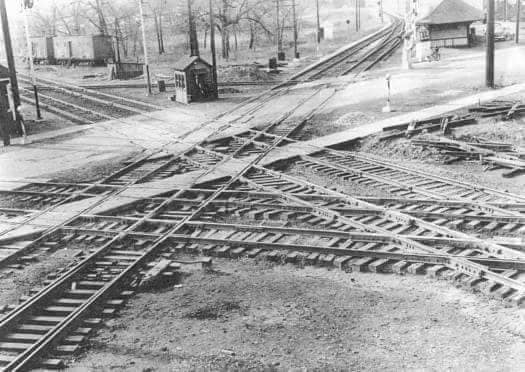
In this photo of the old depot in Downers Grove, IL is a guard or watchman tower on the right side. Someone would staff the tower and trigger the gates to lower when a train was approaching. And then release the gates after the train has cleared.
Keith Pokorny posted Dennis DeBrulerIt still has a watchman tower! Now I'm going to have to do another trip there. When I went to the True Value store, I was around Lawn Ave. I see I need to go another block west.Michael MatalisThe crossing tower is a replica. They should let railfans up there and charge by the hour.
David Daruszka shared
The station sign says "Altenheim" which is a cemetery located at 7900 W. Madison Street in Forest Park. The railroad was built by the Chicago & Great Western Railroad, a subsidiary of the Wisconsin Central Railroad. It became the Chicago & Northern Pacific Railroad, who provided commuter service including stations in Beverly and Morgan Park. Ownership of the railroad changed hands a couple of time until it became part of the Baltimore & Ohio Chicago Terminal Railroad (B&OCT). The tracks were an important connection for the SOO Line (successor to the WC) and their passenger trains operated out of Beman's Grand Central Station on Polk Street. The line no longer sees any kind of train service due to the condition of the bridges along the route. The tower in the background is more than likely a shanty for the crossing guard at a street crossing.
I have defined the label "towerGuard" to mark other posts that contain at least one photo with a watchman tower. This photo is so neat, I have copied them here.
Chicago & North Western Historical Society posted
We are in Chicago looking east along the C&NW west line in November 1905 when the railroad is working on elevating the right of way at the insistence of the City of Chicago. The street crossing in the foreground is Western Avenue! Note the Milwaukee Road trackage splitting off from the C&NW rails. For you Milwaukee Road fans, "Tower A-2" will be built at the lower left of this photo. What a smokey city! Dennis DeBrulerLook at the line of watchmen towers along the left, one per street. Steve McCollumRead "The Devil in the White City" for some good background on the times. Grade level crossings were killing one person a day on average. And the smoke? Locomotives, plus coal-fired boilers for heat and power. Remember that the Chicago tunnel system was built to deliver coal and haul away ashes. Dennis DeBrulerCoal smoke was so bad that a (big) report was written in 1915 concluding that the railroads should electrify their city tracks. This is why the IC electrified its passenger tracks. (Diesel was invented before they had to electrify their freight tracks. And then their freight traffic to downtown went away and coal heating got replaced by natural gas.) I use this report for its detailed maps of the railroads in 1915. https://archive.org/details/smokeabatementel00chicuoft
Some crossing didn't even have crossing gates. The guard would have a ground level shanty and walk out into the street holding a stop sign.
This is a complete rewrite of my posting on Griffith Junction. Thanks to Wayne Hudak, I recently learned the tower was east of Broad Street. For the first three years that I was studying railroads, I thought it was on the west side. Griffith Junction was a popular railfan site since it had four mainlines and one branch line. Consequently, I have found a lot of pictures. So this posting concentrates on the junction and tower itself. Pictures that show (at least part of) a depot are in a Griffith depots posting. Photos of trains passing through the junction are in the appropriate Erie+C&O, EJ&E and GTW postings. Photos of trains on an interchange track or involving the NYC/Michigan Central Joliet Cutoff are still in this posting. Some photos are in more than one posting because they included multiple buildings. These are the most useful ones in terms of trying to visualize what the junction and depots looked like before the abandonments.
I got a copy of an historical aerial view while it could still be used for non-commercial use. The tower was the white roofed building southeast of the junction along the GTW tracks.
The above image does not show some of the details I was researching, so I did another search for the late 1930s photos. I didn't find free copies, but the image below more clearly shows that the town was north of the junction. This would make sense since the crossing gates for Broad Street must have been down most of the time.
Wayne Hudak posted
Griffith-1940's Bob LalichAt one time, the track that is occupied by the MOW cars crossed the Erie/C&O and connected to the NYC/MC. Anyone know when that connection was removed? Wayne HudakNo clue, Wished I did [In another posting of this photo, Wayne identified it as the early 50s.]
Richard Blunt posted
Old crossing diamonds in Griffith Indiana. Some of it is still there but a lot of it is gone. 180 trains a day when I was a kid. Ted Gregory posted
Dave Stroebe posted A Grand Trunk Western at Griffith Ind west bound for Chicago in 1977. The Tower and depot have now been moved off this location. The GTW is now Canadian National.
The C&O tracks entered the area from the southeast. This 1916 map indicates the C&O crossed the Erie just south of the junction, and it had its own diamonds across the EJ&E, GTW and MC. It finally joined the Erie after its MY Tower Yard for the rest of the way to State Line Junction where it joined the C&WI to access Dearborn Station. (The joint Erie+C&O route shared a bridge with the Nickle Plate to cross the Grand Calumet River.) Later, the C&O joined Erie south of the junction to reduce the number of diamonds that had to be maintained.
CRJ
Griffith is a location of major historical interest. Until the early 1980's, the double track Erie Lackawanna route and Chessie System's ex-Chesapeake & Ohio line from Cincinnati entered from the south-southeast. They joined together, crossed both the J and GTW, and then headed in a northwesterly direction toward Hammond, Indiana, using Chicago & Western Indiana tracks from there into Chicago. Some of the diamonds were actually in Broad Street, making maintenance a difficult chore. In addition, a Conrail branch line to Joliet (ex-NYC, ex-MC) entered the junction from the northeast and paralleled the J to the southwest. It crossed the J about a quarter- mile northeast of the junction, and then crossed CN, Erie and C&O at the junction. If all that weren't enough, the J had a line heading east from Griffith to Porter Junction, about 20 miles. Griffith must have been a sight to see back in the Golden Age.
Matt Lasayko commented on a posting Stan Stanovich...so the story goes, I was once told that in the pre-Conrail era, that there was always a headlight visible on the horizon of at least one of the lines at all times!!! Wayne HudakI railfanned the Griffith crossing from 1972 to the shutdown of the former Erie line in about 1980. Previous to the EL-Conrail abandonment you could see a train through there every 5 minutes. I have an early RAILFAN mag article about Griffiths always a headlight visible on the horizon of at least one of the lines at all times!!!
Bob Lalich also commented on a posting
Here is an EJ&E drawing of the crossing.
As an experiment, I increased the size by 150%. I still have trouble reading some of the street names. I believe the building to the left of the depot is labeled Trainmaster Headquarters.
Looking East on the shared C&O Erie route. Note the C&O tracks diverting just past the junction and the white C&O depot for their agent/operator in the middle background. The MC track is in the foreground. The GTW and EJ&E cross themselves and the Erie+C&O by the tower.
Locomotive Jordan posted July 06, 1974, we look east down the Erie and C&O mains at the diamonds from other railroads. We see the old tower. Just another day in Griffith, IN. before more mergers and abandonment changes the landscape and history of the area. Photo was taken by John Strombeck, it is out of my collection.
William Poole: As soon as I saw this photo, I said to myself 🙃Griffith,In.
EL 6/29/67 ---11/1/74 then to IHB & PC. GREAT PHOTO THANKS.
Matthew Ditton: I railfanned at Griffith a few years ago and it was pretty busy with two lines. It must have been really non stop when there were five lines there.
Bob Poortinga: Matthew Ditton The EJ&E did a lot of interchange business with the GTW, Erie, and C&O at Griffith. So, in addition to through trains, there was also a lot of transfer runs. As a youth, I lived a few miles away from Griffith and would often bike there to watch trains. That was in the early '60s when there was still varnish passing through.
Scott Ramsey: Matthew Ditton Back in the 60's there was a train crossing Broad St. Every 6-7 minutes around 8-10 an hour.
Jason Jordan posted (source) Walt FlesPrior to july 2000 when they moved it.The GTW/CN is going off the the upper left. Just to the west (right) of this picture is where the EL/C&O used to cross, making this a sea of 12 diamonds.
[The tower has been moved north of the EJ&E tracks to be part of a railroad heritage park.]
Bill Molony posted
Griffith Interlocking Tower - August 12, 1973.
Bill Molony reposted
The Griffith, Indiana interlocking tower on August 12, 1973.
At that time, the Elgin, Joliet & Eastern, the Chesapeake & Ohio, the Grand Trunk Western, the Erie Lackawanna and the Penn Central all intersected in Griffith.
Bill Molony reposted Michael SteffenThe railroads all crossed Broad Street in Griffith. In the early ‘80’s I was told by a long time J Telegrapher (Tower Operator) that When all 5 railroads were running hard, the manually operated crossing gates would be in operation 45 minutes out of the hour. At its’ busiest the Tower was manned by a Telegrapher and a Leverman. There was also a crossing Watchman at grade. Jim JamrusA clever haulage agreement between UP and NS allowed NS to finally abandon the MC line (aka PC, CR, NS depending on the decade).....CR still needed the middle segment of the old MC Joliet line to access the Ford stamping plant long after the Chicago Heights to Joliet segment (and the segment east of Hartsdale) was abandoned. CHTT (UP) did the actual switching of the plant once the cars were delivered by CR/NS to Chicago Heights so NS made an arrangement where they'd drop cars off for Ford around 83rd St in Chicago and UP would then pick them up and run them down to Chicago Heights on behalf of NS along with any other Chicago Heights cars that UP had for the CHTT industries that day (UP was going there anyway and they had dibs on performing the actual switching). NS maintained marketing control of their Ford business and they still technically show Chicago Heights as an NS destination but physical movement of the cars is now done by UP by way of a haulage agreement out of Chicago. This arrangement allowed NS to cut a crew and loco and nix the remains of the MC line that still existed between Hartsdale and Chicago Heights. Steven W PanekThe NS didn't cut the crew and loco. The crew was and still is based in Kankakee, Illinois. When the NS still had the Hartsdale job, the crew was cabbed from Kankakee to Hartsdale (Schererville, Indiana) to serve to remaining customer. When NS completely pulled out. NS relocated the crew and loco, typically a 4 axle unit to Kankakee. BTW, CN now uses Hartsdale Yard.
John Del Vecchio posted three photos with the comment: "EJ&E tower in Griffith, IN. The EL, C&O, EJ&E, GTW, PC all crossed at this location. Tower was relocated to opposite side of crossing."
1
2
3
Scott Griffith posted Chad QuickGF Tower. Gotta love those "wrong way" TO signals which show trains running with current of traffic but with the eastbound or northbound trains on the left hand track Wayne HudakAmtrak's James Whitcomb Riley on the former C&O/Erie. Track in foreground is the former Michigan Central (Joliet Cut Off) [The GTW depot is the first building on the right and the tower is the second building.]
Bill Molony posted
Elgin, Joliet & Eastern EMD SD38-2 #656 at the Griffith interlocking - 1997.
[The MC is probably gone in 1997. So the foreground track would be the connector from GTW to EJ&E that we can see on today's satellite images. The weeds are hiding the GTW tracks themselves.]
Here in this super cool photograph we see Erie Lackawanna 3656 leading a manifest through Griffith, Indiana about to cross the diamonds on December 21, 1973.
Photo Credit To John Eagan.
[GTW depot on the right, the tower in the middle, and the MC track in the foreground. That is probably the crossing guard standing in the street.]
The CN decided to yard an empty auto rack train on the American Chemical Service lead at Griffith, Indiana. The east end of Griffith Yard is blocked from what l can see. Photo taken this morning from the S. Broad St grade crossing
[The engines are on the interchange track that goes to the remnants of the C&O mainline that serves the American Chemical Services plant. The track in the foreground is the interchange track between CN/EJ&E and CN/GTW.]
Jack Olenjniczak posted Working the old C&O spur today in Griffith, EJ&E 703.
(Facebook has been deleting most of my comments that contain a Google Maps URL. It declares them a violation of Community Standards. So now you have to copy&paste the GPS coordinates into the search field of Google Maps.)
This is the only photo I have seen of the Michigan Central Joliet Cuttoff being used so I'm not going to create a special railfan posting for it like I did the other railroads through here.
Mark Llanuza posted
Its April 1975 westbound Penn Central crossing the Erie at Griffith Ind heading to Joliet IL on the old Michigan central .Only two trains a day went through here on the Penn central .We waited all day at the Jct Rich RibarevskiLooks like a lot of auto boxes for Ford - Chicago Heights stamping plant Mark LlanuzaCorey Kinley this line was taken out of service right after Conrail [Checking my cheat-sheet for mergers, Conrail was formed in 1976. The fact they waited all day for a train is an indication of why it was abandoned. It was redundant with the EJ&E route between here and Joliet. Much of the way, they were just a 1000 feet apart. In some places, they were next to each other.]
The EJ&E forked soon after it crossed the CN/GTW tracks. The tranks that went straight to Hobart are now gone. The tracks that curve north are the mainline that goes to Kirk Yard. The EJ&E track crossed the Michigan Central track that paralleled the Hobart-Griffith branch of the EJ&E. Wayne got off the beaten path and caught the EJ&E banging the MC diamond.
Wayne Hudak commented on a posting
Wayne HudakDennis DeBruler, here's a scene of 2 more diamonds away from the center of the Broad Street plant, never much photographed. I caught this EJ&E Baldwin ready to head northbound to Kirk Yard in Gary crossing the Michigan Central's Joliet Cut Off.
Since this photo shows two trains, it doesn't fit in the railroad specific postings so I put it here in the general junction posting.
Steven W Panek posted
I decided to get out and do some train watching Saturday afternoon at Griffith, Indiana. Caught 2 trains simultaneously. The train in the foreground is CN L-503 heading for Kirk Yard and the second train on the south wye is Q-116 heading east for Michigan.
Eric Berg posted
Me lining up a train at Griffith tower in 1999. Tom Figura photo.
Sam AnthonyI see the timers to wind out if you try to change the line up. Seems like they take FUREVER to wind down.Eric Berg8 minutes Eric Berg posted again Me working Larry Youngs Vacation on 2nd trick at Griffith tower on August 26, 1999. (Tom Figura photo) Michael SteffenDon’t forget the gates. Eric BergWhen I broke in with Larry, I lined up a Grand Trunk train and sat down at the desk. He looked at me and said, "What are you forgetting?" I said, "I don't know". He said, "Okay, but in about 45 seconds, you're going to be standing in a courtroom facing MULTIPLE COUNTS OF INVOLUNTARY MANSLAUGHTER! GET OVER HERE!" After that, I NEVER forgot those gates. He said, "I don't care if the phones ringing, the radios going, nothing. When you line a train up, you HAVE to stand here until its over the crossing." That afternoon, I would never forget again.....
Mark Llanuza posted
Its 1989 inside EJ&E tower at Griffith Ind
Griffith
This must be the craziest railroad intersection in the world. Griffith, IN. Five railroads converging in one area. EJ&E, GTW, EL, PC (NYC/MC) and C&O. Only two remain, and the junction is under CN control today.
I first visited Griffith as a young boy and it was an absolutely incredible place. I had a friend who's dad was an EJ&E track supervisor. There were derailments and other problems at Griffith almost every week, and my friend and I would go with his dad on weekends when things happened. I remember EL E8's tip-toeing over broken diamonds, and going in the cab of a derailed C&O GP9 at night. At the time, GTW and EJ&E were by far the most active. The only railroad I've never seen in action here is PC.
After I hired out on the EJ&E, I saw pairs of white Erie Western Alco RS-3's frequently pass through the junction.
Ed BentonAt one time Streator Illinois had the Wabash, Santa Fe, New York Central, Gulf Mobile and Ohio, and CB&Q ALL crossing at grade within a 2 block area of each other. They all served the various coal and brick and glass plants all over town. Dennis DeBrulerAnd the CB&Q had two different routes terminating at this town: Ottawa, Oswege & Fox River Valley from the North and Illinois Valley & Northern from the Northwest. https://towns-and-nature.blogspot.com/.../streator-il... Kevin also posted in Windy City Rails Stan Stanovich...I’m told that prior to the creation of Conrail that there was a headlight on the horizon on at least one of these lines 24/7!!! Michael RihaOne source said 180 trains a day in the 1950s.
1
2
3
In addition to a couple of photos that are already on the page, Stuff Thats Gone posted this topo.
This must be the craziest railroad intersection in the world. Griffith IN. Five railroads converging. You can find their names on the map. Nice contract for Union Switch and Signal. Dennis DeBrulerThe topo map shows what I noticed on an old aerial map: most of the people lived north of the junction so that they didn't have to wait for a break in the trains to get across the junction to get to downtown or the Chicago metro area.
Eric Berg posted
EJ&E Griffith tower in 1935, looking east on the Erie. John W. Barriger photo.
[The top of the tower is peaking over the EJ&E building. Note the NYC/MC(Joliet Cutoff) tracks in the foreground.]
Seth Lakin commented on Bob Lalich's posting asking for pre-WII drawings
Here's a 7-17-44 but with revisions to 1-1-69. slightly different from what you have.
[Bob is researching the track we can see in the John Barriger photo that is between the watchman shanty and the MC tracks. The current theory is that it is a connection between the GTW and MC tracks.]
My token effort at capturing EJ&E history. Here's some interior scenes of Griffith Tower when it was still in service on August 8, 1993.
By this time, of course, the C&O, Erie, Michigan Central, and the J's Porter Branch were already history.
David DutroNice pictures and memories John. I spent more than a few hours inside this place when it was up and running, next to State Line and Hohman Street it was the busiest place around, the Erie and C&O ran almost constantly, lots of interchange traffic as well.
1
2
Bill Char Lang posted
Griffith IN. board February, 1976
Jake Boss posted nine photos with the comment: "Some photos from the EJ&E Griffith interlocking tower. The tower was operational from 1924-1999. The
Griffith Historical Society relocated it on the other side of the tracks in 2000. 1st photo is overlooking the Broad St. crossing of the CN Matteson sub. They occasionally open the tower to the public on summer weekends. Definitely a hot spot for watching trains pound the diamonds with the large amount of rail traffic rolling through."
How does a group of “not the youngest of people” raise thousands upon thousands of dollars in just 7 months?
First of all, we bought a banner that said HELP US SAVE AND MOVE OUR TOWER!
Then we called on the Griffith Fire Department and asked them to put up the banner for us. The idea was everyone would see our message while waiting for trains to pass at our crossing.
This was in the year 2000. The internet and social media were in their infancies. So, how did one get the word out beyond our town?
We called the newspapers, who graciously published stories and photos about our efforts.
The very next day, the president of the Griffith Saving Bank called and gave us $1,000.
We were on our way!
Next, we wrote letters to any and all local, state and federal foundations, including the Lily Endowment.
Donald Trump had a casino boat in Griffith, so we contacted him. He gave us $100.
In the end, though, most donations came right from our town.
The schools stepped up. Beiriger held a Penny War that earned over $500.
The Griffith Junior/Senior High School had a walk-a-thon from their schools to our Historical Park and back. They raised over $500 for us.
We even had the honor to be written up in a newspaper column by Bo Kane, who grew up in Griffith and had a grandmother who lived right by.
Town organizations sent donations, and stores and businesses contributed to our cause.
Many of them put out Save The Tower mugs for us, so people we didn’t even know could donate to us.
Towns people who once worked for railroads or had a railroading heritage were very generous.
And friends from out of town, the Blackhawk Railway Historical Society, procured a $5,000 National Railway Heritage Grant for us.
The support we got from everyone was overwhelming and we will be forever grateful to them.
We were especially so on July 20th, 2000, when Dillabaugh, Inc. did what seemed impossible and moved a three story bright tower.
Out onto Broad Street at 9 o’clock, across the tracks and onto our property by lunchtime, standing above the new foundation at quitting time.
And the box of soap that was on a shelf in the upper room never moved. It was still in place when the boards were later removed and the building was opened up!
A historic job done by everybody involved, well done and ahead of schedule.
Griffith History Museums posted two photos with the comment:
𝐎𝐧𝐜𝐞 𝐔𝐩𝐨𝐧 𝐚 𝐓𝐨𝐰𝐞𝐫 - 𝐏𝐚𝐫𝐭 𝟏
𝙊𝙪𝙧 𝙎𝙤𝙘𝙞𝙚𝙩𝙮 𝙎𝙖𝙜𝙖 - 𝙎𝙖𝙫𝙞𝙣𝙜 𝙩𝙝𝙚 𝙏𝙤𝙬𝙚𝙧
𝘣𝘺 𝘒𝘢𝘳𝘦𝘯 𝘒𝘶𝘭𝘪𝘯𝘴𝘬𝘪
The tale of the Tower, and indeed a great deal of Griffith Historical Society’s history, reads like a storybook, hence the title.
Do you know what 𝙨𝙚𝙧𝙚𝙣𝙙𝙞𝙥𝙞𝙩𝙮 is? Beyond an amazing Griffith ice cream parlor? I use the world a lot when talking about how we developed and grew.
Serendipity in the dictionary is described as: 𝗮 𝗰𝗵𝗮𝗻𝗰𝗲 𝗼𝗰𝗰𝘂𝗿𝗿𝗲𝗻𝗰𝗲 𝘁𝗵𝗮𝘁 𝗱𝗲𝘃𝗲𝗹𝗼𝗽𝘀 𝗶𝗻 𝗮 𝗵𝗮𝗽𝗽𝘆 𝗼𝗿 𝗯𝗲𝗻𝗲𝗳𝗶𝗰𝗶𝗮𝗹 𝘄𝗮𝘆.
Serendipity in real life:
• The chance meeting of four people who went on to spearhead the saving of the last Griffith’s depot from demolition. (See our first “Society Saga” in our spring newsletter or on our website for that story.)
• The time the land we hoped to expand on, that was $20,000 when we first asked to purchase it, dropping to $8,000 when we absolutely, positively, 100% had to purchase it.
• And we must mention how I was serendipitously connected to the General Superintendent of the Elgin Joliet & Eastern railroad when I called asking for key chains and paper engineer hat to give away to kids.
That man, Mel Turner, ended up giving us the Tower some five years later.
You know how you immediately click with someone? That was me and Mr T (though I never called him that to his face).
We talked for nearly an hour: about our getting the land and our future plans for it; about his railroad’s plans for tearing down our Tower, and could we have the equipment in the upper room, which was a yes.
From time to time, I would write him, filling him in on everything we were doing, and asking about the Tower. I found those old letters recently, and it was as though I was writing to a friend. I can only help wondering what he thought of my rambles.
In mid-December, 1999, Mr. Turner came out to the Park during our Santa event, with his beloved dog, Buddy. Our Tower, he told us, was being closed down at the end of the year. And, he said, he was giving us the Tower!
The whole building!! And $30,000, to help with the move!!!
And we had until July 30th to get the Tower off their land.
Tale to be continued...[See the post above before this one.]
1
2
Keith Pokimy posted
IC 1005 leads the L-515 local past the tower at Griffith, IN. 1/27/2019
[The admin turned of commenting just before I was going to comment about how I liked an overview shot of the junction. Also, I wonder where L-515 goes to that it needs six locomotives to pull a train from Kirk Yard. Note that it not only has an IC in front, it has a GTW trailing. It is on Matteson/EJ&E and crossing Elsdon/GTW. The relocated tower building is in the background. Street View]
IC 1015 (SD70) leads CN L536 through Griffith, Indiana past the old equipment and tower.
[Joseph is further east of the junction than any other photo I have seen here. That would be the former EJ&E route.]
David Wilson from his photoset
19700740 26 GM&O Griffith, IN [You can use the arrows to see an EJ&E centercab photo to the right and several more Griffith photos to the left.]
Description and comments from the previous photo in David's photostream:
Gulf Mobile and Ohio was a railroad created in the 1940's out of the Gulf Mobile and Northern, Mobile and Ohio, and Chicago and Alton railroads. It would merged with Illinois Central two years later to form the Illinois Central Gulf. GM&O did not go to Griffith, Indiana, where these photos were taken. This was a unit coal train coming from somewhere in the East.
David, this was a regular move to and from Commonwealth Edison's State Line Generating Station on the IL-IN border on the lakefront. Thanks for sharing!
Lake Shore Model Railroad Association posted 16 photos with the comment: 6/8/20 Monday!!! White still closed due to the 'Rona, we are able to get out about for some railfanning. Griffith, IN was busy today 6/8/20 as we caught all this from 3-5pm! CN, IC, KCS and QNS&L.
Jer Centa shared 6/8/20 Monday 3-5pm Griffith, IN, it was a busy period of the day for sure!
Dennis DeBruler commented on Jer's share with this photo from near the top of these notes The photos are a reminder that the remaining two routes, EJ&E and GTW, are now owned by CN. https://www.google.com/.../@41.5200485,-87.../data=!3m1!1e3 [The comment includes the color key.]
Wayne Hudak posted four of his Griffith photos in a public group. I recommend clicking the link because the comments clarify that the tower operator controlled the crossing gates and the crossing guard was just a first-trick job. Wayne also mentions that the tower was run by EJ&E.
Jim Klamo posted Saw this in Griffith, IN. About 11:00 today [Sep 4, 2020]. Don't see these very often anymore.
That's my ride. Right about that time I was thinking the mexican restaurant across the street just opened. Do I have time to run over and grab some tacos before I get the signal?
Pulled out of Griffith onto the South Bend Subdivision to wait for one prior to shoving west on Matteson Sunday Main 2 and ended up waiting for 3 before getting the signal.
Ted Gregory posted [Some comments indicate that we are looking northwest along the Erie+C&O. The GTW depot is on the left side of the photo.]
Steven M Geisler posted A C&O train on the triple sets of diamonds at Griffith Tower, If I remember correctly, it's the C&O/EL crossing GTW and EJ&E. Griffith, IN. April. 1972 Steven M Geisler shared Dennis DeBruler shared Joel Sieracki: Much easier than having many more grade crossings to maintain. One set of gates and one crossing guard handled everything. Just like having one interlocking tower in this spot. Imagine if the Pennsy Panhandle tried to squeeze in here instead of Hartsdale? Terry Holmstrom: Gabby Rivard a former GTW Tower operator says Griffith at the height of railroading handled 125 trains daily. Stan Stanovich: ...for what it’s worth, I was once told that prior to the formation of Conrail that at Griffith there was a headlight on the horizon on at least one of these lines 24/7!!! Kenny Crafton: What does it look like today.
Jon Roma commented on Dennis DeBruler's share Diagram of Griffith circa 1961.
Bob Lalich commented on Dennis DeBruler's share, Facebook resolution Note the track off the GTW ending in the weeds just west of the Erie/C&O. That track originally crossed the Erie/C&O and connected to the MC. In addition, there was a connection from the Erie/C&O to the MC. This is a portion of a 1918 valuation map.
Dennis DeBruler replied to Kenny Crafton's comment
The tower has been moved to be part of a railroad history park. The former-GTW still crosses the former-EJ&E, but both are now owned by CN. In addition to Erie, C&O and MC being abandoned, the EJE& route that used to continue straight to Lake Station, IN, has also been torn up. A remnant of the C&O south of the junction still exists as an industrial spur. The Erie route is now a trail. I see that the trail has a parking lot on both the north and south sides of the junction.
Note that the train in the photo is switching from right-hand running to left-hand running. That is because the C&O tracks left the shared route just south of this junction and turned more eastward.
Hoosier Hobbies posted two photos with the comment: "Griffith IN Broad Street Crossing 1973. Before and After repaving. Griffith used to be a 5 railroad town, now they are down to 1 [CN]."
1
2
Darren Reynolds posted four photos with the comment: "'Griffith' tower (GF) , Indiana."
Maxwell Crosby: Went in the tower for the first time this summer [2024] and a previous operator just happened to be visiting. Apparently it’s exactly how it was the day it closed down. Its note preserved next to the Diamond in the park after being moved.
Robert Carter: Which railroad operated the tower or was it a shared asset?
Jon Roma: Robert Carter, all interlocking towers are a joint facility shared by the railroads that participate. However, Griffith Tower was staffed by employees of the EJ&E.
1
2
3
4
Locomotive Jordan posted August 15, 2000, we see the Griffith, IN. tower being prepped to be moved to the north side of the tracks for historic preservation. Photo was taken by Bruce Emmons, it is out of my collection.
Joseph Tuch Santucci: Union Pacific actually kicked in some money for that project when they thought they were going to buy the J.
Earlier this week I travelled to Griffith, IN to assist the Griffith Historical Society with the GRS Model 2 in Griffith Tower.
For the first time since 1999, all the levers in the machine have been restored to normal. When the tower was taken out of service, lock levers 19 and 22 were reversed. These are the levers for the GTW mains.
Plans are being formulated to wire up the machine so it will be able to operate again.
James Anders: Brian Hall I have some old signal drawings of the Griffith interlocking if you get stumped and need to understand the why it is the way it is.
Peter James Paras: You should contact Harris Tower museum in Harrisburg, Pennsylvania. They restored their machine, built a hardware interface to a computer that runs a software simulation into the machine. In turn when you line switches and signals the machine does it to the software program to allow a train through.
Gregg WolfersheimThe opening shot had one of the center cabs still running with it's Baldwin powerplants. The C&O with three SD7's riding on trade-in ALCo Trimount trucks. Some of those locos are still running on some shortlines!
(new window)
At 3:00 is a NYC train. So that would be on the Joliet Cutoff of the Michigan Central that paralleled the EJ&E to Porter and through the junction.
At 5:16 is the weed spraying. One did not ask if stuff was toxic and what it would do to the environment until the 1970s.
At 7:00, Erie was pulling piggybacks. That would be bleeding edge in the 60s.
At 7:06 is another NYC train.
At 8:03, grabbing train orders from the caboose from an ironman.
"Five rail lines formed the junction and more than 180 trains passed through daily, in what was one of the largest railroad interlockings in the world." [NWI Times Article]