While
analyzing the IHB route for replacement diamonds, I discovered that it went over
a track near the Sanitary and Ship Canal of which I was not familiar. It turns out the
MWRD has its own railroad to take sludge from its
Stickney Water Reclamation Plant to its
drying lagoons, which are down by Hodgkins
between the canal and river.
I attended an open house at the Stickney WRP on May 21, 2016. I learned that the current term for sludge is now "biosolids."
The biosolid cars are shoved through the output part of their centrifuge building. The biosolids will spend 6-18 months in the drying fields. The
Maggie Daley Park used a lot of these biosolids because it helps grow strong turf that can stand up to kids playing on it. They were also used to help turn railroad tracks into the
Ping Tom Memorial Park. Biosolids are also effective in restoring damaged land such as surface coal mines and the slag piles on the south side of Chicago.
 |
| 20160504,21 3218 The brick building is their centrifuge building. |
A closeup of a biosolids car. I took these pictures out of the window of the bus that was taking us on the tour. I'm glad the glass did not confuse the auto-focus or cause glare.
On the north side of the loading building are empty cars waiting for their loads.
 |
| 20160521 3186 |
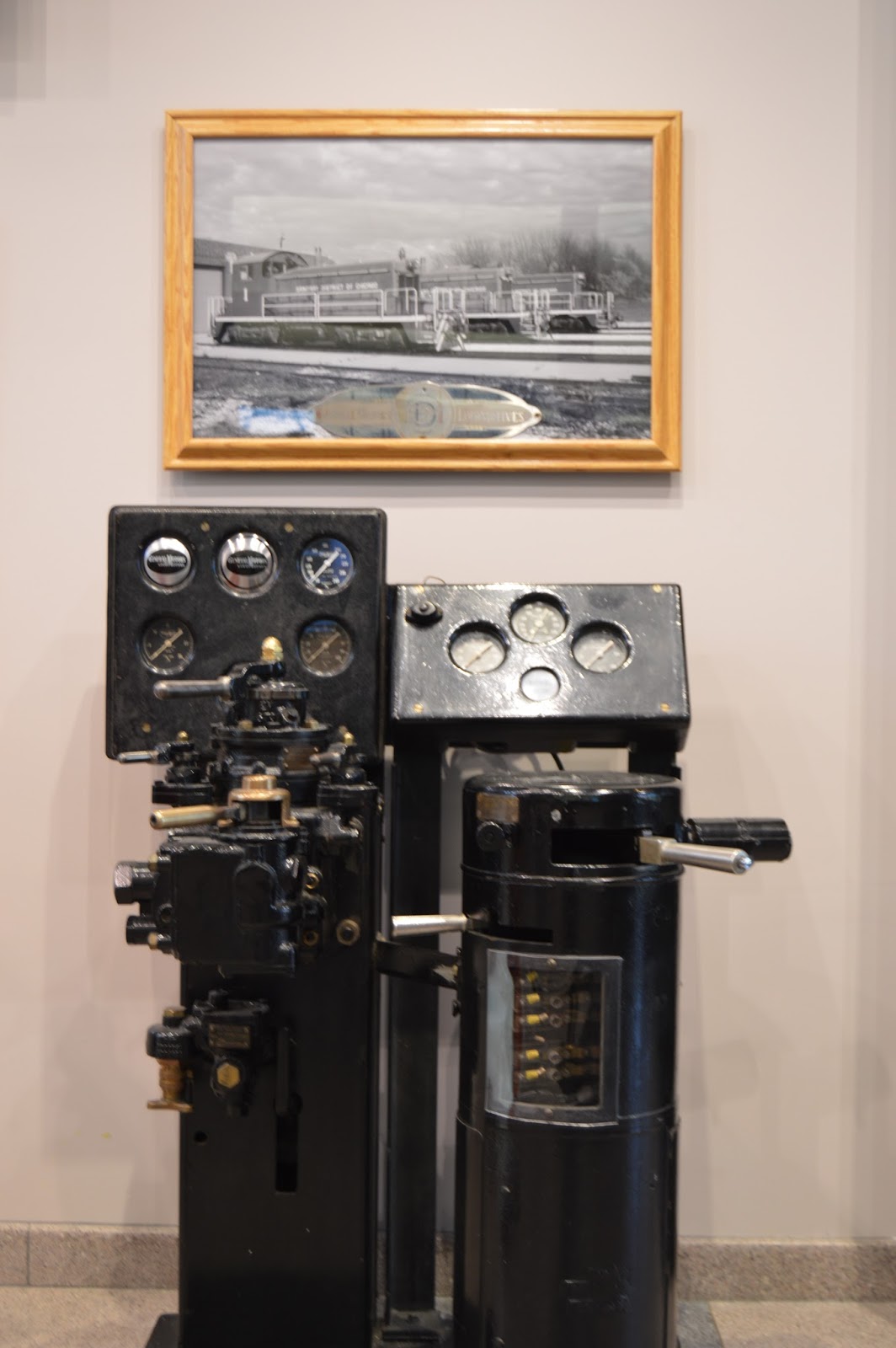
When they updated the controls for their locomotives, they saved one of the old control stands so the kids can touch something during the tour.
After the tour, I drove down Laramie Avenue to Ed Meyer Road. The sewage plant did not smell, but
Koppers did.
They have changed the color scheme of their caboose since Steven took pictures in 1989 below.
The chain link fence is a frustration, but can you imagine a Class I railroad having a logo this complex on their equipment in the 21st Century?
Unfortunately, another closeup of a chain-link fence. But that is the first
Jordan Spreader I have personally seen. A reminder that people use their toilet year round and that they can't stop hauling biosolids because of some snow.
They said they don't use any chemicals to treat the water, just different bacteria to "eat" the solids. But these are two of the five tank cars I saw on their tracks.
 |
Steven J. Brown posted
Sanitary District of Chicago EMD SW1 #1 does the honors on a sludge train temporarily outfitted for passengers at a (for some reason) open house at the water reclamation facility in Stickney, Illinois - September 17, 1989. |
 |
Steven J. Brown posted
[See caption of above picture.] |
 |
Denis Johnston commented on the posting
I re-lettered that locomotive around that time. Also a sludge car. The engine and caboose were pristine condition. Also re-lettered their Jordon spreader. |
Update:
Marty Bernard
posted four photos with the comment: "The Full Chicago Sanitary District Roster."
 |
| 1. CSDX (Metropolitan Water Reclamation District of Greater Chicago) SW1 #1 built July 1952 seen in Chicago, IL Sept. 5, 1987. Larry Anglund photo |
 |
| 2. CSDX (Metropolitan Water Reclamation District of Greater Chicago) SW1 #2 built July 1952 seen in Chicago, IL Sept. 5, 1987. Larry Anglund photo |
 |
| 3. CSDX (Metropolitan Water Reclamation District of Greater Chicago) SW1 #3 built July 1952 seen in Chicago, IL Sept. 5, 1987. Larry Anglund photo |
 |
4. CSDX (Metropolitan Water Reclamation District of Greater Chicago) MP15 #4 seen in Chicago, IL Sept. 5, 1987. Larry Anglund photo
John Eagan: It’s amazing that they sold this one off and rely upon the SW1’s. |
 |
Craig Homberg commented on John's comment on photo 4, cropped
Not sold off . Being returned after rebuilding and repaint. April 13 2023. Back on property April 14. |
| Meet the poop train, or, the Chicago Sanitary District Railroad (CSDX)- it is the only railroad in the United States to haul human waste, and it does so daily- from the treatment plant in Stickney, to the fields of Willow Springs... |
 |
Jacob Metzger posted
A hidden gem of Chicago, the Sanitary District of Chicago Railway, in Stickney. The ten mile railroad hauls human waste from the treatment plant to the storage fields in Hodgkins. The bio solids produced here are used all over the country, and were even used in Maggie Dailey Park.
I took a ride on that train when they had an open house one time (1990). Actually, I worked at the Stickney Plant and the entire process is really quite interesting. It doesn't stink in the way that you would imagine, at least to me. It smells more like rotting vegetation, or like being in a swamp. After the sludge is dried in the drying fields, what is not used here, is loaded onto train cars and taken down to southern Illinois for disposal. Can't remember where. When you drive over the mile long bridge on LaGrange Rd, the fields are down below and that is the aroma you can smell along there, sometimes stronger than other times.
I live in LaGrange, and if the weather is hot, and the wind is blowing north, you can smell it. It smells like swamp, with a twist of pepper (odd, right?).. We always attributed it to Corn Products but have.... learned otherwise, haha. It's a fascinating progress for sure!
Also, if I may add this- the Sanitary District doesn't connect to outside railroads, unless they need to move locomotives or cars onto the property. The process of moving dried sludge to S. Illinois stopped sometime in the mid nineties due to large metallic element deposits in the sludge, and it was determined as unusable. I believe they export it by truck and use it for fertilizer in some situations, like they did at Maggie Daley Park, where it was used as a "foundation" for the sod. |
 |
Jacob Metzger posted
One of the Sanitary SW1's pulling the morning dump back from the fields. |
Jacob has also caught
1&2 and
4. He reports that unit 4 is out just a week or two a year.
 |
Larry Meyer posted
Metropolitan Water Reclamation District of Greater Chicago.
[If you are a Facebook member, you can follow the "posted" link and see several other pictures posted in the comments.] |
 |
Joseph Tuch Santucci posted
The Sanitary District of Chicago has their own railroad. They load the processed flushings from all the toilets in Chicago into air dump cars and haul these trains on the own line from southwest suburban Stickney out to the dump in McCook daily. This is their caboose. It hasn’t moved in awhile leading me to believe they’ve gone to cabooseless operation. I haven’t actually spotted any of their trains heading to or from the dump in several years so I cannot say this for certain. April 2019. |
 |
Nick Hart posted
After dumping in the fields of Summit, the Sanitary District of Chicago leads 13 cars under the former C&IW (now a CN branch line) in Forest View, bound for the plant in Stickney.
May 12th, 2017
|
 |
Jacob Metzger posted
What a shitty railroad....
I've never seen the blue one. I think it used to be yellow or orange.
It was yellow. Repainted 3ish years ago. |
 |
Nick Hart posted
The Metropolitan Water Reclamation District of Greater Chicago (Sanitary District of Chicago) transports human waste from their plant in Stickney, IL to the waste fields in Summit. They own three SW1's (#'s 1, 2 and 3) and an MP15DC (#4). On May 12th, 2017, #2 is eastbound, seen passing under the former Chicago & Illinois Western in Forest View, which is now used as a branch line for a CN local to switch local industries. Within a few minutes, the veteran SW1 would reach the plant with thirteen empties. Regarding traffic on the branch line today, I'm not even sure how often that CN local runs as Watco took over operations for a few of the industries in the Stickney/Lyons area.
#2 was built in July of 1952. She's still kickin' after over 66 years!
Jacob Metzger Every two weeks to one company or another in Lyons.Maxwell Crosby Not many places where the locomotives are still plain bearing and have single beam headlights.
One of my bucket list catches if I’m ever lucky.James L. Ludwig I miss the days that they gave the open house in the fall and were giving excursions with bench seating in the gondolas around the property. |
 |
Nick Hart posted
I thought I would continue with some more photos from the Sanitary District of Chicago. In this August 6th, 2016 view, SW1's 2 and 1 are seen returning from the Summit fields and shoving 26 empties into the plant in Stickney, IL. You can regularly count on the train to have either 13 or 26 cars. In most of my experiences, two switchers are used on the heavier 26 car trains. With the 26 cars on this morning's train, my guess would be Taco Bell had a busy night. |
 |
Halsted Pazdzior posted
Chicago Metropolitan Sanitary District. Lyons. 1/14/19 |
 |
Nick Hart posted
The Sanitary District of Chicago's roundhouse offered a view of their full roster today. From left to right, MP15DC 4 and SW1's 2, 3 & 1 bask in the afternoon sunlight. Usually, the power is kept indoors after operations, so it's possible that some kind of company event was taking place. This railroad is definitely a gem in Chicagoland railroading. They're the only railroad in America that transports human waste.
Stickney, IL
03-12-19
Matthew James Goss Great shot. Definitely highlights the difference in the size of the engine and the height of locomotive of the MP15DC over the 3 SW1's. |
Junior Hills
posted four photos with the comment:
Hauling that Poop is the Sanitary District of Chicago RR. The power seen here is a pair of vintage EMD SW1's which are in immulate shape and were built in the late 1940's. There was another pair of SW1's down the street at the Manufacturer's Junction RY in Cicero, IL, but those have since been scrapped. The RR'S sole purpose is to haul human crap from their processing plant to drying ponds a few miles further down the line. The human excrement is carried in side dump cars and the RR is totally independent, never leaving their own property. 7/27/2015, Summit, IL.
Dustin Miller Appropriately numbered 1&2.
Mike Holuba They don't interchange any traffic but they do have a connection to CN.
George Melvin Very cool and they will never run out of product to haul, this industry can't be moved overseas!
Andrew Johnson How much trackage they have?
Dennis DeBruler 30 miles with 156 railcars. (The Chicago River An illustrated History and Guide to the River and Its Waterways, 2nd Edition, 2006, David M. Solzman, p.207)
Andrew Johnson Dennis DeBruler what’s their end point?
Dennis DeBruler Andrew Johnson Sludge drying pits between the Des Plaines River and the Chicago Sanitary & Ship Canal.
https://www.google.com/.../@41.7609077,-87.../data=!3m1!1e3
The book also mentioned a barge loading facility. I believe I found that here:
https://www.google.com/.../@41.7852598,-87.../data=!3m1!1e3
MWRD owns farms somewhere down by the bend of the Illinois River,
https://www.google.com/maps/@41.1855909,-89.2185237,10.13z, and they used to barge the dried sludge down there to use as fertilizer on the fields. But then they discovered that the heavy metals in the waste was absorbed by the plants, so they quit doing that. The sludge is now used to help turn brown land into parks. For example, Maggie Daily Park was built on former railroad tracks and Calumet Park was built on slag dumps from the steel mills that used to be on the south side.
https://www.google.com/.../data=!4m5!3m4...
https://www.google.com/.../data=!4m5!3m4...
MWRD now uses the farms to research techniques to reduce the runoff from fertilizer to help reduce the algae bloom in the Gulf of Mexico.
Dennis DeBruler Andrew Johnson These notes have a satellite map link for the farms.
https://industrialscenery.blogspot.com/.../mwrds-soil...
Junior Hill
posted with the same comment.
Jeff Delhaye They call it "New Earth"
Jacob Metzger It’s such an awesome operation.
They unfortunately don’t use the SW’s anymore.
Greenwood Vytautas Champ What is the current power?
Jacob Metzger MP15DC no. 4:
It has enough horsepower to pull 26 cars, while a single SW1 pulls 13 cars. [see his photo below]
Jacob Metzger In addition, the SW1’s have had varying problems. No 3 had crankshaft and water pump issues, no. 1 has a bad electrical system.
Michael Matalis When the IC used to handle this stuff to southern Illinois for land reclamation people joking referred to the trains as ICBM's.
David Jordan Junior Hill Michael Matalis I came across a Peoria Journal Star article on this dated March 20, 1974 stating rail shipments of sewage to an abandoned strip mine in the Shawnee National Forest between Harrisburg and Marion were set to start in the spring. I wonder how long this lasted?
Erik Coleman There's a septic field near Arcola that took in the crap for a while. The field is still there but the switch was taken out in the 80s.
Erik Coleman There was the apocryphal story that one of the tank valves of the "ICBM" was loose as a railfan was photographing along the curve near Buckley on the IC, so the crew said "I guess the sh*t hit the fan!"
Dennis DeBruler I wonder when they switched from barges to trains to ship the "fertilizer" to their downstream farms. The farms are now used for runoff reduction research.
https://industrialscenery.blogspot.com/.../mwrds-soil...
 |
| 1 |
 |
| 2 |
 |
| 3 |
 |
| 4 |
 |
| The photo that Jacob provided with his "MP15DC no. 4" comment |
Jacob Metzger
posted ten photos with the comment:
A follow up to Junior's post about the Chicago Sanitary District Railroad, owned and operated by the Metropolitan Water Reclamation District of Greater Chicago.
Taken in La Grange, Forrest View, Stickney and Lyons, Illinois up and down their right-of-way over the past several years.
[The comments indicate it is pretty easy to get permission to shoot because of "public remit."]
 |
| 1 |
 |
| 2 |
 |
| 3 |
 |
| 4 |
 |
| 5 |
 |
| 6 |
 |
| 7 |
 |
| 8 |
 |
| 9 |
 |
| 10 |
 |
Dennis DeBruler commented on Jacob's post
Thanks for including photos of the cars being dumped. Here is another view of the south side of the centrifuge and loading buildings. When they could not come to terms with Vulcan to use (part of?) their quarry for a reservoir, they built the centrifuge building and used some of their drying field property for the reservoir. The rock they dug out of their property is marketed by Vulcan. The partial building on the right is relatively new and contains the phosphorus extraction project. That is another effort of the MWRD to help reduce the algae bloom in the Gulf of Mexico. Plus the phosphorus provides another revenue stream. |
 |
Dennis DeBruler commented on Jacob's post
A view of the north side. Both of these photos were taken from a tour bus. |
(
Facebooked)
Their railroad is a thirty-mile shortline that has four locomotives and 156 railcars. (The Chicago River An illustrated History and Guide to the River and Its Waterways, 2nd Edition, 2006, David M. Solzman, p.207) David also mentions there is a barge loading facility so that sludge can be shipped by barge. So I looked for it, and I believe
this is it.
A video of the sludge cars being dumped. They appear to be air dump cars but it looks like the load is heavy enough that they need help to get the dump started.
 |
Nick Hart posted
With a pair of SW1's and 26 cars, the Sanitary District of Chicago begins the "dumping" process at the waste fields in Willow Springs this morning. It's been quite a while since I've seen more than a solo unit on this train. MP15 #4, which was involved in the July 2020 derailment, continues to slumber away in the shops with an uncertain future. 02-02-21 |
 |
Nick Hart posted
That's a load of crap! On a beautiful winter's day, an afternoon run to the Willow Springs drying fields is made by the Metropolitan Water Reclamation District of Greater Chicago. SW1 #3, closing in on its 69th loyal year with the company, stands by as the final few side dump cars are unloaded. A couple minutes later, the crew would begin the process of running around the train for the return trip to the plant in Stickney. February 23rd, 2021
Daniel Herkes: Are the cars pneumatic dump, or does the back hoe tip them?
Jacob Metzger: Pneumatic with some love taps from the back hoe. It helps break up the bio matter and keeps frozen sheets from pulling an entire car in.
The back hoe can also hold a car back, if need be.
[The comments point out that a previous train shoved a car onto the hill.] |
 |
safe_image for RailPictures.Net Photo: CSDX 2 Chicago Sanitary District EMD SW1 at Willow Spring, Illinois by Nick Hart
The Metropolitan Water Reclamation District of Greater Chicago (Sanitary District of Chicago, for short) dumps its last few loads at the fields, with SW1 #2 appropriately doing the honors. Minutes later, the 1952 classic would run around the train and make its trip back to the plant in Stickney. The railroad owns three SW1's and an MP15DC. The SW1's haven't gotten much run time in the last few years, but a recent derailment has sidelined the MP15 indefinitely. July 24th, 2020 [https://www.railpictures.net/photo/743985/] Matthew Chapman Anyone know the final disposition of that waste sludge? Am I looking at it?
I guess I'm wondering what happens to it beyond this. Does it stay in these fields forever, get biodegraded further and eventually nourish the soil, or does it later get scooped out of here and moved on to some kind of next step?
Sorry, I'm just curious about the whole process. Henry Murphy A very long time ago a close friend worked for the 'sludge project'. They dumped that nasty stuff on farmland and then analyzed it to see if that would be safe. There were lots of heavy metals that would show up in some samples. Since this was "science" the samples that indicated that this was a bad idea were discarded and that data was disappeared. Dennis DeBruler They bought 13,500 acres of land down by Peoria with the intent of barging the sludge there. But, as mentioned, they discovered that the crops absorbed heavy metals. So they now use the biosolids to help build parks on garage roofs, slag dumps, etc. The farm land is now being used to research methods to reduce runoff from farming operations.
https://industrialscenery.blogspot.com/.../mwrds-soil... |
 |
Johnny Hanson posted
Chicago Sanitary District #3, an EMD SW1 heads back east after unloading a couple of cars in Summit, IL. Here we see the train coming back eastbound under the Harlem Avenue bridge. #3 would drop off its empty’s and then head back into their Shops in Stickney, IL and be done for the day. Usually the Chicago Sanitary District doesn’t use their SW1s. On July 14, 2020, their main locomotive which was MP15AC #4 that they would use all the time derailed (no injuries) and was damaged pretty badly. Ever since the derailment, the Chicago Sanitary District has been using their SW1s because of the MP15AC derailing. 8/17/20 |
 |
Nick Hart posted
The Metropolitan Water Reclamation District of Greater Chicago had quite a few cars ready to head out of their Stickney plant this morning, so SW1's 2 and 3 had a busy morning and afternoon ahead. After dumping 26 cars at the Willow Springs drying fields, the attractive duo is seen heading east through McCook, bound for Stickney. In the process, the train skirts the Chicago Sanitary & Ship Canal and the McCook Reservoir. 07-19-2021
|
 |
Nick Hart posted
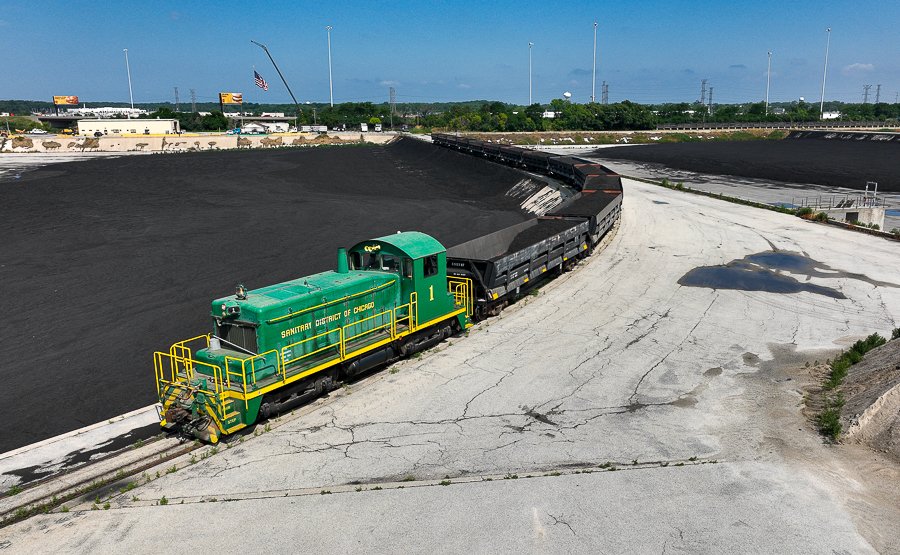
Welcome back. CSDX SW1 #1, one of the three SW1's owned by the Metropolitan Water Reclamation District of Greater Chicago, will turn 70 this month. It's been out of service for quite some time due to electrical problems and other various issues. I was pleasantly surprised to see it handling the morning duties on July 5th, 2022. It's seen shoving into position at the drying fields to begin the dump of 13 cars. Willow Springs, IL
Old Glory waving in the background is a reminder of how heavy our hearts are after the tragic 4th of July parade shooting in Highland Park, IL. [An early-20s kid shot 83 rounds into the parade and killed 7 people and wounded many. Two of the fatalities were the parents of a two year old that was found wondering around looking for his parents. The police taped off the area for days and then hauled off all of the strollers, etc.] |
 |
Jonny Hansen posted
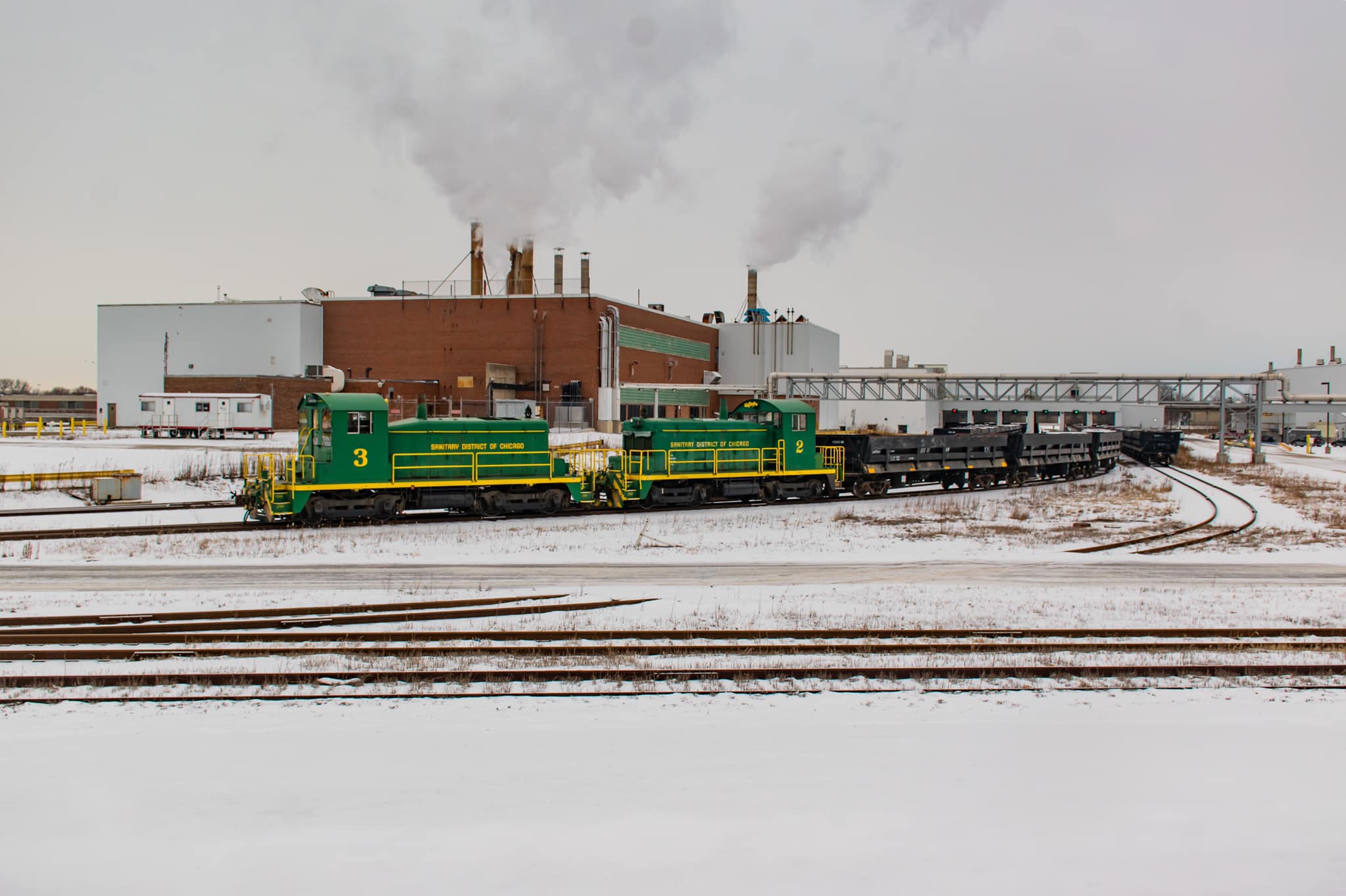
| Two of the Metropolitan Water Reclamation District of Greater Chicago‘s SW1’s, 3 and 2, shove 26 empties they just brought back from the dumping fields in McCook into the loader in Stickney for more loading.
1/30/23
Dillon Harrison: Hang on… those are actually MU capable??
Rob Olewinski Cmraseye: yes
Harold J. Krewer: Dillon Harrison, those units have been totally rebuilt with 26 air and an AAR control stand, so quite sure they can MU.
Craig Cloud: Harold J. Krewer shop built handrails too. |
CSDX SW1 #1 coming out of hiding brought out the railfans. This was posted on the same day.
 |
HalstEd Pazdzior posted
CSDX #1 going for its morning dump.  . Willow Springs area. Metropolitan Water Reclamation District of Greater Chicago.
7/5/22 . Willow Springs area. Metropolitan Water Reclamation District of Greater Chicago.
7/5/22
|
 |
Nick Hart posted
This morning presented an opportunity to nab the Sanitation returning east with an SW1 facing the "correct" way. #3 has 13 empties in tow as it skirts the Chicago Sanitary & Ship Canal and the McCook Reservoir. 04-11-23 |