(
Satellite, 20,360)
I've been following the
Battleship New Jersey YouTube channel for a few years. On Mar 21, 2024, they left their museum dock in Camden, NJ, for the first time in 20 years for a 2-month drydocking process. It has been 32 years since it was drydocked, and this drydocking is expected to last another 30 years. I plan to add to these notes as the drydocking continues. They are offering
drydock tours of her during Apr and May on the weekends.
This is the channel's live feed of the battleship leaving its dock. I don't know how long they had a bad signal because I skipped the ceremony. Note that soon after they shoved away from the dock, they turned the ship around.
Note the propwash coming from underneath the pilothouse on the lead tugboat. I presume that it has a
Voith Schneider "Propeller" (VSP) rather than a standard screw propeller. Or maybe it is a bow mounted
Z-drive.
McAllister Towing
posted three photos with the comment:
What a historic day on the Delaware River! The tugs Beverly R. McAllister, McAllister Responder, Reid McAllister and Robert E. McAllister had the awesome responsibility of moving the battleship, USS New Jersey. It is the first time the New Jersey has moved in over 20 years. The famous floating museum is going to drydock to undergo maintenance and refurbishment.
The tugs, with over 14,000 hp combined, transited the ship from her longtime home in Camden, NJ south down the Delaware. On the route she passed under the renowned
Walt Whitman Bridge before docking at Paulsboro terminal. Many American flags were seen flying along the route, saluting the most decorated battleship in US history as she sailed past.
Congratulations to
McAllister Towing of Philadelphia, docking pilot Captain Joseph E. Benton III and the captains and crews of the tugboats in executing this momentous operation safely and securely. Bravo to you all!
 |
| 1 |
 |
| 2 |
 |
| 3 |
 |
| Dana Russikoff provided a 0:11 video of the turning of the ship as a comment on the McAllister Towing post |
 |
| Bryan Kohler commented on the McAllister Towing post |
The white water between the port tug and the ship is prop wash.
 |
Donald Stockman commented on the McAllister Towing post
It was great seeing it in person. |
 |
Benjamin Kranefeld commented on the McAllister Towing post
You guys did an awesome job getting her down the river! I was in Gloucester City watching her pass by. |
 |
| Nick Ariemma commented on the McAllister Towing post |
 |
| Jim Bastan commented on the McAllister Towing post |
Benjamin Kranefeld
posted five photos with the comment:
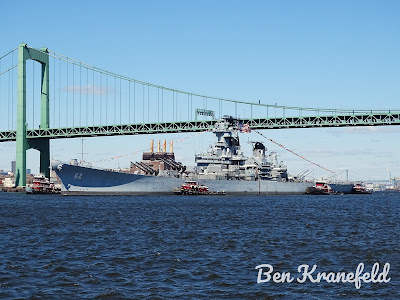
The Battleship New Jersey was moved today from her berth in Camden for the first time in over 20 years. She was taken south along the Delaware River by tug boat to a port in Paulsboro. There, she will be filled with water to properly adjust the ballast (level) of the ship before she enters drydock in the Philadelphia Naval Shipyard. Maintenance will be performed and fresh paint applied while in Philadelphia.
I was fortunate enough to catch a portion of the move that took place this morning. My photos were taken from Gloucester City, in the vicinity of the
Walt Whitman Bridge.
 |
| 1 |
 |
| 2 |
 |
| 4 |
 |
| 5 |
In preparation for the move, they had rented a crane to remove structures such as antennae from the top of their mast.
 |
Paulina Sawicki commented on Benjamin's post
Beautiful sight to see! I swear Facebook destroys the quality though. |
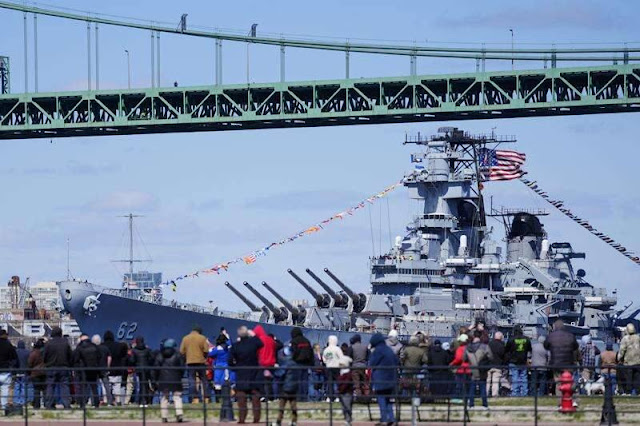 |
Bridges Now and Then posted
"People gather in Gloucester City, N.J., to view the USS New Jersey pass beneath the Walt Whitman Bridge, Thursday, March 21, 2024. The retired battleship is initially headed to the Paulsboro Marine Terminal, where it will be balanced to prepare for dry docking, and will then go to the Philadelphia Navy Yard." (AP Photo/Matt Rourke) |
 |
| John Brady commented on the above post |
A timelapse video of the departure that started in the morning. I snapshotted it while they were dropping the final mooring lines.
 |
| 0:34 timelapse video @ 0:27 |
 |
Ryan Szimanski posted
We took a lot of photos and videos today, I mean did you see the 4 hour livestream? But here's a quick preview of one of the cameras that was up at the top of the ship as we went under the bridge.
Brent Woodman: I noticed vehicular traffic was stopped on the bridge as she passed underneath. Was this cautionary in case of a bridge strike, or to keep drivers from being distracted as she sailed by? It was a beautiful site. I watched the entire livestream from Georgia.
Michael Summers: Brent Woodman, the bridge is built to flex. Keeping vehicles off of it would maximize the clearance between the ship and the underside of the bridge.
Dan Sarandrea: Several volleys from each of the port and starboard saluting guns to commemorate the day's events. Three at departure, one return salute to Olympia, one return salute to Ft. Mifflin, and IIRC one salute passing the Navy Yard. NO volleys from the 5"/38s due to the proximity of the tugboats.
Clark Perks: Why did the trip happen at high tide?
Were you TRYING to get close to the bridge?!
Duane McDonald: Clark Perks they were TRYING to get less close to the bottom of the river. That's a very big ship for that river.
[The comments contain several fan photos.]
Bridges Now and Then shared
The top camera on USS New Jersey caught the passage under the Walt Whitman Bridge yesterday. Awesome! |
A recap of the trip from the museum dock. It includes some timelapse video from ship of the move. But it also has some of the prep work such as this crane removing the mast and radar antenae so that they could fit under the bridge. The clearance of the bridge goes from 150' to 145' when there are cars on it.
Recap of the trip into drydock #3.
 |
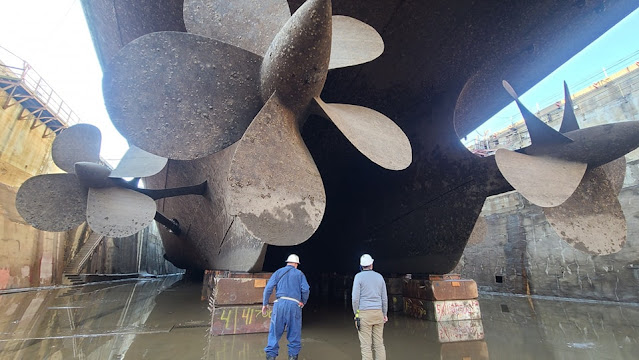
Ryan Szimanski posted
We've got a first look at the screws and rudders! Lyle Byler: I wasn't aware the inboard screws were 5 blade and outboard only 4. Hesham Oubari: Looks much better than when I was in the drydock in 87. I remember punching my hand through what remained of the rudder. Dave Esselburn: I kind of expected a little more rust and growth on there. Obviously it's not a closeup, but to the untrained eye, it looks like a fresh coat of paint is all it needs. Gabriel Wagner: Dave Esselburn from my understanding the steel of those days is much less porous than that of modern day and less susceptible to scaling like the modern stuff. Chris Duffy: It’s important to remember the old girl sits in freshwater, not salt. Much easier on the hull obviously. |
 |
Ryan Szimanski posted
At long last, I finally got to walk under the ship. We are keeping some water in the dock until the dock can have the mud washed down tomorrow so it's still a little wet. So far, things look good. Until we wash the mud and growth off the ship we won't have the full picture but I'm optimistic. You too can walk under the ship, get your tickets at battleshipnewjersey.org Vince Robinson: Question: With the outboard screws only being 4 bladed, did those shafts require a higher RPM than the inboard? Or did all turn the same speed for a given bell? Vince Pa: Vince Robinson #1&2 look like left hand pitch port side. So shaft would spin counter clockwise. 3&4 clockwise. The view on center line looking forward is awesome. Looks like the entrance to a tunnel for water drawing to #2&3 Corey Patrick: Vince Robinson Shafts typically all turned same rpms for a given speed. The pitch of the blades on the screws are quite different between the 4 bladed and 5 bladed screws however. David Hansch: Corey Patrick also the flow field the prop is in is very different which plays into the choice of pitch. |
 |
Ryan Szimanski posted
Here's a preview of what to expect from the ship's underside. Seems promising so far! |
 |
Iowa Class Battleships posted
USS New Jersey seen in dry dock from the air. Sent in by Arthur Gerwitz. |
The USS Kentucky, B-66, was built with the same design as
New Jersey, B-62.
 |
Sopheaknsp056 posted
USS Kentucky (BB-66) as seen from the bow looking towards the stern, She was an uncompleted battleship intended to be the last ship of the Iowa class Under construction; the twin rudder stock housings are easily seen in the foreground along with the port side lower armor belt and the aft torpedo defense system framing. the round barbettes which would have held her 16-inch (406 mm) main battery are prominent. Phillip Johnson: The caption is wrong, this is the stern looking towards the bow. Art Jacobson: At least the bow of the Kentucky lives on since it was used to replace the damaged Wisconsin bow in 1956. Joe Blacker: Why 66, where's the 65 ! Phillip Johnson: Joe Blacker BB-65 was the planned USS Illinois. It too was never completed, and I believe didn’t get as far along in construction as the BB-66. BB-67 was the first of the planned but never started Montana class. |
Speaking of Kentucky:
 |
Battle Stations Naval Warfare posted
USS Kentucky (BB-66)I s moved from her building dock at the Norfolk Naval Shipyard, Virginia, circa 20 January 1950. The ship, completed only up to her second deck, was launched to clear the drydock, so that USS Missouri (BB-63) could undergo repairs for damage received when she went aground on 17 January 1950. Official U.S. Navy Photograph, now in the collections of the National Archives.
Brian Scott: Believe it or not, she was scheduled to come out of DryDock 8 on that date, not for the arrival of Muddy Mo. That was just a coincidence. And the fact that she is incomplete should give you a clue that she was never commissioned, thus no USS. Facts All-steel derrick crane YD-26 on the right. Seth Block: She was never launched so she is not actually named either… |


%20Video%20_%20Facebook.png)
%20Video%20_%20Facebook.png)


