The Chicago & Illinois Midland is not named because of "target" cities like most railroads, but because of the companies that owned it --- Chicago Edison and Illinois Midland Coal. The first segment was chartered by farmers around
Pawnee, IL in 1890 to connect that town to IC's Springfield-St. Louis branch that was four miles to the west. Remember, four miles was a significant distance back in the horse & wagon days with muddy roads, and by 1890 the construction of railroads was a well developed enterprise.
The connection to the IC was named Pawnee Junction and then Cimic. [
American-Rails]
In 1900, F. S. Peabody sent James Kincaid to develop what became Peabody Mines #7, #8 and #10 and the town of
Kincaid, IL. Since the market for this coal was Chicago Edison, the two companies formed the C&IM in 1905 and extended the 4-mile railroad east to Kincaid and Taylorville (connections with Wabash and B&O) and west to Auburn (connection with Alton) and Compro (connection with C&NW). (In 1907 Chicago Edison merged with Commonwealth Electric to become Commonwealth Edison.) The railroad also served the town of
Tovey (Italian mine workers) and
Bulpitt (Lithuanian mine workers) that were created when Peabody sank Mine #7. [
BreezeCourier]
In 1926 they bought the moribund Chicago, Peoria & St. Louis. It connected only the last two names of its title via Springfield. The C&IM retained the north part that was known as the Springfield, Havana & Peoria. The southern part is still shown as C&IM on my 1928 railroad atlas. But it was sold to the Illinois Central. C&IM also acquired CP&StL's one-fourth share of the Peoria & Pekin Union Railway. The C&IM also acquired trackage rights over the IC between Springfield and Cimic to connect its two segments. At this time coal was 90% of the traffic. It was transferred to barges at Havana to serve eleven power generating plants in the Chicago area. Coal was also supplied to a power plant in Pekin. [American-Rails and railroad atlases ]
.png) |
kids, License: Creative Commons Attribution-Share-Alike (CC BY-SA)
South of Springfield, it became part of the Big Four. |
 |
Bill Molony posted
This map of the Chicago & Illinois Midland Railway Company is from the November/December 1988 edition of the Official Railway Guide.
Commonwealth Edison sold the C&IM in December 1987 to a group of private investors. The ownership of the C&IM changed hands twice more before it was purchased by Genesse & Wyoming Inc. in 1996 and the name was changed to Illinois and Midland Railroad.
Tom Horvath: I was sent down to Powerton yard along with engineer Bob Clemens for 6 months in I believe 2002, to help train and work with the I&M crews to get them qualified to run our DPU coal trains that were being delivered to the Powerton Power Plant and Kinkaid Power Plant. Was qualified on the whole line. I drew the first ride with a I&M crew with one of our coal trains to Kinkaid, ordered for something like midnight 30. Typical 20-25 mph trip over I&M tracks, then when we swung onto the CN tracks at Springfield, it was 10 mph from Springfield all the way down to Cimic, IL. where we swung back on to I&M tracks for the final stretch to Kinkaid. 10 MPN, in the middle of the night over old, jointed rail and I was just toast. I drained my entire thermos of coffee in the first 30 minutes and was amazed that we did not come off the rails anywhere. Apparently the 10 mph restriction was something the I&M self imposed on their trains while running over the CN due to a previous dispute over who would pay for the derailment clean up costs for I&M trains that derailed on the CN.
Paul D. Tincher: Having you and Bob there, running UP locomotives, was like I never left the UP!😜 The 10 MPH over the CN was also due to their ties being the consistency of toothpicks! They eventually changed out the ties, and raised the speed limit to 25 MPH, but for empties only. Loads still go 10. |
While studying a satellite map, I noticed that
a "mine mouth" plant was built. A 660mw unit came on line in 1967 and a second unit fired up in 1968. [
SourceWatch] The irony of being a "mine mouth" plant is that it decided to use low-sulfer coal from Wyoming rather than install sulfur scrubbers. ("Nothing bothers me more than to see trains taking Wyoming coal down to the plant to burn," said Phil Gonet, Illinois Coal Association president. [
sj-r]) It still confuses me why plants in other states can afford scrubbers so that they can burn Illinois Basin coal, but Illinois plants can't afford to install scrubbers. So the C&IM started carrying coal in both directions --- Wyoming to the power plant and Peabody #10 coal to the Illinois River. Peabody #10 closed in 1994. [
ChicagoTribune]
It was the deregulation act of 1980 that caused ownership of the C&IM to change.
Now that railroads could set their own freight rates C&IM’s parent found it was simply cheaper to contract with other nearby railroads rather than move the black diamonds through a subsidiary. So, in late 1987 the railroad was sold to private investors and then in 1996 was acquired by short line conglomerate Genesee & Wyoming. Following G&W's takeover the company was renamed as Illinois & Midland Railroad. Today, the I&M remains a successful operation witnessing more than 100,000 annual carloads. However, it no longer handles only coal with traffic consisting of "...agricultural/food products, building materials, wood products, minerals/ores, and municipal/ industrial waste." [American-Rails]
The I&M also acquired trackage rights on the UP/C&NW between Powerton and Barr for a more direct connection between the Peoria/Pekin area and Springfield. [
G&W]
Update:
 |
Bill Molony posted
This map of the Chicago & Illinois Midland is from the May 1949 edition of the Official Guide of the Railways.At that time, the C&IM was still offering passenger train service between Pekin and Springfield, with two trips a day in each direction.
|
Marke E. Vaughan
posted two photos with the comment: "
Often carrying the coal on the C&IM were the 7xxx series gondola cars. I had never been able to locate a photo on the inside of the car. My eureka moment came when reviewing the searchable photo archives at Lake States Railway Historical Association. They have an amazing series of historical railway photos and is well worth investigating their resources."
On a sidebar, I thought these cars were pretty much in captive service on the C&IM. Fast forward and I was sent a photo of an eastbound Wabash freight train departing Decatur, Illinois yard. The photo has a healthy string of C&IM 7xxx loaded coal cars. Further I have some yard checks from Bluffs, Illinois and there were an abundance of 7xxx cars coming and going to the CIPS coal-fired generating station at Meredosia. The cars were interchanged to and from the Wabash in Springfield, IL.
Jim French: Mark E. Vaughan, While before my time, I believe they were also commonly used for coal coming into the INU (ComEd) Dixon Illinois Station. I recall my dad referencing C&IM battleship gons.
 |
| 1 |
 |
| 2 |
 |
Rick F commented on Mark's post
another note on these.. Pullman supplied the cars as a kit to the railroad I was told by an old employee. They would come into Taylorville in pieces and the railroad would assemble them there. I am not sure if this is true as I had no way to fact check his information at the time but then again not sure why he wouldnt be telling the truth.. Also when looking at photos of the cars, I noticed the ends changed during the run of the cars.
[This is one of many photos featured in the Havana Coal Transloading Dock notes.] |
 |
Lance Wales posted
Help with some identification please? Picked up this print at a flea market years ago for $3. Only markings on the back is "Dave Lewis, of Peoria, IL". Obviously it is the C&IM 500 on their passenger train, but where are we? I would guess Havanna, IL or somewhere near, as there are no facilities other than the coal chute and water tank.
[The comments are not conclusive as to where this was. So I can't put it in the Towns and Nature blog without additional research.
Update: thanks to the comments below, I now have town specific notes: Old Salem Chautauqua.] |
These are two of the three photos that Joe Zeller
posted of catching their paint scheme in
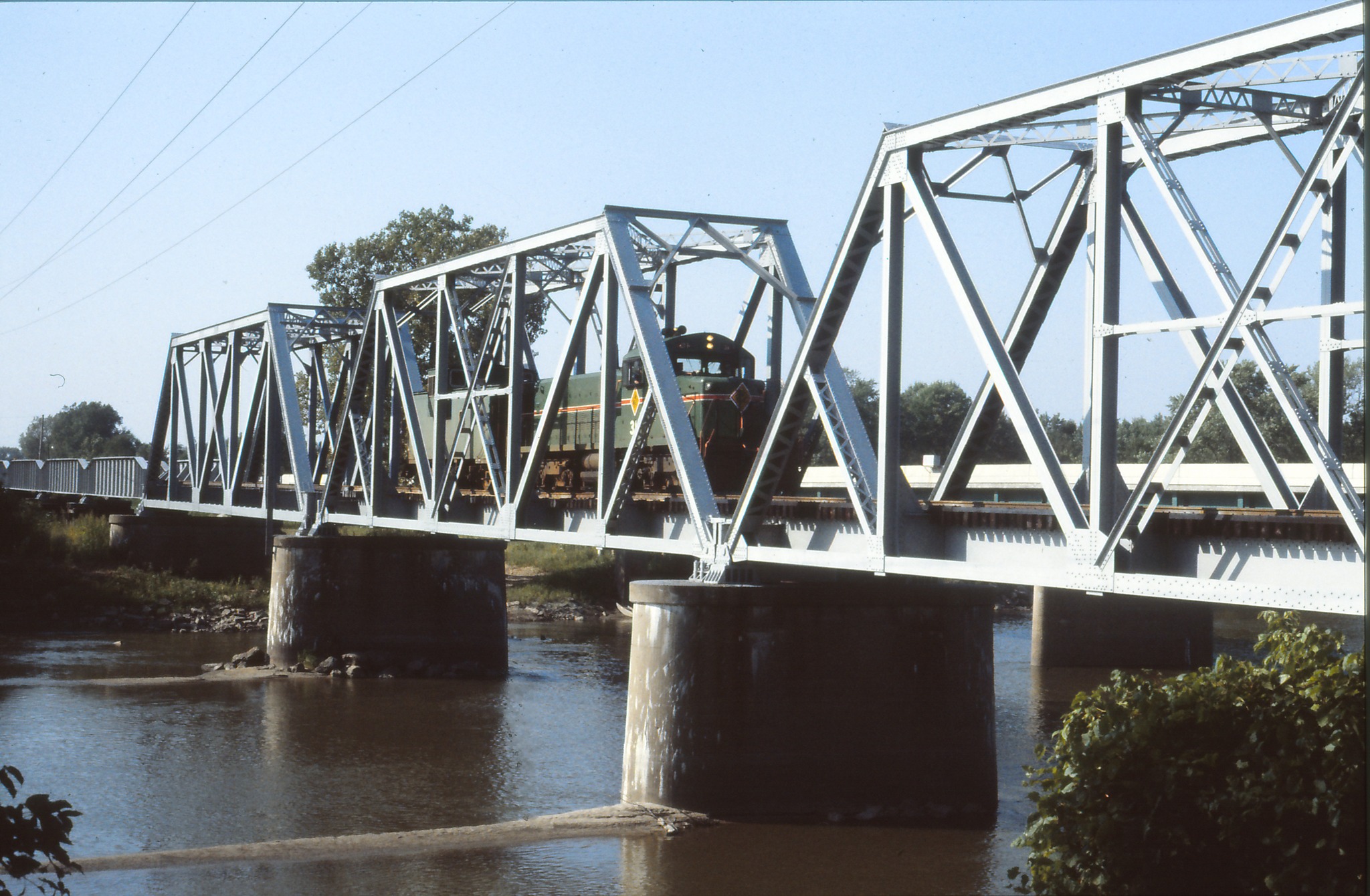
Barr Yard on the way to another Genesee & Wyoming railroad, Marquette Rail. Note how they just painted green paint over the "C&" when it changed from ownership from Chicago & Illinois Midland to Illinois & Midland.
 |
| 1 |
 |
| 2 |




.png)


