Showing posts with label rfWeitzman. Show all posts

Friday, June 19, 2015

Redundant (Parallel) Railroad Routes in Chicago

Photo by Douglas Weitzman,
"New York Central 4076 pulling #6 into the Englewood Station"
The Pennsylvania and New York Central had parallel 4-track routes through southeastern Chicago between Englewood and the Calumet River. At Englewood, the NYC turned north and paralleled the Rock Island into LaSalle Street Station. The Pennsylvania route continued northwest across the 3-track Rock Island route before it turned north to Union Station. So when Penn Central was formed, it had 8 tracks between the state line and Englewood. This has been reduced to two of the former Pennsy tracks and they are now owned by Norfolk Southern. (The NS changes from former-Pennsy tracks to former-NYC tracks between 116th and 117th Streets in Whiting, IN. See Colehour Yard for a discussion as to why Conrail switched right-of-ways.) The Englewood Union Station [Bernard, DeBruler] used to be in the middle of the triangle formed by the NYC, Pennsy, and Rock Island south of 63rd Street. A view of the station from the north.

1938 Aerial Photo from ILHAP
NYC had a yard at Englewood that is now a NS intermodal facility. Since NS now runs their trains through Chicago on the former-Pennsy tracks, NS no longer needs the former-NYC tracks that went north from here. When the Rock Island went bankrupt, the Metra bought their route to Joliet so that they could continue running commuter service to Joliet. But they also evidently got the parallel NYC route between Englewood and the LaSalle Street Station. Looking at a satellite map, the double tracks clearly crossover from the Rock Island (west) side to the NYC (east) side between 61st and 60th Street. The Rock Island right-of-way is now a service road much of the distance between Englewood and 23rd Street. What is strange is that there is one track left on the west side of the Rock Island route along a lot of the route. But the track is severed at some of the crossings so some of the track segments are unusable. It is strange that the unusable track has not been removed to be used somewhere else or for its scrap value.

Every time I hear about an Amtrak train needing 5 hours to get from Elkhart, IN, to Union Station, I wonder if they should have removed less than 6 tracks. The NS tracks not only carry all of the Amtrak trains to the east, they carry a lot of freight trains. One of the sources of the delay was the crossing of the former Rock Island tracks with the former Pennsy tracks. The P1 CREATE project removed this source of delays by building a bridge to carry the Metra/RI tracks over the NS/Pennsy tracks. Note that the commuter trains on the RI line can more easily climb a ramp to a bridge than the freight trains on the NS line.

Update:
Paul Bourjaily posted
A Rock Island passenger train passes near Comiskey Park, circa 1945. Photographer unknown. Thank you to the Chicago History folks for this one!
Eric Risse I suspect this was in cold weather, judging by the smoke, a lot of people still burned coal back then.
A Flickr photo of a PRR train at Englewood with a view of the interlocking tower.

Bill Molony posted
Pennsylvania Railroad class K4 4-6-2 Pacific-type #5383 with PRR train #58, The Liberty Limited, and New York Central Railroad class J3a 4-6-4 Hudson-type #5424 with NYC train #10, The Water Level Limited, departing eastbound from Englewood Union Station on May 11, 1940.

NYCSHS posted
In the time honored tradition, N.Y.C. J-3a Hudson 5424 with the "Water Level Limited" well in hand pulls away from Pennsy K-4 5383 leading the "Liberty Limited" out of Englewood, Ill. on May 11, 1940. As any steam fan knows, this was the site of many N.Y.C.- P.R.R . "races". Harold K. Vollrath Collection, NYCSHS Collection.
Jack Franks That was a short race the Pennsy had quicker power but had to slow down thru the bridge at River Branch Junction, while the NYC bridge was full speed.

Mike Breski shared
Larry Grzywinski From Englewood to over the Calumet River on to where the main lines separate by Colehour Yard and the state line. [So at one time the Pennsy didn't slow down?]

Bill Molony posted in Facebook
Bill posted again
Bill Molony Raymond Lowey designed the PRR T-1 4-4-4-4's
 and Henry Dreyfuss designed the NYC J1' Hudsons

Michael Milner They styled them
Bill's comment:

Pennsylvania Railroad class T1 4-4-4-4 Duplex-type #6111 and New York Central Railroad class J1e 4-6-4 Hudson-type #5344, ready to depart eastbound from Englewood Union Station on November 4, 1944.
Thomas J. McAllister shared this photo.
Bill Molony posted
Pennsylvania Railroad class S1 6-4-4-6 Duplex #6100 with The Trailblazer, racing New York Central class J3a 4-6-4 Hudson #5448 with the Advance Commodore Vanderbilt eastbound from Englewood Union Station.
Jerry Jackson Any idea of the year?
Bill Molony The NYC's streamlined J3a Hudsons were built in 1937 and 1938, and the PRR's #6100 was built in January of 1939, so this photo was most likely taken in about 1940, give or take a year.
Jeff Delhaye Both of them are missing some skirting, so I'd tend to add in 3 or 4 years

Garry Hendricks posted
There must be countless pictures of this daily event between the Broadway and the Century. I have never seen any pictures of this event when both trains were being pulled by diesels. I am beginning to wonder if any such pictures exist.
David Burhenn Is that the S-1 on the left? Great contrast between Loewy and Dreyfuss streamlining.
Bruce B. Reynolds It is the S-1 on the left, already missing many panels of its shroud for better access for the maintenance folks.
David Burhenn Even though I am a big Pennsy fan, and love the S-1, I have to say that the Dreyfuss Hudsons were just perfection. Dreyfuss understood how to streamline a steam locomotive without hiding all the interesting bits (and allowing crews to maintain them).
Jon Roma These trains did not leave their respective stations simultaneously throughout their entire lifetime, plus a minute difference in loading time at Englewood would affect where the two trains ran neck-and-neck, and I'm sure there were days when they were far enough apart that they couldn't "race" each other before the two lines separated east of the state line. With ample power, either train could quickly make up a minute or two delay getting away from Englewood without breaking a sweat.
Lawrence Smith also PRR was at mercy of the lift bridge at 21st street. IF it was up trains had to wait. NYC could move directly to Englewood assuming 16th st jct was clear.

Later, Bill posted in a different group and got a comment by Robert Leffingwell:
In the 50s, the Broadway and the 20th Century left Englewood at the same time.
Bill reposted 20160426 and got the comments:

Eric Risse The PRR S1 was the largest steam locomotive ever built for passenger service (so big it could only run on small portions of the PRR system) Weighed in at a million lbs with the tender, and had 84" drivers.


David Daruszka: Exposure adjusted.
Matt McClure All that NYC ROW sits fallow now---perfect for dedicated Amtrak tracks east into Indiana. Although a connection at the ex-IC would be way, way faster into downtown that the ex-PRR slugging west of the Dan Ryan. Great photo.

Bob Lalich Both locomotives have had some of their sheet metal removed to ease maintenance.

Bill Molony posted in Facebook
Bill's comment:
Pennsylvania Railroad class K4s 4-6-2 Pacific-type #5364 and New York Central class J-3a 4-6-4 Hudson-type #5450, ready to depart eastbound at Englewood Union Station in March of 1946.

Bill Molony posted
A brand new A-B-A set of Pennsylvania Railroad E7's with PRR train #28, The Broadway Limited, and New York Central class S-1b 4-8-4 Niagara-type #6022 with NYC train #2, The Pacemaker, departing eastbound from Englewood Union Station in November of 1947.

BRHS posted
Pennsylvania Railroad train #28, the Broadway Limited, and New York Central train #2, the Pacemaker, both departing eastbound from Englewood Union Station in November, 1947.
The Broadway Limited is being pulled by a new A-B-A set of EMD E7's, and the Pacemaker is being pulled by class S-2a Alco Niagara-type 4-8-4 #6022.

Graeme Nitz posted
Englewood IL 1948.
Being an SPF I am mortified to think that the Niagara will [win] this one as the Centipede would probably fail!
Ted Gregory shared
Jeff Lewis: Baldwin Locomotive Works offered their full cowl locomotives with either the "baby face" or "shark nose" design. Pennsy ordered numerous models with both designs. Unfortunately, none of them survived.

Taylor Rush posted
"The Daily Race" out of Chicago, Illinois. The "20th Century Limited" of the New York Central, has the lead on the "Broadway Limited" of the Pennsylvania Railroad. These were the all-Pullman flagship trains of the rival companies, and both departed at the same time, the NYC out of LaSalle Street Station and the PRR out of Union Station. The tracks ran parallel for a few miles between Englewood, Illinois and Gary, Indiana, and the throttles were widened out for a bit of friendly competition.
Powering the "20th Century Limited" is J-1e class "Hudson" number 5344, the "Commodore Vanderbilt." The "Broadway Limited" appears to have one of their powerful K class "Pacific" locomotives on the point. The photo was likely taken between very late 1934 and mid 1938.

Tom J. Cassidy shared

Jim Arvites posted
View of the Pennsylvania Railroad's "Broadway Limited" on the left and the New York Central's "20th Century Limited" on the right racing eastward toward New York after leaving Chicago's Englewood Union Station in the pre-streamline era in the 1930's. When I was a little guy in 1956 my family took a vacation to New York on the NYC's "Commodore Vanderbilt." I remember a similar race with a Pennsy passenger train after we left Englewood Union station.
Bob Poortinga I believe that this may be older than 1930. The PRR train is on the eastward passenger main. This track arrangement was changed sometime in the mid to late 1920s when the signal system was upgraded from semaphores to position lights.

Brian Morgan posted
The Great South Chicago Race between the New York Central's Twentieth Century Limited and the Pennsylvania Railroads Broadway Limited between Englewood Union Station and South Chicago's Calumet Park.
Larry DiGangi
 Howard Fogg painting
William A. Shaffer The Great Speed War of 1938: "Twentieth Century Limited" vs. "Broadway Limited". New York to Chicago in 16 hours!
Richard Mead Well the Hudson wouldn't slip as badly starting up.

Bill Molony posted in Facebook
Bill's comment:
This post card view of Englewood Union Station at 63rd and State was issued by the Rock Island Railroad in about 1920.
Tarik Da Carpetman Baker posted
We have seen quite a few shots of the Pennsy+NYC southwest of Englewood because of the "races." Here area couple of shots of the Rock Island +NYC north of Englewood before the Dan Ryan express was built.

This is an E6 pulling a southbound Rock Island train around 39th Street in the 1940s. Notice the Old Comiskey in the background. The tracks on this side of the train are NYC tracks. Also notice the haze from all of the coal burning furnaces.
Jim Matthiessen commented on the above posting
Victor StLawrence The building in the right middle background along the tracks with the peaked roof is the old main building of Armour Institute (IIT).


Victor StLawrence reply

Tarik Da Carpetman Baker posted
Another view of the RI+NYC viaduct across town. Most of the comments are about moving the public housing and clearing the space for the Dan Ryan. The group is public so you can read further if you want. But of particular interest is:

Jeff Bloomdahl My dad was in charge of crews moving many of the buildings that were in the way of the expressway. One of the major moves was the church in the bottom right hand corner of this picture. They moved the church to around 39th and the Dan Ryan, where it still stands today!
Roderick C Williams shared
[The Red Line being built in 1969 at 34th Street]
John Markl Note the lack of barricades and jersey barriers....you'd never see that todayTodd Pearson Note the Rock Island intermodal heading for 12th street.

[Another image of the Armour Institute building mentioned above.]
Mark Hinsdale posted

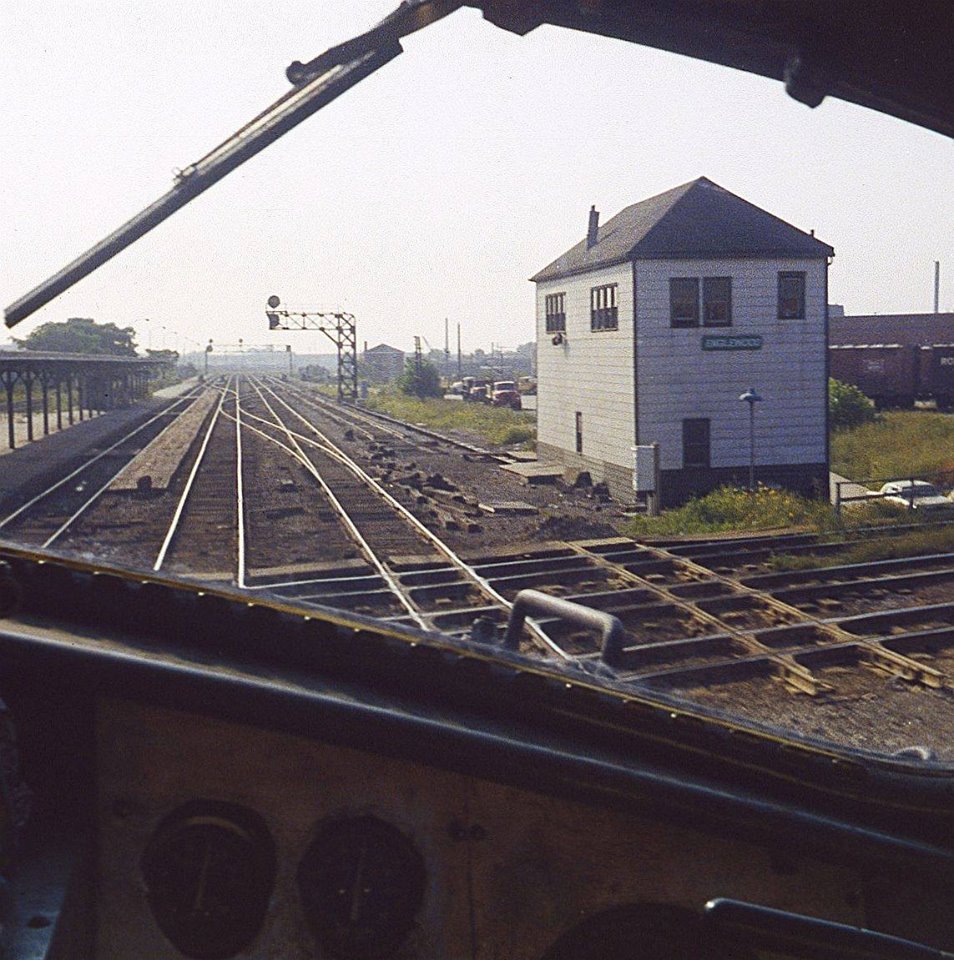
"View From the Cab"
Amtrak Train #360, the eastbound "Wolverine," is about to cross the Rock Island main line at Englewood, in Chicago, as it heads toward Detroit on Penn Central's ex Pennsylvania Railroad trackage. The operator in the tower to the right controlled all moves through this crossing. July, 1971 photo by Mark Hinsdale.

Bill Molony posted
Two the Pennsylvania Railroad's new EMD E7a's, leading PRR train #28, the eastbound Broadway Limited out of Englewood Union Station in June of 1949.
The Broadway Limited was an all-Pullman train, with no coaches or checked baggage, but it did operate with an RPO car.
[
Four track PRR mainline in foreground. On the right would be the four track NYC mainline and their yard.]
Bill Molony posted
In the center is Rock Island E7A #642, leading a westbound intercity passenger train into Englewood Union Station.
In the station to the left is another Rock Island E7A with an eastbound passenger train. 
In the station to the right is an eastbound New York Central passenger train. 
Undated, but circa 1960.
Bill Molony posted
Pennsylvania Railroad class K-4s 4-6-2 Pacific-type #3874, approaching Englewood Union Station with a westbound New York-to-Chicago express train in August of 1946.
[The freight cars in the background are on the NYC tracks that have already started their curve to the north to join the Rock Island corridor to La Salle Street Station.]

Eli Santin posted
1943: New York Central 4-6-4 #5452 departs Englewood Union Station with the 20th Century Limited while passengers board the PRR's Broadway Limited on the opposite track. Paul Eilenberger photo - courtesy of the NYCSHS Archival Collection.
[Pennsy is still loading so they are going to loose this race. A comment indicates that the "finish line" was Whiting Interlocking.]

It occurred to me that a Facebook comment should have been saved. But I didn't. Fortunately, I remember the content if not the author. The timetable direction for the Rock Island going to Chicago is East. The timetable direction for the NYC going to Chicago is West. To avoid confusion on the parallel routes between Englewood and  La Salle Street Station, the timetable directions of North and South are used on that segment.

Comments on a posting:
Bob Lalich Gary Petranek - the former NYC route from Chicago to New York City is intact except for a small stretch between Grand Crossing and Whiting in which the parallel ex-PRR is used. The NKP is intact from Chicago to Buffalo except for a small stretch from Grand Crossing to Pullman Jct.
Dennis DeBruler Gary Petranek RI and NYC shared a 4-track mainline between Englewood and LaSalle Station. From satellite images, past Englewood, Metra uses RI. But by 59th Street, it has switched over to the NYC tracks and uses the RI overpasses for an access road. The notable exception is south of 47th Street where Metra kept the "Rocket House" as an engine service facility. Between Archer and 18th, they switched back to the RI tracks. These notes are probably more information than you wanted :-)https://industrialscenery.blogspot.com/.../redundant...

Wednesday, February 18, 2015

Amtrak Locomotives

I normally don't pay much attention to passenger and commuter trains. But Amtrak has painted some of their current locomotives with their old paint schemes and some railfans are making a special effort to get pictures of them. So I became curious about Amtrak locomotives and their liveries.

In the beginning, 1971, Amtrak used whatever passenger equipment they had obtained from the railroads as a part of the deal of no longer requiring the railroads to provide passenger service. This was known as the "rainbow" era.

Photo by Michael Matalis, used with permission
Before I go into the history of the locomotives and liveries, lets look at the contemporary GE Genesis P42DC passenger locomotives with its standard Phase V livery, which was introduced in 2001. This picture was the outbound Southwest Chief, Train #3, taken in Westmont, IL, at Cass Avenue. To help celebrate their 40th anniversary, Amtrak picked four GE Genesis units to be painted in a former livery as a Heritage Unit. Specifically units 156/66/145/184 were painted in the four phases, respectively.
Amtrak: Phase I, introduced in 1972, on a SDP40F. Heritage unit is #156.


Amtrak's first paint scheme, or Phase I, was introduced for the first locomotive design purchased by Amtrak -- EMD SDP40F. This 6-axle (C-C) design was for long distance passenger trains. 150 were built between 1973 and 1974. They used the 16-cylinder turbocharged 645E3 that generated 3,000 hp with a 57:20 gearing that allowed 100 mph. This design was based on EMD's SD40-2 freight locomotive and was designed for easy conversion to freight locomotives should Amtrak cease operation. They included a steam generator because most of the passenger cars they inherited were built during the steam era. (The E units that had been used by the railroads for passenger trains also had steam generators.)

Copyleft: Photo by Drew Jacksich from San Jose, CA, The Republic of California.
I include the 1978 photo from Wikipedia of the San Francisco Zephyr, Train #5, through Emigrant Gap because it makes it more obvious why the Phase I scheme had the nickname "bloody nose."

R. Craig caught Phase I Heritage Unit #156 in Rock Island, IL.

Amtrak: Phase II, introduced in 1975, on a F40PH. Heritage unit is #66.


EMD built the 4-axle (B-B) F40PH from 1975 to 1992 and MK Rail and MotivePower Industries built it from 1991 to 2000. The Phase II paint scheme extended the stripes that were being used on the passenger cars to the engine, including the nose. Charles J. Freericks caught Phase II Heritage Unit #66 in California.

The FP40PH was intended for short- to medium-length trains on Amtrak's shorter routes. It was also used by many commuter trains. But since it also had 3,000 hp (later 3,200 hp), it proved it could handle the long-distance trains, and it replaced the SDP40Fs by 1985. The main reason the SDP40Fs were replaced was that they rode rough and they had derailments. Because Amtrak specified a hollow bolster for the trucks to reduce their weight to help compensate for the extra weight of the steam generation equipment (including the water tanks), many suspected the trucks were the cause of the derailments. Later testing by EMD and FRA concluded that the light baggage car that followed the heavy locomotives was the cause of the derailments because the car caused harmonic vibrations. Another reason the SDP40Fs were replaced is that they needed to be converted from steam generation to Head-End Power because the passenger cars were being replaced with new cars that used electricity instead of steam. F40PHRs were built with parts from traded-in SDP40Fs. (SDP40F, F40PH, HT-C bolsters)

Amtrak: Phase III, introduced in 1979, on a F40PH. Heritage unit is #145.

Phase III changed the pattern of the strips from three skinny white stripes to one wide white stripe. When first introduced, the P42DC used a variant of this scheme. Specifically the white stripe was skinner and the red and blue stripes were darker.

Charles J. Freericks caught Heritage Unit #145 in California. I asked for permission to use some additional Phase III photos.

Boston MA South Station, Photo by Douglas Weitzman,
used with permission
Photo by Ray Tutaj Jr. from Grain Elevators,
used with permission

Amtrak: Phase IV, introduced in 1993, on a P42. Heritage unit is #184.


Phase IV was a rather radical departure from previous liveries. Geno Dailey caught F40PH 406 repainted in Phase IV.


Photo by Michael Matalis, used with permission

On Christmas 2014, Michael caught Amtrak heritage #184 leading inbound (eastbound) Southwest Chief - Train #4 in Westmont, IL.

Photo by Michael Matalis, used with permission


In summary, Photo by Matt Donnelly

Also, the intro picture in a GE article concerning the P42 Genesis locomotive  includes the Phase II and IV Heritage Units.

The Acela had some other liveries, but since I'm a Midwesterner, I'm skipping those. In addition to the four 40th Anniversary Heritage Units, the units that pulled the display train, #822 and F40PH #406, also had a special livery. Mike Matalis grabbed a couple of shots of #822 at the Fairview Ave. crossing in Downers Grove, IL on Feb. 9, 2015 leading the California Zephyr, Train #5.

Photo by Michael Matalis, used with permission

Photo by Michael Matalis, used with permission


On Nov. 11, 2014, Mike caught the "cabbage car" (combination cab car and baggage car) 90368 on the inbound Illinois Zephyr. It was a conversion of a F40PHR and retained its Phase III livery. The motive power is on the other end of the train. I thought the use of the cabbage car was to run the in-state trains like a push-pull commuter train. Specifically, the train does not have to be turned at the terminal ends. But this works only if the seats are flippable. Since flippable seats are not comfortable,  I wondered if I was right about the Illini Zephyr being run in a push/pull mode. So I asked about it on a Facebook group, and I learned that half of the seats face one way and the other half face the other way. So the seats do not have to be flippable to operate in a push-pull manner.

Update: Siemens is making new locomotives for state subsidized services.
Photo by Mike Matalis, used with permission


Wednesday, January 28, 2015

L&I: Louisville and Indiana Railroad Overview

LIRC
The Louisville and Indiana Railroad (LIRC) was formed in March 1994 when Conrail was chopped up by NS and CSX. On the south side, in its headquarter town of Jeffersonville, IN, it crosses the Ohio River bridge and serves one of the Ports of Indiana.

The LIRC route began as two railroads: "the Madison & Indianapolis Railroad, which started business in 1838; and the Jeffersonville Railroad, which began operating in 1850. The railroads merged in 1866 and later became part of the Pennsylvania Railroad." (ProgressiveRailroading)

A Sept. 2013 Progressive Railroading article reports a "South Wind" project in which CSX would pay almost $100 million dollars to upgrade the line to accommodate 286,000-pound rail cars, as well as double-stack and high-cube equipment that is 20' 2" high. CSX wants to use this route because their Cincinnati-Louisville route "was nearing capacity, and the grades and curvature on the route constrained train lengths, tonnages and operating speeds. It wasn't practical to upgrade the route, CSX officials concluded. But upgrading the LIRC would be, they believed."

But their system map does not show trackage rights over this route. I found a July 2014 article that indicates the Surface Transportation Board was still studying the plan. The LIRC had spent $1.3 million to rebuild crossings so that it can run trains at 30 mph instead of 10 mph. The plan is being held up by John Drybread, Edinburgh's utility director, because the number of trains would increase from 6 to 15. But South Wind would increase train speeds from 25 to 45 mph. Increasing the speed offsets the increased number of trains in terms of total delay. And it about halves the wait time for a train. Since Downers Grove sees about 80 trains a day, I can tell you that if you are sitting in a car or an ambulance, it is the wait time for a train, not the number of trains, that John should be looking at. The train speeds in Downers were restricted last summer because of a station construction project and the longer wait times were noticeable as bigger traffic backups. The STB should require that CSX installs signaling equipment that is good enough to allow Edinburgh to be a "quite zone" and then allow the project to proceed. Again, my experience with the 5 grade crossings in Downers is that freight trains are not the problem, it is the commuter trains during the rush hour that cause more significant traffic backups.

The locomotive roster is a museum even by shortline standards. Their newest locomotives are GP38-2s. I've spotted at least 3 different paint schemes. But the photos on their home page use Tuscon Red. I like that the color and their logo is a nod to their Pennsylvania RR heritage.

I notice that the route goes through Columbus, IN, but Cummins is not one of the customers listed on their site unless the Cummins plant is in Walesboro Industrial Park. But the customer list must not be complete because I saw reference to sugar as a cargo used by Hershey. Yet Hershey was not on the list.


Update: A Flickr photo of their green and yellow livery.
Lukas Irons posted
Everything old is new again, including a revamped railyard, all five tracks of it in Jeffersonville Indiana. The Louisville and Indiana Railroads new transload facility is all finished. Dutch Lane Yard has already attracted Lubrizol to the area and products will be transloaded here along with steel and other things.
Photo by Douglas Weitzman
Dawn, 4/6/16. Louisville & Indiana 22006 2003 in the Jeffersonville, In. yard.
CSX got approval to upgrade L&I track and bridges with $100 million on April 10, 2015. Found this link in a posting by Scott Nauert with the comment:
This CANNOT be good news for CSX's now-dead Illinois Sub between East STL and Olney.. The government gave the highball to CSX to upgrade and re-route major traffic over the L&I between Indy and Louisville, making the Illinois Sub even more redundant, considering UP interchange traffic destined for the south and east has to be processed at Avon anyway.

Photo by Douglas Weitzman, 8/28/2016
Photo by Douglas Weitzman
The Roundel is honoring Indiana's 200th year.