These are notes that I am writing to help me learn our industrial history. They are my best understanding, but that does not mean they are a correct understanding.
A little History for you and whomever is interested. This was a pumping station for the Standard Oil Co. oil pipeline running from Oklahoma / Texas to the Whiting Indiana Standard Oil Refinery. This pipeline was constructed in 1906, about the same time as the Santa Fe Railroad pushed from Ft. Madison to Chicago. There are /were matching pumping stations just like this one at Kernan IL, Wilbern IL, Dahinda IL. Ponemah IL. (In Warren County) and Ft, Madison.
There are also surviving Oil Pipeline Pumping stations buildings at Ransom Il,. La Rose Il., Ormonde Il. and Ft. Madison. Ia. Those are a different style of buildings and layout, as it is a different pipeline. Those pumping stations were built by the Sinclair Oil Company in 1918 to also go to the Chicago area. "A half interest in the Sinclair Pipe Company was purchased in 1921, ( By Standard Oil Ind.) for $16.4 million in cash, improving transportation capacity. Sinclair's 2,900 miles of pipeline ran from north Texas to Chicago, encompassed almost 6,000 wells, and ran through oil-rich Wyoming."
Standard Oil Ind. needed more capacity so ".... in 1930, Standard acquired both the remaining 50 percent interest in the Sinclair Pipe Line Company and the Sinclair Crude Oil Purchasing Company for $72.5 million, giving it control over one of the country's largest pipeline systems and crude oil buying agencies. These subsidiaries now became the Stanolind Pipe Line Company and the Stanolind Crude Oil Purchasing Company..... "
So both of the Pipe Lines ended up owned Standard Oil of Indiana (Standard).Then consolidated under the Amoco Oil Co., and now BP. There are still BP pipelines that run along side the old AT&SF to Chicago. More History than you ever needed! Enjoy!
I just did a little internet searching when I took interest in the buildings at Ponemah, and found others like them. Then it was pointed out that they are spaced 30 to 40 miles apart. Ormonde is only 5 miles from Ponemah, and a different style of building. I went and talked to the FS plant manager at Ormonde, and he had a schematic of the plant when it was owned by Stanolind. (Which also match plants in Marcelline Mo. to a tee.) So if you look in google maps/ earth, Ft. Madison to Ponemah to Dahinda, to Wilburn, to Kernan all all spaced at approx 40 miles and all the same plant.
And Ft, Madison to Ormonde, to Laura, to LaRose, To Ransom all are approximately 40 miles apart and are all of the of the other style. There still is a BP pipeline pumping station in Laura, but modern. The older Standard Oil Pipeline had coal fed boilers supplying steam to stream driven pumps. The Sinclair pumping stations used gasoline / distillate engines.
Note that for some of these towns, these pumping stations were the only industry. You can tell they were a source of pride because they have not removed the tall smokestacks.
Update: Ryan-Dawn Chapman posted a Gulf facility down in Clay County near Edgewood.
Walter L Simms posted Okay my favorite Tower Story. I was working as Assistant Superintendent at Corwith where you couldn't get in or out unless going through the IC Interlocking. So, one afternoon the Yardmaster called me and told me the IC interlocker wouldn't be manned for the next 4 hours. I then called the IC Chief confirming that this was in fact the situation. The Chief confirmed it was true so I told him I could run the tower as I had worked a pistol grip tower in Amarillo for years, and we had trains--hotshots to run out of Corwith in the next 4 hours. He told me he would approve it if I was sure I could run it which I did. I worked the tower during the 4 hours running many trains on the IC and our Santa Fe trains. When a new rested operator showed up, I called the Chief and told him an op was there. He than asked me if I wanted a job.
Steven J. Brown posted Santa Fe's, an inbound meets an outbound, at Corwith Tower in Chicago, Illinois - Winter 1983. Steven J. Brown shared
Steven J. Brown posted Roster shot of GM&O (ICG) Corwith Tower in Chicago, Illinois - January 26, 1990 Steven J. Brown shared Andy Hughes: My buddy worked there. We both hired out in 71 as tower operators he went to the GM&O and me to the Milwaukee Rd. I wish I had been able to get in Corwith. It was really enforced by the ATSF. I think Corwith controlled the other interlocking across (north) if the expressway. I never did figure out how to drive in there. I walked in once by using the old Illinois Northern abandoned bridge over the canal. Still in there I never spotted an access rd. Richard Blough: Great photo, thanks for posting. Worked there about 3 years back in the day. Access....38th st. to St. Louis Ave then 1 block to the tracks and turn left on the rock road to the tower. Looks like you can still go that way on Google earth but I'm sure you would not be welcome. Who was the fellow that hired out there in '71?
Photo from Steve Rosen A small view from the window atCorwith tower, of a northbound Amtrak train. You'll notice an order hoop....when I first worked there, all trains southbound had to pick up orders from the hoop, and couldn't go much further south if they didn't have them. The operator (that would be me) would get orders from the dispatcher, reading them back word for word, copy them by hand, and put them in the upper and lower hoop for the engineer and the conductor to pick up, on the fly. It was exciting railroading, the way it was everywhere at one time. The orders gave specific instructions about where the train had permission to be, and when, and how fast they could go. These peices of crinkly tissue-like paper were the thing that keep trains from running into each other.
Mike Mowen posted three photos with the comment: "From when I worked at the Former GMO/ IC / CN Corwith Tower near Chicago."
1
2
3
Cuck Roth posted Inside Corwith tower June of 2005 Mike Croy: Vince Blake all the hardware is at the Illinois Railway Museum - I’ve seen it. Jon Roma: Yep, the building is long gone. The tower was closed November 9, 2008.
Dave Arganbright posted You certainly get a unique perspective from the cab. Here we are at Corwith on the Alton in 1987. The Santa Fe crosses in the foreground and the old Illinois Northern crosses in the background. My photo. Edward Kwiatkowski I lived a few blocks away from the old Illinois Northern branch, in Chicago's Little Village neighborhood. The Santa Fe I.N local, operated Monday through Friday during the 1970's and 80's. The I.N branch tracks have since been removed. Dennis DeBruler This places the tower in the northwest quadrant of the IN and GM&O tracks. https://www.google.com/.../@41.8256935,-87.../data=!3m1!1e3
Bill Molony posted
Corwith Interlocking Tower, as it looked on May 1, 1971. Mike Croy Been in the tower many times. The US&S interlocking machine and other equipment from inside the tower is located at the Illinois Railway Museum. Jon Roma This was a GRS Model 2 unit lever machine, not a US&S. Bob Lalich I take it that when the tower was built, the senior road, the Alton at the time, chose to operate it for some reason. Normally, the junior road would operate the tower. Jon RomaBob Lalich, not necessarily. The decision who operated the tower was settled by contract, and there was not always a formula who did what. Often, the junior road would pay for the cost of the interlocking, after which the senior road would man it. The operating costs were typically apportioned by how many appliances each railroad had in the plant.
When Corwith was opened, it was definitely manned by the C&A, and that control eventually passed to CN over the years with all the mergers involved.
Not long before the tower's closing CN and BNSF inked an agreement where the control of Corwith passed into BNSF's hands; being adjacent to the BNSF's important Corwith Yard, the railroad was eager to be in control there.
Bob LalichFor those interested in historic details, the first railroad to cross the Alton here was the Chicago & Southeastern RR, which was acquired by the Chicago Danville & Vincennes, a predecessor of the C&EI. It is unclear if they ever operated the line. The C&S was sold to the Chicago & Grand Trunk Ry after the CD&V made arrangements to use the Panhandle from Dolton in 1872.
Dave Arganbright posted Approaching Corwith on the way back from Plaines again in 1987. The Santa Fe is immediately in front and the IN tracks were on the other side of the tower. My photo.
Today, wind power is used to generate electricity. But before farms where electrified, many farms had a windmill to pump water. Below is a closeup of the pump in the base of the windmill to the right.
Both my grandparents and my wife's grandparents had windmills on their property that we can remember seeing. This windmill and pump below are near the J.H. Hawes Grain Elevator in Atlanta, IL.
20160706 3469
This text and two images are from the plaque by the windmill.
The first windmills were developed in ancient times, with evidence of wind-powered machines dating back to ancient Greece and Persia. However, the earliest known practical windmills were developed in the Middle East during the 9th century.
These early windmills were vertical-axis wind turbines, also known as panemone windmills, which were used for grinding grain and drawing water. The design was later improved upon in Europe during the medieval period, with the introduction of the horizontal-axis windmill, which was capable of generating more power.
The first recorded windmill in Europe was built in England in the 12th century, and windmills became increasingly popular in Europe during the 18th and 19th centuries. Today, wind turbines are commonly used to generate electricity on a large scale, particularly in areas with strong and consistent winds.
Timothy Miller: Keep it well anchored,greased & painted and it will last forever… mine is going on 32 years old .. love it !
Steve OConnor posted some pictures with the comment:
The Challenge Windmill Company, Batavia - This property that is known as the Challenge Windmill plant has had a colorful history. In 1857, Nelson Burr founded the first wooden pump company which grew to become Challenge Windmill and Feed Company. At that time, the plant was powered by water and wind. The buildings at one time covered over 165,000 feet on eight acres. Since then the wooden and other structures have all been removed. The 515 building was a foundry and the 525 building was a wood shop powered by the mill race below. The 415 building was a machine shop, also powered by a water turbine. The 335 building was for assembly and storage. The company prospered until the early 20th century. During World War II, munition shell casings were produced in the foundry. This is where the colorful part of the Challenge Co. starts. In 1946, Dr.Henry Garsson, Murray Garsson, and Congressman May were found guilty of conspiracy to defraud the government and war-bribery. During the war, they had fraudulently obtained $78,000,000 in war contracts. The Challenge Co. was one of several companies that they had purchased with no funds of their own. The trial heard over 100 witnesses and lasted over eleven weeks. Witnesses included General Eisenhower, Secretary of State George C.Marshall and Secretary of War Robert Patterson. In 1949, the property was purchased at an auction and the buildings were leased for manufacturing and warehousing to multiple tenants. In 1992, the conversion to office use started.
1
2
3
4
5
You can tell that this plant used to use water power because of the dam and the tailrace on the right.
William A. Shaffer posted
Sad Windmill I saw this windmill on the way back from Fredericksburg, TX back in 2012 and photographet it. (Photo by William A. Shaffer)
Rural American History Captured shared
The next generation of windmills unveiled at the 1904 World's Fair in St. Louis, Missouri.
Image via Google eBook via BridgeHunter-1881 and BridgeHunter-1911 Also, Engineering News Article, Public Domain. There are several other pictures in the article. "Old bridge in background."
1911 Strauss Bridge
Larry Irvin Flickr via BridgeHunter-1911, License: Creative Commons Attribution-Share-Alike (CC BY-SA) P&PU bridge over the Illinois River (used by the TP&W) near Peoria on 11-23-75
A glimpse of the old bridge. And it looks like the Illinois River was running rather high.
Noah Haggerty posted Here's a photo of the Peoria & Pekin Union's bascule leaf style over the Illinois River in Peoria, IL. This was probably taken right around mid-October of 1984 when the bridge was converted to a lift span. John & Roger Kujawa Photo, Thomas Dyrek Collection. Noah Haggerty posted with the same comment
Donald E Faris posted Once again getting around to a bit of scanning. Here's Rock Island 4523 with four cars and a caboose 8/25/1979. David JordanA CCLX-marked covered hopper behind 4523 tells me this train is from Pekin, exercising P&PU trackage rights in place since 1973.
John Stell posted TP&W 700-1000-902 on P&PU Illinois river bridge with train No 121.Photographer not shown September 1970 John Stelll colllection
John Stell posted This is No 121 I was trying to post earlier, Harold J. Krewer If the Feb. 1970 date is correct, this could have been one of the first trains to cross the river on the P&PU. The TP&W bridge was knocked out on or about Feb. 12, 1970. [I don't know where Harold got Feb 1970 date.] David JordanHarold J. Krewer I didn't think TP&W had any geeps painted in acrylic orange until 1971?
Todd Pendleton corrected John Stell's posting Extra 700 West crossing Illinois River on P&PU bridge on 9-29-79. Photographer unknown. John Stell collection.
John Stell posted TP&W 700, 1000, and 902 crossing Illinois River on P&PU grasshopper bridge in September 1970. Photographer unknown John Stell collection. Dean CunninghamI remember that P&PU lift span - Used climb on it during bridge inspection in the 1950's.
John Stell posted TP&W 700 is westbound on P&PU Illinois River bridge, Slide is marked Ross Porter collection and now in John Stell collection.
Michael Broshears posted Westbound TPW crossing the PPU bridge in 1978.
Douglas Butler posted Credit to Julia Belle Swain P&PU Strauss Heel Trunnion Railroad Bridge is replaced in Peoria, IL. Also, BridgeHunter-1911 "Lost P&PU RR bridge over Illinois River @ Peoria, May 1984 photo taken from Julia Belle Swain riverboat cruise. GS, May 1984"
Noah Haggerty posted BN C30-7 #5097 leads a westbound empty coal across the P&PU Illinois River bridge in East Peoria, Illinois. This is in October of 1984, when the bridge was rebuilt from its trunnion style to its lift style. John & Roger Kujawa Photo, Thomas Dyrek Collection. David Jordan: The P&PU bascule leaf was replaced by a lift span between October 16 and 19, 1984. So the setup indicates a date just prior. The train is actually an empty coal train from C&IM. Noah Haggerty: David Jordan Thanks for the info. So if it came from the C&IM, it would instead be northbound? David Jordan: Noah Haggerty Westbound, back to Galesburg and then the Powder River Basin. Photo vantage point is on the Peoria side of the river, south side of the bridge. Matt Ryan: Did a barge hit is? Harold J. Krewer: Matt Ryan, no, but the Army Corps of Engineers had been trying for years to straighten and widen the navigation channel of the Illinois River through Peoria. Most of the 'problem' bridges (IT, TP&W, Cedar St. Bridge) had been eliminated by attrition, leaving the P&PU bascule span as the narrowest channel left. As you can see, the vertical lift span was significantly longer, thus widening the channel to an acceptable level for the now-standard 3-barge-wide tows. David Jordan: Harold J. Krewer Franklin Street, not Cedar Street.
Noah Haggerty posted with the same comment Jim Washer: I recognize the little loader in the white rock barge...Jubilee Materials barge dock. I worked there in '84-'85. David Jordan: Empty coal train from the C&IM heading back west just before the bascule leaf was replaced by a lift span between October 16 and 19, 1984.
Noah Haggerty posted UP SD40-2 #3523 and two other EMD SD's roll over the Illinois River bridge in Peoria, IL sometime in the early 1980's before the bridge replacement. The power was likely going back to Adams Street yard after delivering a train billed for the C&IM & Havana dock. John & Roger Kujawa Photo, Thomas Dyrek Collection.
Marty Bernard posted 3. Peoria & Pekin Union Rwy Co. (P&PU) EMD SW1200 500 built May 1965 and seen crossing the Illinois River at Peoria, IL May 10, 1980. Bill Kuba photo, Iowa Chapter NRHS Collection Marty Bernard shared
I found a lot more photos taken in East Peoria, Illinois of the P&PU's bridge replacement over the Illinois River from October 16-19, 1984. This changed the bridge from a bascule leaf style to a lift span.
This is Part 1, showing the completion of the lift towers and the beginning to remove the bascule styled bridge. This might not all be the correct order, but I tried.
John & Roger Kujawa Photo, Thomas Dyrek Collection.
1 Building the supports to the lift bridge.
2
3
4
5 Now with the towers built, it's time for the bascule leaf bridge to come down.
6
7 Hard to see, but the truss on the bascule bridge has come down and would be moved out before morning.
8
9 By now, the truss is gone and it is time for the transfer.
10 This would be used to carry the bascule lift out of the bridge.
Noah Haggerty posted ten photos with the comment: "Here is Part 2 of the P&PU's bridge replacement over the Illinois River from October 16-19, 1984. This changed the bridge from a bascule leaf style to a lift span. This part shows the transfer done to remove the bascule and put in the lift bridge. This might not all be the correct order, but I tried.
John & Roger Kujawa Photo, Thomas Dyrek Collection."
1 Moving the weight(?) out of the bascule bridge.
2 Moving the weight(?) out of the bascule bridge.
3 While dismantling the bascule leaf bridge, the lift is in the distance.
4 The last pieces of the bascule are dismantled.
5 Now with no bridge in sight, the workers prepared to move the lift bridge the next morning.
6 Preparing to move the lift bridge.
7 Preparing to move the lift bridge.
8 Moving the lift bridge.
9 Moving the lift bridge.
10 Moving the lift bridge.
Noah Haggerty posted eight photos with the comment: "Here is the third and final part of the Peoria & Pekin Union's bridge replacement over the Illinois River in Peoria, IL from October 16-19, 1984, which changed the bridge from a bascule leaf style to a lift span. This part contains some pictures I forgot from the previous parts, along with photos of the new lift bridge. This might not all be the correct order, but I tried. John & Roger Kujawa Photo, Thomas Dyrek Collection."
1 One I forgot, both the bascule leaf in bridge, with the lift yet to be moved.
2 Another I forgot from part 2: the lift bridge being moved.
3 Now at night, the lift bridge is being attached and raised.
4 Now at night, the lift bridge is being attached and raised.
5 The next morning, shows the bridge from by the railroad tracks.
6 Part of the bascule leaf bridge sits to the side.
7 Another photo of the bridge, now from the side.
8 The lift bridge is now done, with the remaining pieces of the old bridge taken away. Next month marks 40 years since this operation happened, and the bridge still stands today.
1985 Lift Bridge
BridgeHunter-1911 indicates the trunnion bridge was built in 1911, and it was in good condition when it was replaced in 1983-85. They describe the design as: "A Heel Trunnion bascule bridge although built as an early design with the machinery installed on the bascule span and the struts pinned fixed to the counterweight bridge tower."
A map shows that there used to be six railroads crossing the river along Peoria and Pekin, but only two still exist. (The other crossing is the UP/C&NW Bridge.) Currently, the P&PU is owned by TZPR+TPW.
On the same day I wrote the above, David posted a ground-level picture of the lift bridge.
David Jordan posted KJRY train on TZPR's Illinois River lift bridge.
Jason Myers commented on a post Potash crossing the Illinois River bridge Erik Rasmussen: Jason Myers best shot I’ve seen here in a while! Great reflection and nice job getting all river in the foreground!
A similar shot of what I'm use to back home in Joliet, The KJ heads Westbound across the Illinois River approaching Bridge Junction.
I did note that it appeared the bridge had been at one point double track.
Todd Newburgh commented on the above posting
[Various comments indicate that this is from April 2013 when TZPR stored cars on the bridge to keep it from being damaged by floodwaters.]
Jodie Volk-Dave Allenson posted In August of 1995, I was the junior man on the Proviso engineers extra board. I was sent to protect the South Pekin board for six days. So here we are meeting a TP&W transfer as we are about to cross the Illinois river on our way back to our yard at Peoria from the P&PU yard in East Peoria. Roger NelsonThe bridge use to be a double main but automatic switches cost too much to maintain. Mark Llanuzathis is a very cool view from a GP-9 Robert M. Kendall2 things. The yard in Peoria was called the Adams St. yard. 10 tracks maybe 300 cars total. The P& PU railroad ( better known as the Push Pull and Upset) is where my Father worked for 21 years before coming to the CNW. My Uncle Bill was 2nd shift yardmaster there till he retired. I don't think that railroad exists today. Ron ZackThe P&PU still exists, but it's been sold and renamed the Tazewell & Peoria Railroad: TZPR. It's part of the growing G&W empire of shortlines. Roger NelsonG&W also bought Rail America which owned Tpw making it one big happy family. Guy Gamblepain in the ass going over there did it a couple a time. ps I got paid for being forced any body else collect! Roger WilhelmiI probably wrote up your claims Guy!
Peter Zimmermann posted Peoria, a few weeks or so ago. [Summer 2016, Keokuk Junction train with their F units leading.]
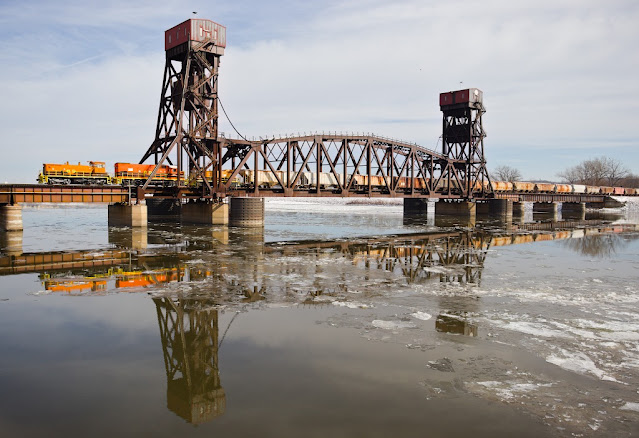
No, I'm not referring to Gaylord, Michigan, and its annual winter "Tip-Up Town" Festival,. but rather Peoria IL, the largest city and primary hub of the Toledo, Peoria & Western Railway (TP&W), long nicknamed the "Tip Up" in railroad circles. By this February, 1997 date, TP&W's controlling ownership by Santa Fe had ended in favor of its sale to Delaware-Otsego Corporation, but the railroad was still operating a large daily westbound train of merchandise and double stacked containers to the BNSF interchange at Lomax IL, behind a traditional brace of former Santa Fe GP20's. Here, the westbound is crossing the Peoria & Pekin Union lift bridge across the Illinois River and beginning its trek across western Illinois to Lomax and eventually, Fort Madison IA. Photos by Mark Hinsdale
At 5:45pm Friday, I finished my newspaper research when the downtown library announced it was closing for the day. I headed over to East Peoria in hopes of catching that A-B-A geep set on the westbound BNSF freight (though a late evening departure seems routine).
I actually saw it, because it was preparing to leave TZPR's East Peoria Yard as I drove past on Wesley Road!
BNSF 2036, BNSF 334, and BNSF 2129 have 20 cars. Scenes are at TZPR's Illinois River Bridge, Darst Street, the through truss bridge just south of Harmon Highway and at W. Farmington Road where a slow order is due to recent flooding.
[The link is to a public group so you should be able to see the comments about B units and Komatsu and Caterpillar flatcar loads.]
Gary Talsky posted
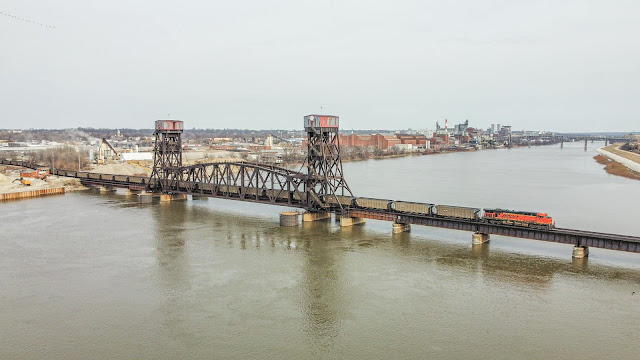
NSDMPE with NS 1024, NS 6744, NS 9875, IAIS 152 cross the bridge tonight (08/15/2017) at 20:10. 1/15 sec. f/5.6 70mm ISO3200 Thanks to Todd Pendleton for the o/s Sparland headsup [This view is a different angle on the bridge. Thanks to the red buildings on top of the towers, I can be confident it is this bridge.]
It is getting to the point that coal trains are worthy of note.
Frank Keller Photography posted BNSF 5793 the rear DPU of a loaded coal train crosses the Illinois River at Peoria, IL. 8.7.18
Gary Talsky posted two photos with the comment: "Not the best resolution and focus for a grab shot since somebody was behind me on the McArthur/Cedar St bridge but here's where the high water stands on Illinois River at the TZPR bridge in Peoria on 02/24/2018 around 15:37. Currently 23.96'"
Hal commented on his posting
The river will touch the bottom of the bridge at 31 feet. The rusty white plate on the protective barrier is (or was at one time) a gauge of the water height. Dennis DeBrulerHal Collins I see the record has been 29.4.
Peoria IL, and it's sister Pekin, across the Illinois River) is an unusual railroad hub in a state crisscrossed by main line railroads.. Although Peoria/East Peoria/Pekin is a sizable, industrial Illinois metropolitan area, it does not straddle any of the primary rail arteries serving the state. Instead, it served as destination to which nearly every railroad in the central part of Illinois built TO, rather than THROUGH. Once sporting fourteen railroads serving it, Peoria even had (and still has) a terminal carrier designed to facilitate interchange to and from the slew of railroads entering the city, and also owns the primary rail lift bridge over the Illinois River. But, with the exception of Toledo, Peoria & Western, itself only a minor player in the historical movement of freight across Illinois, the many different rail companies serving Peoria terminated there, with moderately trafficked branch lines to perform the task. Still served by eight railroads; more than a lot of cities many times it's size in this day and age, Peoria/Pekin remains a fascinating place to railfan (if you're patient!) and to study Illinois railroad heritage. Mark HinsdaleThe KJ transfer with the two Geeps crossing the TZER Illinois River lift bridge.
HalstEd Pazdzior A TZPR local heads back towards East Peoria. 3/17/22
I have been passing up photos of this bridge because it is a railfan favorite, but I note this one because I did not know that the IC used this route.
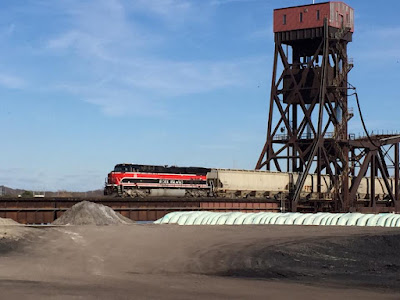
Grant Di Mille posted A CN-IC empty grain train crosses the Peoria & Pekin Union railroad bridge across the Illinois River. This train will use haulage rights across the BNSF from Peoria to East Dubuque where it will acquire home rails. Les Reder shared
Dave Allenson posted A few months after I was set up, I spent a few days working out of S. Pekin. I am on a run back to Adams St. yard from the P&PU at East Peoria. As luck would have it, I had my camera with me! August, 1995.
Comments on the above post
Josh Clark posted two photos with the comment: "2 on the TZPR for today."
1
2
Josh Clark posted HESR 3485 under the bridge this afternoon
BNSF ES44DC 7475 leads PEIGAL West across the Illinois River into Peoria, IL.
2 of 9 photos in the area posted by Josh Clark with the comment: "Last weekend, I had the opportunity to document another great run of the KJRY’s Mapleton turn job. They ran with a healthy 5 units, including three classic GP20s in the middle."
a
b
The towboat Zeus allided with this bridge at about 8:20, Jan 7, 2019. [pjstar] No one was seriously hurt. The bridge was restored to service by the afternoon of the next day [David Jordan comment on a post] The Coast Guard would not say much to the pjstar reporter, including the name of the towboat, which is displayed on the side of the towboat. But it is good they didn't say much because what they did say was incredibly inaccurate: "shearing off the top of the vessel’s pilothouse" "upon impact Monday night, the towboat’s pilot was pelted with debris but escaped serious injury" After seeing a photo, the roof was not sheared off, the entire pilothouse was sheared off!
Jennifer Humphreys commented on a post
My hubby saw it yesterday. Sent me this.
The pjstar also claimed "the towboat was pulling two barges downriver." Even without seeing the photo, I knew that towboats push, not pull, barges. A more creditable description is "The Peoria Rail Road Bridge started dropping before The Zeus had cleared. The Captain had enough time to knock her out of gear and hurry down the stairs before they made impact at 7.5 mph." [Hooked Up Hard Down The Towboater Lifestyle]
Tim Richards: The pilot didnt have time to get out of the wheelhouse. He drove on the floor behind his chair and every thing ripped off over him.
Rj Green: Watched it happen I went out and grabbed his tow.
Barry Potts: Is the bridge manned or is it controlled in the yard. I can't remember.
Carl Bates: Barry Potts unmanned
Bobby Kelley Jr.: I myself was going though Florida Ave. bridge going to Industrial Locks when it started coming down on me just as the head of my tow was going though. Plus the bridge tender wouldn't answer the radio. I had to sound general alarm, shine both of my spotlights in his booth, and sounded my horns. All the while as I was backing down hard. When he finally answered he said he thought I was going fast enough that I would've passing quick enough so he started dropping the bridge down. That scared the crap out of me.
[According to some comments, some bridge tenders are notorious for lifting late and dropping early.]





.jpg)


%20Chicago%20&%20North%20Western%20Railroad%20Fans%20_%20A%20few%20months%20after%20I%20was%20set%20up,%20I%20.png)