Showing posts with label bridgeBobTail. Show all posts

Monday, April 20, 2026

Lock #42 on Trent-Severn Waterway near Couchiching and April 2026 Flood

Lock: (Satellite)
Bobtail Bridge: (Satellite? I could not find it. It is not this "Historic Railway Bridge.")


parks, cropped
47.2m (155') x 9.7m (32') x 6.2m (20')

Mark Culp, Jun 2023

Mark Culp, Jun 2023

April 2026 Flood

He mentions these picnic table tops.
Same Reel

Here is a normal view of those picnic tables. 
Boats are allowed to moor there for up to two nights. [parks]
Peter P., Jun 2022

Facebook Reel

Bobtail Bridge


I can't tell for sure because this photo is just part of the bridge, but it looks like it may be a bobtail (asymmetric) bridge rather than a swing bridge.
Jason Edgar, Jun 2022

Tuesday, July 9, 2024

1916,1947 UP/C&NW+CPKC/Milwaukee Bridge over Mississippi River in St. Paul, MN

(no Bridge Hunter? no Historic Bridges; John A. Weeks IIISatellite)

This is one of the flood incidents of 2024.

According to a topo map and John Weeks, this is UP/C&NW/Minneapolis, St. Paul & Pacific (Omaha) and CPKC/Milwaukee Road. The locals refer to it as the Omaha bridge. A more official name is River Bridge #15. John explains that this structure was one of the original 15 bridges to span the Mississippi River. The first crossing here was built in 1869, and it was a wooden drawbridge.
 
River View, Aug 2016

A bobtail bridge always has a counterweight on the short end to balance the bridge over the pivot.
JohnWeeks
The bridge is 1,055' (322m) long with a navigation channel of 160' (49m).
"Despite a fair number of trains using this crossing, the bridge is maintained in an open position except when trains are using the bridge. The unusual feature of the swing span is that the pivot point is not in the middle of the bridge. Rather, the river section of the swing span is 185 feet [56m] long, while the other side is only 75 feet [23m] long. This feature is called an asymmetrical swing bridge [or bobtail bridge], and it is the only bridge like it on the Mississippi River.According to a local legend, once the bridge was erected, the owner of the land adjacent to the rail line objected to having the bridge swing over his land. To solve the problem, the railroad simply cut off that part of the bridge, and balanced it out with the large concrete slug that hangs off the back end of the swing span. The real reason for the non-symmetrical swing span is that the navigation channel is so close to the shore. The result is that half of the swing span would swing over dry land, so why span that dry land with expensive steel when cheap timber and cheap concrete would do the trick?
[John also describes the corporate history of the bridge.]

Another view of a normal river level.
JohnWeeks

Becky Haag posted three photos with the comment:
Play Bridge
The asymmetrical 1915 Omaha Swing Bridge crosses the Mississippi in St. Paul, MN. On one of my cruises on the Padelford riverboats this summer, I got to see it swing not once, but twice since there were trains waiting as we passed upstream and downstream. It was very cool because I'd never seen it move before.
1

2

3

Becky Haag commented on her post
And you always get a wave from the bridge operator as you go by.

Becky Haag posted two photos with the comment: "I finally got a fairly decent photo of the asymmetrical 1915 Omaha Swing Bridge and the approach in St. Paul this fall on a Padelford Riverboat cruise. It's still used by UP and we got a wave from the bridge tender."
1

2

Andre Wehrle commented on Becky's post
Nice. I got some shots of it in 2021 also from a Padelford boat.

Becky Haag commented on her own post
My dad hit the jackpot on one of his rides. The river was low enough that they could make it without opening the bridge, but he said it was pretty close. He'd never seen the bridge closed, let alone have a train go over them.

.

Flood of 2024


Compare the height on the piers to the river view at the top of these notes.
19:31 video @ 6:46


Wednesday, November 22, 2023

Neptune's Staircase Locks and bobtail bridges on Caledonian Canal near Fort William, Scotland

(Satellite, 7,716 photos)

AtlasObscura, AEROID / CC BY-SA 3.0

For  the love of Narrowboats posted
Neptune's Staircase...
Neptune's Staircase  is a staircase lock comprising eight locks on the Caledonian Canal.
Built by Thomas Telford between 1803 and 1822, it is the longest staircase lock in Britain. The system was originally hand-powered but has been converted to hydraulic operation.
The current lock gates weigh 22 tons each, and require a team of at least three lock-keepers to operate the staircase. They usually operate on an "efficiency basis"; that is, they try either to fill each cut with ascending boats or with descending boats, or to allow for passing, i.e. a dropping craft to pass a rising craft on the same fill/empty cycle.
image credit... Pierre Lesage

Satellite

BritainExpress
"Neptune's Staircase is a series of 8 locks on the Caledonian Canal...The locks were designed by the famous Scottish engineer Thomas Telford and made to handle a change in elevation of 64 feet (19.5m). It is the longest staircase lock in Britain at over a quarter-mile in length (447m) and takes boats about 90 minutes to navigate from top to bottom (or vice-versa). The Staircase took 19 years to build, starting in 1803 and ending in 1822....Telford's design called for a depth of 20 feet (9m) but in the name of cutting costs, the actual finished depth was just 14 feet (roughly 4.5m). This cost-cutting proved shortsighted, as the shallow depth meant that the canal was unusable by most of the large ships being built when the canal was opened....The Caledonian Canal spans the Great Glen, linking Fort William to Inverness. It was designed by Telford to ease boat transport at a time when the Napoleonic Wars threatened British shipping. By travelling up the Canal boats could forego the dangerous trip around the north of Scotland."

A view looking down the staircase. It is near the southern end of the canal.
ScottishCanals

Street View, Jun 2017

The above street view was taken from a bobtail bridge. Note that the railroad bridge is also a bobtail bridge.
Satellite

A video of that bridge opening up.
barry watt, Oct 2023

The railroad bridge is also worth noting.
Street View, Mar 2023

I'm goint to "park" this 2;59 video about the Great Glen fault here for now. I assume this is the "straight line" on which the Caledonian Canal was built.


Sunday, May 28, 2023

1899-1958 Soulanges Canal on the St. Lawrence River

Lower Entrance: (Satellite)
Lock #1: (Satellite) Lift: 23.5' (7m)
Lock #2: (Satellite) Lift: 23.5' (7m)
Lock #3: (Satellite) Lift: 23.5' (7m)
A-30 Road Tunnel: (Satellite)
Lock #4: (Satellite) Lift: 12' (3.7m)
Guard Gate: (Satellite) This was closed in case of emergencies.
Powerhouse: (Satellite)
RR Bobtail Bridge: (Satellite)
Lock #5: (Satellite) Lift: 1' (0.3m)
Upstream Entrance: (Satellite)

The locks are 280' (85m) x 46' (14m) x 15' (4.6m) [stlawrencepiks]

Lock #1 is in the foreground and Lock #2 is in the background.
Association for Great Lakes Maritime History posted
An image of a steamer passing through a lock of the Soulanges Canal near Montreal, Quebec, dated Aug. 23, 1958 (Library of Congress – U.S. News & World Report Photograph Collection). A high-resolution copy of the photograph shows the vessel to be the freighter Fernie.
Additional Historical Information – Soulanges Canal
The Soulanges Canal followed the north shore of the St. Lawrence River between Pointe-des-Cascades and Couteaux-Landing, Que. The 14-mile-long canal enabled vessels to bypass the rapids between Lake Saint-Louis and Lake Saint-Francis.
Operation of the canal and its lock was powered by a small hydro-electric power station. The station also provided electricity for illumination, making the Soulanges Canal the first in the world to be lit at night, allowing for round-the-clock operation. 
First opened in 1890, the canal and its locks remained in operation until 1958 when they were replaced by an enlarged Beauharnois Canal which became part of the St. Lawrence Seaway. After it closed, there were plans to re-open the Soulanges for pleasure boats, but they never materialized. Today, it is a popular cycling trail and park.
Information Sources:


stlawrencepiks
The Old Beauharnois Canal was completed in 1845. The Soulanges Canal opened in 1899. The Beauharnois Power Canal opened in 1932. The two locks at the end of the power canal were added by 1959 as part of the St. Lawrence Seaway project. The Soulanges Canal was closed when the Seaway opened because those two locks could do the work of the five locks on the old canal.

stlawrencepiks, National Geographic photo. This page has a lot of photos of freighters on the canal.
Eastern Shell is leaving Lock #1; and, in the background, a salty is leaving Lock #3.

All of the road swing bridges have been replaced with fixed bridges. And new crossings just filled in the canal.
Satellite

The railroad bridge is still a swing bridge. This view also catches the northern historical bridge over the water bypass next to Lock #5. We can see that it is a series of stone arches. Historic Bridges has photos of the southern bridge.
Street View, Aug 2022

The railroad bridge is a bobtail bridge instead of a swing bridge because the water bypass channel is wider than the canal. The bypass channel is the reason why the lock's lift is only 1' (0.3m).
Satellite

Lock #3:
Dennis Jarvis Flickr, License: Creative Commons Attribution-Share-Alike (CC BY-SA)
Quebec-00151 - Lock number 3 of the Soulanges Canal.

Dennis Jarvis Flickr, License: Creative Commons Attribution-Share-Alike (CC BY-SA)
Quebec-00141 - Lock number 3 of the Soulanges Canal.

Lock #4:
Street View, Sep 2022
The road shows the hill that required a lock to be used here.

In the 1800s, canals were built around rapids in the St. Lawrence River for upbound traffic. Since the freighters were built to the dimensions of the locks, they were called "canallers." To go downbound, the canallers, and passenger ships, would shoot the rapids. That must have been interesting.
CanalDeSoulanges_history, this web page has a history of the canal.
"At this area, the river has a series of rapids, formed by four slope breaks totaling a drop of 25,6 [84'] meters over 12,8 kilometers [8 miles]."

CanalDeSoulanges_history
They had to dig through rock strewn clay on top of sandy soil. The rocks in the clay made it hard to remove the dirt, and the clay on top of sand made it hard to keep the dirt out of the canal. Because of those landslides, extra work was needed to prevent the shores from caving in.

The powerhouse:
Photo: CanalDeSoulanges_heritage; Text: CanalDeSoulanges_history
"This hydroelectric energy was provided by a small power plant, built in 1899 by engineer Thomas Monro, located at the meeting point of the Soulanges canal and the rivière à la Graisse in Les Cèdres. This location. chosen because of its six-meter [19.7'] drop between the canal and the river, ensured sufficient hydraulic force to turn the turbines of the power plant. Although designed for an industrial purpose, the architecture of this building stands out by its “castle” style that was in vogue in the 1870s and that we can find in a series of hotels, such as the Château Frontenac in Quebec City."
Electric streetlamps strung along the canal allowed ships to go through the canal at night as well as during the day.

Street View, Jul 2019

Friday, May 26, 2023

Beauharnois Canal, Locks, Dam and 1932+1951+1961 1.9gw Powerhouse

Lower Lock: (Satellite)
Upper Lock: (Satellite)
Powerhouse: (Satellite)
Dam: (Satellite, actually, the powerhouse is the dam)
Herbert Suspension Bridge: (Satellite)
Road Tunnel: (Satellite)
RR Bridge: (Satellite, it looks like a bobtail (offset swing) bridge)
A-30 Bridge: (Satellite)

The rapids that this canal bypasses "has a series of rapids, formed by four slope breaks totaling a drop of 25,6 [84'] meters over 12,8 kilometers [8 miles]." [CanalDeSoulanges] So each lock probably has a lift of 42' (12.8m).

This Seaway canal along the south side of the river replaces an 1899 canal along the north side of the river.
 
John Van de Broek posted
Saturday morning drive by from the A30 up bound near Montreal…
Dennis DeBruler: Upper and Lower Beauharnois Locks, https://maps.app.goo.gl/WJo8p36X9zVXYqQf8.
 
stlawrencepiks, this has more maps and construction photos of the locks
"This map illustrates three sets of canals that were built in this area between Lake St. Francis and Lake St. Louis. The old Beauharnois Canal that ran from Valleyfield to Melocheville, (not shown), the Soulanges Canal that bypassed the rapids by going north of the river and the Beauharnois Power and Seaway Canal."

The canal is on the right side of this photo.
HydroQuebec

Street View, Oct 2022

Note the suspension bridge on the right.
Street View, Oct 2022

Street View, Oct 2022

After heading north from the bridges over the tailrace of the powerhouse, one comes to the tunnel under the Seaway canal. It looks like they moved more rock in the cuts to the approaches than from the tunnel itself.
Street View, Jun 2022

In the foreground is the railroad drawbridge and Lock #2. I looked at every street view available, and the upper rail hid Lock #1 and the top of the powerhouse in each one.
Street View, Aug 2022

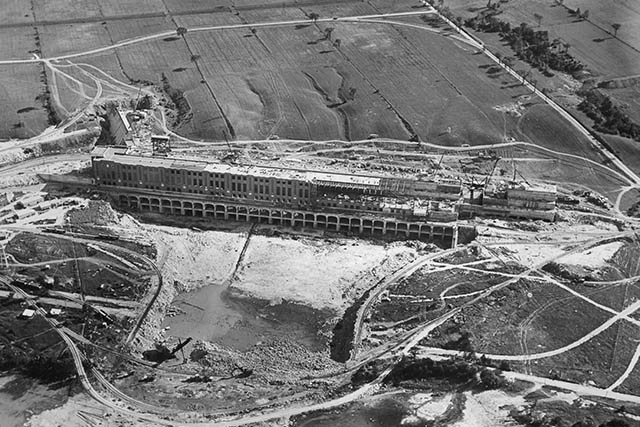
This satellite image allowed me to identify the railroad drawbridge as a bobtail bridge. But what makes this particularly noteworthy is that one of the miter gates has been augmented by sector gates. I've seen sector gates before in rather low-lift locks, but this lock has a rather high lift. Judging from some of the photos, they normally use the miter gates.
Satellite

HydroQuebec_history
The plant was built in three phases. The first phase was completed in 1932 and included the headrace canal and 14 generating units. The second phase finished in 1951 and added 12 units. The third phase added 10 units by 1961
The plant is 926m (0.58 miles) long.

HydroQuebec_history, 1956-1961 on the timeline.

Milieu
"The Beauharnois Power Station is capable of generating 1,911 MW at a maximum flow of 8,200 m3/s.[1m3 = 35.3cu.ft. so the flow is 290kcfs. (Can fill 3 Olympic-sized pools every second.)]...There are 36 turbines in total, 26 of which are Francis Turbines and a further 10 conventional blade [Kaplan] turbines....The Beauharnois canal brings water from Lake Saint-Francis to the dam. It is 24,5 km [15 miles] long by approximately 1 km [0.6 mile] wide for a maximum depth of 9m [30m]. In front of the dam the depth can reach 20m."

That flow is just a fraction of the river's flow. There is another hydroelectric plant in the river itself.
Satellite

Gallery

Gallery

The draft of ships using the St. Lawrence Seaway is 8m (26') [Dennis DeBruler], so the 9m depth of the headrace canal could handle the Salties. Thus the Seaway construction simply had to add a couple of locks on the west side of the headrace.
Satellite

Looking Southish or upstream:
marinas

Looking Northish or upstream:
Michael Restoule posted
Ecosse ,Miss MJ and Vigilant 1 in the upper and lower Beauharnois locks Quebec

Skye Media Quebec posted
Did you know that?
Beauharnois locks have 2 layers of water. The first level at Lock 3 is open to the public, but the second level, even later, is not. Here is a unique view of Lock 4 that goes under the Madeleine Parent Bridge of Highway 30 and gives access to the Beauharnois Canal. It takes about 1 hour per platform to raise the 2 levels of water for the ships.
[This was auto translated from French.]
Skye Media Quebec shared

Jan 5, 2026:
Janey Anderson posted four photos with the comment:
Upbound Traffic Resumes at Beauharnois After Prolonged Delay
After several days of delays caused by heavy ice and one-way downbound traffic, upbound movement has finally resumed at the Beauharnois Locks.
Tanker Algonova was first to make the passage, now en route to Sarnia. Following closely behind, tug Wilf Seymour and barge Alouette Spirit also underway, heading upbound to Hamilton.
With freezing conditions causing repeated issues in the lock chambers and requiring slow, staggered transits for downbound vessels, this progress marks a significant shift in momentum. 
Here you see Wilf Seymour pushing Alouette Spirit barge shots in the icy lock and following Algonova and CCGS Des Groseilliers upon exiting.
Jan. 5,  2026
Anthony BK: That was me in one of the excavators since dec 25th on the left ! Top and bottom lol
1

2

3

4