Showing posts with label rfHall. Show all posts

Friday, December 3, 2021

1936 Aban/CP Wood Bridge over Red River at East Coulee, Alberta

(no Bridge Hunter; Historic Bridges; Satellite)

Marty Bernard posted four images with the comment:
Can We ID This Fantastic TinkerToy Bridge
Duane Hall was in Western Canada when he took these slides dated November 1978.  Thus location could be in Alberta or Manitoba.  Or I could be totally wrong.  Help please.
[EDIT] Jason Paul Sailer commented that it is in East Coulee, Alberta.

Marty Bernard shared

1

2

3

4

"This abandoned bridge is part of the Atlas No. 3 Coal Mine National Historic Site of Canada." [Historic Bridges]

Dennis DeBruler commented on Marty's share
C Hanchey Flickr,
License: Attribution-NonCommercial (CC BY-NC)
Click the left arrow to scroll through several more photos.


Thursday, July 1, 2021

1902 CSX/Toledo Terminal Lower River Bridge over Maumee River

(Bridge HunterHistoric BridgesSatellite)

The Toledo Terminal Railroad went around the Toledo metro area.

C Hanchey Flickr via Bridge Hunter, License: Attribution-NonCommercial (CC BY-NC) 

1 of 7 photos posted by Andrew Dean Detroit
Algoma Conveyor heading into Toledo with assistance from Tug Michigan and Cleveland.
Andrew Dean Detroit shared

Tim Shanahan shared four photos posted by Mike Wilkewitz with the comment: "The Algoma Sault cargo ship passing thru the CSX swing bridge (Lower River Bridge) over the Maumee River. Taken on 4/14/21 at 14:20 at Toledo". Mike also posted a video. The span closing starts about a minute into the video.
1

2

3

4

37:44 video @ 2:24, the video is sped up
The scene is repeated at 22:41 with a regular speed.
 
Marine Historical Society of Detroit posted
Shortly after consolidating the newly-formed U.S. Steel fleet under the Pittsburgh Steamship Company name in 1901, the company started painting the stacks of their vessels silver (hulls were green initially with "straw yellow" cabins.) This quickly earned the fleet the nickname Tin Stackers.  Nine "tin stackers" have steam up and are ready to depart layup in Toledo, on the west shore of the Maumee River near Bayview Park.  The Toledo Terminal swing bridge can be seen in the background.  The date is not noted. Robert Zeleznik collection/MHSD. 
This particular MHSD volunteer is more of a tugboat, fishtug and carferry aficionado, so I will make no attempt to try and identify the vessels. Feel free to comment those you can identify. The Norman B. Ream is obvious, and the photo also mentions the Henry C. Frick and the William J. Filbert. If the Frick is in view, it would date the photo prior to 1964.
 
Bridge Now and Then posted
From the Charles F. Mensing Collection, a 1902 view of stone used for the construction of the Toledo Terminal Railroad Bridge on the Maumee River in the North Toledo Area. (Toledo-Lucas County Public Libraries)
Carl Thomas Ballard: That’s the mast and boom are wood… serious old school….

3 of 5 photos posted by Marty Bernard with the comment:
A C&O Freight Roll By That Needs Info
Leader was C&O GP30 3021 built August 1963.   Duane Hall photos taken May 1982.  I think Duane was in Toledo when he took these.
M.J. Todd commented,  "The C&O freight is on the Toledo Terminal RR approaching and crossing the Maumee River Bridge. The train had just rounded the curve from Oregon, OH and is passing back into Toledo, OH before stepping across the OH/MI State Line approximately 4.8 miles ahead."
John Means: He was. This is Lower Bridge north of Ironville on the Toledo Terminal.
a

b

c

Charles Geletzke Jr. posted
CN (former D&TSL-GTW) Train 382 is seen on the CSXT's former Toledo Terminal Railroad Lower River Bridge on February 23, 2000.  The units are the CN 5543-6008-GTW 5937-5922 with 34 loads, 52 empties, and 4,569 tons. The train is headed to Sarnia, Ontario via the former D&TSL Lang Yard. (C. H. Geletzke, Jr. photo)

Benjamin Swanson posted
B522 rolling over the Lower River Bridge this [Apr 21, 2025] afternoon.

Monday, January 14, 2019

Specialized Containers for Intermodal Loads

I've already written notes about how the ubiquitous boxcar started getting replaced by specialized cars in the 1960s. For example, grain used to be hauled in boxcars. Southern Railway invented the covered hopper car to carry grain much more efficiently. And autoracks made shipping cars in boxcars obsolete. I'm now starting to see that not all containerized loads fit in a box.


Shawn Floyd posted
Dennis DeBruler It looks like the "container" is just 40' long. Maybe the metal is being exported.
[The comments debate what metal is being shipped. Some say that it looks like too many slabs to be steel and stay within the 88,000 lbs capacity limit. These are called flatbed containers. The advantages are: heavy loads can be loaded through the top using regular cranes, the floor is stronger, and there are more and stronger tie-down lugs. They can also add bulkheads.]
A couple of grab shots on I-80 while heading west through Joliet. The truck is probably headed to the UP or BNSF intermodal yard that is south of Joliet. These turned out pretty well considering I was shooting them "blind." That is, I kept my eye on the road, not the camera.

20170608,15 9186, cropped

I posted these photos on Facebook.
Dennis DeBruler 1295 is Trichlorosilane, whatever that is. The blue placard means it is dangerous when wet.
Alan Roeben Gives off hydrochloric acid when it gets in contact with water. 

Used in silicon conductors when ultrapure.


Dennis DeBruler posted two photos with the comment: "In a westbound intermodal train on BNSF in Downers Grove, IL, on 5-29-17, I saw my first container compatible tanks.They were in the piggyback part of the train instead of the double-stack deep well part. The second tank had a placard: 1993: 131 Compound, cleaning liquid (flammable)."
1

2

The Arrowedge is also a specialized container. In fact, it is very specialized because it doesn't hold a load at all and should be placed only as the top container on the first platform.

Update:
safe_image for What Is Intermodal Equipment?

And before today's standard container and deep-well platforms were developed and adopted, there were some interesting experiments.
Marty Bernard posted three photos with the comment: "AT&SF Containers at San Bernardino, CA, Duane Hall photo, August 1986."
David Williams: I was at Corwith when Santa Fe debuted the A Stack to the shipping traffic managers. They were really supposed to be for a hybrid grain/intermodal use. The top and side bottoms were able to be opened and closed for grain loading and emptying, even designed to empty the top container thru the bottom container like dumping grain cars. If memory serves me, the thought was to put these in the fields during harvest time, collect them when filled, stack on fuel foilers and run them ad/hoc in intermodal or merch service to supplement unit grain train service. When not in harvest service they could be used in intermodal service, notice how heavily reinforced the rear doors are, hence part of it’s downfall. These were so heavy engineered to be able to hold bulk grain and they were HEAVY. They also needed a chassis (wheels) to be moved on the road. Unfortunately the prototype chassis was a cut up Fuel Foiler section with tires, as it needed the support from the full length of the spine/beam of the railcar, this too was HEAVY. Interesting idea that was destined to fail, too HEAVY. They ended up as storage containers at various locations.
Just some more worthless trivia stuck in my head. When the mechanical engineers came to John Reed (CEO) with this articulated intermodal flat car idea, they figured it would be best in a 6 trailer configuration. John Reed who was a tea totaler wouldn’t have any thing on his railway known as a six pack, I can’t make this stuff up! Fast forward to today - spine cars (articulated cars) are in 5, 3 and 1 configuration and all ten packs/ Fuel Foilers are a historic memory.
Jerry Mike Harris: A stack never caught on, but the ten packs made Santa Fe a big profit.... they ran the wheels off these cars... I did a study when I was on staff and the ten pack put on almost 10 times more milage than a conventional trailer flat car in a years time...
Steve Rippeteau: David Williams OK your dissertation helps explain the issue ATSF had to reckon with the lack of braking power. Ever since that era ATSF came up with the “tons per operative brake” or TOB formula so we could determine what the maximum speed of our train could be set at. Those A trailers were so damn heavy, (even empty) especially on a 10 pack with only 3 brake valves and 20 A containers, we couldn’t have slowed down fast enough for normal track speed! WOW! I never did work a train with those A stacks in the 40 years I was on the ATSF. Thanks for your info!
Ted Gregory shared
Brian N Amy Regal: That neat. Was there a purpose to being designed like that I’ve square corners.
Dennis DeBruler: Brian N Amy Regal I had assumed the curve at the top was like the curve on autoracks --- it avoided having to cut "ears" into tunnels.
1

2

3

Marty Bernard posted three photos with the comment: "Three More of Those AT&SF Containers. Duane Hall took these in August 1986 in San Bernardino, CA."
John Perkowski: What I see is lost space and difficulty to load and unload. If I were offered these as a shipper, I’d be running to UP, SP, or MoPac.
1

2
Jonathan Forrest Stroup: This looks oddly like an aviation setup.
Steve Rippeteau: Jonathan Forrest Stroup yes, my foggy memory remembers an article in the ATSF company magazine saying they were designed to slide into the cargo hull of aircraft similar to the ARMY & AIR FORCE shipments. So they took intermodal one more step.

3
[The logo explains why they called them "A Stack" containers.]


Sunday, September 2, 2018

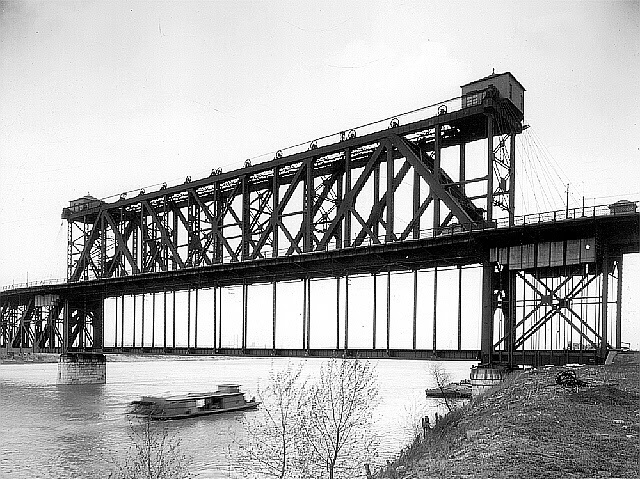
1911 Armour Swift Burlington (ASB) Bridge over Missouri River in Kansas City, MO

(Bridge HunterHistoric Bridges; HAER; 3D Satellite)

Burlington as in CB&Q.

Street View, Jun 2022

Randy Volskay posted
I find draw spans intriguing, and I'm sure I'm far from the only person, with such fascination. This span is the Armour-Swift-Burlington drawbridge spanning the Missouri River, between downtown Kansas City, and North Kansas City, Missouri. Like a couple other draws, in the area, it once featured an auto roadway, on the upper deck, with rails on the lower. This span was peculiar in that the lower chords simply pulled up through the girders of the main structure, the main span did not mover. It was raised, this day, but I never found out if it was because of the flooding, or a standard exercise. River traffic had been suspended, at that time.
This was a dual deck bridge that carried tracks on the lower deck and, initially, a trolley on the upper deck with road outriggers from the upper deck. Later, the trolley was replaced by two more (skinny) lanes of traffic. Except for the navigation span, the tracks were in a through truss and the trolley was on a deck truss. For the navigation span, the trolley was in a through truss and the tracks were on a deck that hung from that truss via steel columns called hangers.

Jim Pearson Photography posted
Kaw River Railroad lease unit WAMX 6033 slowly moves across the Kansas River into at Santa Fe Junction with a daily mixed freight on June 29th, 2022.
According to Wikipedia: The Kaw River Railroad (reporting mark KAW) is a Kansas City, Missouri railroad, established in June 2004. Twelve miles of original track served the Kansas City Southern Railroad and its customers in Kansas City and Union Station. The original KAW was a Kansas City Southern Railway Company property and was the first shortline Watco began operating for KCS, serving customers in the Greater Kansas City area and interchanges with the BNSF, KCS, and Union Pacific. 
The April 2005 expansion was a BNSF property serving customers in Clay County, Missouri and interchanges with the BNSF at Birmingham, Missouri. The KCTL interchanges with the BNSF, ICE, KCS, Norfolk Southern and Union Pacific at Kansas City.
Tech Info: DJI Mavic Air 2S Drone, RAW, 22mm, f/2.8, 1/2000, ISO 110.
https://fineartamerica.com/featured/kaw-river-railroad-lease-unit-wamx-6033-at-kansas-city-mo-jim-pearson.html
Jeff Cook: If you look closely, the white building with the big trusses on top is the arena formerly known as Kemper Arena. It was host to the 1976 Republican National Convention, the 1988 Final Four, the Big 8 and Big 12 basketball tournament, numerous NCAA tournament games, many concerts and other events. The first concert I ever attended in person was Elvis Presley there in 1977, just 2 months before his death. Many great memories in that building. The KC West Bottoms area is still thriving with railroad traffic these days.
Robert Youngers: Jeff Cook and Kemper is where the stockyards used to be. There was tons of tracks here according to the map I have (it shows the RI, Santa Fe, Katy, Milwaukee Road, and BN had small yards at Kemper). Santa Fe had a line that ran along the flood wall to the RI bridge where it merged with the Frisco and a KCT line that continued on from BN Jct. At the RI bridge it became the Kansas City Connecting RR which ran apparently underneath the MP and UP lines (and also connected to them) and ended at a small yard on the north side (there is a trench visible on Google that should be where the line was: 
https://www.google.com/maps/@39.098222,-94.6100193,194m/data=!3m1!1e3
 And BN (Burlington) had a small yard where that construction lot is. And the KCS line to Armourdale was along the north side of the river.
Tim Parker: Are there any pictures of the flood bridge up? Do they open it often for maintenance?
Derek Brady: Tim Parker it's rarely opened except in severe flooding conditions. It isn't a simple process like a drawbridge. They do maintain it, just not to the full extent of opening it.
I've seen a few photos, but I don't know where. It hasn't been opened very often, early 50's (54 ish I think) and '93 and maybe once more. They had it ready to open when I was working out of Herington to KC , same with the bridge across the Ks river at Topeka, but they didn't raise either. By ready I mean rails cut, people on standby just hanging around waiting for the word to start the lifting process and put flood gates in.
 
kcengineers
"The bridge is one of only two of its type ever built. To satisfy the railroad's need for the railroad tracks across the bridge to be as low as possible, and the riverboats' need to have enough clearance under the bridge, Waddell developed a unique design that had automobile traffic on a top deck and rail traffic on a lower deck that could be raised to allow riverboats to pass. The lifting of the lower deck was accomplished by telescoping the hangers of the lower deck into the truss members of the upper deck, thus allowing automobile traffic to continue even when the lower deck was raised."

Randy Perkinson posted four photos with the comment:
This is the Armour-Swift-Burlington Bridge (or just ASB Bridge) across the Missouri River at Kansas City, Missouri.
This historic 1912 bridge once carried both road and rail traffic, but the roadway deck was removed following completion of the Heart of America Bridge just downstream.
The main span railroad deck is suspended from the upper level, stationary truss and can be raised via a system of cables, pulleys, and counterweights up into the truss to allow river boats to pass under.
This bridge is an American Society of Civil Engineers National Historic Civil Engineering Landmark.
Timothy Noles: Designed by Hardesty Hanover founder JAL Waddell!
1

2

3

4

Google Book, p772
Old Postcard from Bridge Hunter
Randy Volskay posted
 NS transfer run crosses the Armour-Swift-Burlington draw bridge, in Kansas City, Mo. This is a pretty unique span. The truss sits above what used to be the highway deck, and the vertical plate columns would lift the track girders to the required height. The highway was moved, about 25 years ago, but the railroad portion, obviously, still moves along.

Postcard Digitally Zoomed
On top of the navigation channel truss, above each hanger, was a sheave (pulley). On both sides of each portal was a drum with grooves. On each side of the adjacent road deck was a line of sheaves. These sheaves allowed steel cables to be strung from the top of each hanger to its own counterweight. (Actually, the end of the suspended deck must have had a couple of cables going directly to the suspended deck without a hanger because I don't see a hanger and I see two smaller counterweights.

The portal photo below shows the road configuration after the trolley tracks had been removed.
photo from MO,48-KANCI,16--9 from mo0450

Digitally Zoomed from the .tiff copy
This closeup shows how the cables passed over the end of the bridge. The shaft on the right goes into the machinery house. There are gaps between the cables compared to the number of groves in the drum because each cable is wrapped more than one revolution around the drum and then connected to a counterweight. This provides enough friction so that this powered drum can raise and lower the track deck. (The counterweights should be adjusted so that it takes about the same amount of power to lower the deck as it does to raise it. I know when they paint a drawbridge in Chicago they have to adjust the counterweights to compensate for the change of the bridge weight caused by the paint job.) It appears that two steel cables are used for each hanger/counterweight connection.

Initially, the deck could be raised in 50 seconds, but due to the age and condition of the machinery, it now [1984] takes about three minutes. The synchronization of the two sets of machinery at either end is handled by a counterweighted rope drive connecting opposite motor shafts. The motors are connected electrically and both operate simultaneously. In case either should be out of service, the lifting deck can be operated by a single motor from either end, the machinery at the opposite end being operated through the rope drive. Limit switches cut off the current to the motors and apply the brakes near each limit of movement. [HAER, p10]
modot_293A_004, July 14, 1951
Disasters, Floods, 1951: Three unidentified men examining flood damage on the washed out railroad level of the ASB Bridge over the Missouri River, Clay County
Randy Volskay posted
Coming home, today, and the old ASB draw bridge, across the Missouri River, in Kansas City, was raised (all the other spans were open, as well). This isn't a frequent event, and I've never been fortunate enough to have seen it.
James Clary posted
One from Kansas City
Blair Denny When I worked for the KCS as a conductor and engineer, we delivered empty coal trains to BNSF Murray Yard in North Kansas City from the KCS's Knoche Yard in Kansas City over this structure. (More often we were routed over the Kansas City Terminal and BNSF along the Bluff Track to the Hannibal Bridge.) This photo of the ASB Bridge is looking north over the Missouri River. The large span over the river's channel lifts vertically.
(Facebooked)
Edward Schlag posted
The Missouri was running fast and high that day. ASB RR Bridge in action back in August, 2011.
Edward Schlag I was there one day when it went up. The noise the bridge and cables made is indescribable! Very cool.

Marty Bernard posted
What Bridge Is This?
This is a Duane Hall photo. The hard to read processor's date on the slide seems to be August 1984. Does the color of the bridge look right? Just beyond the bridge, another bridge is under construction (?).
[EDIT] The Armour-Swift-Burlington Bridge, also known as the North Kansas City Bridge and the LRC Bridge, is a rail crossing over the Missouri River in Kansas City, Missouri, that formerly handled automobile traffic. Wikipedia
John Perkowski: Yep, the ASB. You’re looking SW to NE, or from KCMO to Northtown. The bridge going up is the Heart of America, or MIssouri Highway 9, and it makes landfall near the new KCMO US Courthouse.
Sawyer Regensberg: I thought this was ASB. Sure has heck saw the real thing often enough!
Fun (and totally unrelated) fact; there’s a sunken LCVP landing craft...with a STEEL hull no less...under the south end of the bridge. You can see it when the rivers down. They were built just upriver and I suspect that one wasn’t sealed correctly and sprang a leak, being rammed ashore to try and save it

Marty Bernard shared

I was looking for views of the Buck O'Neil Bridge, and I found this view. It strikes me that the river level is rather high. But this is the only view available from this location so I can't look at other dates.
Street View, Jun 2015

Steve Monroe posted six photos with the comment: "Lift for barge traffic-Missouri River. Still in use."
1

2

3

4

5

6