Showing posts with label rfDziobko. Show all posts

Saturday, July 9, 2016

21st Street Towers

There are two towers near the 21st Street Crossing. Most pictures of this crossing don't let you see either of the towers because a train blocks the view. I have collected the few pictures that include a view of a tower in this posting. This is a rewrite of the posting because I finally came across a photo that shows both towers. The little brown building near the bridge would be the tower that controls the Canal Street RR Bridge. The brick building on the right is the tower that controls the 21st Street Crossing.

(Update: the 1944 two story brick interlocking tower shown in these notes replaced an 1893 elevated tower.)
Steven J. Brown posted
Amtrak Ann Rutledge #303 at 21st Street in Chicago - August 30, 1988.

Steven likes this railfan location. I'm glad because it clearly documented both towers: bridge and junction.
Steven J. Brown posted
Conrail SW7 8908 (built 1950 as Peoria & Eastern 8908 to PC 8908, became Brandywine Valley 8203) at 21st Street in Chicago, Illinois - April 12, 1988.
Erick Roman: I imagine this job was based out of the yard at Ashland. And are returning. But where are they coming from? Did they have industry work north of 21st street. Or are they coming from Amtrak?
Cool photo, thanks for sharing this.
Joel Sieracki: Continental Paper Grading Company on Lumber St received lots of box cars until they moved to Hodgkins in 2020.
Steven J. Brown shared

Photo from a posting
Amtrak SW8 750 switching the south end of the Chicago yard at 21st Street - September 12, 1988.
Gordon Leonard posted
It's still Feb. 1976. We're still at The Bridge. Check out the damage at the lower right front. It hit something....!
Bjarne Henderson They ran fast and were a pleasure to work on from a service attendant's perspective. They had access doors near the food service area so you didn't need to schlep all your stuff from one end of the car or the other as you still have to do with Amfleet. Clearly, whoever designed the Turbocafe considered the needs of employees as well as the passengers. Too bad that they wore out too quickly compared to their peers.
[This photo catches the bridge tower. Note the signal heads are missing many positions because only slow speeds are allowed across this bridge.]
Bill Molony posted
Pennsylvania Railroad Baldwin "Sharknose" DR-6-6-2000 #5786 with train #52, the Fort Pitt, on July 4, 1949.
Dennis DeBruler One of the better photos I have seen of the bridge" tower." The junction tower is to the right, out of frame. The controls for the bridge were moved from the cabin above the span to this tower.

John Dziobko Jr. has a 1955 picture that captures most of the junction tower and the bridge control tower. It appears the signal has yet to be converted to a "red eye" head because it is displaying the old horizontal positional aspect for "stop" of three yellow lights.
 
Robert Daly posted two photos with the comment: "Chicago & Western Indiana's 21st Street Tower, October 5 1974. This facility controlled the junction with the PC (PRR), ICG (IC and GM&O) and ATSF. The location was known as AT&SF Junction to the C&WI but Fort Wayne Junction to the PRR. The dwarf (excuse me, vertically challenged) semaphore looks like a Disney Pixar creation."
1

2

Joseph Tuch Santucci posted
21st Street Tower in Chicago. This tower stood on the southeast quadrant where CN’s Illinois Central Freeport Subdivision crossed and connected to the Amtrak Chicago Terminal trackage. Ownership of the line changed from Conrail and later NS to Amtrak on the south side (compass) of the interlocking. Prior to Amtrak this was PRR then PC track. It was sold to Amtrak I believe in the late 70’s or very early 80’s. 
The GM&O and predecessor Chicago & Alton connected here in the northwest quadrant which is out of the photo. The Chicago & Western Indiana also crossed here with their right of way to the immediate west of the Chicago line. They crossed at an angle and their tracks were located at the bottom of this photo. The Santa Fe also crossed the Chicago Line just south of the IC tracks and their coach yard and servicing facilities were behind me. 
In the early 2000’s 21st Street also controlled Amtrak Terminal trackage in New Orleans remotely from here. Yes, New Orleans. 
While it’s still a busy crossing it’s not like it was in the heyday. The tower was closed around 2009 or 2010 I think. Memory isn’t quite certain these days. And the tower is gone. I was in here a couple times back in 1986-87. 
On the IC and CWI it was 21st Street. On the GM&O it was Fort Wayne Jct and on Conrail it was Alton Jct. 
This photo was from 2004 if memory serves correct.
Bob Poortinga: Just to the left and behind 21st tower you can see the shanty that housed the operator at South Branch Bridge. This person was both a block operator for PRR/PC/CR and the bridge operator. I posted that job for a couple of days and got to operate the bridge as part of my training. This was about 1973 or thereabouts.
Harold J. Krewer: Earl Poulsen, the tower belonged to (and was staffed by) the C&WI, even long after all the C&WI track to Dearborn Station had been abandoned. They sold the interlocking plant and tower to Amtrak in (IIRC) the early 1990s as the C&WI was being dissolved. The four regular operators (first, second, third and relief) also came along with the tower and became Amtrak employees.
21st St was remoted to the Lumber St. Train Director in early 2005. I was one of the Trainmasters assigned to oversee the cutover, which took place overnight on a Friday night/Saturday morning.
[Several of the comments provide details about how the tracks through this crossing changed.]
 
Dave Allenson commented on Joseph's post
A view of the inside of 21st St. from January, 1997.
 
Steven Keen commented on Joseph's post
Is this the same bridge?
Dennis DeBruler: Steven Keen yes, https://maps.app.goo.gl/mFF2Sek9UFtxdghf8. That view used to have a lot of C&WI tracks in it.

Mark Llanuza caught the junction tower:
Mark Llanuza Photo
Penn Central E-8 at Fort Wayne Jct Santa Fe tower 1973
 
Larry Candilas posted
March 1978 - southbound ICG switcher is lost and looking for it's train. A junction of several names, depending on what railroad you worked for - 21st St, Alton Jct, AT&SF Jct.

Mark Hinsdale posted
Filed under "Local things we just don't see anymore..."
What I presume to be a BNSF Cicero (or Eola) to Glenn Yard transfer job curves off Amtrak's South Branch Bridge and onto the Illinois Central Railroad's Joliet District (the ex Gulf, Mobile & Ohio main line), on a beautiful June, 1998 afternoon. A quarter century later, first generation power and inter-yard transfer moves across the city are long gone from BNSF, as is the brick interlocking tower where operators controlled the once complicated junction at Chicago's 21'st Street.
[And you don't see that H1 livery very often anymore.]
Kevin A. Sadowski: Man that scheme really looked good on everything from high hood geeps to -9s
Mark Hinsdale shared
Steve Kraus: Old power and towers, okay. Why don’t they need transfers anymore?
Daniel Evans: Rationalisation of smaller yards into larger ones, usually further from the city, and direct runthroughs of full manifest trains between them, avoiding congested routes in Chicago if possible.
For BNSF-CN, CN have now centralised everything at Kirk, and BNSF rely on Galesburg to sort out a lot of Chicago transfers. The routing is probably Galesburg - Eola - former EJE - Kirk now.
Walt Del Calle: Daniel Evans exactly. Once in a while, the Galesburg crew will have to do a bit of work at Eola. The train will be tied down on the J main, most often at West Bridge Junction, East Bridge Junction, or 111th St. and a CN crew will come for it.
Walt Del Calle: CN brings the westbound L-595 into Eola and ties it down unless the BNSF crew is there already, which happens once in a while.

Jeffrey Schackart posted
i operated this junction at 21 and canal in 1980,...2 story brick building by engine shown...the chicago and western indiana operated this junction point.

This shows another tower that would be further south. Given how old this view is, this building may be a switch tender shanty.
Kevin Leahy posted
PRR K-4 heading out of town. circa 1939.
Eric Reinert Blasting out of town is more like it! At 22nd St. having just crossed the C&WI tracks. First stop: Englewood. Just to the left of the PRR PL signal you can just make out the elevated tower that straddled the complex crossing here until about 1945.
Update:
I put a red rectangle around the tower because I almost missed it. Mark caught the area after the C&WI and Santa Fe tracks had been torn up but before new Chinatown was built.
Mark Llanuza posted
Its 1987 at Chinatown 21st jct
Fred Mohr Hmmm thinking 89 with the CTA orange line completed in the background.Erik Coleman And the 3118 didn't exist until November 1988.
Jim Ripley shared
[Judging from the comments, I'm supposed to get excited about a GM&O Alco PA in Chicago. But I'm more excited about a view of both the junction and bridge towers and the number of diamonds the view includes.]
Bill Molony posted
Chicago & Western Indiana Railroad Alco RS-1 #526, pushing the equipment for Erie Lackawanna train #6 from the C&WI Coach Yard at 47th Street through 21st Street towards Dearborn Station - 1967.
Bill Molony shared
Steven J. Brown posted
Viewed from 18th Street in Chicago, The Amtrak City of New Orleans waits for the Capitol Limited to clear 21st Street/Alton Jct before taking the left and then shoving into Union Station - January 24, 1990. CTA Orange line is under construction.
[The tower is on the right in front of the lead Amtrak locomotive.]

Bob Lalich Flickr

21st UP business car 12-89


I happened to catch this unusual move at 21st St. I have no idea what the circumstances were but I'd sure like to know.


Another view that has both towers because the photographer is above the train so that the train does not "skunk" the towers.


Wednesday, October 28, 2015

PRR's South Branch Bridge Interlocking Tower

When researching the Canal Street RR Bridge, I learned that control of the bridge was transferred from the machinery building on top of the span to a "nearby interlocking tower." The building on the right in these photos is that interlocking tower. It controls the bridge and the signals regulating the crossing of the bridge. There was a larger tower southeast of this one that controlled the 21st Crossing.
Posted by Bill Molony on Facebook
Bill posted again
Pennsylvania Railroad Baldwin DR-6-4-2000 "Sharknose" #5786 departing from Chicago with PRR train #52, the Fort Pitt on July 4, 1949.
David Nelson April 27, 1947 - April 28, 1968.
Dennis DeBruler One of the better views I have seen of the bridge control tower.

Bob Lalich commented on a post
The cabin seen right of the tracks controlled the interlocking depicted in this drawing. I believe the bridge itself was controlled by an operator in the structure on top of the span.

Dennis DeBruler commented on Bob's comment
When built, it was controlled from a room in the shadows under the machinery house. But when I researched the bridge, I read that control was transferred to "a nearby interlocking tower." Unfortunately, I didn't note the source of that statement. I searched some references, but I was unable to find that statement again.

Thanks for confirming that the little tower was an interlocking tower.


Bill Molony posted on Facebook

Willam A. Shaffer posted
Amtrak E8A #201 (ex-B&O #1443) - Chicago, IL (Circa 1973)
(Photo by Mike Parafink - Collection of William A. Shaffer)
AMTK #201 is shown crossing the 21st Street Bridge in Chicago.
[
Note that we can see part of the bridge tender's shack. Also note the top signal head can display only the "red eye" aspect.]
Willam A. Shaffer posted
B&O E8A Locomotive .(June, 1973)
21st Street - Chicago, IL
(Photo by Mike Parafink - Collection of William A. Shaffer)
Mark Jones: William A. Shaffer, Ex-B&O E-unit ( probably 1457?!) and look at the South Branch Bridge in Penn Central script w/ “W-19”— do you remember what that meant? !? It was for the trainmen and told them “track 19, West side platform unloading”…. Still remember that after all these years!
William A. Shaffer: Yes, I still remember the designations and what they meant! Seems like just yesterday!
Gordon Leonard posted
It's still Feb. 1976. We're still at The Bridge. Check out the damage at the lower right front. It hit something....!
Bjarne Henderson They ran fast and were a pleasure to work on from a service attendant's perspective. They had access doors near the food service area so you didn't need to schlep all your stuff from one end of the car or the other as you still have to do with Amfleet. Clearly, whoever designed the Turbocafe considered the needs of employees as well as the passengers. Too bad that they wore out too quickly compared to their peers.
[Note the signal heads are missing many positions because only slow speeds are indicated for crossing the bridge.]
Steven J. Brown posted
Amtrak International departs Chicago for Toronto at 21st Street - September 12, 1988. The International used to alternate VIA/Amtrak equipment every other day. VIA Rail F40PH-2 6407 was built in 1986).
Dennis DeBruler It shows the one-story bridge tower by the bridge and the interlocking tower a little to the east.

John Dziobko's 1962 photo shows the "red eye" head illuminated. A 1955 photo of a C&WI commuter train shows the "stop" head before it was converted to a "red eye."

Mike Breski posted GM&O 101 crossing the bridge.
Bob Poortinga One of the few photos I've seen that shows the PRR South Branch Bridge interlocking shanty. The block operator also operated the bridge. If you look closely, you can see the PL signal that protected the bridge. This was *not* part of 21st St. Interlocking. If you look even more closely, you can see part of the backside of the home signal for 21st St just above the engineers location.
Dennis DeBruler While trying to find the link for the above photo, I found a similar view.
http://rrpicturearchives.net/showPicture.aspx?id=1880219
Dennis DeBruler Sam's upload: http://cachman.rrpicturearchives.net/showPicture.aspx...
[Additional comments discuss Pennsy's 22nd Street Tower.]

Monday, June 29, 2015

IRM: Switching Class and Fairbanks-Morse


Updates: I learned from The Diesel Shop that Milwaukee Road 760 was Fairbanks-Morse first diesel locomotive. The aerial photo of the factory has been moved to Beloit, WI factory.

20150627 2129
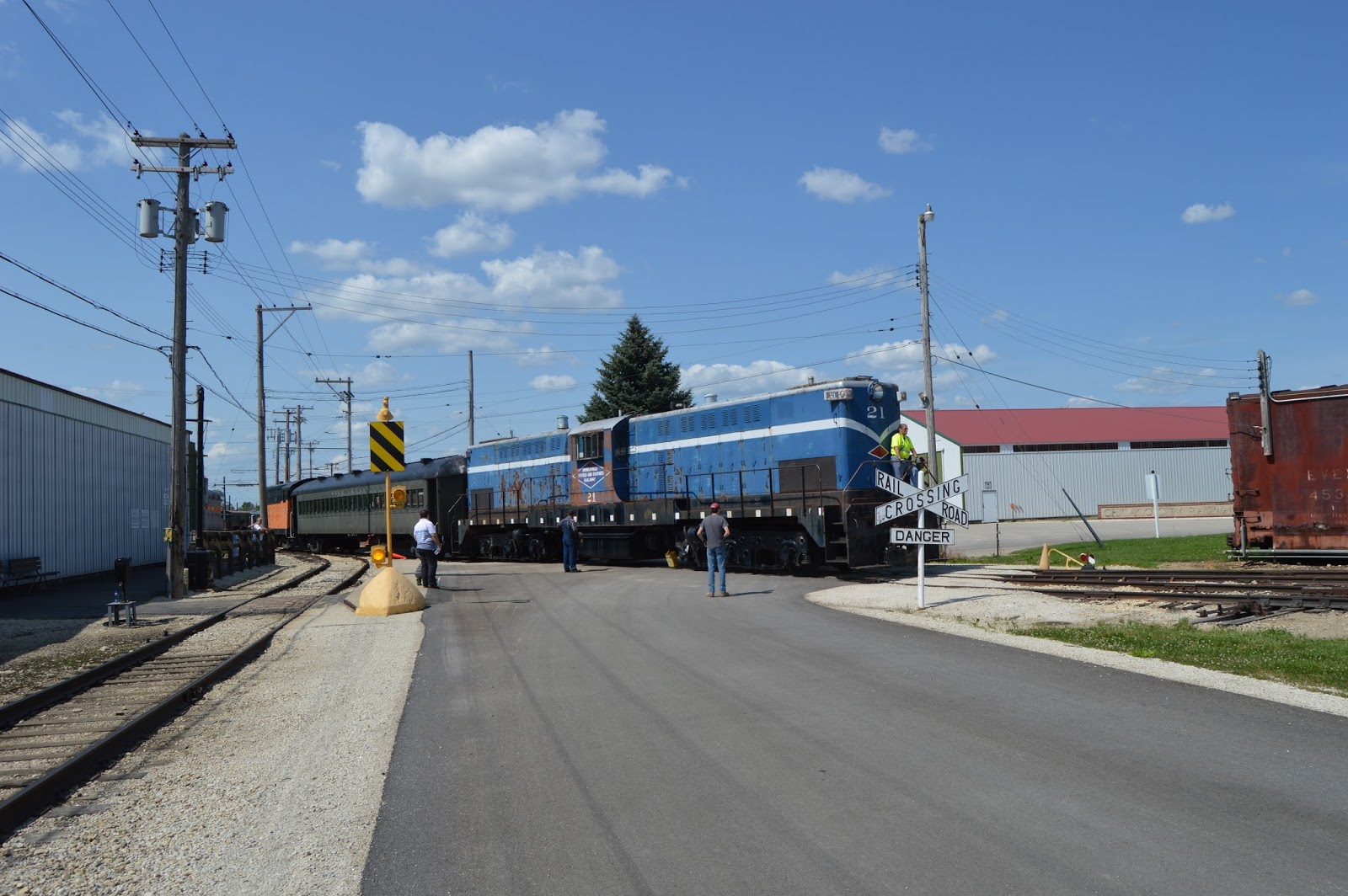
There was a lot of activity involving Milwaukee Road 760 at the Illinois Railway Museum. I learned later that they were teaching a class of volunteers how to do switching.


The first activity that I had spotted is below --- Milwaukee Road #760 pulling a crane out of the steam engine service facility.


2:45:22
After I visited Barn 7, I noticed #760 was running light back to the steam service area. I asked the trainman if it was a Fairbanks-Morse Diesel. It was. He said the IRM has three, but this is the only one that is operational. I suggested that one of the RMs be displayed with some of the covers opened so that we could see what an opposed-piston diesel looks like. As I had mentioned: "FM made an opposing piston design that did not work very well in locomotives, but did work very well in the submarines of WWII." The IRM roster indicates this FM H10-44 was built in 1944 and arrived at the museum in 1981. It had six cylinders and it ran on AAR-A trucks with WH 362D traction motors. Each cylinder would have two pistons. So it is comparable to a 12-cylinder V-8 engine and generated 1200 horsepower. (The other two FMs are SWPC (Southwest Portland Cement) #409 H20-44 built in 1947 and Santa Fe #543 H-12-44TS built in 1956. See the end of the posting for a picture of #543.) The building in the background of these pictures is Barn 9, the one I generally see because it contains the big equipment such as the Zephyr, GG1, Little Joe, UP DDX, and steam locomotives.

I took this picture to record that they have not started yet on the turntable and roundhouse that the master plan specifies for this location. I believe the crane had been coupled to the coach car. So normally one cannot see this lineup of steam engines.

Digitally zoomed and brightened since the locomotives were backlit

2:49:20
#760 was going back on the north lead to couple to the passenger coach and TP&W diesel that we saw above on the north lead. Note that they have moved the crane to the lead next to the southern most lead. The earlier picture of them pulling the crane out of the yard has a time stamp of 2:37:10. And the picture above with the time stamp of 2:45:22 was of #760 leaving the yard after it shoved the crane into place. So it took 8 minutes to place the crane. I took a video of them pulling the coach and TP&W engine to capture the sound of the opposed piston engine and "switching speed."
(new window)


2:58:04
As they pull out the TP&W #400, we see that they still have a Chicago & Northwestern diesel on the north lead.
2:58:04, digitally zoomed
TP&W #400 is an Alco RS-11 built in 1958 and arrived in 1983. It rode on AAR-B trucks with GE 752 motors powered by a 12-251B engine that produces 1800 horsepower. CNW 4160 is not in their printed roster that I bought for a dollar, but it is in the online roster.

I noticed every time the engineer goosed the throttle, the exhaust turned white for a couple of seconds. So I took a series of pictures trying to capture each acceleration. You have to look closely to tell the "smoke" from the clouds, but it is discernible. I assume the smoke is caused by turbo lag.


When I entered Barn 9, the CB&Q Burlington Zephyr was on the left and a huge center cab locomotive was on the right. The barn doors were open so I had some light. But you can see the width of the aisle is big enough to walk, but not to take decent pictures. After I walked down this aisle, then took quite a few pictures of the Maintenance of Way equipment they had on the other side of Barn 9, and then walked back along another aisle in Barn 9, I discovered that this center cab engine was one of the "homework" problems for the switching class.

3:48:11
3:22:12
3:48:21
3:22:18
3:24:40
3:49:19
3:25:00
3:25:22
As I explained in a video, the coupler did not lock until the fourth try. They wanted to couple with a "gentle" speed.
(new window)


I had overheard that they were going to do some more switching, including a cut of cabooses. I had already noticed a cut of cabooses near the back of their property. But my friend and I were done looking at Barn 9 and we were getting tired, so I did not stay for more switching activity.


Kevin Piper posted two photos with the comment:
Milwaukee Road H10-44 760 (originally delivered as the 1802), is the first Fairbanks-Morse locomotive constructed in their own plant. It is preserved and on display in operating condition at the Illinois Railway Museum. I like how the restoration was done to represent how it looked when last in regular service. Union, IL, 6-18-11.
(Facebooked)
1

2
Wzrren Avis posted
End cross section of Fairbanks-Morse two stroke opposed piston diesel engine. They have their own unique noise.
Gregory Maxwell These are power on USCG WTGB Ice-breaking tugboats (which are diesel electric)
Jeff Lilja These engines were also used on WW II subs
Joshua Sutherland I believe they still use them as auxiliary engines in modern nuclear subs.
David Brann Years ago, I had a co-worker who had been a crewman on one of those subs. He said that the overhead was really low, and it was a real treat to change out the upper crankshaft!
David Behlke Rob Jenkins Their locomotive plant was in Beloit, Wisconsin. They still have a large plant there now, and they produce the ALCO 251 prime mover as well.
Denny Kurzawski This design is still used on the HUGE container ships.. It's been around quite a long time..
Pete DeFillipo I own an H12-44 locomotive that has a 38D8-1/8 6 cylinder OP engine. I had to install a new timing chain, reset the proper lower crankshaft timing and install and properly shim 12 rebuilt fuel injection pumps (2 per cylinder) . Then I needed to adjust both sets of pumps to fire at the same time per cylinder. ALOT of tedious labor. Thats for sure. I have 50 pounds of engine and loco shop books which came in handy while doing all this work. I also own a spare 38D8-/8 engine core that I am trying to sell. It is missing some parts though.

Michael Milner comment on a post of some locomotives
Cross section from tugboatenthusiastsociety.org website. This is one of the most interesting Diesel engines. The Napier Deltic was also an opposed piston design used in British locomotives and marine applications that shares some similar traits with the FM.

IRM generally does a pretty good job of either painting their diesels or storing them in a barn. I took pictures of Santa Fe 543 because it is a rather noticeable exception to good preservation practices. When I checked the roster, I learned that this is another one of the museums three FMs. It is a Terminal Switch H-12-44TS built in 1956 and it arrived in 2009. The recent arrival is probably why it is currently parked outside in poor condition. The next time I visit the museum, I need to hunt for the third FM --- SWPC 409.

(Update: Karl Rethwisch posted two photos.

  • when it arrived at the IRM in Sept. 2009
  • 44 years earlier when it was working in the Santa Fe coach yard

In the 1970s photo, you can see the Willis/Sears Tower being constructed in the background.)

Fortunately, Josh posted to a public group so I have replaced his photo of a new Wabash FM with a link.
John W. Stubblefield You had to love these 8 units. Went up Harriston Hill with 2 dead f-7 and the TM. It Pulled the whole train which was pretty good sized as we Picked a large cut in Springfield.
Update:
Lou posted some FM switchers working in Chicago. From that posting I learned that the three FMs that Santa Fe used were unique because they were "equipped with a boiler for train heat pulling the same train." John Dziobko Jr. caught 543 while it was still in decent shape.

William A. Shaffer posted
Norfolk & Western #3595 at Bellevue, OH. This Fairbanks-Morse H-24-66 "Train Master" was Wabash 595, built in 1956.
(Unknown Photographer - Collection of William A. Shaffer)
William A. Shaffer It is my understanding that of all the F-M H-24-66's produced, only one was saved and that it is somewhere in Canada!
William A. Shaffer posted
Wabash H24-66 Fairbanks-Morse Trainmaster #597 at Oakwood Yard
(Photographer Unknown - Collection of William A. Shaffer)
Richard Fiedler B902 a "booster" built for Mexico but bought by the power short Wabash follows.
Richard Fiedler B902 was a C424 and the issue I believe was that the controls were still in Spanish.
Larry LeCrone They were b units because they had no John.
Dave Hyer Correction, only six went to N&W. B902 was wrecked 12 days before the merger and was scrapped. The rest got toilets and English cab labels in 1965.
William A. Shaffer posted
Wabash H24-66 Fairbanks-Morse Trainmaster #550
(Photographer Unknown - Collection of William A. Shaffer)
Wabash #550 was built by Fairbanks-Morse in 1954 and there is no indication that it was ever numbered into the N&W Roster. Wabash #550 was the TM-1 Demonstrator.

William A. Shaffer posted
Norfolk & Western H24-66 Trainmaster #3592 (ex-WAB #592)
(Photographer Unknown - Collection of William A. Shaffer)
William A. Shaffer posted
Wabash FM Trainmasters #550 & #551 at Decatur, IL (Spring, 1954)
(Photo by Al Chione - Collection of William A. Shaffer)
[Update: he has created an album, but so far this is the only picture in it.]

William A. Shaffer posted
Wabash FM Trainmaster #598 at Chicago, IL (June, 1965)
(Photo by Al Chione - Collection of William A. Shaffer)


William A. Shaffer posted
Penn Central FM H16-44 
(Photographer Unknown - Collection of William A. Shaffer)
Loren Hatch Actually, it was the H16-66 that was considered the "Baby Trainmaster." PRR concentrated its FMs in Chicago, as that was the closest on line point to FM's Beloit headquarters.
Richard Fiedler PRR concentrated it's FM's at 59th St roundhouse. I remembered seeing them belching black smoke pulling transfers to the BRC at Hayford. Thought it would go on forever.
Kevan Davis FM had a building over by Dearborn Station - Fairbanks, Morse and Company Building
900 S. Wabash Ave., Chicago, Illinois

David Daruszka The building dates from when FM was a scale manufacturing company.
William A. Shaffer posted
Wabash H2466 #550
Randy Crismore They were great looking then and still are today.
Richard Fiedler 2400 HP. Ahead of its time.
[It was one of their Trainmaster demonstrators. Later Alco rebuilt it with an Alco 251 engine.]
Gordon Leonard posted
Here is 543's sister in June 1972.
Steve Kraus OP power. They say the salesman used to balance a coin on edge on an OP running at full power on the test stand to show how smooth they ran.Brandon McShane During the short period of time when ex-UP Es were assigned to the Texas Chief.
They tried to do a passenger locomotive:
Kathee Morey shared
Wayne Hudak Always my favorites, the "covered wagons" or "cab units". My interest as a kid and my interest in modeling today. Units above are Fairbanks Morse "C-Liners" built in 1950.

Jim Arvites posted
On this Day in History on June 29, 1947 the Milwaukee Road's flagship train "Olympian Hiawatha" made its first runs between Chicago and Seattle/Tacoma on a 43 hour 30 minute schedule. Picture below of the "Olympian Hiawatha" departing Chicago in 1948.
Michael Matalis In my humble (and personal) opinion, one of the best looking FM's ever built.
David Daruszka https://en.wikipedia.org/wiki/FM_Erie-built


A video of a FM 760 demonstration describing 2-stroke opposed-piston engine and the fact they were used in submarines on their side. (But a comment disagrees about it being on its side.) It looks like the video was made at IRM.
(new window)


FairbanksMorse from a Michael Milner comment on a post of some locomotives
These locomotives had a FM 38D-8 1/8 eight-cylinder opposed piston engine as a prime mover which was also used in US Navy submarines in WWII and as back-up in nukes.

7 photos of F-M Milwaukee Road switchers