These are notes that I am writing to help me learn our industrial history. They are my best understanding, but that does not mean they are a correct understanding.
Brian Balzer posted Detroit, Toledo, & Ironton [DT&I] tressel in downtown Washington Court House, Ohio, heading south for Wavery and Jackson. It now sits as an ornament on the city walking/cycling trail. Troy Kleman: Henry Ford's railroad. The DT&I turned quite a profit under Ford's ownership. Mike Kotler: My understanding is that the DT&I route via Waverly was abandoned because of a treacherous, sharp curve on the line that was notorious for derailments. They got trackage rights on a parallel route instead. Tim Shanahan shared
The B&O had two routes through town, and the Pennsy also had a route through town.
1961 Washington Court House Quad @ 24,000
The DT&I shared one of the B&O routes through town.
1961 Washington Court House Quad @ 24,000
The DT&I route north of Washington Court House (WCH) is now owned by the Indiana & Ohio Railway (IORY). And the remaining B&O routes are also owned by IORY.
The DT&I and B&O paralleled each other between here and WCH. The IORY now uses the B&O route on this segment and the DT&I tracks are sometimes used for storage. Because the IORY uses the B&O route, the DT&I upstream crossing of the river is also abandoned. But we can still see the footings of the DT&I bridge.
The predecessor bridge looks awfully spindly to have made it into the second half of the 20th Century.
Provided by Peter Dudley on BridgeHunter-1913 The original bridge at this site was completed by Detroit & Lima Northern Railway, a predecessor of Detroit, Toledo & Ironton Railroad, in 1898. This photograph provides a view downstream, along the "old channel" of the Rouge River, showing Zug Island (right), and an interlocking tower (left). The tower controlled the level crossing of the railroad by Detroit United Railway's West Jefferson Avenue electric interurban line. A passenger station was built just north of West Jefferson, c. 1923 (Burton Historical Collection photo DPA0116, accessible online from www.DPL.org [link was broke]).
I was looking at several street and Google Earth views to see if this bridge is normally open or closed. (I can't decide if it is normally open or closed because I frequently saw both.) I noticed the exit only sign in this view.
But two trucks are clearly entering the island in this view.
Google Earth, Apr 2019
The "EXIT ONLY" sign appears in all of the street views back to Jul 2017. This is the most recent view that does not have the sign. I include the blast furnace because it will be disappearing. And the blue counterweight to the left of the right tower of the pipe bridge is Bridge #141, the only other road access to the island. It is also shared with the railroad.
Nolan Skip Raspbury LaFramboise II commented on a post Go upriver a couple of blocks to the other dual purpose Zug Island bridge, and that's where neighborhood kids would swim in the 1950s and 60s. Delray was a densely populated city in its own right. On one side of that bridge (to the left) were a couple of barge homes - owned by my co-worker at Joey's Stables Restaurant - and on the other side (to the right) was a gas/service station. Both jumping off places for locals, as well as the bridge itself. I know people who water skiied through the original channel. Dare? Challenge? Heaven knows why we do what we do when we're young and immortal..
A 1940 Detroit topo map shows that Detroit, Toledo & Ironton also served Zug Island.
This railroad bridge shares the right-of-way with vehicles because that is normally the only way they can get on the island. Back when US Steel on Zug Island was running full bore, this bridge must have got crowded during shift changes. (There was a second bridge, #210, just east of this one. But it was just for railroad traffic. [Historic Bridges presentation, p18 & p26]) The Hot Metal Escape Bridge [Historic Bridges presentation, p8-11] was built in 1976.
Photo from Bikes, Books & a Little Music via BridgeHunter, License: Creative Commons Attribution-Share-Alike (CC BY-SA)
Jan 21, 2022: Craig Hensley Photography posted Zug Island The Y194 job shoving their way across the the bridge onto Zug Island. This shot is pretty neat, because you can also see the piers for the new Gordie Howe International bridge being built in the background. CSX Y194 - DJI Mavic Air2s - 1/17/22 - Detroit, Michigan Peter Dudley: A similar bascule bridge once paralleled the still-existing bridge, just upstream (foreground). It served the soda ash plant (left). Kevin Nelson: Peter Dudley It was known as Bridge 210. The existing one is Bridge 141. Jim Ibershoff: glad to see Delray connecting is still working. Henry Goodbread: What makes the water tinged so blue? Craig Hensley: Henry Goodbread good question! I think that the lack of ship traffic in the river and the layer of ice that is forming creates a blue-green tinge. The rouge is normally a middle color because shipping traffic moves the sediment around on the floor of the river.
Craig Hensley Photography posted three photos with the comment:
A few more from last Monday’s Boat-line run in the sunshine. I really enjoy bridge shots and Detroit has some really neat old school bridge designs that span the Rouge River in a couple of spots. So whenever I get a chance to shoot something on one of them I’m pretty ecstatic. CSX GP38-2 #2542 shoving Y144 across 1 of 2 bascule style bridges onto Zug Island.
Charles Fannin: This bridge doesn't have a traditional type pivot pin, it walks as it raises or lowers. Do you know of others? Effect caused by rolling on outer radius of bottom edge. It has slots or pins to keep aligned as it rolls on the flat part of structure, effectively "walking".
1
2
3
Dennis DeBruler commented on Charles' comment It is called a Scherzer bridge because he patented that design. Chicago used to have a lot of them at the beginning of the 20th Century. Joliet still has theirs. From what I have observed, they are more common for railroads. https://bridgehunter.com/category/builder/scherzer-rolling-lift-bridge-co/
There used to be a lot more industry north of the island as recently as 1980.
1980 Detroit Quad @ 24,000
HistoricBridges explains that there used to be a second bridge here, #210. And that this control house operated both bridges. It still controls the current bridge.
The 2005 SPV Map indicates the reporting mark for DCAX is "DC" and that the railroad is a subsidiary of US Steel. Knorek uses DCRR for the Delray Connecting Railroad, but I don't think that is official. The 2005 SPV Map lists DCRR as DuBois County Railroad.
Historic Bridges has not yet documented this bridge because it is in an industrial area and Nathan can't get photos of it. But he has documented it in a presentation, pages 12-17.
Cleveland State University Library Photograph Collection (The Detroit Toledo & Ironton Railroad Book) via BridgeHunter
Google Maps labels both sides of Zug Island as River Rouge. (The USGS map makes the same mistake.) This topo map confirms that the south side was dug out to shorten the distance and curves that an iron ore freighter would have to negotiate to get to Ford's plant. The canal is aptly named since it provides a shortcut for the freighters. And it explains the name of this bridge. The widening and straightening of the Rouge River in 1922 was a joint project between Ford and the federal government. Unlike Zug Island, the steel plant built by Ford is still receiving iron ore boats. If you look at the photos posted by Andrew Dean Detroit, several other industries such as cement plants also receive loads from freighters on this river.
The DT&I mainline used to cross over this bridge onto Zug Island and then curve northwestish to cross the original course of the Rouge River to get to get to Delray to connect with other railroads. [MichiganRailroads-yard via MichiganRailroads-search]
1940 Detroit Quad @ 1:24,000
In some of the photos, this bridge looks like a truss bridge that can magically go up. But these closer photos show the heavy duty members on the bridge-house end that can hold the counterweight. So I presume it is a trunnion bridge. I still have not figured out where the rack is. Knorek has a copyrighted photo that reinforces that this is a trunnion bridge. But the view does not provide insight as to the location of the pinion gear and rack.
Photo taken by The Great Out Doors via BridgeHunter, License: Creative Commons Attribution (CC BY)
Photo taken by Jann Mayer in July 2019 via BridgeHunter, License: Creative Commons Attribution (CC BY) [The various smokestacks in the background appear to be part of the Detroit Sewage Treatment Plant.]
Andrew Dean Aerial Photography posted Herbert C. Jackson passing by the rail bridge at Zug Island.
Here is a view of the North end. When you do a Google search for "short cut canal," many of the entries are for the Panama Canal. But I did find this post.
1 of 3 photos on MichiganRailroads-bridge "The Bridge and interlocking tower in 1972. [Charles Geletzke Jr.]
The tower for this bridge also controls local track switching. It is one of the few remaining interlocking towers in the country that is still staffed. [RailroadFan]
Mike Delaney posted First vessel to unload at Ford Rouge dock after river widening and changes. Cletus Schneider arrives to unload. 1923
Steven Pergeau posted Douglas Butler shared Credit to Steven Pergeau This is a Short Cut Canal RR Bascule Bridge detail located in Detroit, MI crossing the Rouge River.
Some people actually fish in the canal. [FishBrain] I wonder how safe it is to eat the fish. In the Chicago area there are recommendations to restrict your input. I think the main culprit is mercury. Since I don't fish, I don't pay close attention. FishBrain is where I saw "21" in the name of the canal.
Is that because its original design depth was 21'? [USACE]
Unknown Author, Public Domain
This is a map of the Detroit, Toledo and Ironton Railroad
as of 1918, with trackage rights in purple and then-proposed lines dotted.
The Detroit, Toledo & Ironton route started as various narrow gauge railroads. With a series of bankruptcies and corporate maneuvers, it became a contiguous standard gauge railroad between Detroit and Ironton with a branch to Toledo. When Henry Ford was building his huge River Rouge Complex, he bought the DT&I on July 9, 1920 and added the Dearborn branch shown on the map below. The DT&I route connected his plant to all of the major east/west railroads and allowed him to choose which railroads handled which shipments. But his vision was much more than a glorified industrial spur. He planed to build an extension to Deepwater, WV where it would connect with the lucrative Virginian Railway. He then planned to buy that railway to give him a connection to an Atlantic port. He also planned to electrify the DT&I. The Dearborn Branch was built with 25-cycle, 22kv catenary. And his company built two electric locomotives to use on that branch. But the bully and horse&wagon attitudes of the Interstate Commerce Commission took all the fun out of playing with railroads. So on June 27, 1929 he sold the DT&I to Pennsy. The route ended up as part of Grand Trunk Western in 1978 instead of becoming part of Conrail. [american-rails] Remnants of the route are now part of the G&W's Indiana & Ohio Railway.
Franklin Hubbard posted, cropped After my late uncle's passing when I was cleaning out his house I discovered this route map on the back of his bedroom door. Today I got it back from being mounted and framed. I think it came out really well. [GTW]
Michael Schwiebert: It’s unfortunate that the GT cared more on paper than they did in reality.
Peter Dudley shared, cropped
A c. 1976 map shows the north end(s) of the Detroit, Toledo & Ironton Railroad (DT&I).
The Dearborn Branch (extending north from D&I Junction) still features about 100 reinforced-concrete electric catenary arches (overhead electrification was unplugged in 1930).
In the background of the photo below you can see some of the 7.5 ton concrete catenaries that were built over the double-track Dearborn Branch. I read that they are gong to be torn down.
Northbound (R) and Southbound (L) Detroit, Toledo & Ironton trains meet on the railroad's Dearborn Branch near Penford in suburban Downriver Detroit. The iconic concrete arches over this section of the DT&I date back to Henry Ford's ambitious, but ultimately aborted electrification project he initiated after purchasing the railroad in 1920. The short-lived electric operation between the Rouge Complex in Dearborn and Flat Rock Yard lasted less than ten years, being discontinued in 1930. March, 1979 photo by Mark Hinsdale
Peter Dudley updated
The one-of-a-kind, experimental Pullman Rail Plane was photographed on October 26, 1933, during a test run along the ruler-straight Dearborn Branch of Detroit, Toledo & Ironton Railroad (DT&I, aka "the railroad with the concrete arches").
The overhead electric catenary along the branch line (which was built to serve Ford Motor Company's Rouge River Complex in Dearborn) had been unplugged in 1930, after Henry Ford sold DT&I to Pennsylvania Railroad (PRR) in 1929.
A map I've seen of a proposed rapid transit route connecting Detroit Metro Airport (DTW) with downtown Detroit (via Ford Motor Company's Michigan Central Station) included this segment of the Dearborn Branch, currently-owned by Canadian National Railway (CN).
The Rail Plane was designed by William Bushnell Stout, who also designed the Ford Tri-Motor airliner. To me, the Rail Plane looks faster than the Douglas DC-3 airliner, which made its first flight on the thirtieth anniversary of the Wright Brothers' first flight (December 17, 1933).
The Rail Plane's top speed was 90 mph, faster than a speeding Budd Rail Diesel Car (RDC), which debuted in 1949.
The Pullman Rail Plane project was dropped after sales failed to materialize (Virtual Motor City Collection photo, retrieved online from Walter P. Reuther Library, Archives of Labor and Urban Affairs, Wayne State University).
Southbound CN L572 with ES44DC #2316 on point as they slowly make their way back to Flat Rock on the Dearborn Sub. The catenary arches were built for the former DT&I as part of Henry Ford's unsuccessful attempt to electrify the railroad. Deemed to costly to remove, the arches stand as a testament to time over a majority of this line.
Roy Howze: What are the arches for brother.? Rich Emery: Roy Howze -- when Henry Ford owned the DT&I railroad, he intended to electrify at least part of it, south of Detroit. These arches are the catenaries intended to hold the electric lines. Jack Lee Stryker II: Roy Howze these arches were built for double track and electrification, and built with generous clearances. Since this line doesn't see double stack intermodal and plenty tall for the autoracks and autoparts cars that go down this line, the arches aren't a clearance issue for now, at least.
I've noticed that cranes with a luffer boom seem to have become more popular. In fact, sometimes the luffer is longer than the main boom. So I've moved the luffer photos here because some of the other crane postings were getting rather big. I'll add new luffer photos here. It has sections:
Richard W Robinson posted three photos with the comment: "Someone Doing a little work near Auburn University." Ben StalveyGroup AdminNice looking 999
1
2
3
Rick Wilson posted two photos. Unfortunately, he didn't answer the questions about the length of the boom and, especially, of the luffer. And no one mentioned the model number.
1
2
Scott Ramsdell posted
18000 with 180 and 230 luffer I had to stretch her out to 265’
Dean Rich posted two photos. Unfortunately, none of the comments indicated what model this is. Judging by the man in the orange vest, the tracks and counterweights are big.
1
2
I commented on the second one, and Dean busted it out as a separate posting, something I have yet to figure out how to do. Dennis DeBrulerFor us sidewalk superintendents, is that panel swinging out because of wind or rapid slew rate? I would think concrete would be heavy enough that it would be hard for it to swing that far out. Dean RichThe panel is not swinging out. The crane is booming down to reach out 198' with a 30,000 lbs. Precast wall. No wind. Very much in control. Dennis DeBrulerWhile I'm learning, is it booming down by angling the base boom forward or angling the luffer boom down, or both? Dean RichThe main boom is configured at 80°. You boom up and down only with the luffer boom. Dennis DeBrulerDean Rich Thanks. I was guessing it was the luffer. The factoid about 80 degrees is also of interest. [But if he was booming down, I would think the load would slant in instead of out, if it would slant at all. It still looks slanted to me. It must be some weird optical illusion that I can't figure out.]
This isn't precast, but the comments below showing me an example of a crane with a luffer is doing precast concrete work.
Dennis DeBruler posted
So which model is this? It is being used to build a dam between the north lobe and the rest of the Thornton Quarry so that the north lobe can keep polluted storm water out of the Chicago area rivers.
[To summarize the comments: 777 series 2 with a luffer] Leo BachinskiWhat's the boom configuration Dennis DeBrulerThat is what I was wondering too. It is a PR picture off the net from the link I provided above. At least they got most of the crane.
How long is the tip and base pieces for a 777 main boom? From that scale, does it have one or two boom sections? How long is a boom section?
How long are the luffer masts? It would take some trig to figure the length of the luffer.
Leo Bachinski commented on Dennis' posting Dennis DeBruler You can see the section joints in these pictures. It looks like the main boom has three sections plus the <whatever I'm supposed to call the tapered section at the end>. Considering a boom section needs to fit on a semi-trailer, I'm guessing a section is 50'.
Leo Bachinski commented on Dennis' posting: "Leo Bachinski commented on Dennis' posting"
Peter Quinn posted
Man, you go downstairs for a cup of coffee and... Peter QuinnNo wind here, heavy fog and we are (somewhat) in the approach corridor for O'Hare, but I'm thinking the taller buildings around would make that moot (regardless of any OSHA regulations).
Peter Quinn posted 13 photos of it booming up in the morning for work with the comment: "Morning stretch!" In the last two photos you can see an airplane landing at O'Hare. Brian PetersonThat's a nice batch of pictures. What's the time span approx ? please... Peter QuinnMaybe 3 minutes. It was faster than I thought it would be. For those of us that don’t work around these machines stuff like this is pretty fascinating.
LiebherrConstruction posted At breathtaking heights, two of our LR 11350 crawler cranes installed a newly developed wind turbine on the wind turbine test field at Østerild in the north of Denmark. Read more about the operation here: https://bit.ly/3QiEuVk
Rob Freestone posted two photos. In the second one they must be laying out the boom for disassembly because they have the dolly on the end of the luffer.
Brandon Storie's Photo Album
Here is an example of the dolly needed to help raise the luffer on a 31000 even though the maximum counterweights of 1,848,000# has been installed.
TADANO Oceania posted four photos with the comment: "Lift Story:P&D Rigging and Crane Hire Pty Ltdrecently completed a lift perfect for showing off their ATF 220G-5 and Tadano’s HTLJ.
Brandon Storie shared Louie Dee18 in beast mode Brandon StorieGround zero few years ago, rebuilding world trade center Louie DeeWe hauled that out of there 68 loads later
Arthur Overdijk shared
Demag CC 2000 RL Theron Stratton I have no experience with this type of crane, but I can not see how the luffer is not pulled over backwards when the load is released. Colin Moran The jib is limited to a max angle and has backstops, also, Effective weight of the jib, block and line. Theron Stratton I hope this is shown at max angle.
[Notice the crane is a ringer. It has to be able to reach everything with the luffer because that crane can't move. It was assembled in place.]
Demag Superlifter photo
[It looks like in this case they move the main boom as well as the luffer. I would think the main boom would have to be more vertical to build the closer struts.]
Arthur Overdijk shared Demag CC 2000 RL
A video of building a Liebherr with a weight wagon. The luffer is as long as the boom. No comment indicated the model or dimensions.
Building a power plant with an 18000 Manitowoc:
Steve Manning posted
This 21000 making easy work unloading header Steve Manning240/240 and yes it's TVA.
[Fortunately some comments provided views of the crane itself. The trailer hauling the header is rather impressive itself.]
Ra Lowery commented on the above posting
Was there today
Brandon Storie commented on the above posting
Mike Steele posted
21,ooo at Kennedy space center Dannie Joel ShieldsDuke web ran the erection part he said the crane I had 750 foot of Boom. Mike SteeleWe built them Dukes gang set them 725 total 1m and a half on the maxer yes it was All rented from mamoutt Arthur MoranTallest thing in Florida Brian PetersonPretty high above sea level for Florida. [According to the comments, they are building a lightning rod.]
It looks like they built at least three of those lightning rods.
Steve Robinson posted
I have no idea where it is or what they are doing but I thought it looked pretty good Marty MullinsDismantling the Space Shuttle Service Tower Pad 39A or B
Nikka Gill posted
Cc2800-1 600ton
[I wish he caught it lifting a module of truss work into place so that we could get a feel for how much truss work it lifts at a time. 600t should be quite a bit of steel. In fact, I just noticed part of a truss module being constructed in the lower-right of the photo. I wonder what company makes CC2800.]
Nick Reynolds posted
I’ve never seen a luffing luffer tower before .... I luff it Nathan Cook I ran 1 years ago in downtown Dallas. Certain areas I could be completely laid out and other areas (swung towards high rise buildings) had to be all the way up. Nick ReynoldsNick is an administrator in this group. Interesting design..I assume you’re trolly never travels on that butt section that raises up and down? Nathan CookNick, trolly has the capability to run the entire length of the jib. Nick ReynoldsNick is an administrator in this group. Wow that’s crazy so what stops it when you are luffed up like that? Nathan Cook Pressure switch hooked to a light, hand/eye coordination, skill & know better. The old school way! Nick Barb They were everywhere last time I was in Thailand.
Ron Fish posted two photos with the comment: "M250 couple of years ago, taking down a tower crane at the capital in Topeka Ks. 190 main 200 luff." Bobby BrownMan, that is one of the tallest, free-standing, tower cranes I've ever seen. Had to have had at least a three to four-foot sway at the cab level.
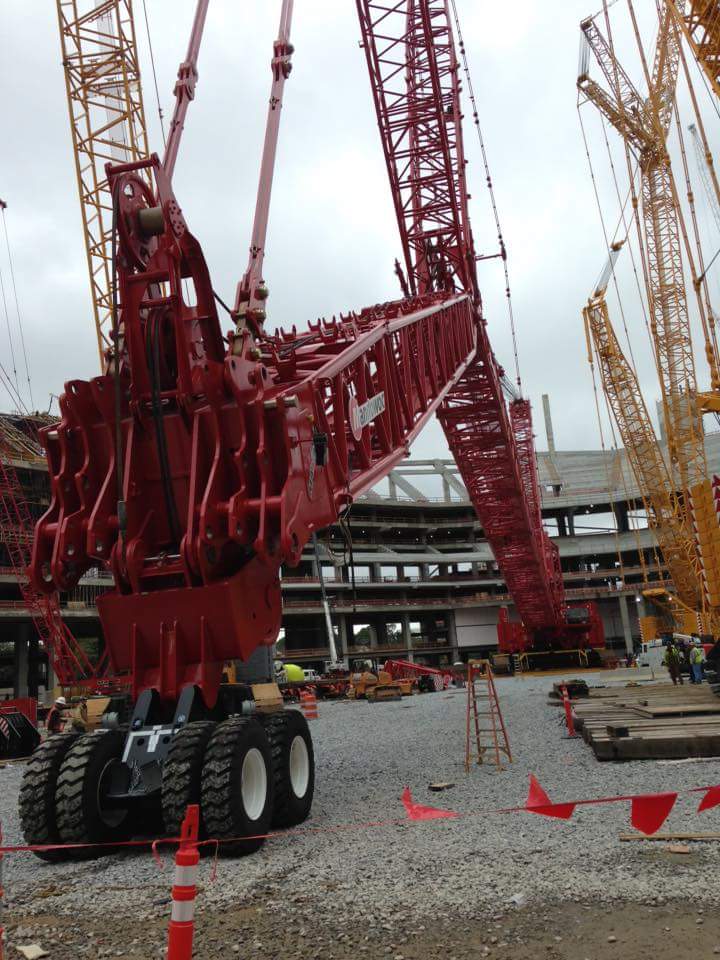
Assembling a Manitowoc 999 with a 149' luffer to build a wind tunnel for Ford. In some of the photos you can see the concrete centenary for Ford's Detroit, Toledo & Ironton Railroad.
Brent M Nelson posted 9 photos with the comment: "999 for the next year and a half."
1
2
3
4
5
6
7
8
9
Bay Crane posted
[I wish they would specify the model and the length of the main and luffer booms.]
Leigh Martin posted two photos with the comment: "Nice rig pouring some concrete today in Naples, Fla." You don't see a concrete bucket being used too often anymore because of precast concrete and concrete pump and belt trucks.
Bruce Steinfurth posted
Longest boom I ever assisted with assembly. M2250 with I believe was 610’ back in 2007. Charlie WardI agree. way to much boom. while the nyc accident several years ago was deemed operator error, I believe the accumulation of ice on the boom was a big contributor to the incident. have never seen a load chart that allowed for that additional weight.Darrold ElliottOperator did not jackknife the boom down. Which caused accident. You cannot in-line that much boom.Brent M NelsonUh, to boom a luffer down, you have to turn the override key as you go out of chart to do so.Joe WhitingWasn't that the one that the boom was completely covered in ice ??as well??Vincent UmstotJoe Whiting yes but that was not the reason the accident happened.Joe WhitingVincent Umstot yeah I know I saw the video he boomed down the main ...I'm sure it did not help that's why I was asking if that was the one.. I know you can only main boom down so many degrees when you have luffer settup...I have run these several times as well.Brett LynchI was running a drill rig in Harlem that morning and had 4 inches of ice build up on the mast of the rig in less then 20 minutes, they can blame it on whoever they want, but ice was definitely a factor! Should of left her vertical!
Jim Tracy posted Dave UnsworthSure looks like a really ugly twist in that 133 luffer.... David WallerThat’s not optical!! She’s in a bind Roy StonePendant line is caught under the pin on the left side. Robert ShawGood call Roy ! The right wheel of luffer is off the ground. Hope someone caught this before tip was off the ground .
Tom Wojak posted
777 with 140'main&140' luff in Aurora NE. Rob StuckelIt's been there for almost a year now. Mars plant.
Terrell Simpson posted two photos with the comment: "Manitowoc 2250 and 888 with luffing jibs waiting for the precast." Chanc Bourdon999 looks like 149 luff Mike WeaverChanc Bourdon good eye, rocks stacked 5 high too
1
2
Screenshot @ -8:52
[Even the worlds largest crawler crane with an incredible pile of counterweights needs a dolly to get the main boom up.]
Steve Robinson posted
Used to do that in my 16t Franna back in the day, Well they were the kind of stories at the pub back then we all told isn't it anyway. Mark GoodrichHanging counterweight off the rear luffer strut is interesting.Arthur OverdijkLiebherr LGD 1400
Eric Cole posted
999 building largest auto mfg plant in the United states. Eric ColeJames JusticeLimestone County Alabama [around I-65 near Huntsville] Steve EllsworthBlake Crenshaw Toyota and Mazda plan to build a $1.6 billion auto assembly plant in Huntsville, Alabama that will employ 4,000 workers.
The plant's location was made official Wednesday afternoon. The companies originally announced plans for a U.S. plant in August when the two Japanese automakers signed a
joint venture agreement, though the exact location was not known at that time.
"Alab Kody Underwood Hard to believe it would be bigger than the ford truck plant. Eric ColeKody Underwood 6 million square feet in 1st 3 buildings, site is 1200 acres Perry Hutchings 999 is one <good> crane in luff, like the 888 you can operate both booms simultaneously , unlike the 2250
[I couldn't find any comments about the boom lengths. Bummer. You can see the wheels on the tip so the boom can easily be raised and lowered.]
Michael Berry posted six photos with the comment: "Found This Baby in Downtown Detroit."
1
2
3
4
5
6
MLC300 and MLC650
Chad Williams posted Ben Stalvey Sweet MLC 650 Eric Cole VPC MAXXXX
[That is a long radius. Normally you don't see the main boom that low without the tip dolly on the ground. No wonder the VPC is out all of the way.]
Peter Quinn posted
Gray day in Chicago. I hope tomorrow we get some sun because I have a decent spectator seat! Ben StalveyGroup AdminWow nice MLC 300 from ALL. Ben StalveyGroup AdminSure is awesome just to think how many 2250 use to do this type of work.Now it's time for the MLC 300s
Rich Trosper posted
MLC 650/Luffer, they were setting 390000 lb. Nacelles outside of Plainview TX two years ago! Ben StalveyBen and 4 others manage the membership, moderators, settings, and posts for Manitowoc Crane Enthusiasts.Awesome amazing crane. The death of the maxer wagons. Jerry SpearnThe VPC will never replace a maxer wagon. The VPC is way to slow. Until Mani fixes the sync and allows the operator to boom up and down with speed and not be stopped all the time making it difficult to control your load smoothly. Don Leverbee1. The screen will tell you if you're booming to fast, if you can't adjust your stick, its not the cranes fault, its yours. 2. Turn the boom hoist speed down from 100% to 85%, if you can't control your speed. 3. In S-3 the VPC Max will not be out run by the boom. 4. With 300k on the hook, how fast do you want to go ? 5. If you want go fast, stay in the small cranes. Jerry SpearnProduction work requires speed. We aren't picking 300k once at 25'. We are picking 30k 100 times at 200' Don LeverbeeYou would still make better time by adjusting your drum speed, vs. Getting stopped by the computer. Play with it, maybe start at 90%. Don LeverbeeYou compared the VPC to a wagon. I assumed you were running a configuration in the VPC to a rig with a wagon. If your only picking 30k, lock the tray, your chart is reduced, but 30k aint shit. Shane CanardI was running that crane and I could get the nacelle at 115’ radius. Tom LaGanga195ton nacelles?
Shane Canard commented on Tom's comment on Rich's posting
[So they lift and attache the blades one at a time.]
Normally, the luffer has a wheel on its end to hold its weight as the main boom is raised from a flat position. Once the boom is vertical, then the weight is centered enough that it can raise its luffer.
Scott Michael Thundercock Adams commented on a posting Ben StalveyDang that painted faded fast
Chad Williams commented on a posting Larry WinchesterTray setup mode pushes them alllll the way back, no matter what, huh? Ben StalveyStay safe Chad on the wind farm. Several say MLC 650 should not be out in that line of work. It all has to do with the right ground prep and conditionsLarry WinchesterBen when I knife down at night, it forces me into that mode and the tray runs to the back and I’m short boomed. I swear it floats a few roller at the toes. LolChad WilliamsThis was a few years ago. That was the first MLC out in that configuration.
Daniel Williams posted
Our company just bought this little betty Ben StalveyNice MLC 300 [That is the largest jib to main ratio I remember seeing.]
Roger Boulianne posted three photos with the comment: "MLC 650. 200 000 lbs @ 200 '." Dominic Précourt [boom configuration:] 203-196
1
2
3
Andre Mylocopos posted two photos with the comment: "MLC 650 in action."
[No answer to my question as to where this bridge was being built.]
1
2
Timandmonico Sonnier posted
Knifing her up in Corpus Christi Ben StalveyMLC 650 what a beast of a crane
Ethan Hebbe posted two photos with the comment: "Spotted at the Live Casino in Baltimore MD. I'm no crawler expert but it looks like an MLC 300 or no?" Ben Stalveycorrect sure is a MLC 300 [That is a long jib compared to the main boom]
1
2, cropped
Luffer jibs for telescopic boom cranes is a more recent development. Comments on a post indicate that the pendant doesn't go all the way to the head to avoid the need for midpoint connections to reduce boom deflection.
AllCrane
[The article accessed by the link says the above rig had a radius of 340' for a 7,300-pound load. The actual load was 2,500-pound HVAC pipes.]
Tyler Travis posted 5 ish years ago. Orlando Int. MCO Photo taken by James Chamberlin. Reaching out! Mike Weaver 2250 Tyler Travis I can't remember the radius but it was a little past the numbers lol [Later comments confirms that he means his max radius was off the chart! The luffer was "300 ish."] Anthony CrandallTyler Travis they gave me a tip height ceiling due to radar. Tyler TravisAnthony Crandall me too and I went past it every day. Then I had the oil pump explode and lock the engine up... 88 on the main and 167 boom to luff.... sat like that for 4 days.
Will Brown posted a request for photos of luffer jib cranes. He got a lots of photos, including mine:
Dennis DeBrulerA 21000 over a 2250[It got a "Like" by Brandon Storie, who I recognize as a "name" in the Manitowoc world.]