These are notes that I am writing to help me learn our industrial history. They are my best understanding, but that does not mean they are a correct understanding.
I already knew about one-way flange bearing diamonds called One Way Low Speed (OWLS) diamonds. These have a ramp for the low-speed route on which the flange rides up and over the track of the high-speed route. This allows the high speed trains to cross the diamond without hitting a gap in the rails. This not only provides a smoother ride for the high-speed route, it reduces the maintenance costs of the diamond. The following post taught me that they now make diamonds that have flange supports for both routes and that both routes can go at a high speed over the diamond.
Tanner Van Noort posted Flange bearing diamond [installation]. Tanner Van Noort: The one is the photo is flange bearing both directions. Vince Davis: A Full Flange Bearing Frog, is good for equal speeds on both routes. The manufacturer can build them for whatever speed you want. [The comments are talking about speeds in the ball park of 60 mph.]
However, voestalpine says their full flange bearing crossing has a 10 mph maximum speed. Several search results are to arema.org, but they want a sign in with an email address. But I was able to find a photo from Progress Rail:
Higher speeds are possible because one route is not being lifted up and over the other route. Wikipedia explains that the 10 mph limit is because of regulations. Railroads can get a waiver if they agree to an aggressive inspection program of the diamond and the wheelsets using the diamond. CSX did the first one in North America in 2006 and BNSF did a couple in 2008. Since that was a decade ago, I wonder if the regulations for inspections have been relaxed.
Moorhead Junction has a full-flange diamond. It is so quiet that I could not hear when the train crossed the diamond! I had to find it visually. I think the front of the lead locomotive is at the diamond in this video. Flat wheels create much more noise.
Here is a short video of a BNSF train on the former Santa Fe route crossing the former Rock Island in Joliet, IL. These diamonds are just a couple of years old. All four were replaced in late spring of 2015 because the spacing between the tracks was being changed. I took the video to record the sound of a train hitting the diamonds.
Since a new train station was built east of the diamonds so that the commuter trains no longer cross them, I'm surprised they have not installed OWLS here. CSX and IAIS run very few freights on the former Rock Island route.
When I did a Google search for the suggested topic of "full flange-bearing diamond frog", I recognized one of the images that they presented:
I recognized the photo because I just got through fixing a detail about that photo in the page they reference. This "image hit" is scary because that is an OWLS diamond, not a full-flange diamond. Now I have to wonder about how many images that I have used from Google search results are wrong.
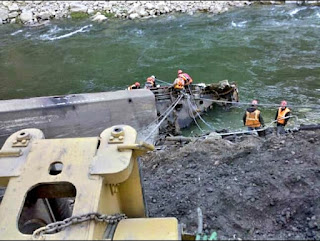
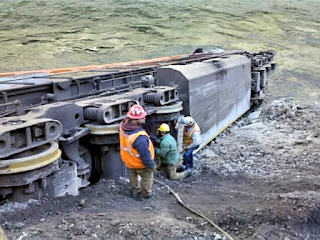
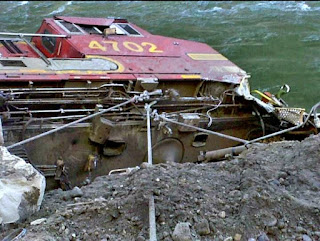
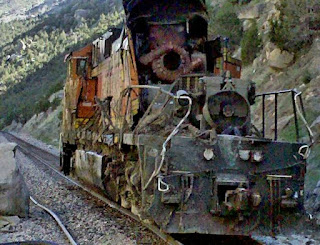
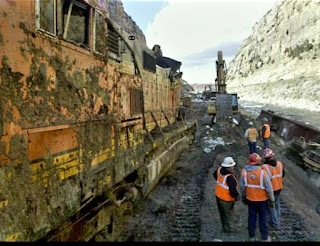
The Jan 1, 2020, derailment into the Kootenai River is below.
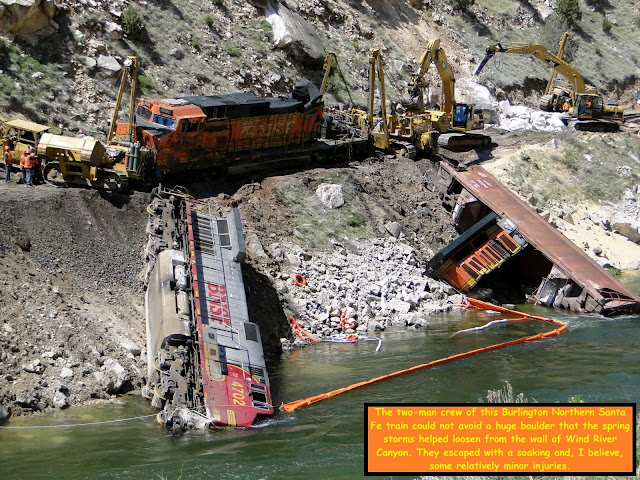
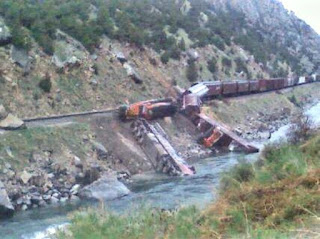
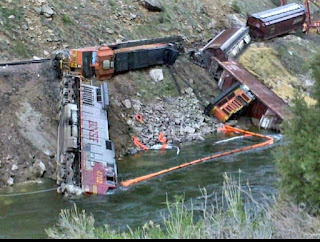
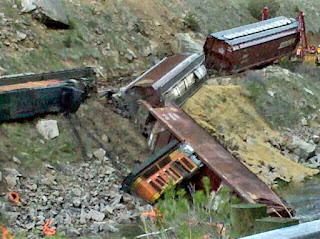
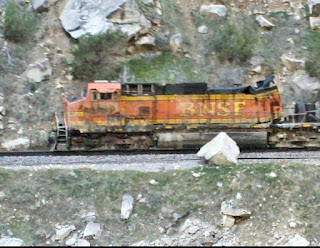
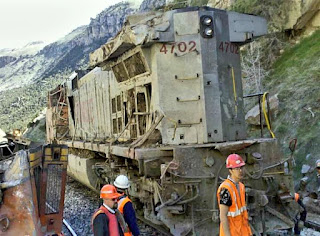
May 12, 2010, into Wind River Canyon Because of a Boulder
John Murnan II May 12, 2010 Wind River Canyon BNSF train wreck [No one seriously injured.] Rick Pierce: Hit a huge boulder. Mike Riley: I was the first bnsf there, across the river. The crew climbed out the engineers window and slid into the water. A farmer on a 4wheeler drove them out. Highway patrol saw the rock fall, tried to get train stopped.
5:58 YouTube video driveby, fortunately, they finally zoomed out. Then parked on the side of the road for more footage. There is a decent shot at 2:47. According to the comment, BNSF had a second derailment here 6 days later!
Josh Melia uploaded 11 photos as comments on John's post:
1
2
3
4
5
6
7
8
9
10
11
The Jan 1, 2020, derailment into the Kootenai River Because of a Landslide
To understand the video below, I include some photos The crew survived. A track inspector knocked out the rear window with a sledge hammer before the cab filled up. Rescue was attempted from a boat, and then a helicopter, and then a boat using a rope system to deal with the fast flowing Kootenai River. The lead engine did leak diesel fuel into the river.
safe_image from Aaron Bryant's share of a KHQ link [The KHQ article has a slideshow of 13 photos. Is that yellow thing next to the cab of the trailing unit an excavator that has already been deployed to the scene?]
#update: A true Hero for the crew trapped in the train is coming to light.Track Inspector, Adam Reeves, climbed down the steep bank and made his way out to the lead engine. He then broke the glass with a sledgehammer for Bill and Brian to escape.
safe_image from Tim Hare's share of a weather.com link that is now broke [The weather channel's headline was: "Idaho Train Derailment May Have Been Caused by Landslide." It looks like they brought in a crane that can go back and forth on some flatcars.] Justin Goodwin Slide fence not working? Stu Hart I worked this territory for 38yrs,,,,what slide fences Stu HartKyle James Jarvis they came around the curve and hit the slide
Marcus Gillebaard They almost drowned guys! Kyle James Jarvis Yep. The Kootenai is one hell of a river. Thank god it wasn't flood season.
Erik Sorbo “Engine and six cars in the river...” Unbelievable!! We’re literally looking at two locomotives that got wet. Yet somehow only one engine and six cars are in the river??? News...
The article says it was east of Bonners Ferry, ID. I can't determine exactly where it was, but the tracks are against a cliff so tightly that they had to dig a tunnel to go around a bend in the river. And they will have to bring in equipment using the tracks. It looks like they are going to start with a sideboom and a crane.
BNSF Railway posted BNSF crews worked diligently over the weekend to remove the final locomotive from the Kootenai River near Bonners Ferry, Idaho, as part of our remediation efforts after the Jan. 1 derailment. To accomplish this, a team of divers placed air bags below the locomotive so that it was able to float to a more accessible location on the other side of the river. More at http://www.bnsf.com/news-media/kootenai-river-subdivision-rockslide.html. [I would like to see photos of the other locomotive on its "extraction ramp" for the Jan 14 recovery mentioned in their news release. Did they pour a lot of rock into the river? At least they should be able to remove the rock.] Kootenai Valley Times posted on Jan 27 The BNSF lead engine that has been submerged on the south side of the Kootenai River in a steep canyon about three miles west of the Montana State line since it derailed at about 9 p.m. January 1 is again on shore and should be removed from the river bank without a trace by the end of this week. Read more at https://www.kootenaivalleytimes.com/…/article_a4229724-4178…. Kirk DeHaan Was a wet winter which caused a big slide where there was no rock fence.
Josh Parrow commented on Kootenai Valley Times post
Terence Campbell commented on Kootenai Valley Times post
I scrolled through the Kootenai Valley Times (KVT) page and this is what I found.
KVT posted a Jan 2 a link Derailment appears to have been caused by rock slideTim Lisa WestMike Weland, the North Idaho News is reporting that track inspector Adam Reeves went down the bank and smashed out the engines windows to free the two guys, can you confirm or deny that? If he did, he sure deserves the credit for helping to save their lives.
KVT posted a Jan 2 link As ever, dire situation brings out community's best "Unassuming hero Adam Reeves, a BNSF track inspector, is credited with giving the rescue effort time to unfold by driving his highline truck to the scene. Climbing out to the lead engine, he smashed out the thick rear window with a sledgehammer, enabling the two men inside the cabin to scramble out before water filled the compartment."[He climbed down that embankment in fog that reduced the visibility to a few feet.]
Jan 3 post: BNSF derailment update Jan 4 post:BNSF line could reopen today "A forward thinking first responder radioed in to have sheriff's dispatchers to notify workers at the Kootenai Tribe's Twin Rivers hatchery and have them shut off the Kootenai River intake and open their Moyie River intakes instead. Kootenai River intakes at the Mission hatchery were closed as well, and sturgeon at the facility were transferred to the Twin Rivers hatchery."
KVT posted a Jan 7 link Both tribal fish hatcheries safe after diesel spill
KVT posted a Jan 9 link EPA update on Kootenai River cleanup
EPA Photo
KVT posted a Jan 14 a link One locomotive recovered, work underway to bring up lead engine
Kevin Mumaw: This was last January near Katka ID. East of Bonners Ferry. Crew went in the water with it at night. Speed is 30 in the area and they were doing about 25 after they dumped it for the rock slide they hit. They were trapped and the cab was nearly submerged. A MOW guy who is also search and rescue high railed in with a fire chief and made his was out onto the loco and beat the back window out with a hammer. The cab was tweaked and the crew could not get out the back door and the front was completely submerged. Luckily it was just above freezing and after a couple attempts a boat was able to get the crew off the top of the loco. Also the water level was down. Had it been high they probably would have drowned. They also had a helo inbound from Whitefish MT in case the boat could not get to them. The area is completely cut off from roads.
Night of Jan 1 2020 Kootenai River, BNSF merch train in the drink!
📸 Credit sir Jon Kerby
He is a retired track inspector from BN/Bnsf rock slide, no fence 🫡🙇♂️
Bonus: Jan 21, 2022 Landslide North of Seattle
This is not in a mountain canyon, but it is a landslide shoving a BNSF intermodal train off the tracks.
safe_image for Mudslide Derails BNSF Freight Train "BNSF has installed barriers, improved drainage and removed 13,000 tons of debris all along the waterfront line that these tracks cover and is continually doing slope restraint and repair."
A screenshot form the video in the above report. I came across the raw video, but I screwed up saving the URL of that video.
These two shots were taken of a CB&Q oiler on August 17, 1964 at Chadwick, IL. Nozzles aimed at both sides of each rail at the front of the car oiled the rails.
The SD9 mid-train was pictured in my previous post.
Kam Miller in Facebook wrote: "In the days when ice was added to refrigerator cars, the ice was contained in what was called a "bunker" at the ends of each car, under where the ice was put in at the roof hatches at the ends of the car. Salt was added to it since they found out that adding salt to the ice, besides melting it a bit, also made the ice colder. The result was called 'brine'. Either fans or vents pushed air over the ice to cool off the insides of the car as it traveled. Many big yards had icing stations inside the yard where the reefer trains were re-iced during the trips.
"The reefers also had drains at the ends which let the brine leak out, and of course, it leaked onto the rails and trucks. Naturally, maintenance of reefers included looking at the trucks to see that the salt brine didn't mess them up too bad, either."
[There were a lot of comments on this post. I discuss their content below.]
1
2
Some of the comments called it a weed sprayer. Marty posted the following to show what a CB&Q sprayer looked like back in the day.
I zoom in on the photo of the oil sprayer so that you can see that the nozzles are aimed at the sides of the rail and avoid the railhead.
Digitally Zoomed
The oil would help keep the brine from touching the rails and causing rust. One comment also mentioned that the brine is hard on the wood ties.
Scott Dolanc: CB&Q and other railroads would spray used engine oil on the joint bars and bolts that held the rails together to protect them from the brine Marty talks about. If a rail broke or some other maintenance needed done, the bolts and joint bars wouldn't be completely rusted together and would be easier to get apart to work on the track structure. Very important on busy mainlines.
Ross Posch: Remember the use of oil on the bolted joints to avoid Sun Kinks.
Bob Parkin: CB&Q Oiler 211581 at Chadwick, IL on August 17, 1964. Oil was sprayed on the rails to reduce the corrosion caused by the salt brine leaking from the ice-cooled refrigerated cars.
Richard Ferzely: The only time I saw that done was summer of 1983. I was working out of Sterling CO. We ran on the UP from Sterling about 25 miles and got back on the BN close to Brush CO. UP section men with hand sprayers walked and oiled every set of angle bars. It was short heavy jointed rail at the time so it took almost all summer to do the 25 miles.
Roger Stabler: In the days of jointed rail, the joints were oiled to help with expansion and contraction.
Michael Armstrong: Rail joints were lubricated to prevent what is known as a “frozen joint”. Rail expands and contracts and it is desired to allow the joint components to move (although controlled movement is minimal) to avoid joint pull-aparts in cold temperatures and kinked rail in hot temperatures.
Tony Verrecchio: Marty Bernard You know when we had stick rail they walked it every day.
Marty Bernard: Tony Verrecchio I remember.
Rob Gardnerv[In response to a comment by Marty that he did not know the rail slid in the joint.]: Marty Bernard the key is alternating round and Oval shaped holes in the joint bars coupled with a built in gapping ability in the spacing of the holes and the fact that the bolts are always smaller than the holes drilled in the rail that they pass through. Jointed rail has to be able to expand and expand with the ambient air Temps. When you're laying rail in the heat of summer you leave little if any Gao when you assemble each joint. Likewise, if you're laying rail in the dead of winter you leave as much of a gap as possible to give the rail room to expand in each adjacent joint with pushing the adjacent rails. Long trains rolling down the track also increase the effective temperature of the rail as the train passes. Hence, on hot summer days, most railroads run heat patrols once the temperature hits 100F to look for the telltale signs of unstable rail and they will post temporary speed restrictions to minimize the chance for track to buckle under a moving train.
Mal Stephens: Marty Bernard even though the joints are plated and bolted,, there is enough tension in the rails from the temperature change for the rails to slide away in the cold until the pressure is onto the bolts,, as the bolt holes are a bigger than the bolts,, and for the rails to expand and close again when the rail get hot,, If the rails corrode enough with the salt reaction this will not happen.
Jeffrey Varney: I also remember that we used to have a crossing gate problem at the old Lake Cook Road crossing at Deerfield. During the winter, the snowplows would dump a lot of salt into and over the road crossing during a snowstorm. When the salt melted the snow, all of the water would run down into the crossing. Soon, the salt water concentration was so high that the crossing gates would activate and stop traffic. I don't remember how many times the maintainer went and checked the crossing and advised the gates were working properly and the salt water in the crossing was to blame. After many times, I told the police to send a fire truck over and flush out the crossing with the firehose. After the first time, when the gates cleared after the crossing was washed clear of the salt water, we did not receive that many calls anymore for gate problems. I would guess that the police would dispatch a fire truck to the scene and if the gates did not clear after the crossing was washed out, then they would call the railroad.
Sidney Mcwhorter: The last oiler train I remember was back in 1971. The man in charge turned in over time around the clock. The road master at the time said he was not going to pay it. The operator told him they had been and he was also.
Bob Johnston: My family was in the produce brokerage business in Paducah for almost 60 years. We brought in thousands of those reefers with fruits & vegetables from all the producing sections. In the winter from the north they put charcoal & later alcohol heaters in the bunkers to prevent freezing. Later it changed to large mechanical reefer with incentive rates. Most of them came in on the “Q”/BN as Paducah (which many people didn’t know) was the southern terminal of the Burlington. The BNSF still comes in here.
Scott Thomas: Well, I can tell you this. The rails were indeed sprayed with an oil, just not like you are thinking. The oil being sprayed on the rails was more like a tar. It served several purpose's. One was it quieted down the noise the trains made passing over the track. For freight no one cared, but it made a big difference in passenger cars. Also, it reduced vibrations in the rail and helped extend tie life. The only reason I know this is because the old Milwaukee Road track out of council bluffs, a lot of that rail still has some of the coating stuck on it. Look at the photos and zoom in on the spray car. You can clearly see the gobs of tar on the car, trucks, etc. That's no weed sprayer. If it were, where are the booms?
Dennis DeBruler: If you click the "post" link in the top line, you will see several comments explaining that this was done for brine protection. The railroads were particularly concerned about the rail joints being frozen with rust. Rust made it difficult to remove the bolts if a 39' "stick" of rail needed to be replaced. More significantly, it did not allow the joint to slide when the rail expanded and contracted. This was back before rail was strong enough to handle contraction and before anchors were invented to help avoid kinks when the rail expanded.
It occurred to me that many Millenniums might not even know what jointed rail is. I live in western Chciagoland and the closest jointed mainline that I have seen is the former Rock Island route in Ottawa, IL, that is now owned by CSX. When BNSF replaces the track in crossings or replaces turnouts in their mainline, they temporarily connect the new rails to the existing rails with joint bars. So I've been able to get some closeups of joints. (There is so much ballast on top of the ties in this photo because they have done just a first pass of surfacing (tamping) the tracks.) The gaps are larger than what was used in jointed rails because these joints will be welded during the night. But jointed rail did have gaps to leave room for expansion in the Summer without kinks. And the joints allowed contraction in the Winter without breaking the rails.
20210523 3956c
Jointed rail was a maintenance nightmare. But before continuous welded rail (CWR) could be used, the tensile strength of steel had to be increased to withstand the internal forces induced by contraction and rail anchors had to be developed to hold the rail from kinking when it expanded. Also, special trains had to be developed to carry quarter-mile long segments of rail. So rail joints that were frozen with rust would give you the disadvantages of CWR without the mitigating factors of increased strength and better anchors.
Pete got tired of all of the comments claiming it was spraying weeds. (And then just two comments after this one was another person claiming the train was doing weed control.)
J Pete Hedgpeth: I wonder from all the "palavering" on here about this subject that if most of you guys really understand how corrosive that salt brine is that used to run out of the drains on those "pre mechanical refrigeration" reefers with ice bunkers on each end. It does, as some have pointed out, take a certain "measure" of salt added to the ice at re icing points. This salt was added in the amounts specified by the "icing instructions" which accompanied the waybill The water, with a high salt concentration was collected at the bottom of the bunder and ran out trough a tube leading outside and pointed away from the car. This highly corrosive mixture poured out sometimes in fairly high volumes. If you have ever seen a "reefer train" heading around an elevated curve you will see a fog consisting of "flying salt water" drifting out. think of the thousand and thousand and thousands of salt water pouring on steel and you have a vile, corrosive soup collecting on everything metal on or about the RO"W. This stuff did it's destruction on anything metal..ie rail, joints, bridge members etc. This oiling was not done just to "get rid of excess oil"...it was done to preserve and reduce the corrosion of anything metal along the row. In my very early days in the RI training program I spent a couple of days in very cold December weather along with the roadmaster on the "Government Bridge across the Mississippi at Rock Island-Davenport appling a goop oiling substance on the metal struts, ties and other supporting members of the bridge. This to reduce the corrosiong at this critical point on the RI. Think about it...Every shipment from CAlifonia (FFV) Fresh Fruit and Vetgetable and Omaha ( hanging meat) passed over this bridge and dumped this vile mixture on the bridge.
Because the railroads and their suppliers used PTC technology to implement old-fashioned fixed block signaling rather than newer methods that were enabled by PTC technology such as moving block signaling, some non-welded joints are permanent to make insulated joints. I put red rectangles around the three insulated joints that are just west of Fairfield Ave. in Downers Grove, IL. The close joint looks like it used four bolts instead of eight but that is because they alternate the direction in which the bolts are inserted. The holes along the left side of the photo are where joints were made between the crossing track on the left and the existing track. Since this is a few days after the track was replaced, the joints have been welded and the bolts and bars are removed.
20210529 3990c
I used to ride the Pennsy from Fort Wayne to Chicago in the late 1960s so I experienced the clickety-clack of the wheels on the joints. While I was trackside, a coal train came rolling through on some temporary joints. At 1:28 I zeroed in on the source of the clickety-clack,. Imagine what this train would sound like if that noise was happening every 39' for the entire length of the train! [DeBruler]
This was the caboose in the above oiler train.
safe_image for photo A comment on a post provided this link with the information "a regular 30' NE-1 Waycar." This comment was in reply to an observation that a waycar looked like a drover caboose because of all of the windows.
The title "Rail Pull" is a pun. It, or CWR (Continuous Welded Rail) pullaparts, means that a rail broke in two pieces because it contracted too much during cold weather. With the tension relieved, the contracted rails leave a gap at the break. It is also the modern way of fixing a break with hydraulic power (see below).
This is a post of my photos and videos of rail pull activity by BNSF in Downers Grove, IL. Fixing Rail Pulls is a general post about closing gaps in rails.
Joe Dockrill posted -14C the most wonderful time of the year [There are so many comments that I just looked at a few of them. There is consensus that it broke at a weld. But the comments debate between factory weld or field weld. You can't weld a broken weld. You have to cut at least 6" from either side and add a "plug." (Whatever a plug is.)]
DeBruler, general notes on rail pulls and the old technology for closing rail gaps. These notes concentrate on a rail pull operation that I personally observed.
Norfolk Southern posted five photos with the comment:
Cold weather brings challenges, but Team NS is always ready. Check out this pull-apart repair in Bellevue, where our railroaders kept the tracks safe and trains moving.
🛤️ What happens?
When rail joints are installed in warm weather, colder temperatures can cause the rail to contract. This puts extra pressure on the bolts holding the joints together.
Over time, if the pressure becomes too great, the bolts can break—causing a pull-apart, where one side of the joint loses its bolts.
🛠 How do we fix it?
Our skilled railroaders use controlled heat —generated by flammable materials at the base of the rail— to expand the rail, closing the gap so new bolts can be installed and track integrity restored.
This is just one of the many ways #TeamNS keeps freight moving safely—no matter what the weather brings!
Ammie Humbers Day: Meanwhile 2 weeks ago [Jan 2025 Polar Vortex] on the Gulf Coast, we came to a screeching hault because it snowed😂… Kudos to all of you who brave the ice & snow for months on end. I guess we get our turn with the scorching humid heat months on end!
Taylor Layne commented on Dan's share Done that a few times in my day
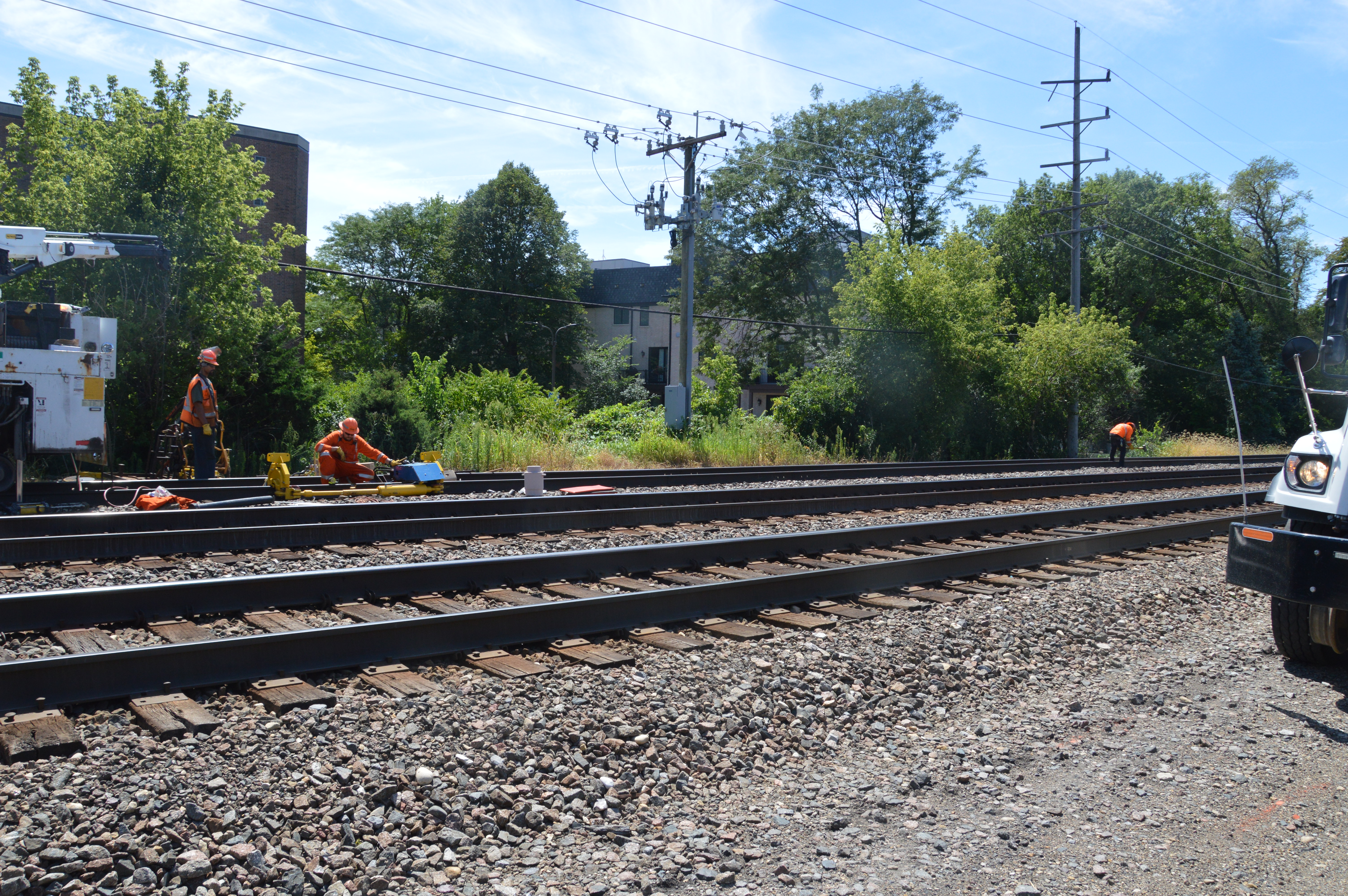
On my way home on Aug 8, 2020, while crossing Forest Avenue in Downers Grove, IL, I noticed a couple of Hi-Rail trucks parked to the west. (Satellite) So I found a parking spot, grabbed my camera and checked it out. It was a welding team that was going to pull the rail before the weld. This is a rare sight because the welding teams normally work at night in this area since it is on BNSF's Racetrack that handles over 100 trains a weekday. Track work such as replacing a crossover is done during the day and uses bolted rail joints. A worker explained the bolted joints would be replaced by welding teams that work during the night. Rail pulling is even more rare because they are normally just replacing joints.
The temperature was 89 degrees, so the gap they were closing was not caused by a rail pull because of cold weather. They must have cut the gap into the rail. Did they install the rail during cold weather so that now they had to remove some rail to avoid rail kinks when the weather stayed hot?
This shows the two trucks that were parked at the work site. They were working on the south, or M3, track. Unfortunately, I'll learn later, the truck on the right blocked my view of Amtrak trains that are inbound (eastbound).
Construction 20200811 2717
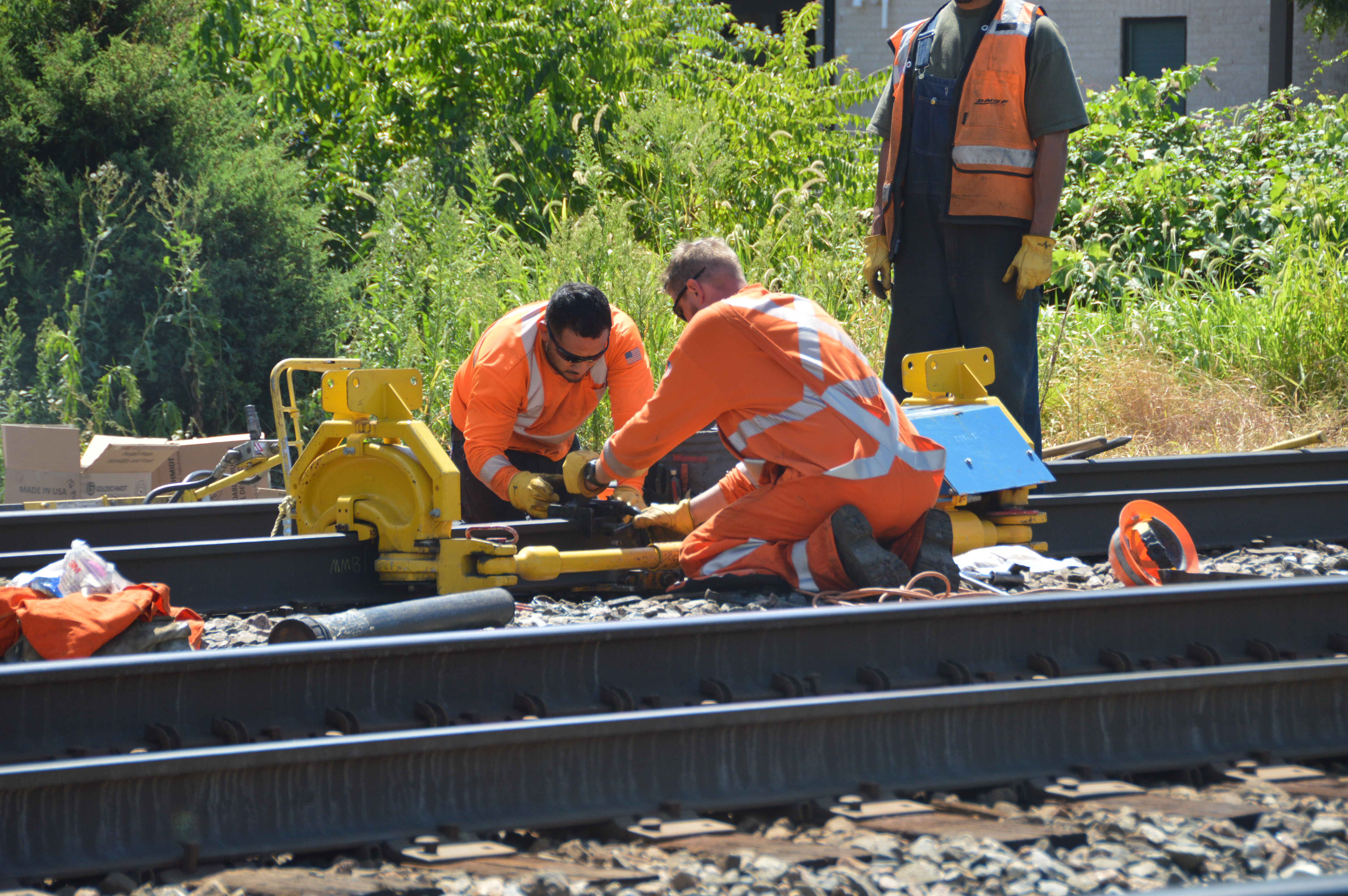
When I arrived, they were using the cutoff saw. Note the hydraulic hoses going to the saw. The truck provides the power.
After inspecting the gap, they did a diagonal cut.
Some video of this cut is the first clip in the first video below.
The final measurement before they set up the rail puller.
The truck has a small crane because some of the equipment is heavy. If you look on the left side of the above photos, you will see that someone had already hooked up the rail puller and got it off the truck and now it was just a matter of swinging it unto place.
I skipped my video of the first pull because it was out of frame. This gap is what happened after they released the puller. The gap had been down to about an inch before the puller was released. The metal pieces beyond the track between the legs are mold parts that have been unloaded to be handy after the pull is done and they start building the mold for the weld.
The worker with the sledge hammer started here and worked his way away from the puller. I think he was hitting the rail anchors to jar them to let the rail slip through them.
For the second pull, I skipped taking a video and alternated between shots of the gap and of the worker using the sledge hammer.
This is about as far as he went with the hammering on this pull because...
...he was soon walking back.
Note the tape measure laid across the gap. The gap is noticeably smaller in this photo.
He must have released the pull because the gap is now wider.
I took video of the third pull, and it is the second clip in the first video below.
Both workers used hammers during that pull and they went further down the track.
I also took video of the fourth pull and it is the third clip in the first video below.
This is the gap that they held while they welded the rail.
They started building the mold for the weld.
But first I took video of a westbound intermodal train. It is the first clip of the second video below. Note that it was honking early and often even though Downers Grove is a quiet zone. That is normal when they are approaching a work zone.
An inbound (eastbound) Amtrak train came by so fast that it took me by surprise because of the truck blocking my view of the track to the West. And because it must not have honked its horn. And because it must have been doing the track speed of 70mph. That train is the third clip in the second video below.
One of the jobs of the helper was to watch for a train when one was due by. I noticed sometimes that he would stand to the right of the work zone looking down the track. I didn't realize until too late that when I saw him looking I should get the camera in video mode and up to my face ready to go. They had a speaker on the truck that let them hear when the dispatcher was telling them when to expect a train. I assume the spotter is why I didn't hear the Amtrak trains honk. Here the helper is holding the torch that will be used to heat the mold.
They are clearing out their tools and have moved the thermite crucible closer to where it will be needed.
He has put the business end of the torch into the mold. I guess that was a test fit because...
...he takes it back out.
Here the torch is in the mold after it is lit. I've seen them do welds before so I know that they will have to let that torch burn for a while. That is why it is break time.
They will get the mold so hot that just putting the crucible on top of the mold will ignite it. I left because I did not want to wait during the torching even though a video of the thermite igniting and burning is always impressive.
As I left, I noticed the welders also do arc welding. I think they do that to add metal to switch points, diamond points, etc.
I also noticed that they had small outriggers deployed on the truck. I assume they did that because of the small crane that they use to unload and load their tools. They have to be careful when jacking the truck up to not get it so high that the flange clears the head of the track.
The second Amtrak train came through as I was leaving. It is the second clip of the second video.




%20Cold%20weather%20brings%20challenges,%20but%20Team%20NS%20is...%20-%20Norfolk%20Southern%20_%20Face.png)