Showing posts with label rfOConner. Show all posts

Monday, April 10, 2017

Windmills

20160811 4243  2016 Sycamore Farm Show
Today, wind power is used to generate electricity. But before farms where electrified, many farms had a windmill to pump water. Below is a closeup of the pump in the base of the windmill to the right.


Both my grandparents and my wife's grandparents had windmills on their property that we can remember seeing. This windmill and pump below are near the J.H. Hawes Grain Elevator in Atlanta, IL.
20160706 3469


This text and two images are from the plaque by the windmill.


How Farms Work posted
The first windmills were developed in ancient times, with evidence of wind-powered machines dating back to ancient Greece and Persia. However, the earliest known practical windmills were developed in the Middle East during the 9th century.
These early windmills were vertical-axis wind turbines, also known as panemone windmills, which were used for grinding grain and drawing water. The design was later improved upon in Europe during the medieval period, with the introduction of the horizontal-axis windmill, which was capable of generating more power.
The first recorded windmill in Europe was built in England in the 12th century, and windmills became increasingly popular in Europe during the 18th and 19th centuries. Today, wind turbines are commonly used to generate electricity on a large scale, particularly in areas with strong and consistent winds.
Timothy Miller: Keep it well anchored,greased & painted and it will last forever… mine is going on 32 years old .. love it !

Steve OConnor posted some pictures with the comment:
The Challenge Windmill Company, Batavia - This property that is known as the Challenge Windmill plant has had a colorful history. In 1857, Nelson Burr founded the first wooden pump company which grew to become Challenge Windmill and Feed Company. At that time, the plant was powered by water and wind. The buildings at one time covered over 165,000 feet on eight acres. Since then the wooden and other structures have all been removed. The 515 building was a foundry and the 525 building was a wood shop powered by the mill race below. The 415 building was a machine shop, also powered by a water turbine. The 335 building was for assembly and storage. The company prospered until the early 20th century. During World War II, munition shell casings were produced in the foundry. This is where the colorful part of the Challenge Co. starts. In 1946, Dr.Henry Garsson, Murray Garsson, and Congressman May were found guilty of conspiracy to defraud the government and war-bribery. During the war, they had fraudulently obtained $78,000,000 in war contracts. The Challenge Co. was one of several companies that they had purchased with no funds of their own. The trial heard over 100 witnesses and lasted over eleven weeks. Witnesses included General Eisenhower, Secretary of State George C.Marshall and Secretary of War Robert Patterson. In 1949, the property was purchased at an auction and the buildings were leased for manufacturing and warehousing to multiple tenants. In 1992, the conversion to office use started.

1

2

3

4

5
You can tell that this plant used to use water power because of the dam and the tailrace on the right.

3D Satellite

Batavia was "the leading windmill manufacturing city of the world."

Update:
William A. Shaffer posted
Aermotor Windmill (5.17.12) (Photo by William A. Shaffer)
When the tail is parallel with the blades instead of perpendicular to them, that means the windmill has been taken out of service.

Combines Harvesters Threshers posted
Roger Holmes updated
What represents the rich farmlands of Illinois more than windmills and corn? © Roger A. Holmes.
William A. Shaffer posted
Sad Windmill
I saw this windmill on the way back from Fredericksburg, TX back in 2012 and photographet it. (Photo by William A. Shaffer)
Rural American History Captured shared
The next generation of windmills unveiled at the 1904 World's Fair in St. Louis, Missouri.

Flint & Walling in Kendallville, IN also made windmills.

Tuesday, September 6, 2016

Rock Island's Coach (12th Street) Yard

Steve OConnor posted
Another of my Dad's (Roderick O'Connor) photos of Chicago circa 1947-48. Rock Island commuter coach yard in Chicago.
Bob Lalich This view looks south from Roosevelt Road at the Rock Island commuter coach yard.

So it would be the yard tracks on the east (right) side of this photo. The tracks on the west side are B&OCT tracks servicing Grand Central Station. Some of the fill of the original course of the South Branch has yet to be developed. I think it became Rock Island's Piggyback Yard.
1938 Aerial Photo from ILHAP

Update: This yard was rebuilt as their 12th Street Piggyback Yard.

David Daruszka commented on a post

William Shapotkin posted
Hard to believe, but Amtrak will turn 48 next year. That means at least two (if not three) generations of fans know of no other intercity rail operator in the USA but Amtrak. Well, this year (2018) marks the 50th anniversary of the Penn Central merger. For the benefit of those who never knew the New York Central, allow me to offer this shot of NYC loco #7300, taken off the Roosevelt Rd bridge looking S-S/W...oh, and speaking of things you can't see anymore, how about those ACF-built ROCK commuter cars, eh?
Robert Bogie This engine was retired in February 1966 so would be prior to that date. More significant is it's unusual paint scheme that no one has mentioned. It has the cigar band stripe used on cab units applied to both ends. Road switchers did not use the cigar band striping.

William Brown posted
From the J Quinn Collection, RI 492 leads on a Train of 2400/2500 Series Commuter Coaches. The 492 is painted in the Material Services Red/Yellow Paint Scheme. The 492 is an Alco RS3 built for Suburban Services in November of 1951. It was Traded to EMD in August of 1970. The photo was taken in the Coach Yard behind the Freight House adjacent to Roosevelt Road in Chicago, Illinois. No photographer noted.

Jeff Worones posted
Fred Mohr Your at the south end of 12st Yard on the turntable leads. 16th St Tower is behind and to the left after you across the "moat" of the CWI RR. Continental paper is the building in the background. The RS's are probably in commuter service and waiting to spin on the turntable.
You still can find part of the pit wall out there today.
Ron Wesolowski Fred Mohr is correct..at least one of the RS3 is a suburban service one...they had the hump on the long hood walkway
Is the circle on this map the turntable? Since this map is concerned with tracks serving the Dearborn Station, a lot of Rock Island tracks are missing.
1964 Dearborn Stations Access

BRHS posted
One of the Rock Island's newly acquired GM Aerotrains, outbound at Roosevelt Road.
Dennis DeBruler Given the B&OCT and St. Charles bridges, the cold storage building, and the top of the South Branch Bridge tower peaking over the top of the cold storage building, we are looking southwest. So the train is heading northbound, which would be incoming.
Bob Lalich Yes, the train is inbound unless they ran these beasts in reverse.

Marty Bernard posted
Baltimore & Ohio RS1 9186 and a baggage car near Grand Central Station, Chicago, IL. Photo taken from Roosevelt Road Bridge on December 26, 1967.
Note The Rock Island piggyback yard and coach yard with daytime layover commuter coaches and the leads to LaSalle Street Station.
A Roger Puta Photograph

A Bill Rala Flickr photo catches a passenger train arrival with an Alco RS-3 switcher getting ready to pick up a set of commuter cars in the RI's commuter yard.

Friday, April 22, 2016

Plymouth Locomotives

Steve OConnor posted
A Plymouth center cab locomotive at Riverdale Acme steel mill,
South Chicago. (Photo- Dr. Raymond Boothe Collection)
Since I have described Whitcomb Locomotives, it is only fair that I describe another manufacturer of "critters" (locomotives with 300-1000 HP) --- Plymouth Locomotive Works.

Richard Mead Is this the locomotive at St Louis MOT ? I ask, because as you will notice it burns propane....not conducive to being around a furnace.

Richard Mead Fate-Root-Heath in Plymouth, OH, built this propane-electric switcher in 1936 for the Joplin-Pittsburgh shortline. The company specialised in building small industrial engines and later changed its name to the Plymouth Locomotive Works. From 1910 to the late 1970s, it produced seven thousand, five hundred locomotives.

#2003 weighs 140,000 lb, has four 110 hp Westinghouse motors and a top speed of 35 mph. It moved to the Kansas City Public Service Freight Operation as #1 at some time, who donated it to the museum in 1964.


As heavy industry left the country and those plants that were left switched from rail service to trucks, the need for plant switchers became obsolete. Those industries that did need a plant switcher could buy an old diesel engine. Or they can use a Trackmobile or road-rail vehicle by adding guide wheel attachments such as Hy-Rail. Thus the demise of traditional critter manufaturers.


5:22 video

Sunday, April 10, 2016

CWP&S's South Deering or 100th Street Yard and Wisconsin Steel Slag Dump

(Satellite information is below)

3
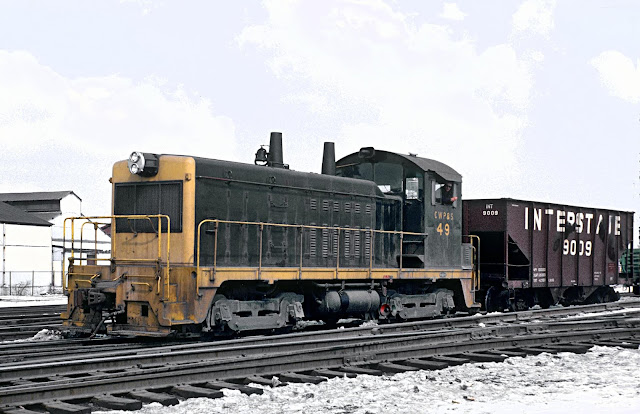
3. CWP&S 49 again, but at 104th St., Chicago, IL on March 31, 1964.

Brubaker, C. William, 1974, "Railroad Yards, South Deering", bru012_10_jF, UIC, CC BY-NC-SA, cropped
View looking southwest from East 103rd Street overpass at a large rail yard site. Boxcars in the foreground include one from the Chicago and Eastern Illinois Railway (C&EI) and another from Detroit, Toledo and Ironton Railroad (DT&I). These rail yards extend southeast from approximately East 100th Street to East 110th Street.

UIC Library Flickr
[Same description as above]
1938 Aerial Photo from ILHAP
I believe the yard went from 100th to 104th and industrial spurs went south down to 110th Street to serve Wisconsin Steel, which was the reason the CWP&S existed. I wonder if the "line" along the middle of the white area was a railroad trestle on which slag cars ran and the white area is a slag dump. It looks like the slag dump has been cleaned up, but a lot of the yard still exists. But they have made some of the land on the north end productive by selling it to industries.

Satellite
Steve OConnor posted
Wisconsin Steel Corporation: Dumping slag in South Chicago (WIS Photo-Dr. Raymond Boothe Collection).
David Raley When I was a conductor for CSX switching a local at NUCOR steel in Crawfordsville, IN, there was a nearby slag pit that when dumped into would light up the whole sky even when it couldn't be seen from where you were standing. The first time I saw it I actually started to run toward my engine because I thought it was an explosion in the mill, but the engineer explained it was just NUCOR's slag dumper and no loud boom would follow the big light it made.

Wayne Evans posted
Dumping cinders from the Wisconsin steel plant in Chicago at 104 street just East of Torrence Ave about 67/68. Working on the Chicago West Pullman & Southern. Low man on the extra board and got all the [difficult] jobs like the coke plant coal dumping.
Chuck Fleisleber Didn't they use to call the neighborhood around there Slag Hill?
Larry Grzywinski Chuck Fleisleber Slag Valley
John Lovaas Inland Steel built 5 square miles of lakefront property this way...Jeffery Hamilton I was a contractor for Acme steel at their plant in Riverdale but traveled to their Coke and Furnace plants in Chicago to do work. Unfortunately, they are no more.
Dennis DeBruler The steel plant still exists, and it is now owned by Arcelor-Mittal.
https://www.google.com/.../data=!3m1!1e3!4m5!3m4...
The bottle trains now come from blast furnaces in Indiana rather than from another location on the Calumet River.
Update:
Gary Sturm posted
CHICAGO WEST PULLMAN & SOUTH engines in the CWP&S yard in South Deering in Chicago in 1981.
[The comments discuss some old steam engines that used to sit in this yard for a long time.]

Marty Bernard posted three photos with the comment: "3 More Chicago West Pullman & Southern Photos."
1
1. CWP&S Office at 2710 E.104th St., Chicago, IL on March 31, 1964.

2
2. CWP&S 49 and 45 at South Deering Yd, Chicago, IL on May 13, 1965.
49 was a NW2 built 9/48, ex-DT&I 911.
45 was a SW8 built in 1952.

Steve OConnor posted
Interlake Iron Corporation-1965: Ladle Accident (IK Photo-Dr. Raymond Boothe Collection).
[
It is a different steel company, but I wanted to keep pictures concerning slag cars together.]
Steven J. Brown posted
Chicago West Pullman and Southern EMD switcher dumping slag near Pullman Junction, Chicago, IL - February 12, 1976.


Marty Bernard posted
3. CRI&P NW2 772 at 103rd St. in the CWP&S Yard, Chicago, IL on May 13, 1964.
Dave Glowczynski Jr.: Where was the 103 st yard?????
Bob Lalich: Dave Glowczynski Jr. - CWP&S 100th St yard is just east of Torrence Ave, between 100th and 104th Sts. Rock Island's Irondale Branch runs along the west side of the yard.

Bob Lalich commented on Dave's comment

Dennis DeBruler commented on Dave's comment, at image resolution
Dennis DeBruler
Admin
Just the other week, I was trying to remember who owned this yard. To add to my confusion, the railroads that go by it were owned by the Rock Island and BRC. But I see on this map provided by Bob Lalich that the CWP&S used trackage rights on the RI to get to this yard. Bob's comment was "Here is a CWP&S map circa 1915, courtesy of the Southeast Chicago Historical Society collection. West Pullman was quite an industrial area at the time." The CWP&S was one of two railroads that International Harvester owned in Chicago. This one served their Wisconsin Steel and Plano Works facilities. Most of the CWP&S route was trackage rights on RI and IC.

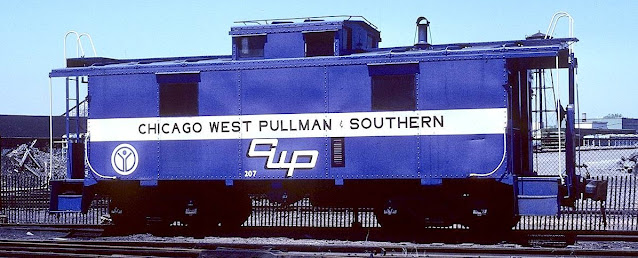
I'm guessing this caboose was parked in this yard.
Gary Sturm posted
Chicago West Pullman & Southern caboose #207 in Chicago in 1976.


IH: CWP&S: Chicago, West Pullman & Southern Overview

Kevin Piper posted a history and several photos.
Franklin Campbell: I remember reading an excerpt of an old Railway Age issue about various railroads being miffed with IH for utilizing the Chicago, West Pullman, and Southern and also the Illinois Northern Railway to pocket the fee for originating cars for IH.

David Daruszka posted the following two pictures with the comment:

Chicago, West Pullman & Southern traces its history to the 1880’s and the growth of Chicago industry. Cyrus McCormick, having founded International Harvester, wanted to grow his business by also controlling his suppliers. High grade Steel was vital to the production of the “reaper”, Harvester’s primary product.
As a part of that strategy, McCormick gained control of the predecessor of Wisconsin Steel, located in South Chicago. The Chicago, West Pullman and Southern Railroad was founded by McCormick, to transport steel between Wisconsin Steel and Harvester’s plants.
Any remaining steel production was sold to McCormick’s good friend, George Pullman, who ran the huge Pullman Works on Chicago’s South Side. A reliable and controllable Railroad was needed to economically provide timely deliveries, so the Chicago West Pullman and Southern Railroad was born and built to serve these two 19th century giants.
In 1983, Chicago West Pullman LLC was formed and bought the Chicago West Pullman & Southern from the bankrupt estate of Wisconsin Steel, which had been spun off by Harvester and left to flounder.
1

2
Bob Lalich commented on the above posting
Here is a CWP&S map circa 1915, courtesy of the Southeast Chicago Historical Society collection. West Pullman was quite an industrial area at the time.
[North is on the left side.]
Paul Petraitis also commented
Here ya go...West Pullman in 1892, industrial park west of Halsted, workers housing east to Normal Ave, fancy shmantzy houses east of Normal aka Stewart Ridge, built amidst the rolling hills of Andrews' Woods...West Pullman got the ICRR to build their Blue Island Branch through town ...the Calumet Electric St Ry ran west from Michigan Avenue along the northern edge of town as far as Morgen (1000 W)
David provided a link for a late-1900's real estate brochure published by the West Pullman Land Association.

Paul Petraitis It looks like they began putting this project together about 1890...chose the name because of the great reputation the Pullman name had at that time...the crash of 1894 hurt everybody AND the Pullman Strike of May 1904 kinda made the Pullman name "box office poison" for many....

Their South Deering Yard was just north of Wisconsin Steel. CWP&S used to have the Irondale Yard.

"In 1902 Deering merged with the McCormick Harvesting Machine Company to form the giant International Harvester Company. Deering owned the Wisconsin Steel Works on the Calumet River, and, by 1924, International Harvester operated at nine different sites throughout Chicago. (The Chicago River An illustrated History and Guide to the River and Its Waterways, 2nd Edition, 2006, David M. Solzman, p.81)

Kevin Piper posted several photos with the comment:
Chicago West Pullman & Southern Railroad was a small but fascinating operation on Chicago's southeast side. It started in 1909 as an industrial railroad to serve Wisconsin Steel and International Harvester's Plano Works. In 1983, Chicago West Pullman Corp. was formed and bought the CWP&S RR from the bankrupt estate of Wisconsin Steel, which had been spun off by owner IH. Through the 1980's, the by then obscure CWP&S RR survived by moving scrap from the dismantling of Wisconsin Steel and freight car storage. Down on its fortunes, and nearly devoid of business, it was again sold in 1991 to OmniTRAX of Denver, and then finally disappeared into today's Chicago Rail Link in 1996.
As a young boy, I rode my bicycle along 119th Street, and east of Ashland Avenue to watch red and white CWP&S locomotives working in the IH foundry area. The CWP&S main yard and office was just off 104th & Torrence. CWP&S accessed the West Pullman industrial area via trackage rights over the Rock Island and Illinois Central. Today some 50 years later, only memories remain.
Marty Gatton shared
Tom Judge My Dad spent some time as a switchman there. He told me the company nickname was "CWP&S: Chicago We Push and Shove."
Ken Rehor commented on Kevin's post
I took this on March 14, 1980 in Forest View, IL on the Chicago & Illinois Western. The car is marked "NEW 1-80"
Paul Jevert One of my grandmother's ex's was a switchman on the CWP & S, Harry [Slatt's] Leek back in the 1920' & 30's ! I also knew a Yardmaster who lived in Hudson Lake IN and who rode the South Shore Line to work. I also worked these C&IW assignments out of Crawford Ave. Wobbly yard off the I.C. Yard Engineer's Xtra Board in the 1970's & 80's ! The photo shows a CWP&S 50 ft. gondola in a Wobbly yard job going out by the MS District drying beds were there was an adjacent scrap yard in which we set mtys in and pulled loads for shipment. I may have worked this Hodgkins Industry job this day of the shoot !

Kam Miller posted
Kam's comment:
This is another line I was partial to back in the day. Loved those red and white locos as I would see them in transfer use at the IC Homewood yard while taking the old rattan-seat single deck mu's to Chicago. I got some decals from a South Holland hobby shop that moved to Wisconsin and made a couple CWP locos myself.
Kam Miller posted
Note in the above photo it is moving slag cars. A reminder that it was an industrial railroad to serve Wisconsin Steel and IH's Plano Works.

Mike Rusnak Got a ride on one those back in the 60's. Was working the IH plant near 121st and Racine.

Dennis DeBruler Mike Rusnak, what did they make at that IH plant? Was it where there is now a field of solar panals?

Mike Rusnak The West Pullman International Harvester plant made a lot of bearings, engine, axle and transmission parts. I worked there for awhile in the mid 70's and my mom worked there during WWII making bomb components. Haven't been back there in many years. Front of the plant was along 120th and ran from Racine to Peoria. The back fronted the Blue Island branch of the ICRR electric line.


Keith Rieger Sr. commented on above posting
 Blue Island about 1974
Bill Molony posted
Chicago, West Pullman & Southern Railroad 0-6-0 #25 was steamed up and ready for a day's work when this photograph was taken on April 18, 1939.
Bob Lalich I believe the only CWP&S roundhouse was located at the south end of their 100th St Yard. It was accessed with switches rather than a turntable.
Bob Lalich commented on Mark Hinsdale's posting

Here is a portion of a 1952 map showing the West Pullman industrial trackage of the CWP&S, and the connections to the PRR and IC.
Dwayne Stegner posted
Chicago, West Pullman & Southern RR.
February 12, 1978 finds Chicago, West Pullman & Southern Railroad's Unit Number 46, and EMD SW-8 Switcher, working a slag train at Chicago, Illinois
Wayne Evans posted
Chicago-West Pullman & Southern dumping cinders from Wisconsin Steel open harths about 1968 or so. East of Torrance at 104 street in Chicago.
Mark Losiniecki My grandfather was a CWP switchman on the slag trains out of Wisconsin Steel.Wayne Evans Worked on them slag trains and in the coke plant because I was low man on the call board. Two shitys jobs in the plants. INH owned the CWPS. Good times even if the work was shitty.

Steven J. Brown posted
Chicago West Pullman and Southern EMD switcher dumping slag near Pullman Junction, Chicago, IL - February 12, 1976.
Steven J. Brown Irondale
Mike Dore Between 103rd and 106th east of Torrence
Gabe Argenta no more mountains of slag nowadays

Lou Gerard posted via Dennis DeBruler
Chicago West Pullman & Southern dumping slag from Wisconsin Steel in Slag Valley. South Chicago 1975.

Marty Bernard shared
CWP&S SW9 51 at 104th and Torrance, Chicago, IL in January 1963. Rick Burn photo
Ken Schmidt commented on a post
This was shot in S. Chicago around 1988. Not the best shot. It used to have a blue and white livery.
[This is green and white.]
Rob Olewinski Cmraseye posted
I have what I need to model one of these in HO...and I want to do the Sanitary District and a Manufactures Junction units as well. So much cool stuff in the 'old' days. Rail Link yard off of Torrance in '90.

Stan L. Maddox posted
I came across this unusual track arrangement in front of the CWP&S Roundhouse in Chicago, IL, circa 1947. Note how a slip switch is utilized to align the track geometry to the stalls (see Bob Lalich’s comments and photo below). Has anyone ever seen this type of solution before? Sanborn Map Co. Vol. 48, 1947, p24.
Bob Lalich commented on Stan's post
Sanborn maps are not 100% accurate representations of railroad tracks. They were drawn for fire insurance purposes so most of the attention is paid to buildings. This 1939 photo appears to show a slip switch in the track leading to the fourth stall of the CWP&S roundhouse. Photo courtesy Blackhawk Chapter NRHS.

Dennis DeBruler commented on Stan's post, photo resolution
I confirmed that the resolution of a 1938 aerial is not good enough to determine the track layout.

Dave Arganbright posted
Wisconsin Steel was shutting down in 1980, but their little CWP still looked great at this time. What's left of CWP *(primarily the Torrence Avenue corridor) is now operated as part of the Chicago Rail Link. My photo.
Rod Truszkowski The ones the raillink use now are junk.

Jeffrey Smith posted
Chicago West Pullman Southren Cab Chicago IL
5/1981 ( Alan Gaines Photo ) .

John Smatlak shared a Flickr
Andre Kristopans Eventually it was dragged to up by 100th Street. Scrapped finally around 2005?
Barry Matthews What does it look like now?
Bob Lalich There is a truck parts operation just east of the location in the photo, and an asphalt plant on the south end of the former WSW property. The rest is vacant.
Paul Fortini 12d 
I used to go down that way in the late 1980s. By then CWP was making money by hauling out the remains of the steel plant and by storing freight cars & locomotives. I remember seeing about six or seven of their locomotives in the yard (was it at 99th street or so?).
 
Marty Bernard posted
Chicago West Pullman and Southern 49 at 104th St., Chicago, IL on March 31, 1964. A NW2 built 9/48.
James Deeds: Ex DTI 910
Interstate Railroad was subsidiary of the Southern

Marty Bernard shared
Dennis Stanczak: Wow, I’ve never seen that paint scheme.
Andre Kristopans: This was in 1960s and before. Red came late 60s, blue very near the end. At least 43 in its last days was green and white but still lettered CWP

Mark Hinsdale posted three photos with the comment:
"South Chicago Workhorse"
Chicago West Pullman & Southern Railroad (CWP&S) was an industrial short line built to serve the needs of owner International Harvester's Plano Works and its subsidiary Wisconsin Steel.  Located in the gritty Irondale neighborhood on Chicago's southeast side, the small carrier toiled away hauling raw materials and finished products associated with both industries throughout most of the last century, until the plants closed in the early 1980's.  What remains of it today belongs to successor Chicago Rail Link, a component of Denver-based OmniTrax. Here are three views of CWP&S, taken during better times in July and September, 1977, before the eventual closing and ultimate dismantling of the two primary industrial complexes it served.  Three photos by Mark Hinsdale, 7-77 and 9-77
Mark Hinsdale shared
1

2

3


(Facebooked)

Marty Bernard posted three pictures, each with a different paint scheme, to a public group.

Sam Carlson posted a couple of pictures of their engines in a blue and white scheme.

Bob Lalich provided a Flickr album of engines.

Marty Bernard posted yard and switcher photos. And Part 1, Part 2 and Part3.

4 photos of locomotives