Showing posts with label brick. Show all posts

Thursday, November 13, 2025

Aban/Pennsy Industrial Spur Bridge over Buffalo Creek in Freeport, PA

(no Bridge Hunter; no Historical Bridges; Satellite)

Dave Kuntz Drone Photos posted four photos with the comment: "A vast amount of bricks - this abandoned bridge near Freeport PA has something I've never seen before: piers make out of bricks.  It turns out that it led to a brick factory so the transportation costs were cheap."
Patrick Kerr: Freeport Brick. They were the world's largest producer of "ladle" brick. Used to line the inside of ladles that held molten steel.
Ron Mele: The brick company was the last rail served business on the Butler Branch before the entirety of the branch was abandoned.
Dave Kuntz Drone Photos shared with the comment: "This brick factory in Freeport PA was at one time the world's largest manufacturer of fire bricks used for steel mills. It closed in 2017 and looks like some sort of bulk materials transfer yard now/"
1

2

3

4

Dennis DeBruler commented on Dave's post
The bridge was for the PRR industrial spur that served that factory. 1953/55 Freeport Quad @ 24,000

Monday, October 30, 2023

Brickyards along the North Shore Channel in Chicago, IL

South of Oakton: (Satellite, bounded by Oakton, Dodge, "L" and North Channel)
South of Touhy: (Satellite, bounded by Touhy, Sacramento, Pratt and Kedzie)

MWRD posted
A view to the south showing several structures on the National Brick Company property near Kedzie and Touhy avenues in Chicago on July 6, 1907. This property was near the path of the planned North Shore Channel, for which the Sanitary District (now MWRD) began construction in 1907 and completed in 1910.

Dennis DeBruler commented on MWRD's post
I included the gasometer that was south of the brickyard because I like finding them. https://clearinghouse.isgs.illinois.edu/webdocs/ilhap/county/data/cook/flight6/0bwq07041.jpg
Bill Meyer: That airplane directional message was pointing toward what was then Sky Harbor airport in Shermerville, that would become today's Northbrook. Airport long gone...

Dennis DeBruler commented on MWRD's post
I first found this clay pit. But then I realized that it is south of Oakton instead of Touhy and close to the O'Brien WRP. The railroad that went over the North Channel was the C&NW Weber Branch.

I presume the Oakton brickyard was the one owned by Barney F. Weber as mentioned in the following comment.
David Daruszka commented on Brian's post
The Weber Branch derived its name from Barney F. Weber who owned a brickyard. He founded the Chicago & West Ridge Railroad, that consisted of track but no rolling stock. It was operated under agreement by the C&NW, but was not part of the Mayfair Cutoff. It connected with the C&NW at Weber Yard. So Mr. Weber's name somehow become associated with the yard and the branch line. Information from the Rogers Park Historical Society newsletter "The Historian".


Tuesday, September 24, 2019

Westmont/Gregg Made Bricks

I didn't realize that bricks were made in the Western Suburbs until I read the post below. I knew there was a lot of brick manufacturing around Goose Island, South Chicago and in Streator, IL after the 1871 Fire because of a city ordinance that ruled out reconstructing with wood. [DeBruler]

The house that William L. Gregg built for himself with one of this first batches of bricks has been preserved in Westmont (Satellite).
20190925 9459

Forgotten Railways, Roads & Places posted
Westmont Station was originally known as "Gregg".
Nothing was more important in paving the way for future Westmont than the building of the Chicago/Aurora branch of the C.B. and Q. Railroad, begun in 1862 and completed two years later. At this time, a large share of the future Westmont was bought up by the Phipps Industrial Land Trust. Shortly after the Chicago Fire of 1871, some of this land was sold to a number of brick manufacturers jumping at the chance to supply bricks for the rebuilding of Chicago.
The most memorable brick manufacturer was William L. Gregg who chose the highest point of land along the C.B. and Q. Railroad for his company so that shipping by steam locomotive would be downhill with a full load of brick. In the spring of 1872, Gregg began manufacturing bricks under the name of Excelsior Brick Company. His company started with a capital investment of $250,000.00, employed 120 people and produced 70,000 bricks a day. While here, Mr. Gregg invented and patented a triple pressure brick machine which revolutionized the brick industry. Using this method, his bricks could withstand 100,000 pounds of pressure without cracking or disturbance of any kind.
Gregg built his home to showcase his product. Records indicate he lived in the home for approximately three years. He considered himself a dealer in patents as he invented sixteen different pieces of brick making apparatus.
By 1900, brick making declined. The area continued to grow and the flag-stop on the “Q” was known as “Gregg’s Milk Station”. The name of the station was shortened to “Gregg”.
After Gregg left the area, the home had various owners and was used as a farm house, restaurant, funeral home, speak easy, and recreation center. Later it was owned by Holy Trinity Catholic Parish and used as a home for a priest for a short time before becoming home to several nuns.
Eventually the home became run down and was going to be demolished. In 1976 the Westmont Area Historical Society was formed to save the home. It was moved one block from its original location on Cass Ave. to its current location on Westmont Park District property. After extensive restoration, it opened as a museum in the fall of 1981.

History via: https://www.westmontparks.org/parks-facilities/gregg-house-museum/
The oral presentation at the museum provided some more information. Gregg was living in Philadelphia when he heard the Chicago rebuild could not use wood and would need a lot of bricks. So he moved to the Chicagoland area to be a part of the rebuild economy. The 80-acre parcel that he bought was typical for the day. His house was originally on Cass. The Holy Trinity Catholic Church owned it and actively used it. But in the 1970s they wanted to tear it down to expand. The Westmont Historical Society was formed, and they moved it a block East. Since the new location was still on the original 80-acre plot, the 1977 move did not invalidate its inclusion on the National Register of Historical Places in 1980.

Gregg designed and built is own equipment to mix, cut and dry the bricks. His machines to mix and cut the bricks ensured that they were of a consistent composition and size. His kiln was designed to dry all of the bricks in it at a uniform rate.
The home of William L. Gregg was constructed in 1872 with bricks manufactured in the newly operating Excelsior Brick Manufacturing Company. Gregg's brickyard, a large and carefully located one for that time, employed 120 workers and manufactured 70,000 bricks a day. Mr. Gregg also invented the triple pressure brick making machine, which revolutionized the brick making industry. He died in 1891 and a few years later, the Excelsior Brick Company ceased production. [Brochure]


I have determined that the above topo excerpt was from the 1901 Riverside Quadrangle @ 1:62,500. The left side of the excerpt is the left side of the quadrangle. The oldest topo for the Westmont area is 1891:
USGS 1891 Riverside Quadrangle @ 1:62,500
By 1927, the suburbs along the CB&Q had "filled in."
USGS 1927 Hinsdale Quadrangle @ 1:24,000
I took a couple of photos of the garden that is behind the house.


They had three (glass covered) frames for the diagrams and text of some of his patents.

A kiln:

A "Brick Mahcine:"

A drying building:

Each Summer they have a different theme for the exhibits in their two front rooms. This year was transportation. So one room was about the CB&Q Railroad.

This is the first time I've seen Lisle included in the list of existing western suburbs. And Hinsdale had a different name. But now I can't remember it. Bush Hill is what is in my brain cells. But I don't trust them.

The second room was about the I&M Canal.

Two closeups to try to get a readable resolution of the facts. If you click an image and use your browser's F11 option, you should get a better view.


This display includes historic and current views of the Fox River Aqueduct in Ottawa, IL.

I took this image for my Gaylord notes.

The museum is full of permanent exhibits of "old things." This is just a sampling. Note the washing machine. The stove had gas burners. They had a sign that explained the temperature of the two ovens was not automatically controlled. Each oven had a thermometer, but a human would have to adjust the controls to maintain the correct temperature. The compartment on top was a warmer.

Early cathode ray tubes were round because that was the strongest shape to withstand the pressure of holding a vacuum inside.

Most old cash registers I have seen are quite fancy. I'm sure this is more representative of what was actually used.

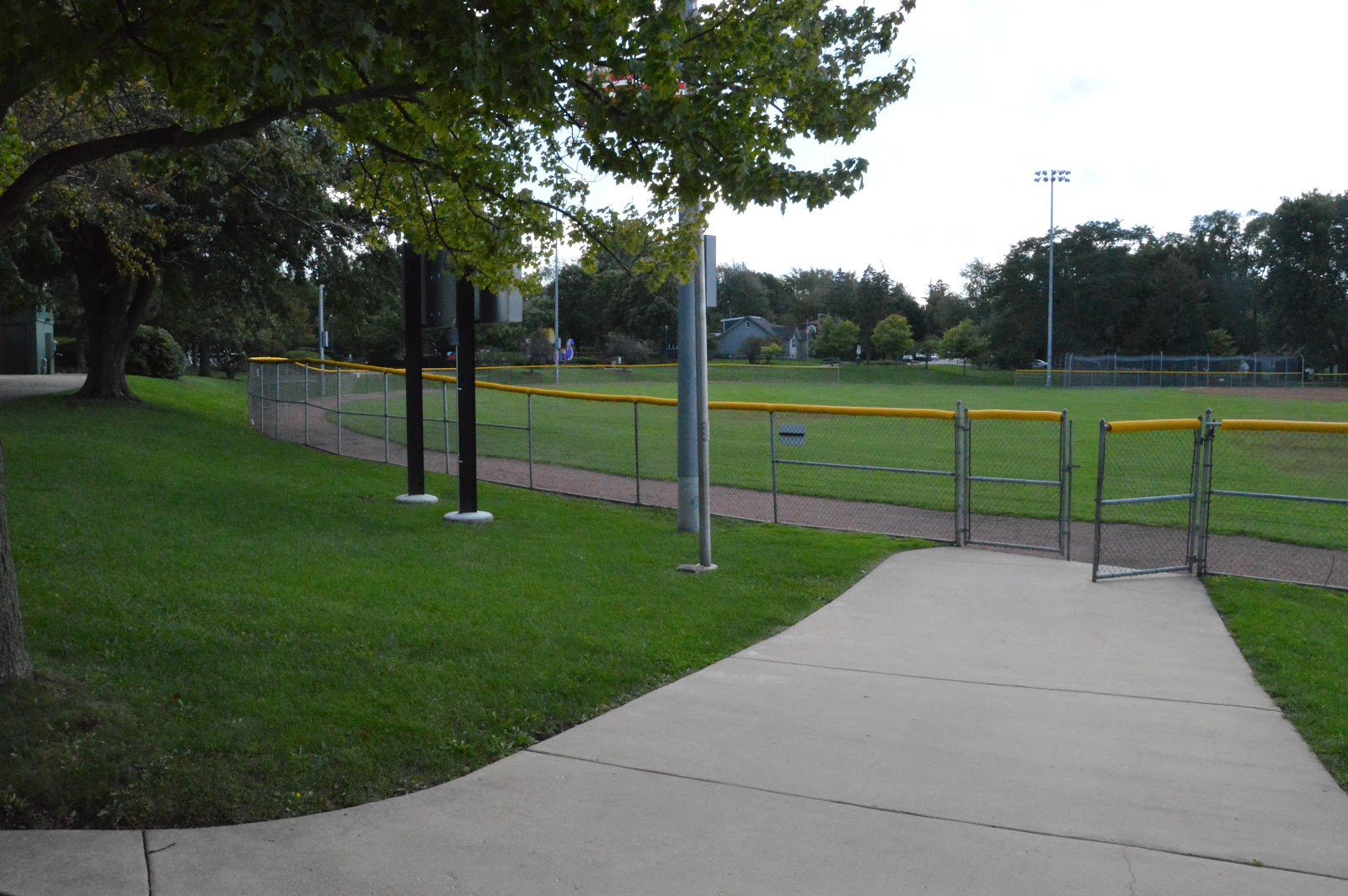
The oral presentation explained that the ball park south of the house was the clay pit for the brick factory. The diamond was visibly lower than the surrounding land. I took a couple of photos to try to capture the slope of the land along the edges of the diamond.


I found myself parked in, so I had to kill some time. I walked down past home plate to take another photo to try to capture the fact that the diamond is in a pit. That is Gregg's House in the middle of the photo. A park district building is to the right of the house.

During the oral presentation, I was showed one of the bricks he made. I knew that the markings on a brick are important to brick collectors. So I went back in to get some close ups of the demonstration brick. Note that the S is backwards.
Image taken with permission of the Gregg House Museum

Image taken with permission of the Gregg House Museum

Image taken with permission of the Gregg House Museum

Friday, January 13, 2017

CB&Q's Lowell & Southern and Risokrat Clay Product Co.

David Jordan
posted
David's comment:
The railroad construction era had slowed by the 1920s, but wasn't quite over in Illinois. This article is about a short branch built for the Lowell & Southern Railroad off of CB&Q's Zearing-Streator Branch, presumably sometime in 1927. This branch served the Ristokrat Clay Product Co. brick plant, which lasted until 1981. Presumably, Burlington Northern served it until the end at which time the branch was abandoned. I typed out the entire story in case the photo of the article is difficult to read.
Peoria Evening Star October 2, 1926
NEW RAILROAD TO TAP MINES IN LA SALLE CO.
Washington Bureau, Peoria Evening Star
Washington, D. C., Oct. 2 - The next rail construction to be undertaken in Illinois will be a four-mile stretch of track in LaSalle county connecting the town of Lowell with the main line of the C. B. & Q. railroad, according to a certificate of convenience and necessity issued here by the interstate commerce commission.
The new road, which will be known as the Lowell & Southern, will tap the extensive clay pits in the vicinity of Lowell. Its incorporators include Allen F. Moore and George E. Moore of Monticello, the former being republican national committeeman from Illinois, and William C. Barnes of Decatur. The estimated cost of construction of the line is $93,350, which will be advanced by Lowell Industries.
Building of the railroad is expected to boom the village of Lowell, which now has between 100 and 150 residents. There are said to be extensive deposits of high grade clay, gravel and limestone in the vicinity,the clay and gravel being practically inexhaustible. There are also veins of coal approximately 40 inches thick, which might be mined profitably.
Plan Other Industries.
A grain elevator will be built at Lowell, and a revival of other industries, including a sawmill and several grist mills, is expected. The L. E. Rogers Clay Products Co. is constructing a plant at Lowell, which will furnish a substantial tonnage for the proposed line.
In the application for a construction permit it was estimated that traffic on the proposed line will develop within five years to 500,- tons per year, with gross revenue aggregating between $75,000 and $80,000 per year. This tonnage is expected to move to various parts of the United States, but principally to the territory west and south of Chicago.
Barnes Known Here.
The Burlington declined to construction the branch line, which will connect with its main track, northwest of Leonore, saying it was in doubt of the ultimate success of the project, but subsequently agreed to operate it and also to take charge of the construction if the promoters would advance the necessary funds, which will be refunded to them if tonnage develops to an extent warranting such action.
William C. Barnes, one of the incorporators of the new road, is well known in Peoria, where he was formerly a newspaper man and subsequently secretary to former Congressman Clifford Ireland."
(end of story)

John Smith don't see any clue of this line you are talking about
David Jordan John Smith Here's something I found on the line. 
http://guitarjourney.tripod.com/rayslasallecoun.../id39.html

Dennis DeBruler You can see a tree line where it ran south then curved over to the east a bit. It went straight south from there mostly along property lines. https://www.google.com/.../@41.2299255,-89.../data=!3m1!1e3
Dennis DeBruler Here is where it joined the mainline, which itself is now hard to find. https://www.google.com/.../@41.2001945,-89.../data=!3m1!1e3


John Smith commented on the above posting
finally found it via 1950's and 70's topo maps
The CB&Q "mainline" was really a secondary line of the CB&Q originally built as the Illinois Valley and Northern.


Satellite
It looks like someone built a modern building on part of the foundation of the long, skinny building at the southwest side of the plant. It is not obvious in a satellite image where the clay pit was in the ruins of the brick plant. Looking at a 1939 aerial photo (below), I realize it wasn't a "pit" but rather it was most of the land northeast of the plant and along the river.

1939 Aerial Photo from ILHAP

1939 Aerial Photo from ILHAP
Fortunately, Ray Tutal Jr. got several pictures before everything was torn down. They are at the bottom of his Online Museum web page. Zooming in on the aerial photo, they appear to be along the long, skinny building. I assume the buildings to the northeast made the bricks, the kilns "cooked" them, and the long building was a warehouse. If you look at John's map above, the L&S did curve west and appears to have gone along side the warehouse building.
1939 Aerial Photo from ILHAP
Near the bottom of the photo on the right shows the curves the L&S used to move a little further east. And in the lower-right corner of the photo below we see the connection with the CB&Q/IV&N.

1939 Aerial Photo from ILHAP
As part of researching the brick company, I found a 1964 directory of mineral producers in Illinois.

Sunday, October 30, 2016

Tie Rod Anchor Plates (Structural Retaining Stars) on Brick Buildings

Some terms for the anchor plates: Structural Retaining Stars, Gib Plates, Hurricane Bolts, Pattress Plates, Masonry Restraints and Tie Backs. [AlliedBolt]
 
20151212 7473
I found this building being remodeled on Goose Island. It is the first building I have seen in Chicago that has tie rod anchor plates. In fact, it has two different types.

It has big ones in vertical columns and little ones near the top along the roof line. The little ones help fasten little rods in the wood beams of the roof to the brick wall to hold up the roof. These are further described below.

I believe the vertical tie plates terminate tie rods that run completely through the brick walls inside the building. This helps hold in the outer walls and provide reinforcement for the interior walls.
Tsongas Industrial History Center posted
For those following our #MillYardMonday posts, sorry we missed one yesterday! Today is Tuesday, but it's the perfect time to learn about tie rods. You may have noticed the black metal knobs that dot the sides of mill buildings at evenly spaced intervals. These knobs are actually the protruding ends of objects called tie rods. The rods were used to secure floor support beams to the mill walls. Builders attached the rods to the beams and then pushed them through the wall, securing them to the outside in a way similar to using nuts and bolts. By attaching the tie rods this way, builders essentially anchored the floor beams to the walls. Eventually this building method was used less often as some believed that, in mill fires, tie rods actually caused more damage to the building. If the wooden floor beams sagged, snapped, or burned, it was likely they would pull down the walls with them since they were attached by the rods. The decision to stop using tie rods in construction made it more likely that the walls of a mill would remain standing after a fire, even if all the floor beams burned away.
In this image of the Boott Mill you can look to the left and see the ends of tie rods scattered across the building. This continues along the whole length of the structure as well as on the opposite side of the mill!
Note the tie plates in these mills run horizontally along the floor lines. The Chicago building must have been built after this lesson was learned and only the roof is tied into the outer walls. They switched to rods through the walls to help hold the outer walls from buckling outwards.

I first saw tie plates in a building in a small town in Illinois. (After a lot of searching in my picture folders, I discovered it was in Indiana.) Of course, I can't remember which town that was. I had gotten out to take pictures of railroad structures along a north/south railroad when I spotted it across the street. These are some of the buildings I came across while looking for the building I wanted to find.

In this building the tie rods with their plates seem to have been used for repairs. Note the cluster on the corner between the second and third floor. There is also a vertical set of tie plates in the lower-right corner.

(20141017 0061, Streetview)
The IC Depot in Mattoon, IL.

(20150730 3695)

One of the back shop buildings in IC's Paducah's shops has plates along the left side and along the bottom of the end wall. In this case, there is probably something heavy on the inside that has been mounted to the wall, and the mount needed the extra strength of a tie rod and plate.

(20150930 4965)

In North Baltimore, OH, I was taking a picture of the 1892 cut stone building, but I notice the building to the right has a couple of tie rod plates by the window.


But looking at a Streetview, they must be for a repair job rather than for the original construction.

(20151101 5239)

A block to the west is an old industrial building. (Unfortunately, it is currently vacant and for sale. I hope a developer can reuse it as an antique shop, wedding reception hall, or whatever building depending on the layout of the interior. People near Chicago have weddings in Streator, IL, even if some of the guests have to stay in Peru or Ottawa, IL because an industrial building was converted to a (relatively) reasonably priced "event center.") This view is looking to the northwest across the CSX/B&O mainline through town.

In this view of the east side, I see some tie plates that were used for repair ---- three horizontal ones on the right and at least two vertical ones on the left. (There may be more vertical ones behind the tree.)

(20151101 5230 and 5241)

A side building of the Tampa Bay depot has a few along the top. The foreground is one of the platforms and its shelter.

(20151225 7772) (I spent Christmas Day driving around Tamp Bay because traffic would be light and because I had been to Busch Gardens the previous year.)
These two buildings in Newburgh, IN, have two types of plates. The one on the left has a couple of the typical star plates. The one on the right has six, green "daisy flower" plates.

(20140811 0493)  Streetview


Bingo. This is the building I had in mind. This is the first one I noticed with tie rod plates on the side. And this appears to be the bad design described by the Tsongas Industrial Historical Center comment above where the floor and roof beams are tied into the walls.

(20141108 0183) Streetview
The middle of the hydro-electric plant in Marseilles, IL, has two rows of tie plates along the top. But in this case I think it is to mount something heavy on the inside of the building.

(20140627 0056) Streetview
Attribution: Oosoom, CC BY_SA 3.0
Tie rods and anchor plates in the ruins of Coventry Cathedral
Tie rods have good tensile strength and bad compression strength whereas masonry has good compression strength and bad tensile strength. Like reinforced concrete, they can be used together to produce a much stronger building.

I have a lot more pictures of brick buildings. But they were just a brick facade over a steel frame (effectively short skyscrapers). The brick in these older buildings with tie rods are probably load bearing walls built in the 1800s and early 1900s, and the rods are the only steel (wrought iron if old enough) in the structure. I assume that if tie rods were not used, more courses of brick would be needed in the walls to withstand lateral loads such as wind load. I wonder how well masonry buildings with tie rods survive earthquakes. (Masonry buildngs without tie rods don't survive.)

An 18-page .pdf sounded interesting, but when I clicked the "Download button," it asked for private information. A 201-page .pdf is more information than I'm willing to look at. I skimmed an 8-page .pdf and noticed that vertical ties are more effective at resisting earthquakes than horizontal ties.

1976 Photo by Robert Daly via DeBruler