Also known as the Limeville Bridge.
 |
| Historic Bridges |
 |
| Aditto Aditto posted Definitely a railroad landmark in the Portsmouth, Ohio area. Chesapeake & Ohio’s Limeville, Sciotoville, Ohio River Bridge, Bridge #17 or just call it a fascinating, mind numbing railroad structure. Even the builders plate weighs several tons. Jay Krajcovic shared Cragnolini M Lines posted with the same comment as Aditto Andy Ippolito shared [This photo is definitely making its rounds on Facebook.] Judith Allen posted with a copy of Aditto's comment Tim Shanahan shared Kellynha Adelino posted Definitely a railroad landmark in the Portsmouth, Ohio area. Chesapeake & Ohio’s Limeville, Sciotoville, Ohio River Bridge, Bridge #17 or just call it a fascinating, mind numbing railroad structure. Even the builders plate weighs several tons. |
 |
| James Bergman commented on Cragnolini's post What interesting is that the photo here shows two sets of track and the other one is one. Johnnie E McCloud Jr.: James Bergman that is actually still one set of tracks. If you look closely there is guardrails on each side of the tracks. With the two center rails been the actual track. |
 |
| James Bergman commented on Johnnie's comment Here is a photo of it being double track, I grew up about 1 mile from this bridge and have seen north and southbound at the same time, very rare but it does happen, and now I drive CSX railroad taxi service and we have discussed this bridge with many engineers and conductors, some don't like crossing it and some love it. |
 |
| Whit Wardell posted GE promo painting on Limeville/Sciotoville bridge crossing the Ohio River on the Russell to Columbus, OH Northern Subdivision. |
Dennis Shafer posted the comment: "Former Chesapeake & Ohio Railay bridge across the Ohio River at Sciotoville, Ohio. Bridge is currently used by CSX Transportation as part of their "Northern Subdivision" between Russell, Kentucky and Columbus, Ohio."
 |
| Jesse Smith commented on Dennis' post That bridge has the highest "live load" rating of any bridge ever built in the world! Here's a northbound crossing it back in 2016. Dennis Shafer What is the live load rating for it? Jesse Smith  Dennis Shafer The weight of the bridge itself (dead load), plus the weight of what rolls over it (the live load). And because it was build in 1917 (the age of heavy steam power), they built "for the future" as engines were just going to get heavier. Dennis Shafer The weight of the bridge itself (dead load), plus the weight of what rolls over it (the live load). And because it was build in 1917 (the age of heavy steam power), they built "for the future" as engines were just going to get heavier.Doug Bess Bridges in that era were designed for steam impact, that is the force of the drivers pounding on the bridge. Also the Limeville bridge is double track so the design of the bridge takes into account of both tracks being loaded at the same time. |
 |
| Andy Chabot posted Limeville Bridge - CSX Northern Subdivision Eastbound empty hopper train is crossing the Ohio River traveling from Ohio toward Russell, Kentucky. 09/30/2007 ©2007 Andy Chabot |
Matt Bruks posted two photos with the comment: "Former C&O Limeville/Sciotoville bridge spanning the Ohio River. Built in 1916, 1550ft in length with the longest span of 775ft. It also carried the record for the longest truss span until 1945. Another neat fact most don’t know, during the WWII time era there was intelligence gathered that it was slated to be bombed by enemies to cripple the infrastructure of the rail line for its huge role in transporting of troop and munition trains. But it was never carried out."
 |
| 1 |
 |
| 2 |
 |
| Cragnolini M Lines posted Definitely a railroad landmark in the Portsmouth, Ohio area. Chesapeake & Ohio’s Limeville, Sciotoville, Ohio River Bridge, Bridge #17 or just call it a fascinating, mind numbing railroad structure. Even the builders plate weighs several tons. Josiah Whitley: My great grandfather was helping build this and somehow lost his footing on the structure and fell off of it into the river. Surprisingly he never got hurt. He just swam to shore and went back to work lol Hubert Carver was his name. Roger Wayne Cooper: My grandpa told me a story about going out on that bridge in the 27 flood I believe he said there was a cow standing on something (I believe it was a cow may have been a hog!!!) in the river and that men from Sciotoville went and rescued it!! That bridge was about the only thing sticking out of the water!! Dan Callendar shared |
 |
| Mtnclimberjoe Rail Photography posted On an overcast afternoon, a GE ES40DC and C40-8W lead CSX manifest freight M311 as it heads north towards Columbus on the CSX Northern Subdivision. The train is coming into Sciotoville, Ohio on the 1916 built continuous truss bridge that features two 775 foot long spans over the Ohio River. ====Info==== 10/27/2023 CSX Northern Subdivision Sciotoville, OH CSX M311-27 (Manifest; Russell, KY to Columbus, OH) CSX 5331 ES40DC Ex. CSX 5331 ES44DC Blt. 2006 CSX 7780 C40-8W Blt. 1992 |
Three photos by Dave Honan with the comment:
A couple miles east of Portsmouth, OH, is CSX's massive Sciotoville Bridge, a two-span, 1,550-foot continuous truss bridge over the Ohio River. The structure, the heaviest continuous truss bridge on the continent, was designed by David Steinman and built by Gustav Lindenthal between 1914-17 for the Chesapeake & Ohio Railway. (April 05, 2004)
 |
| 1 |
 |
| 2 |
 |
| 3 |
 |
| Street View |
 |
| Steven J. Brown posted Family Lines SD40-2 SBD 8079 (built 1979 as L&N 8079, became CSX SD40-3 4044) crossing the Ohio River near Portsmouth, Ohio - July 3, 1987. Mike Lusher: I've read that it's the strongest bridge ever built in the entire world. It was built to handle the weight of two H-7 locomotives with loaded trains passing each other at track speed. Steven J. Brown shared |
Stu Levene photo:
One side was built on falsework. Then the cantilever design allowed the other side to be built with minimal falsework because the first side was available to balance it. But the forces on the joints changed between the initial truss structure on the first side and the final cantilevered truss so hydraulic jacks were needed to join some of the members for riveting. The following catches the center pier completed, wooden piers used as falsework, a travelling gantry on the false work to build the supported span, and a creeper hoist on the other side of the center pier to build the suspended span.
"It contains some of the most massive members and chords ever seen in a truss bridge." [Historic Bridges] The following shows a member that requires both booms of the hoisting tower to lift it.
Ken L. Chamblin posted five photos with the comment:
The seldom-photographed Sciotoville (Limeville) Bridge towers above a CSX train of 129 empty coal hoppers. The shot was taken from on top of the parapet at the south side of the bridge.Appalachian Railfan photo:
A coal train makes it way westbound (TT Direction) with coal destined for points north as the final light of day is setting over the Ohio River. A scene like this only makes me reflect on a time when it was possible to see C&O Superpower haul miles of black diamonds along this route. What a sight that would have been to see.
"This bridge held the record for longest continuous truss span [775'] in the world from its opening until 1945. See April 2000 Trains Magazine for an article on this bridge." [Bridge Hunter] It was also the heaviest. [Historic Bridges] "It remains today the mightiest bridge ever built from the point of view of its load capacity." [cohs]
 |
| McClintic-Marshall Company booklet from Historic Bridges |
 |
| Gary Bellamy commented on a posting |
 |
| Ken L. Chamblin commented on a posting Here is a view from the Ky side taken by me from my train |
 |
| Ken L. Chamblin commented on a posting Got Tunnel Vision? |
 |
| Engineering News-Record Vol. 80, No. 2, p62 from Historic Bridges |
 |
| Engineering News-Record, Jan 31, 1918, p221 from Historic Bridges |
 |
| Engineering News-Record Vol. 80, No. 2, p66 from Historic Bridges |
A pictorial summary of the construction stages. As the suspended span grew, they could remove some of the false work under the supported span because it was being held up by the weight of the suspended span. Reducing the number of falsework piers in the river was important in the Winter to reduce the impact of ice flows on the falsework.
 |
| Engineering News-Record, Jan 31, 1918, p235 from Historic Bridges |
 |
| One of three photos posted by Charles E. Whisnant |
The massive size of the members is caught by this photo. I had to look a while before I did find some men in the photo.
 |
| Transactions of the American Society of Civil Engineers, Vol. LXXXV, 1922, p931 from Historic Bridges |
 |
|
Scott Burrell For many years it carried the highest live/dead weight rating of any bridge in existence.
Donald Montgomery Wow, bet it takes 3 months or longer to inspect...
Raymond Adomonis shared Dennis DeBruler Aaron J. Border has this commentary on his photo: "The massive spans of the Gustav Lindenthal-designed Sciotoville bridge tower above an eastbound grain train as it crosses the Ohio River into Kentucky. Towering 236 feet above the river at its highest point, the twin 775-foot long spans of this bridge were the longest in the world from its completion in 1917 until 1945." https://railpictures.net/photo/342144/ Dennis DeBruler Aaron J. Border: "Westbound grain empties cross the Ohio River on the massive Limeville-Sciotoville Bridge. Completed in 1917, the bridge was designed by famed architect Gustav Lindenthal, and remains today the largest continuous truss railroad bridge in the world." https://railpictures.net/photo/361116/ Debbie Newson Hampton posted I'm fascinated by the Sciotoville Bridge featured in this pic of an eastbound crossing the Ohio River in Siloam, KY. Towering 236 feet above the river at its highest point, the twin 775-foot long spans of this bridge were the longest in the world from its completion in 1917 until 1945. Photo by Aaron J. Border. Randall Hapton shared Bruce B. Reynolds: Designed by Gustav Lindenthal, who also designed the Queensboro Bridge (59th Street Bridge) and the New York Connecting Railroad (a/k/a Hell's Gate Bridge). Jeff Miller: I think its the heaviest (Most steel) in the world. Tim Shanahan shared |
 |
| Jason Widdig posted, cropped Queen of the Mississippi. 10-11-2021 Sciotoville Ohio. |
 |
| Kenneth James White posted My favorite railroad bridge: The Sciotoville Bridge spanning the Ohio River at Sciotoville Oh. Opened in 1917. Bruce B. Reynolds: Designed by Gustav Lindenthal, most noted for the Hell Gate bridge of the New York Connecting Railroad. |
 |
| safe_image for 2012 Wang Halen Flickr CSX T361 - Sciotoville, OH Coal loads ease across the massive Limeville-Sciotoville bridge, built in the 1916 to carry the C&O mainline across the Ohio River. At the time of it's completion, it was the largest through truss bridge in the world. |
 |
| Leon L Lancaster commented on a post C&O texas class 2-10-4 coming off the limeville bridge from ohio into kentucky. photo by gene huddleston. taken from the book C&O POWER by al staufer. |
Ken L. Chamblin posted five photos with the comment:
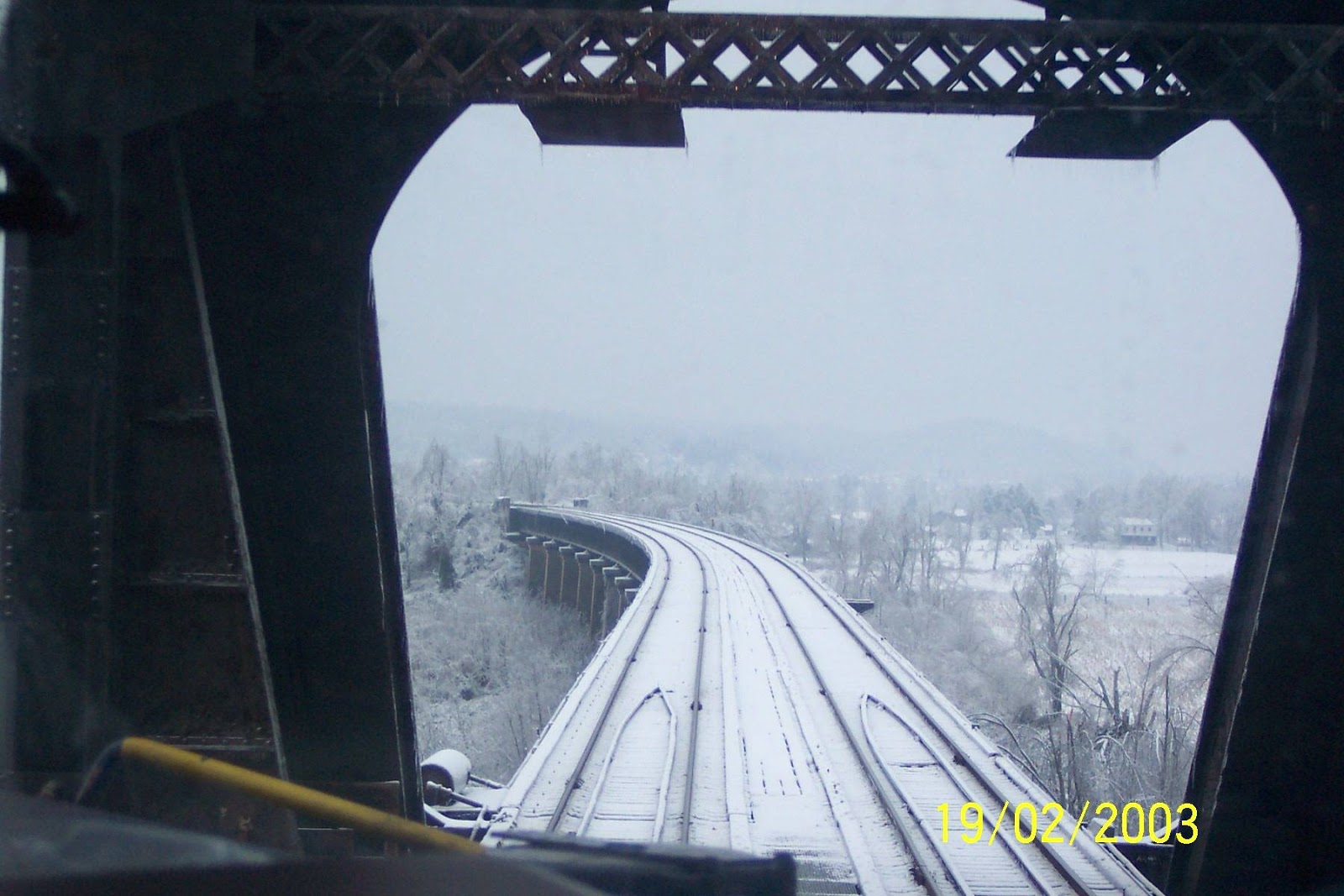
Here are a few pics from my trips on the Great Northern Subdivision. This bridge shown when I was traveling south and north was made in Germany and floated up the Ohio River many years before my time. It spans the Ohio River between NJ Cabin on the Ky. side and Sciotoville on the Ohio side. It's located at MP CJ 1.5 and is of serious interest to railfans.
 |
| 1 |
 |
| 2 |
 |
| 3 |
 |
| 4 |
 |
| 5 |
 |
| Ken commented on his post Here is a picture that was given to me. I received it as is with the side text cut off. It was a local resident to the area photo. |
 |
| GScaler posted In 1994 I caught Milwaukee Road 261 crossing the Ohio River on the CSX (former C&O) Sciotoville bridge returning from pulling the New River train. This was the last year these trains were pulled by steam and 261 was used as NKP 765 was in for a major overhaul. |

This is the C&O Sciotoville/Limeville continuous truss bridge spanning 1770 ft across the Ohio River at Portsmouth, Ohio. I believe this bridge is the largest of it's kind in the US and 20th in the world. This bridge connects the West Virginia coal fields with the coal docks on Lake Erie for further shipping to steel mills.This bridge has two sets of tracks and was built in 1917 and 13,000 tons of steel. That is a lot of steel but then not so much. Cliffs Indiana Harbor No. 7 Blast furnace makes over 11,000 tons of iron in one day.I drove to work for a couple of years everyday along US 52 but never got a good photo of it. I am submitting photos of this bridge but they are not from my collection and from others.
 |
| 1 |
 |
| 2 |
(new window) He gets to the bridge at 2:00. After he does his turn over the bridge, skip to 4:27. He launched from the Kentucky side.
 |
| Screenshot [The river is high on the piers and shoreline.] |
 |
| 1 of 7 drone photos posted by Bridges & Tunnelszzz This mammoth railroad bridge carries CSX over the Ohio River between Sciotoville, Ohio, and Limeville, Kentucky. Built by the McClintick-Marshall Construction Company between 1914-17, it was the longest continuous truss bridge in the world until 1935. Its erection marked a major advancement in the art of bridge engineering and was a major achievement in continuous truss analysis. ➤ Check out more photos of the Sciotoville Railroad Bridge at http://bridgestunnels.com/location/sciotoville-railroad-bridge/ From the link: "The crossing was planned to be a two-span continuous truss, an unusual design of the time. Each span was planned to be 775-feet in length as the War Department required a minimum of 750-feet to accommodate the largest of river vessels. Additionally, the bridge was situated along a bend along a shallow and rocky portion of the Ohio River. Although the low water channel was situated beneath the Kentucky span, the principal current would switch to the Ohio side during high water." [There is a lot of construction information in that article. Continuous trusses are rare until after compters were invented because the stress computations are much more complicated than for a series of simple trusses.] |


