Monday, November 28, 2016

Illinois Watch Company: Springfield Factory

From posting in Lost Illinois Manufacturing
This factory in Springfield was built by Illinois Watch Company. As the watch business declined, the Sangamo Electric Company grew to fully occupy the factory. By 1962 Sangamo "employed 2,800 workers making electric transformers, meters, time switches and speedometers. In 1978 a French company bought Sangamo and closed the Springfield plant." Sangamo's contribution to WWII was "anti-submarine sonar and mica and paper capacitors, as well as watt-hour meters." [Lost Illinois Manufacturing posting]

In case the Facebook "posting" link is not permanent, I include the first two photos from the posting and summarize the posting.

This 1927 advertisement explains why an "electricity" company got started in a watch factory. In the 1920s electricity was unreliable and the 60-hertz frequency was not accurate, so they used electricity to wind a 24-hour mainspring of a clock that used "a precision jeweled lever escapement as the heart of the movement."

As electricity became reliable and accurate, the mechanical escape clock became obsolete. But the company had already started making watt-hour meters and other products and continued to grow.

(One of the first commercial atomic clocks was bought by a power company so that they could make small adjustments in their 60-hertz power so that over a period of time a day would average, with atomic precision, 60cycles*60seconds*60minutes*24hour cycles.)

By 1970, the company had four other plants in the US and 6 other plants in the world. So when Schlumberger bought the company in 1975, they closed the Springfield plant in 1978 by moving its production to other plants.

Satellite
The factory site now has the Illinois Environmental Protection Agency and a McDonalds.

At the end of the posting are the links: county and company.
Update: It is a 52:08 long silent film. The You Tube comments are extensive.


Springfield Rewind posted
Sangamo Electric 11th St - Nov 1967

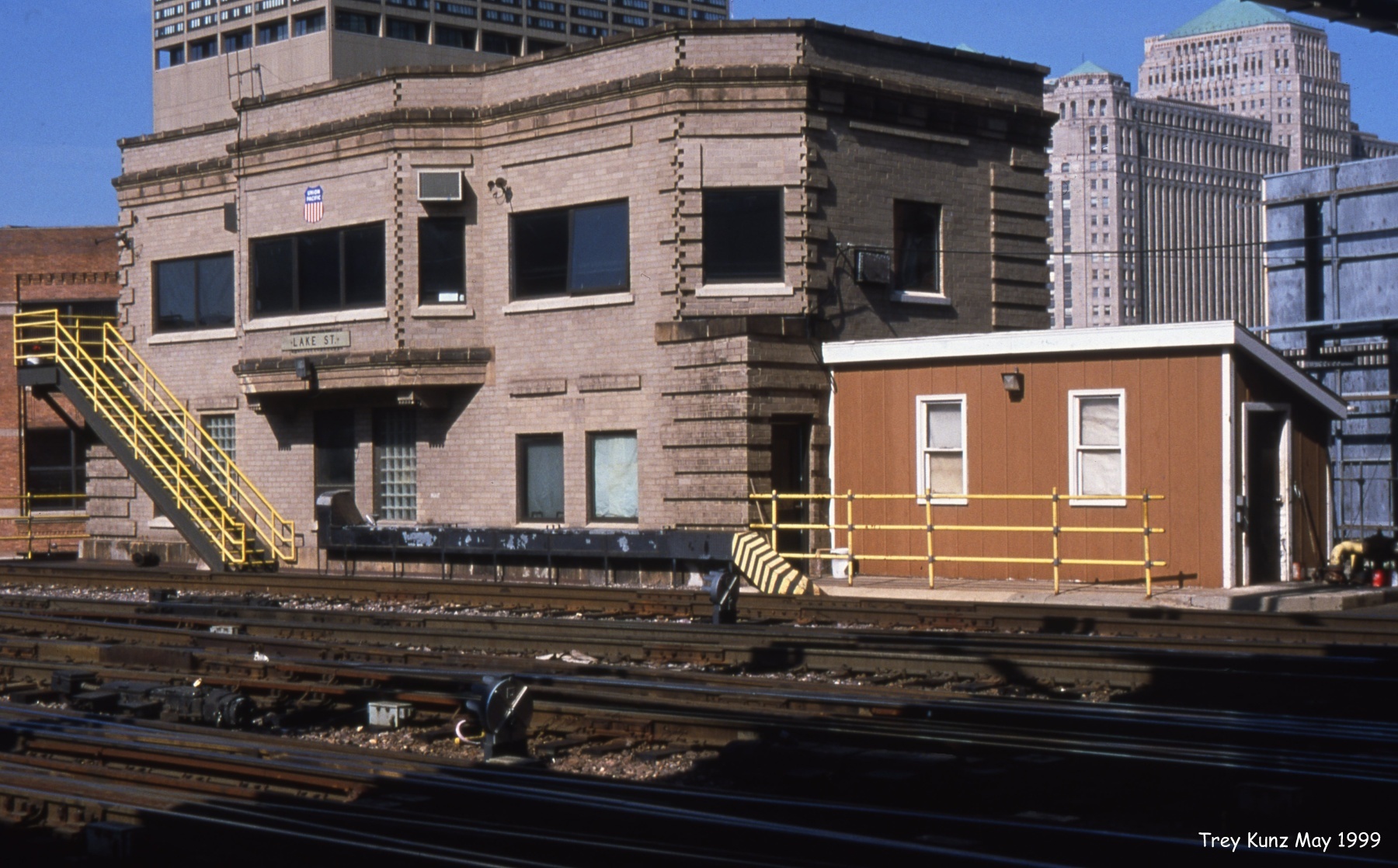
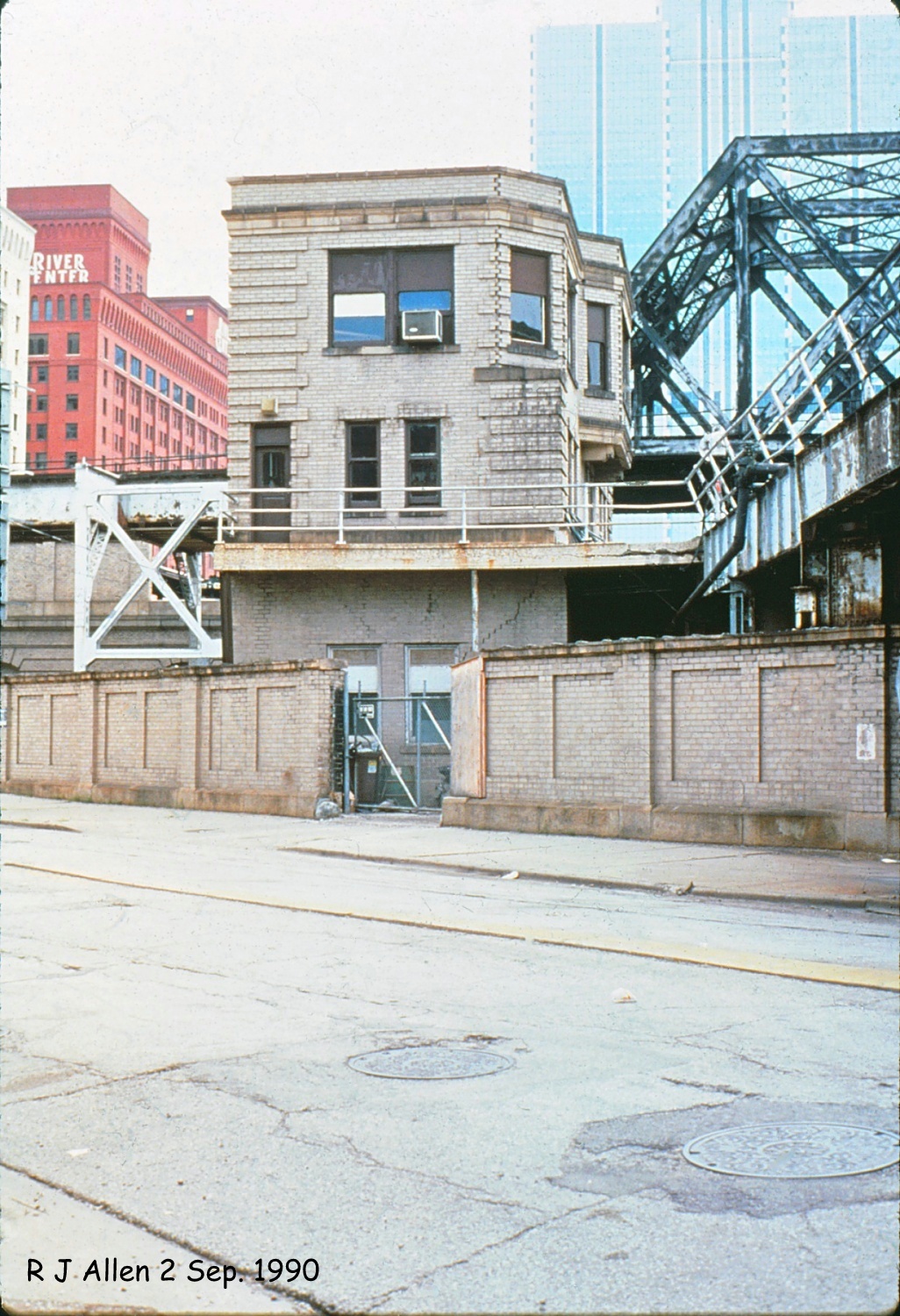
UP/C&NW Lake Street Tower for their Chicago Passenger Terminal (CPT)


See Clinton Street Tower for more information on the location of this tower.

This tower controls the throat to the Chicago Passenger Terminal (CPT).
Greg Kozlick posted
The complicated trackwork at Ogilvie Transportation Center, formerly North Western Station, in Chicago. Metra 166 is in the fuel pocket while an outbound train passes under the signal bridge and around the bend. January 7, 2023.
Phil Zocco: How does one design that let alone build it??!!
Mike Howard: Phil Zocco you should see the locking bed on the lever machine in the tower . Took me a whole shift to oil it .

Chicago & North Western Historical Society posted
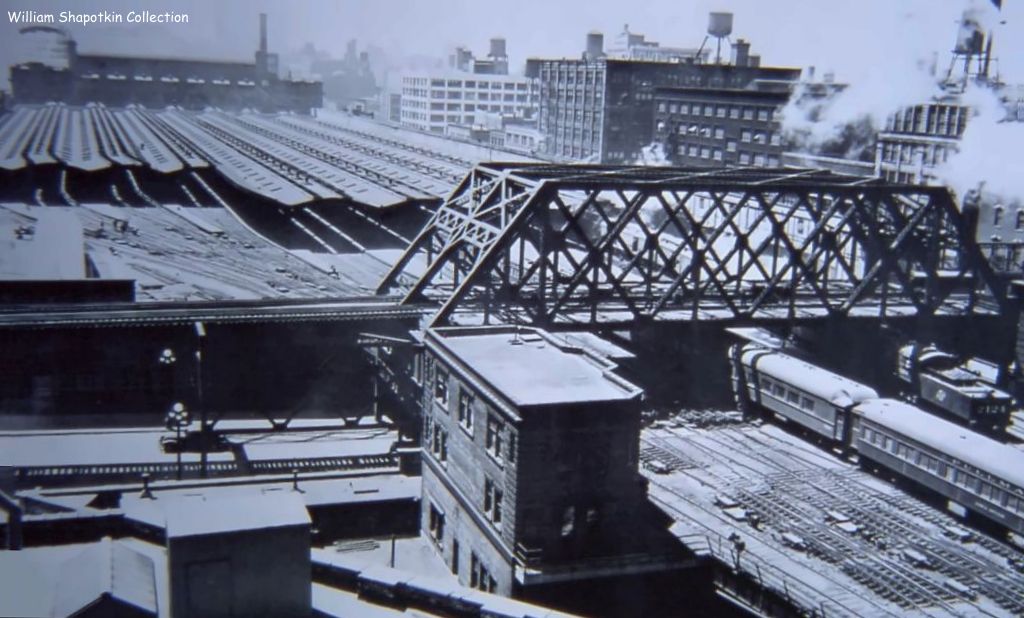
This is a C&NW company photograph of the approach to the "Chicago passenger terminal" taken some time in the late 1940s. The west end of the boiler house for the station can be seen at the far left of the photo. It still stands and is used as office space today. Busy times on the railroad! Se the photo below this one to see the interlocking board in the Lake Street tower which controls these tracks. Where is the rapid transit bridge over the tracks?
Mark Ratzer The CTA bridge is behind the photographer - Lake Street tower is just north of the bridge, and appears to be the vantage point for this north-northwestward facing view.

Given Mark's answer, I was able to locate Lake Tower. Zoom out and look at the tracks. The number of double-slip turnouts in that throat to the train station must be a maintenance nightmare.

Chicago & North Western Historical Society posted
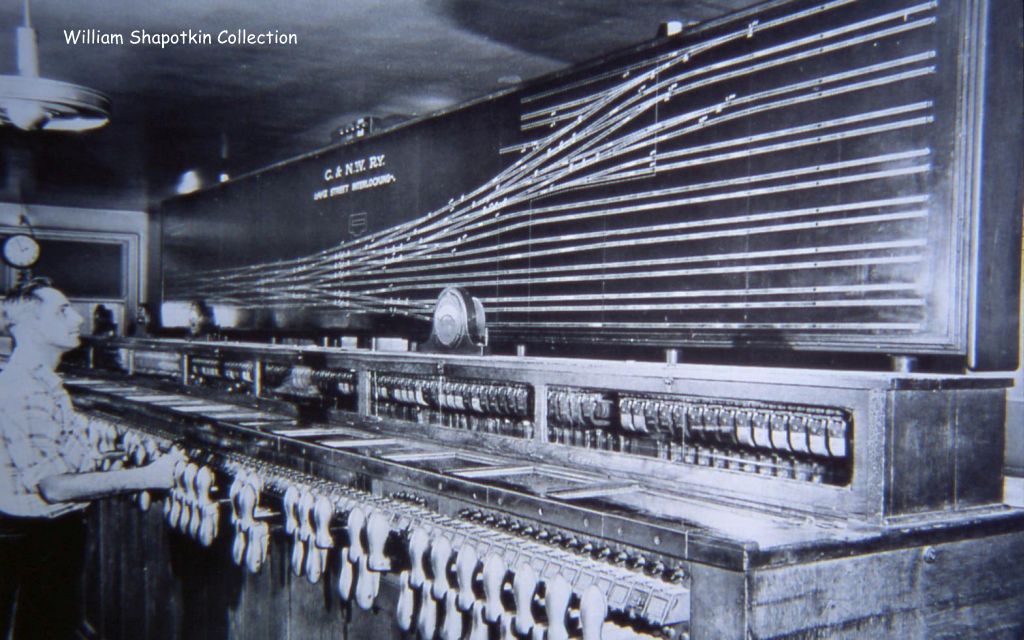
This is a C&NW company photo of the interior of the Lake Street interlocking plant which controls (even today) the switches leading into the - now - Ogilvie Transportation Center. See the photo above to see how busy the operators were.

Update:
Nick Jenkins commented on a post

Jon Roma commented on a post

C&NW Historical Society posted
This is what the inside of the Lake Street "tower" looked like in 1948 on this C&NW company publicity photo held by the C&NW Historical Society. The tower controls the "throat" of the tracks into the old Madison Street Station - now the "Ogilvie Transportation Center." I am told that it still looks like that today!
Carl Venzke posted
C&NW's Lake Street Tower, Chicago - The diagram in the Lake Street interlocking tower for C&NW's North Western Terminal in Chicago

David Daruszka updated
Jon Roma commented on David's posting
This isn't quite the same angle, and there's a bit of lens distortion, but here's a picture of Lake Street taken in 2012 when the tower and interlocking machine were 101 years old.
Mike Froio Love the oak paneling and details.
Craig Sanders Quarter-sawed oak was usually reserved for upscale homes at the time this tower was put into service, but the railroads thought it to be appropriate here. Nice, classy touch!
[Several comments about the maintenance of this machine including:]

Jon Roma This type of machine never had pipelines. It was an all-electric plant that went in service in 1911 with the C&NW's then-new Chicago passenger terminal.

There have been numerous revisions to the outside plant, like replacement of the semaphore dwarfs 
with LED-equipped color light signals, replacement of the switches and switch machines, and removal of the movable point frogs, and modernization of the circuitry. However, the machine depicted, which includes mechanical locking inside the oak cabinet, is still in service in 2018.
Mark Llanuza took five interior shots in 1983.
1

2

3

4

5
Tom Guilbault at Lake St. Tower, 1983. Our thanks to Stan Peczkowski, former Lake St. Tower Supervisor for many years, who remembered Tom.


Michael Morris posted
Dennis DeBruler We get a glimpse of the Lake Street Tower on the left. I understand that this is one of the few interlocking towers in Chicago that is still staffed.
https://industrialscenery.blogspot.com/2016/11/c-lake-tower-for-their-chicago-train.html
David Daruszka commented on Michael's post
And once the tower was inhabited by a beautiful woman who beckoned railroaders to their doom.

Michael North posted seven photos with the comment: "Chicago & Northwestern Lake street interlocking January 1990. The last time I ever photographed or witnessed this relic."
Brandon McShane The tower is still there but the controls have been modernized and of course the semaphores are gone.


1
Signal and overall upgrades were underway. A massive project that would be the end of the vintage 2A's there. 

2
RTA commuter train leaving. Pre Metra ? F40 ?
Jason Simon Sure was the early 90’s. There where 10 RTA colored engines left in the metra system. The bilevels where all RTA painted (rare to find a RTA marking) CNW cars. I use to take the NW line in with knowing of the crews.

3
CTA crossing over the CNW plant.
Mike Howard Shortly after these pictures were taken the CTA replaced the bridge and the rest of the Green line .Charles Scherer Lake st. L

4
 The train sheds, end of the line or the terminal.

5
2A high signals on the bridge on the elevated.
Mike Howard Bridge D by Halsted St

6
Days are numbered.
Mike Howard Bridge D

7
Classic C&NW 2A signal bridge in downtown Chicago with the color light signal replacements up now awaiing cut over. 2A's would soon be history. Sears tower can be seen in the background.
Mike Howard Bridge A at Lake St. interlocking plant


Chicago & North Western Historical Society posted
This Christmas Eve 1951 Chicago and North Western company publicity photo shows the Chicago terminal "throat" with kerosene heaters being used to keep the switches thawed. The heaters are now natural gas fed.

BRHS posted
Kerosene heating units keeping switches warm on the tracks leading to Chicago & North Western Station - December 20th, 1951.
[Obviously taken from the same location, but exposed better.]
Albert Carello That December was a really brutal winter!
Bruce DeMaeyer I was always of the opinion that the heaters were run by natural gas.
The Blackhawk Railway Historical Society Today, they are, but this was from back in 1951.
Bruce DeMaeyer Do you know when the change was made?
Jon Roma After the turn of the century, I think.
Patrick McNamara Jon Roma - Nonsense. These kerosene tubs were in common use thru the 1980s at Proviso and wherever there was a switch to be kept free of ice build-up.
Jon Roma Patrick McNamara, the question was asked when the change to natural gas was made at Lake Street interlocking. I might remind you that "around the turn of the century" was 20 years ago, and we weren't talking about Proviso 20 years before that.
Jer Centa And nowadays when switch heaters are on its called in as a fire..... every single year.......
Dave Rodgers When I first worked for the "J" I was in the B&B and we cleaned switches by hand (broom) and would fill these smudge pots and light them with a fusee. 1971
Lawrence Smith Memories of my childhood. Mom why r the tracks on fire?
A third exposure of that photo.
Kelly Harris posted
Love this photo! Can almost smell it. I love winter!

Brendon J Dock shared
[It is easier to see Clinton Street Tower under the signal bridge and to the left of the far train.]


Rod Truszkowski posted
[1915 Smoke Abatement Report, p497]
David Cole posted two photos with the comment:
A study in then and now...The 400 departs North Western Station in 1953. Today these are the throat tracks of the Ogilvie Transportation Center... North Western Station sounds soooo much better!
1

2

Two photos posted by Patrick Bullis with the comment: "OTC Lake St.. Built 1906? Still in use."
1

2

John Iwanski posted
I managed to frame this nice shot this morning as I walked into the office, catching Metra’s Chicago and Northwestern heritage unit next to the Lake St., Tower - with plenty of Union Pacific service trucks down on Milwaukee Avenue.


More views of what is controlled by this tower

A 1:42 video of tower operations (source link).  Joel Kirchner 16 tracks funnel into 6 leads and you can go from every track into every lead. Just a couple hundred movements a day!

At 1:23 in this video, this tower appears on the left.

Chicago, Ottawa & Peoria over Spring Creek near Spring Valley

ITS/CO&P was an interurban. I don't normally do interurbans because trying to learn the Illinois railroads is daunting enough. But this is an impressive bridge.


Kerry Bruck posted
Ken Hejl The train in the valley is actually the C&NW. The far grade is the steep hill vehicle road that went from Greenwood down to the mine.

Jay Davis posted
The Interurban Bridge, Spring Valley Illinois 1920’s
Joseph Obrien shared

Nathaniel Kazzy commented on Jay's post

Andy Zukowski posted
Inter-Urban Railroad Bridge Spring Valley Illinois. Postcard Dated 1905
Kevin BrockRobert Weber Yes. The C&NW #1 Mine yard and CRI&P are below.
My dad said it was a little scary going across the bridge. He was only about 10 when the interurban shut down.
Ken HejlKevin Brock That is actually the Chicago & Northwestern. The Rock Island is behind the bridge.
Nathan HessWhere was the bridge located? I’m not too familiar with Spring Valley in that era.
Ken HejlNathan Hess The track ran down the center of Greenwood St. South to the end of Greenwood.Made a 90 degree curve to the east. Went about 300 feet and out onto the bridge and east to Webster Park.
I might add----On the 300 foot stretch, there are still old ties in the ground.

Michael Nieslawski posted
Spring Valley area shot C.O.P Chicago Ottawa Peoria Railway Interurban Illini Trail - Year of photo Unknown
[According to the comments, this is in Spring Valley looking north, and these are the C&NW tracks.]

Jim Johnson posted
Sping Valley bridge from a new perspective.

The C&NW served three coal mines on the west side of Spring Valley.
I've written a few postings about BNSF/BN/CB&Q/IV&N in Peru. (Search Towns and Nature with the string "peru, il:" and ignore the results except for the titles beginning with "Peru, IL:") I was trying to follow the IV&N further west, but I had to go back north to US-6 to continue West. I came to a hill that was steep and long enough to allow me to try downshifting the minivan that I had bought just a few weeks earlier. Since the transmission has six gears, it did not have numbers for the lower gears like my older minivans had. So I had read the owner's manual to figure out how to use the "+" and "-" indicators. The manual did not make sense. I used this hill to determine that the van works the way I think it should rather than the way the manual explained.
20150807,08 3923rc+12+12
I'm already significantly down the hill before I took this picture. The BN labeled bridge reminded me that the IV&N climbed out of the Illinois River valley using the Spring River valley.

Looking at a 1939 aerial photo, I'm reminded of another reason why I don't research interurbans --- they were abandoned by the time of these photos. Kerry Bruck added the following comment to his posting:
The CO&P left the streets at the south end of Greenwood Street--one block east of Rt 89. The bridge in the photo is crossing the C&NW yards where the C&NW served Spring Valley Coal Company, Mine #1 (located to the right of this photo-East), an interchange with the CRI&P more or less to the left of this photo-West), and a short spur with a steep grade to access a lumber & coal company (between the trestle and the yard below-ran from the yards a block to the West of Greenwood Street). After crossing the C&NW and then Spring Creek, the CO&P ran a short distance on a grade--the land elevation rises quickly East of Spring Creek. A short distance East on this grade the CO&P crossed over the CB&Q which ran through a cut at that point. The CO&P then ran where a gravel road still exists South of Webster Park and turned to the North on the Eastern most street of Webster Park. It ran North to Route 6 and then East to Peru.

The red line is my current guess as to where the trestle was. Harold J. Krewer confirmed this was correct. (I had posted some earlier guesses that were quite wrong.) Harold adds: "That road extending from the bridge site and making the dogleg northeast appears to be on the old CO&P grade."

1939 Aerial Photo from ILHAP
Ken Hejl Followed the entire ROW from Greenwood to Rt. 6 about 3 years ago. 80 years later, it is all intact except for the 2 bridges. Walked from Greenwood to the western bridge abutment and then from Rt 6 to the eastern abutment. In Webster Park, it actually ran behind the homes on the eastern end of Webster, not in the street. People's back yards end at the ROW. It is raised above the yards. Used to work with a guy that lived there. At the south end of Webster it curved 90 degrees west ( a heavy tree line) and crossed Oak St. It continued west where gravel road is now (also called Oak on maps). Where the gravel road turns left, down the hill, the ROW went straight to the IV&N abutments. From there west, it is very grown in, but passable ( I went in the spring) through the dogleg area to the east end of the bridge. Last time I was out there was in the 70's when the C&NW was still in. An old set of stairs and loading area remains at the west end of the IV&N abutments. I might add that I walked with permission of the land owner. It is all owned by Western Sand & Gravel now.

The photo of the coal mine has been moved to Spring Valley Illinois Coal Mine. This photo of the mine shows this trestle in the background.
Roger Kujawa posted
Spring Valley Illinois Coal Co. Mine PC Miners ~1900's Bureau County IL RR cars. Looking South towards the Illinois River. Served by the C&NW.
Roger Kujawa shared

Sunday, November 27, 2016

NS/N&W/Wabash Landers Yard

(Satellite, most of the yard has been converted to intermodal service. But it still has 10 classification tracks.)
Don DeWald posted
Wabash P-1 Hudson 4-6-4 in Chicago, 1951. These locomotives were rebuilt into Hudsons from 3 cylinder 2-8-2 freight engines at the Wabash shops in Decatur, IL in 1943. They were used on the Wabash Cannonball and other passenger trains.
Steve T Ridge The engineers called them "sports models"
When Richard Fiedler shared Don's posting, he added the comment "At Landers in Chicago." His share had the following comments:

Ed Bell Would this require a new frame?
Richard Fiedler Yes the old 2-8-2 frame was not used in the rebuild instead a new one piece cast steel frame by General Steel of Granite City was used. The new frame had the cylinders cast into it. The boiler, cab, and tender were reused. The engine axels had roller bearings. The tender retained friction bearings.
Richard Fiedler My understanding is they were fast and free rolling but a tad slippery.

It looks like the coaling tower was made of steel. Richard Fiedler concurred: "That's what I figured too. The main giveaway was the post war 1950's style bungalows in the background on the other side of what appears to be 79th St. That's the neighborhood I grew up in. I would figure this shot to bd from 1952-3 the very end of Wabash steam and near the end of the building boom in that part of the neighborhood. The area in the yard where the coal chute stood was to become piggyback ramps and a large LCL freight house."

1938 Aerial Photo from ILHAP
The engine servicing facilities where on the south side of the yard. Richard Fiedler provided the following information concerning the closeup of the engine service facilities:
Yes that is the water tower a steel one and just to the right is the pump house that lasted into the 1990's and up to the time that NS converted the whole yard to intermodal. To the right of the water tower was the pump house, the storehouse, and finally the "hotel" or bunkhouse for crews laying over. The bunkhouse was pictured in the book on the 4th district and it was a wood 2 story affair and was quite decrepit from what I remember. The water tower and bunkhouse disappeared by 1960 or so the storehouse later freight house lasted into the mid 80's. To the left or west of the water tower were the ash pits and coal chute and those disappeared late 50's when the area was converted to TOFC ramps and trailer parking.
I see that large rectangular shadow to the far left and that must be from the coal chute. The smaller shadow center just below the sand house area is the water tank and it casts a long thin shadow.  
1938 Aerial Photo from ILHAP
Phillip Ness posted the question: "When was the Landers yard built in Chicago?" Richard Fiedler commented:
The line was built in 1879-80. A Wabash structures book lists a frame depot 16x40' built 1891 and other structures built there between 1893 and 1894. In 1906 a concrete 20 stall roundhouse was built adjacent to 79th and California. The yard was rebuilt in the late 40's and again in the late 50's. The viaduct spanning 79th and Kedzie was put in in the 49's expansion. Prior to that 47th street was the primary Wabash facility for manifests and as that facility diminished Landers increased. All passenger and freight locomotives both steam and diesel were serviced at Landers. Prior to the Landers roundhouse Wabash engines were services at a 19 stall roundhouse at 40th St built in 1879.
Richard indicated pages 137-139 of the 1906 Railway Master Mechanic describes the roundhouse.
Update: Richard Fiedler's posting indicated it was page 409 in the Chicago Smoke Abatement Book.
Albert J Reinschmidt Really cool! I had heard that the B&OCT had come this far north. Later turning east @ 83rd, wonder why the change. Also hard to. Believe that in the 50s there was a sharply curved connecting track between the two yards. Only saw it used a couple of times. Later trains would saw back and forth over Western Ave.

1915 Smoke Abatement Report
Richard Fiedler commented on William Shapotikin's post
[The post is about the Landers Station marked on the above 1915 map and passenger timetables.]
New brick yard office and tower 1959 or so. Note in the distance a structure or shelter between the Wabash and the Belt. This is not the simple 3 sided open wood shelter I remember at Western Ave.

BRHS posted
The Norfolk Southern (ex-Wabash) Landers Yard Tower on the southwest side of Chicago - July 15th, 1989.
Photograph by Bob Storozuk.
From the Blackhawk collection.
[A comment indicates that it was torn down around 2018.]


Richard commented on his posting: View from the Landers Yard tower late 50's and to the left you can see curved stub tracks that were the old B&OCT alignment.
Richard Fiedler commented on William Shapotikin's post
Landers yard in the mid 50’s undergoing renovation. View is about 76th and Artesian. Note to the right track under construction, to the center distance the Firestone tire warehouse and beyond that the engine terminal roundhouse and crew “flop house”, and to the left the remnants to the former B&OCT alignment that serviced Gee Lumber a wine warehouse plus Firestone. The new brick yard office was not built yet. Out to sight to the right along Columbus (SW Highway) would have been the site for the original Landers Depot from 1893. Also earlier maps showed a balloon interchange track to the Belt and that’s removed. Wabash RR Historical Society Photo.


Dennis DeBruler commented on Bill's post
It looks like Landers Yard had grain elevators on the east end.

Mid-Century Decatur posted
This shiny black Wabash coal hopper at Landers yard in Chicago is less than a month out of the Decatur shops where it was completed in January 1951.  
The car was one out of a lot of 400 steel 50-ton coal hoppers produced in Decatur beginning in August 1950. The shops were then backlogged with orders; the only constraint on continuous production was the availability of steel. 
Photo: Richard A. Horn
Richard Fiedler shared

Richard Fiedler commented on the above post
Another view along 79th St in Chicago. 1951.