Wednesday, September 24, 2014

Chicago Railroad Bottleneck and CREATE Overview

Update: the link to the CREATE site in case you want to skip to the chase,
a Nov. 17, 2014, video about the need to continue funding CREATE.
CREATE's Flickr photostream

For general freight flows in the US, go here.

Back when farmers had to ship their crops and pickup their supplies with horse and wagon, it made sense to have a lot of railroad lines crossing our country. But with the advent of trucks and paved roads, a lot of those lines did not make economic sense. Unfortunately, the federal regulatory agency did not allow the railroads to abandon the lines that were made obsolete by the invention and development of the internal combustion machine (both cars and trucks) until the 1980s. When they were finally able to abandon lines, the companies tore up a lot of the lines to reduce their property tax liability, including New York Central tracks that would have allowed transcontinental trains to completely bypass Chicago area.

In the 1980s, railroading was considered a dying industry because of the interstates so tearing up tracks and abandoning right-of-ways was considered prudent. But with the invention of intermodal traffic and unit trains, freight traffic has recovered and now the railroads don't have enough track to handle the load. According to a Feb 14, 2012 issue of ChicagoMag:
Railroads have gone from having too much track to having not enough. Today, the nation’s rail network is just 94,942 miles, less than half of what it was in 1970, yet it is hauling 137 percent more freight, making for extreme congestion and longer shipping times.
In fact, BNSF is closing intermodal yards to force the traffic off their rails and make their intermodal service statistics look better. Today, a quarter of all rail traffic in the nation touches Chicago. Nearly half of the intermodal rail traffic goes by or through the city. The city sees 1,300 trains each day, 800 passenger and 500 freight. A May 27, 2012, NYTimes article explains the results of the Chicago bottleneck:
Shippers complain that a load of freight can make its way from Los Angeles to Chicago in 48 hours, then take 30 hours to travel across the city. A recent trainload of sulfur took some 27 hours to pass through Chicago — an average speed of 1.13 miles per hour, or about a quarter the pace of many electric wheelchairs.
A rail-flow map further illustrates Chicago's central role in freight traffic. This is why Chicago became the center for the futures trade industry.

US Government

Viral Media posted
Chicago Trains Per Day
Each day, nearly 500 freight trains and 760 passenger trains pass through the region, moving the goods and people that help pump life into the national economy. For 150 years, Chicago has remained the nation’s busiest rail hub. Today, it is the world’s third most active rail intermodal hub with 25% of U.S. freight rail traffic and 46% of all intermodal traffic beginning, ending or traveling through Chicago. 22,000 Intermodal lifts happen each day at the Chicago terminal (every time a container is moved onto or off a train).
Chicago Terminal Area
Freight Trains per Day 2018
The map was created by CMAP. The Chicago Metropolitan Agency for Planning (CMAP) is the region’s comprehensive planning organization. The agency and its partners developed and are now implementing ON TO 2050, a new long-range plan to help the seven counties and 284 communities of northeastern Illinois implement strategies that address transportation, housing, economic development, open space, the environment, and other quality-of-life issues.
Estimate by CMAP represents the average weekday, excluding switching and equipment moves.
Source: National Transportation Database (NTD), 2011, Updated with information from CREATE Program, NTD 2017, FRA and Illinois Commerce Commission Grade Crossing Databases, CN EJE Operations Monitoring, 75th CIP EIS, 2019 AAR Illinois Profile, Google Earth, field data collection, and personal communications. Missing data was interpolated. Note: Figures include overhead trackage rights for many railroads.
Richard Fiedler shared

uchicago (source: Matt McClure comment about Harold M. Mayer's 1943 dissertation in post)

There is a lot of room for improvement. According to the NYTimes article some of the switches still [May 7, 2012] have to be operated manually after the train passes. Since the railroads trashed their cabooses in the 1980s, that means a crew member has to walk the length of the train -- a mile or more -- to throw the switch and then walk back.

To reduce congestion in Chicago, in 2003 a program called CREATE (an acronym for Chicago Region Environmental and Transportation Efficiency Program) was formed to coordinate solutions with the cooperation of the railroads, AAR, and all levels of government. The program defines 70 projects to eliminate grade crossings, add flyovers at railroad intersections, add more tracks, etc. As an example of one of the projects, the ASCE describes the B2 project. And I investigated GS15a and GS14. A project that is near and dear to my heart is GS7 because I live in Downers Grove.

CREATE is not just construction projects. It also instigated programs to improve the cooperation and coordination among the railroads. Before this program, they did not share information. Now they work with the Chicago Transportation Coordination Office (CTCO) to input information to a centralized database of needed freight car transfers that is shared by all of the railroads. I remember when air traffic control implemented what they called "full flight control." Before that control, flights would take off and then when they got close to their destination they would have to circle until a slot opened up to allow them to land. I remember circling for a while over Iowa one time waiting to get a landing slot at O'Hare. With full flight control, a plane is not allowed to take off until it is assigned a landing slot. I have spent more time sitting on a plane in Newark than I care to remember, but that beats setting in a plane over Iowa that periodically did sharp banks. (They really don't circle, it is more like square.) Now freight trains will be held on sidings out in the country until there is planned capacity to get it through Chicago, including the receiving railroad.

The Canadian National railroad was not satisfied with the progress of the CREATE program so in 2008 they proposed to buy the Elgin, Joliet and Eastern Railway Company (EJ&E) from USS Steel for $300 million, which has been purchased. When they are done upgrading the EJ&E, they will move their freight to the former EJ&E tracks and from the former Illinois Central tracks that run into the city. It is those former IC tracks that Amtrak was complaining about in the ChicagoMag article:
More than 4,000 instances of freight train interference on Amtrak’s City of New Orleans route and on Amtrak service between Chicago and Carbondale were counted on the CN-owned rail lines last year, Amtrak said in the complaint. The delays totaled the equivalent of more than 26 days, Amtrak said.
If CN quits using that track and abandons it, then CN will have solved the congestion problem. But then Amtrak would then need to buy the track to keep their southern routes intact. Since Amtrak was not willing to pay $100,000 for a former Santa Fe bridge that BNSF abandoned to keep the Southwest Chief service going on their mainline through Streator, IL, to Galesburg, it will be interesting to see what they do about the former IC route.

A couple of questions during an April 17, 2013, interview with the program director of CREATE, William C. Thompson, provides a nice update of the program.
Q: It has been 10 years since CREATE's launch. Can you quantify the progress that's been made in reducing the amount of time to traverse Chicagoland?
A: The railroads have seen about a 30-percent reduction in cross-town transit times. In 2003, it was taking trains just under 43 hours to move through the Chicago terminal. In 2012, trains were moving through the terminal in 32 hours. The Chicago terminal is ringed by automatic equipment identification (AEI) readers that enable us to accurately measure performance. Each railcar in North America has an AEI tag on it. By using data from the AEI readers, the railroads are able to receive the real dates and times a car entered and departed the terminal.
Q: What are the major challenges still facing railroads in unclogging the region?
A: The major challenge is to obtain the needed funding to finish the remaining projects in the face of continued traffic growth. It is important to remember that CREATE is not just about freight. It is also about improving intercity and commuter passenger rail service, and reducing road congestion. The railroads have agreed that passenger trains will have top priority for movements. This is known as the "Chicago Protocol." The protocol results in a shutdown of much of the Chicago-area mainline freight operations Monday through Friday between 6 a.m. and 9 a.m. and between 4 p.m. and 7 p.m. This amounts to a 25-percent reduction in track capacity during that time. The challenge is to continue to build facilities that will permit the freight and passenger operations to be separated during those critical rush hours.

There are still many grade separation projects and passenger projects that must be cleared environmentally, designed, and constructed. The challenge facing the CREATE partners is to gather sufficient funding to complete the program. So far, we have received about $1.2 billion in funding for a $3.2 billion-plus program. Currently, 16 CREATE projects are complete, 12 are under construction, and 19 are in the design phase. Twenty-one of the 70 projects have not started design.
The remainder of this posting is information from a presentation prepared for the American Association of Port Authorities (AAPA) that I found particularly interesting and that I want to easily reference.

Chicago Rail Infrastructure
• 16,000 acres, twice the area of O’Hare
• 78 yards, including 21 intermodal (rail-truck)
• 2,800 route-miles of track
• 12 commuter rail routes
• 1,100 viaducts and bridges
Daily Activity:
• 1,200 trains (500 freight, 700 passenger)
• 37,500 rail cars processed
• 20,000 truck moves through intermodal gates


• World’s 3rd busiest intermodal hub.
• One third of all freight rail traffic converges on Chicago daily.


AAPA Slideshow


AAPA Slideshow

AAPA Slideshow


AAPA Slideshow

AAPA Slideshow

AAPA Slideshow

I remember Amtrak wanted a control room that would be staffed with representatives from each of the railroads to improve communication and cooperation. They were even willing to donate space for the room in the Union Station. I wonder if it happened and CIROC is the result.

It is interesting to see how the plan changed from 2003. This plan was before CN decided to buy EJ&E in 2007.
OUTLINE OF THE PROPOSED CHICAGO RAIL PLAN
The purpose of the plan is to expedite freight traffic through the area, and to separate commuter and freight operations as much as possible, thus improving the area's commuter rail system as well. The plan is known as CREATE (Chicago Regional Environmental and Transportation Efficiency Plan).
1. Rebuild the Panhandle right-of-way that parallels CSX (B&OCT) and Norfolk Southern (Chicago River & Indiana) at Brighton and Ash Street, and have Canadian National ex-IC trains from Glenn and Hawthorne yards feed into it at those junctions. Trains would then proceed south on the Panhandle, pass under the Chicago Transit Authority's Orange Line overpass, and then begin climbing. Just before 49th Street, they would turn east on a new flyover that would carry them over the CSX main and feed into the ex-Grand Trunk line that comes east from Elsdon. They would then feed into NS ex-Pennsy Fort Wayne main somewhere around 47th Street, where a new connection would be constructed. The ex-Gulf Mobile & Ohio line would not be abandoned east of Brighton since Amtrak St.Louis trains need it to reach Union Station.
CN trains would then use the NS tracks (a third main would be constructed) to Grand Crossing (75th Street) where a new connection in the southwest quadrant would be used to access the ex-IC main. North of 75th, the IC would be abandoned (of course the Metra Electric tracks would stay), as would the St. Charles Airline and some of CN's ex-IC Iowa line tracks east of Ash St. A flyover would be built at Englewood, carrying Metra's LaSalle Street station trains on the ex-Rock Island over the NS/CN main.
2. The CSX ex-B&OCT Altenheim Sub would be revived to carry CN's ex-Wisconsin Central trains to the restored Panhandle right-of-way. The Altenheim was closed in 2002 owing to deterioration of some bridges on the lightly used line.
3.The Metra Southwest commuter trains to Orland Park and Manhattan will be moved from Union Station to LaSalle Street. They would take the Metra ex-Rock Island main down to about 74th Street, where a brand new elevated ROW about two or three blocks in length would be built from the Rock to 74th Street Jct (UP, Belt Rwy, NS, Metra ex-C&WI). West of there, Belt Junction would be eliminated and the Belt shifted to where the ex-Wabash is now. The Metra trains would parallel the Belt on the south from 74th to Forest Hill.
4. If a Metra route using the ex-C&WI, ex-C&EI route to the south suburbs is ever established, their trains would also depart LaSalle Street and access the ex-C&WI tracks off the Rock elevation somewhere around 80th St. A flyover or perhaps a viaduct would carry them over Dolton Junction, and probably Lincoln Ave and 142nd St. They will terminate at Crete, IL, south of Chicago Heights.
The railroads are expected to cover about 15% of the projected cost. The rest is supposed to come from federal, state and local funds, but the feds will no doubt shoulder the lion's share of it.
Flyovers to be constructed on the Chicago Rail Plan:Englewood: Metra (ex-Rock) over NS (ex-PRR)
74th Street: Metra (ex-Wabash) over the Belt Rwy and NS (ex-Wabash), and a new connection to the Metra ex-Rock Island main
Forest Hill: CSX/B&OCT over new Metra alignment and NS
49th Street: CN (ex-Panhandle ROW) over CSX/B&OCT, connecting to CN (ex-GTW)
CP Canal (Argo): CN (ex-GM&O) over IHB/CSX
Chicago Ridge: Metra (ex-Wabash) over IHB/CSX
Brighton Park: CN (ex-GM&O) over CSX/B&OCT and NS
For more on the Chicago Rail Plan, see the September 2003 issue of Trains magazine.
[http://www.dhke.com/CRJ/chirail.htm]
81 Chicago Railroading photos that look very familiar

2019 Annual Newsletter

(Facebooked)

Aug 2025 concerning the UP-NS merger.
RailwayAge via Matt McClure post
Historical interchange time of 2-3 days is now more like 18 hours.
Well-detailed, including UP CEO Vena exaggeration of Chicago's interchange times.

CREATE: GS15a Update and South Shore Freight (CSS Bridge over Torrence Ave)

Update: The project was completed July, 2015.

(Bridge Hunter, see below for various satellite views; a previous posting covers moving the truss bridge into place)

I was headed back from Indiana on a Sunday, so instead of taking my usual route of I-80 to I-294, I went North on I-94 to the 130th street exit. (I try to limit my visits to the big city to Sunday's because of parking, traffic, etc.) I wanted to check out the progress of the CREATE GS15a grade separation project that required moving a big truss bridge a couple of years ago. I had noticed that they had closed Torrence Avenue over 2 years ago but had not started any digging for the underpasses. If you look at a map, you will see that this closes one of the few north/south roads in the area. But they seem to be in no hurry, they are not paying for Sunday overtime. After two years of construction, they appear to have 3 of the 4 legs of the intersection dug, but they haven't started on the fourth leg yet. Construction of the new Norfolk Southern (former Nickel Plate Railroad) bridge looks completed.

20140921 0097rc

The big truss bridge carries the Chicago, South Shore & South Bend Railroad whose nickname is South Shore Freight. It is the last remaining active interurban railroad. Its interurban heritage is very evident in Michigan City where it still runs down a street. After their most recent bankruptcy in the 1980s, the freight and passenger operations were separated so that the freight operations would be a viable company by removing the losses from the passenger operations. Freight is operated by South Shore Freight and the commuter service is provided by the Northern Indiana Commuter Transportation District. The track is owned and maintained by the NICTD. The freight operation pays for track use rights. This explains the South Shore Freight name that I saw on the locomotives as I drove along the construction on 130th before I got to the intersection:


Zooming in on the engines, we see they are 2005 and 2007. According to The Diesel Shop, these are GP38-2s built in January, 1981. I also found a list that includes the electric locomotives used on the line.


The railroad used to use electric locomotives for freight service until 1983. One of their Little Joes has been preserved at the IRM. It is so big that they can't house it in their display barns so they repainted it for preservation with paint, equipment, and expertise provided by Sherwin-Williams.

SSF, scroll to the bottom of the page

Sam Carlson posted
This unit is veddy beeg.
CSS&SB, unlike the Milwaukee Road, did not call their three samples 'Little Joes.' They were simply the 800's.
Here's 803 moving west while switching Burnham Yard in Burnham, IL on a frosty February 2, 1981.
803 is veddy beeg!
Mark Egebrecht Are you sure this isnt January 2? I thought the last run was at the end of January, 1981?


Back to the GS15a construction. One of the reasons justifying the expense of the project was to retain the 4000 jobs at the Ford assembly plant in the northwest quadrant of the intersection (satellite). (It appears the assembly plant does not get any auto parts via the railroad. All of the industrial spurs go to the American Sweetner Corp.) A freight train blocking the road for 20 minutes not only interferes with employees getting to their parking lot, it backs up cars coming off the assembly line from getting to Ford's Shipping Yard (satellite). Looking at a satellite image, the shipping yard is clearly south of the intersection. In fact, when I zoom in on the first picture above, you can see vehicle-carrier cars parked in the yard to be loaded.


So how has Ford been getting their new cars from the assembly plant to the shipping yard while construction is in progress? The posted detour takes you down Brainard Ave. to Burnham Ave. and then back along State Street and Torrance Ave. That is a long ways. I'm surprised they are not working on the intersection on Sundays. To add to the pain of the detour, we were stopped by a northbound coal unit train crossing Brainard (satellite). And I was reminded that the freights in this area move sloooowly. I'm beginning to appreciate that the freights through Downers Grove move pretty fast. The depot on the right of the picture had a "Hegewisch" sign on the end.


I have not been able to figure out who owns that track. (Update: it was the PRR's South Chicago & Southern (Bernice Cutoff), and it is now operated by IHB and/or NS.)

Update: The brown bridge that has been added is a pedestrian crossing.

20160521 3321
Thanks to the red light, I had plenty of time to take pictures.


Steven J. Brown posted
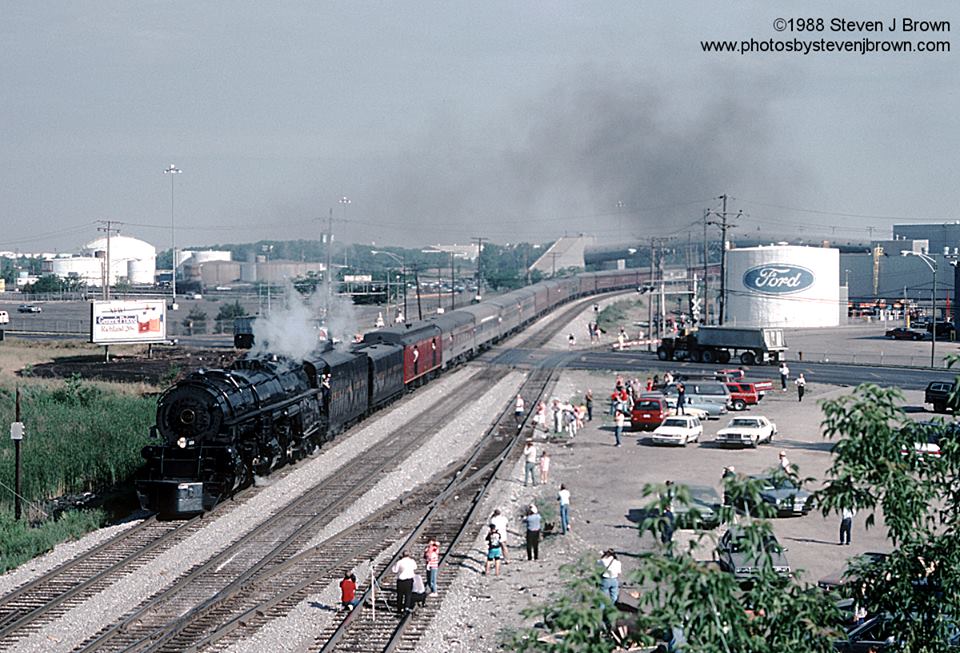
Norfolk & Western Class A 1218 runs on a round trip between Chicago and Fort Wayne - June 18, 1988.
Waldolf Ursine It looks like it was taken from the South Shore embankment looking north towards 130th st and the Ford Torrance assembly Plant.
Steven J. Brown You are correct.
One of five photos posted by Mark Hinsdale
Harvey Kahler I'm guessing this is over 130th looking se to the new NICTD-CSS oh bridge. Train pulling autos out of the Ford yard. The assembly plant is behind you.
Mark Hinsdale Correct.
Back when the Chicago South Shore also handled the freight.
American-Rails.com posted
George Gherardi I’d say East Chicago at about MP 66.0 where the tracks spread around the platform. Sliver of parking lot seen on far left.
[Satellite, there is a simi-truck blocking the view when using Street View from the tollway.]
Lester Sielski Little Joe!
David Mitchell These are the ones that the Milwauked Road didn't buy and regretted later...
Kris Rumbut posted
Celebrating #CSSsaturday by Crossing Big Blue in Hegewisch, IL 12/22/18.
Kris Rumbut posted
Reporting live from the field for #CSSsaturday.

Bob Lalich Flickr 1981 Photo

New waits for Old

A WB South Shore freight waits for a WB passenger train to clear Wagner Siding, 10-81.

Old cars, Old paint on the Geeps, Wagner Siding...you're sure dating yourself with this one..


This is what it looked like with the old South Shore bridge and the C&WI tracks still paralleled the NKP tracks.
American-Rails.com posted
Bob Lalich: Mac English - this is the Chicago & Western Indiana RR. The train is returning from a transfer run to EL's Hammond Yard. [It is on the C&WI tracks.]
Rick La Fever: I wonder how long that would take? Cicero to Hammond while playing Mother May I at the various interlockings along the way.
Bob Lalich: Rick La Fever - there were non-interlocked junctions along the way as well - 80th St and Pullman Jct to name two.

Bill Molony shared
Ray Weart: This is actually a rare photo for two reasons. 1. It's on the C&WI. I've never seen a photo of a Q train that far south. 2. The Mars light is on. For some reason, Q engineers all but never used the Mars lights.


Mark Hinsale posted
Waiting at the light…

Patrick McParland posted three photos with the comment:
Brainerd and Blue Bridge at 130th & Torrence
(pat’s photos)
Paul Webb shared
1

2

3


Tuesday, September 23, 2014

1905,1930 Aerial Lift Bridge over the 1870 Duluth Ship Canal

(The original contents of this post has been moved to Frankfort, IN.)


A video of Paul R. Tregurtha having to do an emergency 360-degree turn because of issues with lifting the span of this bridge was my motivation for finally documenting this bridge. I've seen plenty of YouTube videos of boats passing under the bridge because the boats and the bridge tender generally "salute" each other. Saluting is sounding their horn.

In the above video, you can see the prop wash of the main propeller, but I could not see any prop wash for a bow thruster. The following photo confirms it has a bow thruster marking. So was it able to do that tight turn with just its rudder? That would explain why it maintained power and speed during the turn.

Interlake Steamship Company posted
Hello Twin Ports! Our M/V Paul R. Tregurtha sails under the iconic Duluth Aerial Lift Bridge on her way to Superior to take on more than 60,000 tons of coal. It will take her 2.5 to 3 days to transport the essential cargo to the DTE power plant in St. Clair. #shippingmatters
๐Ÿ“ธ: David Schauer

Damian Entwistle Flickr, cropped; License: Attribution-NonCommercial 2.0 Generic (CC BY-NC 2.0)
Duluth - Enger Tower, view to lift bridge

Damian Entwistle Video, cropped; License: Attribution-NonCommercial 2.0 Generic (CC BY-NC 2.0)
Duluth - Enger Tower, lift bridge and laker

Bridges Now and Then posted
1909 postcard of Duluth, Minnesota's Aerial Transfer Bridge. (Perfect Duluth Day)

Robby Gragg Flickr
Phillip R Clarke
The Phillip R Clarke ducks under the historic aerial lift bridge in Duluth, MN.

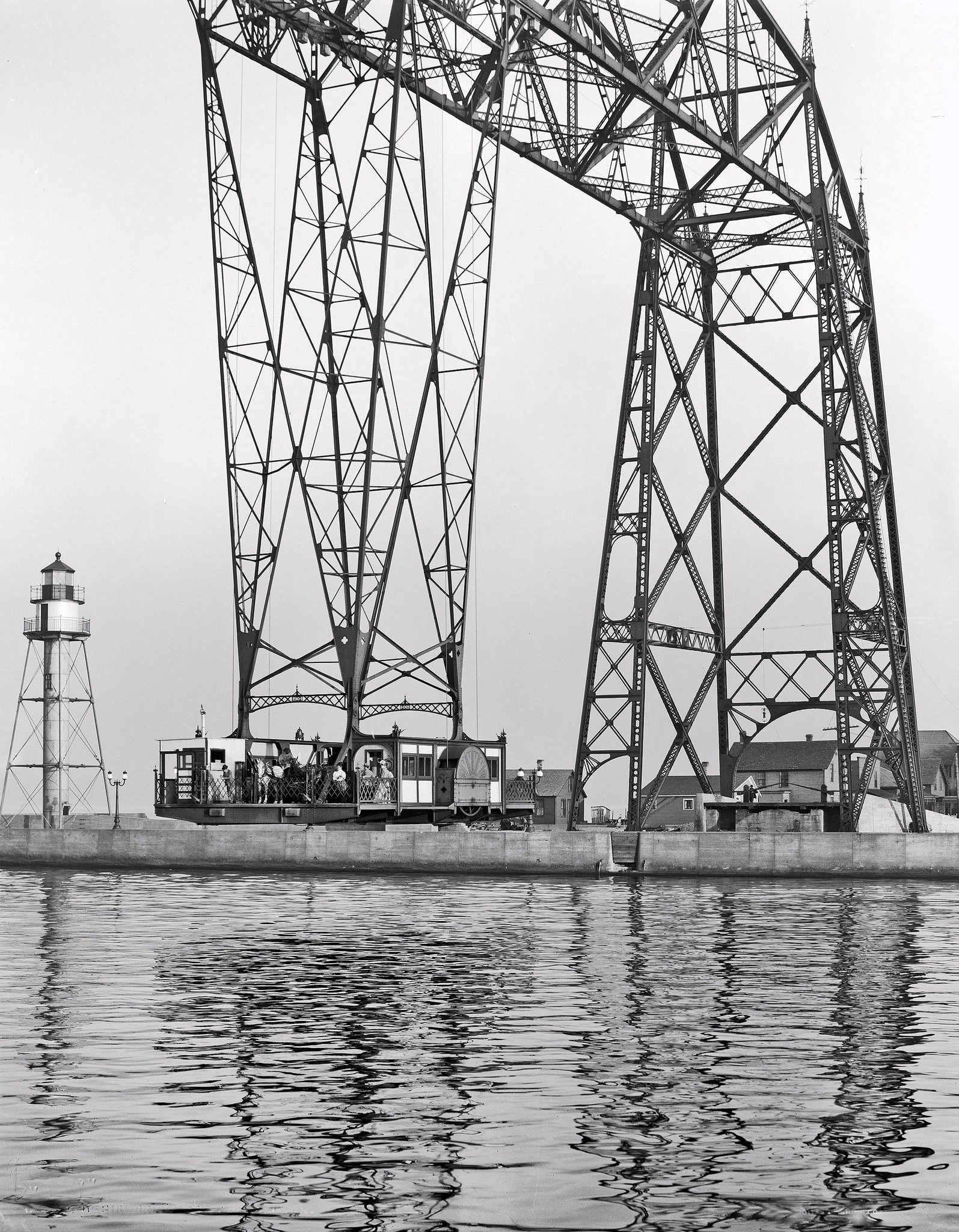
The reason for the two dates is that it was originally built in 1905 as the transporter shown in this photo. In 1930, after raising the transporter truss and reinforcing the towers, a lift span was added.
Tom Wigley Flickr, License: Attribution-NonCommercial-ShareAlike 2.0 Generic (CC BY-NC-SA 2.0)

Aerial bridge. Duluth, Minnesota

Circa 1905. "Aerial bridge. Duluth, Minnesota." Suspended Car Transfer over the Duluth Ship Canal. The gondola could carry 60 tons of cargo across the 300-foot channel with minimal obstruction of the shipping lane. After modification for service as a vertical lift, the span became known as the Aerial Lift Bridge. 8x10 dry plate glass negative, Detroit Publishing Company.

Steve Vanden Bosch posted
David Stack: This very unusual aerial ferry configuration of the Duluth canal bridge was in operation from 1905 to 1929.

Bridges Now and Then posted
Onlookers watch the gondola of the Duluth Aerial Transfer Bridge cross the Duluth Ship Canal, 1905. (Library of Congress)
 
Jerry Bielicki updated
Duluth.......1905
Jerry Bielicki shared
Laura Jacobs: original by photographer Hugh McKenzie.
Gordy Schmitt
Detroit Publishing Company photo, they show a 1908 date on the photo. https://www.loc.gov/resource/det.4a23152/
 
Bridges Now and Then posted
A vintage view of the Aerial Transfer Bridge in Duluth, Minnesota, from 1915, before conversion to a lift bridge. (Minnesota History Shop)
Jim Ritchie: https://www.perfectduluthday.com/2020/12/22/aerial-transfer-bridge-circa-1905/
 
Association for Great Lakes Maritime History posted
The freighter Francis L. Robbins with the Aerial Bridge in the background at Duluth, Minn., circa 1906 (Image Source: University of Wisconsin Madison Libraries Digital Collection – The Great Lakes Maritime History Project). 
The photographer was Hugh McKenzie (1879-1957). The image is part of the Kenneth E. Thro Collection of the Jim Dan Hill Library at the University of Wisconsin Superior. It was created from a glass plate negative.
[The remainder of the description is a history of the freighter.]
[The original description used the name "Aerial Lift Bridge." Thus the following comments.]
Robert Porterfield: The bridge in the background is a transfer bridge. It does not lift. Instead a movable section of bridge deck is suspended from bridge and travels from on side to the other to carry passengers and vehicles across the water.
Association for Great Lakes Maritime History: Thanks for the correction. As you noted, the name wasn't changed to the Aerial Lift Bridge until after the structure was modified to its current configuration and the gondola removed in 1929.

HAER MINN,69-DULU,9--4, cropped
4. SOUTH ELEVATION OF BRIDGE, WITH THE 'ROGER BLOUGH' HAVING PASSED UNDER - Duluth Aerial Lift Bridge, Lake Avenue, across Duluth Ship Canal, Duluth, St. Louis County, MN

The bridge spans the Duluth Ship Canal, which was dug in 1870 through the sand bar that routed the Saint Louise River further south and east before opening into the lake. The sand spit, commonly called "Park Point" by locals, named Minnesota Point, allowed ships to avoid Superior WI while still getting from the river to Lake Superior. This also turned the peninsula into an island. Ferries worked - but not during icy winter. 
In 1892, John Low Waddell designed a high lifting vertical lift bridge. The War department did not approve so Duluth did not get to build it. But the design was modified and built in Chicago as the South Halsted Street Bridge. Thomas McGilvray, a city engineer, drew the plans for the structure that was built, apparently inspired by a similar traveler type bridge, the Rouen Transporter Bridge across the Seine.

By the late 1920, the bridge was not keeping up with demand. The upgrade began in 1929, adding lifting span with a automotive deck. The fix span across the top had to be raised to allow room for the lifted span, so the towers straight vertical sections were added. In addition, significant structure was added within the towers to accommodate the counterweights and lifting mechanism. The rebuilt bridge first lifted for a vessel 1930 Mar 29.

[Bridge Hunter Description]
So was the War Department afraid that the lift span would fall down?

LC-USF34-064038-D (b&w film neg.), cropped
Aerial bridge. Duluth, Minnesota

LC-USF34-064039-D (b&w film neg.)
Aerial bridge. Duluth, Minnesota
[Note that the ship has passed and the lift span is on its way down.]

LC-HS503- 705
Credit line: Photographs in the Carol M. Highsmith Archive, Library of Congress, Prints and Photographs Division.
Carol M. Highsmith's photographs are in the public domain.

the lift span is already on its way back down.
David Schauer posted
Blade Runner...
M/V Ronnie arriving in nice light with wind blades for the port terminal. North Carolina with an assist. Duluth, MN - April 30, 2024

Al Miller posted three photos with the comment:
Edgar B. Speer departs Duluth in late March 1984 as the first boat to leave port that spring. She's bound for Two Harbors to load taconite pellets. G-Tug Vermont will accompany the Speer to assist with icebreaking and docking.
I was working for the Duluth News-Tribune at the time and had just done a story previewing the shipping season -- always one of the most pleasant tasks of the year. The photographer assigned to shoot the first boat movement persuaded me to accompany him -- probably so he wouldn't have to write the two-sentence photo cutline himself. He knew the operators of the Aerial Bridge, so we were able to be on the span when they raised it to allow the Speer to pass. I don't remember why I had my camera with me that day, but I'm glad I did. I wasn't a big fan of the 1,000-footers but this turned out to be a series of photos I still treasure.
1

2

3

A view of the underside of the lift span.
Bjornberg Photography posted
Steaming by:
It was a blue bird kind of day late as I captured a close up of the Alpena's smokestack when she passed underneath the Duluth lift bridge late last year. Amazing to see an 80-year-old ship (the oldest operating on the Great Lakes) in such great condition!

Because ship fans are normally after freighters in the harbor canal, this is the only photo I've seen with the span just part way up.
Rich Pedersen posted
The Federal Seto anchored in the lake as the Aerial Lift Bridge raises for a couple of sailboats this evening. 5/27/22
Chris Mazzella: Not uncommon
Lynn Theeck: It's been sitting there almost two days.

Michael Rainaldo posted four photos with the comment:
Not exactly ship related but then again, I guess it is. Enjoyed watching the MNDOT crews inspecting the Aerial Lift Bridge in Duluth, MN yesterday. Not often you get a close up look as they are usually hanging under the Blatnik or Bong bridges at 120 ft over the water, under the roadway & unseen to traffic overhead.
Interesting to watch was when a ship or boat came in & the bridge lifted as normal and the crew and equipment went up with it.   I guess you just never know what you'll see on a morning bike ride.
Jeremiah Shoemaker: Ultrasonic and visual NDT! Love to see it!
Access the public interactive bridge map here: https://mndot.maps.arcgis.com/.../webappviewer/index.html...
1

2

3

4

John Harker posted ten photos.
1

2

3

4

5

6

7

8

9

10

Bob Hamilton posted five photos with the comment: "A few shots of Duluth's famous Aerial Lift Bridge."
1

2

3

4

5
 
David Schauer posted
The oldest on the lakes, steamer Alpena (1942), arrived this morning with cement for Amrize (Lafarge) in Superior.  Duluth, MN - October 21, 2025

David Schauer posted
The ultimate location identifier, Duluth's Aerial Lift Bridge, had a double transit on the same lift yesterday as the H. Lee White arrived just ahead of corporate cousin Indiana Harbor. Gus Schauer image. October 24, 2025

At 0:20, the Laker sounds a salute. Was that a long and two shorts (--.)? That is a "D" in Morse code. I wonder what it stand for. The bridge definitely returned a salute of a long and two shorts. At 1:10, the captain sounds another salute with an exaggerated long and two shorts.
1:30 video
"The boat is the H Lee White." [It still bothers me to call a big ship a boat. That is why I use the term Laker or freighter."

Note the freight on the horizon on the right side of this video. That is the Arthur M Anderson doing a loop because the bridge tender asked him to slow down his arrival because he was expecting an ambulance to cross the bridge. Soon after this the bridge tender gave him an all clear. The rest of the video is a timelapse of the freight finishing the loop and coming in the canal. At 2:48 we get a new view and regular speed. At 4:27, we hear the salute. It sounded like three longs and 2 shorts. (---..) So, unlike trains for a crossing, the freighters don't use the same letter.
7:01 video @ 0:39
..