Tuesday, November 24, 2015

IH: McCormick Reaper Works, Revisited

(Update: Lost Illinois Manufacturing posting. He has some pictures that I don't have.)

You should start with this post, which was the original plants for McCormick and Deering.

Illinois Digital Archives
This postcard was handed out at the International Harvester's exhibit at the Century of Progress, 1933-34. The text indicates:

McCormick Works (red)
Tractor Works (blue)
Combined Area - 147.1 Acres

The water along the right edge would be the Chicago Sanitary and Ship Canal. The water in the middle is the original South Branch before it was filled in. If you look at the 1915 map in the above reference, just a little of the Tractor Works existed and some of the Reaper Work buildings have changed. The easiest change to spot is that the building on the south shore the of the South Branch is new. The above link was provided as a comment for the following Facebook posting.

Ken Gidewall commneted on a post
Sharon Clancy Ken Gidewall my mom made airplane parts there during WWII.

Eugene Klichowski commented on a post

Paul Renaud ->  Forgotten Chicago

Paul's comment:
Southeast panorama of the McCormick Reaper Works, rail yard and canal. The factory was owned by the McCormick Harvesting Machine company before 1902. In 1902 it became the McCormick Works of the International Harvester Company. The factory was located at Blue Island and Western Avenues in the Chicago subdivision called "Canalport." It was closed in 1961.
Darla Zailskas in another posting of this picture commented that it was "circa 1900."

I think the stretch of water in the photo is the South Branch rather than the canal. And I think it is after 1915 because the building on the left appears to be the new one mentioned above.

Paul posted three more pictures to Forgotten Chicago. The comments are, respectively:
  • Quitting Time at McCormick Reaper Works
  • McCormick Reaper Works factory and rail yard as seen across a canal. Workers can be seen unloading wood.
  • Twine mill with shipping platform at the McCormick Reaper Works, just after construction.
Posted
Posted 
Posted
For the middle photo, I think the view is across a channalized South Branch rather than the S&S Canal. There was controversy in the comments for the third photo as to its location. I have not been able to determine where it was.

About the only difference between the aerial view above and the aerial photo in my  previous posting is that the South Branch river has been filled in west of the new building on the south shore of the river.

In the upper-right corner of the aerial view you can see part of the Chicago Produce Terminal yard.

References for future research concerning IH:  After the Holidays, I need to remember to check out International Harvester, Mccormick, Navistar : milestones in the company that helped build America (from a library search).

Update:
MWRD posted
Construction of the first 8 Track Rail Bridge over the Chicago Sanitary and Ship Canal on September 21, 1900. This bridge was replaced by the current 8-track "scissors" bridge, which is actually four separate spans with two rail tracks each, built by the MWRD between 1908 and 1910.
Dennis DeBruler: I believe the buildings in the right background were the McCormick Harvesting Machine Co. before it was absorbed by International Harvester Co. in 1902.

Trent Blasco posted
Farmall Tractors and Tanks during World War II at the Tractor Works, 2600 West 31st Street.
(Chicago History Museum, ICHi-25512)
Jeff Nichols posted
McCormick Works (Blue Island & Western) photographed from the opposite bank of the Chicago River, 1914. McCormick - International Harvester, Wisconsin Historical Society, Image ID: 45297
Marty Miller posted
 McCormick Works at Western and Blue Island. I don't think the workers used this entrance?Photo dated 1926
Chris La Course posted
The McCormick Reaper Works, 26th and Oakley, 1928, Chicago
MWRD posted
Historical Photo of the Week: Workers prepare to raise a sunken tug boat out of the Chicago Sanitary and Ship Canal on July 12, 1922, viewed looking roughly northwest from an area near Damen Ave. (Robey St. at the time of the photo).
David Daruszka McCormick Reaper Works in the background. All gone today
MWRD posted
Paul Rabenhorst shared
MWRD shared
MWRD posted on Mar 21, 2023
Association for Great Lakes Maritime History posted
[Their description provides a history of the tug.]

MWRD posted
A diving crew and other workers prepare to raise a sunken tugboat out of the Chicago Sanitary and Ship Canal, viewed looking roughly northwest from an area near Damen Avenue (Robey Street at the time of the photo), on July 13, 1922. 
William Lafferty: We've seen this one before. Racine heeled over 11 July 1922 while maneuvering a vessel aside the Santa Fe elevator dock off Damen. Great Lakes Towing Company dispatched a salvage team from Cleveland to raise it, shown here, the tug one of the firm's vessels. There were no injuries. Racine, built in 1914, went on to serve until 1979 as the Canadian tug Douglas Reid.
Dennis DeBruler: This is one of the best views I've seen of the McCormick Reaper Works. In the middle background we see the South Branch before it was filled in.

ChicagoHistory has an interactive picture of the works.

A video advertising their complete line of tractors. Unfortunately, I could not find a date.

Monday, November 23, 2015

Pullman Works Transfer Table

(Update: the factory in general)

Paul Petraitis -> RAILROAD HISTORY BUFFS OF ILLINOIS
Pullman erecting shops ca 1885
There were quite a view comments associated with this posting as to the function of the little car. The consensus was Richard Fiedler's suggestion: "Ornate shelter for the transfer table operator."

I've read that the shops had 22 miles of track on their property that was switched by their own engines. The green rectangle in the overview aerial photo below indicates where one of their roundhouses was located.

Paul Petraitis comment
At first, I thought the shops had two transfer tables at 90-degrees to each other because of all those wheels on the left in this picture. But now I believe those are just car trucks stored on sidings. Below is a partial resolution aerial photo to provide some context. The red rectangle indicates the excerpt below at full resolution. You can see the transfer table tracks go in an east/west direction between the buildings. I spent some time looking for the Sanborn Map, but I still haven't found which volume they are in.

1938 Aerial Photo from ILHAP


The red rectangle area

Paul Petraitis posted
Update: Paul's comment:
Pullman Factory 1890, from a 5x7 glass negative I printed up when I worked at the Chicago Historical Society 1970-86.
Paul Petraitis posted
Pullman factory
David Daruszka Transfer table.

Chicago & North Western Historical Society posted
Ever wondered why some people call an intercity train "the varnish." This photo will help answer that question. This 1891 C&NW chair car was built at Pullman, Illinois by the famous Pullman company. It is being move onto the "transfer table" to be sent off to C&NW service. The car is well VARNISHED inside and out. People should visit the National Parks District P:ullman museum at 111th and Cottage Grove in Chicago ( fine museum). On can stand on the site seen here. The photo is from the Smithsonian Museum.
Raymond Storey shared

DaVe Durham posted

Comments on DaVe's post

David Daruszka commented on Chuck's posting

It appears there was more than one transfer table in the factory because this one does not have an operators cab. Maybe it is simply pushed by some workers.
David Daruszka commented on Chuck's posting

1918 Cliffs/ArcelorMittal/Interlake/Acme Steel Mill at Riverdale, IL

(Satellite)

Interlake/Acme used to also have an iron (blast furnaces) and coke plant in Chicago.

Michael Brandt posted
A great aerial shot of Acme Steel in Riverdale.
Mark Byerly: Every night at 9:00 they would open the roof to pour off the steel. We always knew when to go home. The sky would be red.
Mark Byerly: Taking the slag to the East Side of Chicago called Slag Valley. The cars would glow red. An awesome site coming home from Little League Field.
David Wilson: When I was little watching cartoons I thought this was it.
Christopher Camalick: I believe when my mom worked their it was called Interlake Steel Co.
Jack Benton: Michael Brandt went from Acme to Interlake and now it’s Arcelor Mittal.

Dennis DeBruler commented on Jack's comment
You are one behind. Cleveland-Cliffs bought most of Arcelor-Mittal's North American assets.
https://maps.app.goo.gl/a7tVzgUoQxN6ZcUMA
Jack Benton: Dennis DeBruler Okay. I missed one. Thanks
https://d1io3yog0oux5.cloudfront.net/.../CLF_FactSheet...
 
David Ruklic posted
Here is a very early picture of Acme from 1919. 134th and Perry. Acme opened in Riverdale in 1918.
Kathe Dulinskas Merigold: I worked there from 1969-1999. Acme was a great company to work for, until Acme filed for bankruptcy
Tom McKeon: I don't remember what year ( 95 - 96 ? ) we were starting to tear down parts of the original Mill , the New Caster was up and running . A lot of the equipment was 1930 and earlier .

Michael Brandt posted
Our best areal shot of Acme Steel. To the left below center is Millerville.

Marc Worst posted
This is the Acme Steel Plant at 135th and Perry Avenue in Chicago and I worked with a friend who said he liked working there in the 1960s.

Bill Bielby posted two photos with the comment: "Top - undated view of Acme Steel in Riverdale from the Pullman Museum website - I'm guessing 1930s or early 1940s. Bottom, current (or at least recent) view from Google Earth. View each image separately to get the full perspective. It's interesting to see sparsely populated section of West Pullman across the river. I'll post a line to the Google Earth site and to the historical image in full resolution in the comments. Too bad the vew is towards the northwest instead of to the south from the other side of the river, which would have shown how sparsely built up Ivanhoe was at that time."
[The Google Earth link did not work for me.]
1

2

Bill commented on Photo 1 above
View to the southwest - probably the most interesting view
https://www.idaillinois.org/digital/collection/pshs02/id/87/rec/16

David Daruszka -> RAILROAD HISTORY BUFFS OF ILLINOIS, also Michael Brandt posted
Pennsy switch engine on the Panhandle line
in Riverdale switching out Acme Steel.

I first learned about this steel plant while studying the Chicago and Great Eastern part of PRR's Panhandle line. David's Facebook posting of the picture on the right motivated me to learn more about the steel plant.

Just as railroads acquire different names throughout history as they are absorbed by other companies, steel companies also tend to have a name history. The current owner is ArcelorMittal.

Acme founded the 114-acre site in 1910 and had a mill running by 1918. Acme replaced that mill with this (below) 1996 state-of-art hot-roll mill. The production facilities of the mill are "basic oxygen furnace; compact strip production facility: ladle metallurgy facility, continuous thin slab caster, tunnel furnace, hot strip mill" (Facts) The tunnel furnace uses 193 rolls. (Video)

Frontier to Heartland
The hot-rolled coils are then shipped to cold-roll mills for further finishing.


David posted a couple more historic pictures as comments to the above posting.
David's comment
David's comment
Google "Streetview"

1938 Aerial Photo from ILHAP
As one would expect, the 1938 aerial view and the 1951 Sanborn Map has the configuration of the 1918 mill. You can see in the Google image that they used vacant land to build the new mill and have torn down the old mill.

I remember seeing a picture that showed a modern CSX engine by the plant, but I can't find that picture again. But it makes sense that CSX would get this Pennsy remnant when Conrail broke up because it could be easily connected to its B&OCT tracks on the east side of Barr Yard.

Update: ACME Steel/Interlake Riverdale Plymouth No. 3 Locomotive

ACME Steel/Interlake Riverdale Blast Furnace Plant and Wisconsin Steel

Steve OConnor posted the Blast Furnace photo, evidently illegally because he provided the link that clearly says at the bottom that you can't use the photo on the web without permission. It looks like there is a gas holding tank on the left of the photo. Steve's comment:
A maze of rail yards surrounds the ACME/Interlake Steel Company plant near Calumet. Blast furnaces "A" and "B" to the north, multiple ore bridges, the suspension bridge conveying coke and gas from the coke plant, and the sintering plant to the south. http://www.idaillinois.org/…/…/collection/pshs02/id/9/rec/71


Sanborn Cook County Vol. 1 - East, Sheet 91

Raymond Boothe posted
Pictured is the Interlake Inc. Riverdale Steel Plant and Factory. As you can see only the BOF (lower right hand of the picture and office building (direct upper left) still stand today. The entire factory and rolling mill are now gone. Right above the old main factory in the open field is where ArcelorMittal's con-caster stands today.
Raymond Boothe Question: Name some products that were made beside steel in the Riverdale Factory?Raymond Boothe Book stitching machines, strapping machines, steel and plastic strapping materials, storage racks, scissors, business cutting machines and other small metal items.
 
Michael Brandt posted
A great 1971 areal shot of Acme Steel. I posted this before, but this is a much better copy.
Jon Wolfe posted
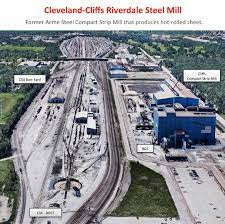
Cliffs/ArcelorMittal/Interlake/Acme Steel Mill at Riverdale, IL
 
Viral Media posted
Hot Metal to Riverdale
In 1994, Acme Steel invested over $400 million in the mini-mill. The mill included "basic oxygen furnace”, compact strip production facility, ladle metallurgy facility, continuous thin slab caster, tunnel furnace, and hot strip mill. Unfortunately, Acme closed operations in 2001 and the mill and the nearby blast furnaces were also idled.
ISG's Riverdale facility sat vacant for almost a year, and was reborn as part of the International Steel Group Inc. ISG didn't buy or need Acme's coke ovens or blast furnaces. Instead it used ISG's Indiana Harbor plant, which produced hot metal for Riverdale. Since then, the plant was sold by ISG to ArcelorMittal, and then to the current owner Cliffs.
Norfolk Southern makes several round trips a day from the blast furnaces in East Chicago to the continuous caster in Riverdale, Illinois. Each bottle car carries 175 tons of molten metal.  When transporting hot metal, “idler” gondolas are used to spread the weight of the loaded hot metal train and also provide additional braking capability. There is a time constraint imposed by the molten metal that requires timely delivery. The cars require special handling and are limited to 25 mph empty and to 15 mph loaded.
After the cars are loaded in Indiana Harbor, the IHB crew picks up the train and moves them to the Michigan Ave Yard where the train is handed off to NS crew for the 12 mile trip to Riverdale. At Dolton Junction, the train leaves the IHB for on a surviving branch of the Pennsylvania Railroad’s Panhandle Line, now owned by Norfolk Southern. The Cliff switching crews receive the cars in Riverdale. The NS crew returns empty hot metal cars back to East Chicago.
[I don't think the idler gondola cars are based on loaded vs. empty. If they removed the idler cars at Riverdale, how are they going to get them back to the blast furnaces. They were used back when a bridge was weak. They are no longer needed because the bridge got upgraded (replaced?). But I never was able to determine which bridge. Note that they still used gondola cars on both ends as buffer cars.]
 
Viral Media posted
[The description is similar to that of the above post.]

Michael Brandt posted
 
Raymond Boothe posted
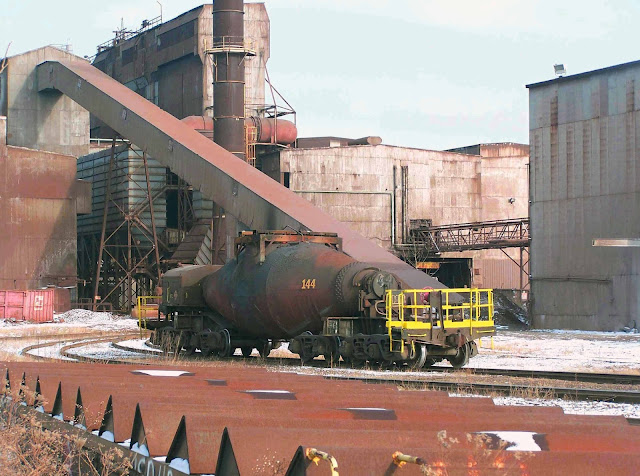
Cliffs Steel Riverdale: Torpedo Car No. 144 sitting outside the BOF Shop (Dr. Raymond Boothe photograph).

Joe Usselman posted
A couple old school EMD's lead a train out of Barr yard in Riverdale in early 2017.
One of several photos posted byTony Margis from a tour. They are blurry because of the low light, but you can get a good feel for the line of rolling stands and the hot sheet metal passing through them.

Karen Brozynski also posted some photos from that tour with the comment:
Arcelor Mittal celebrated the 100th Anniversary of the plant in Riverdale. Got to take a tour. I never appreciated just how HOT it is in a steel plant. If a family member worked in a mill or still does it is not work for the weak. We were in the rolling mill. Met some great people who worked there. Might get some donations out of it.
1

2

3

4

6

7


Street View
[
I was verifying that SEPA #4 has a closed gate across its entrance.]

safe_image for a John McCluskey Album of 239 Views

Since I don't know exactly which ones of these photos were taken at Riverdale and which were taken at the blast furnace plant, I include them all.
Lost Illinois Manufacturing posted thirteen photos with the comment:
Acme Steel Co.The Acme Flexible Clasp Co. was founded in Chicago in 1884. In 1899, the company merged with the Quincy Hardware Manufacturing Co. of Quincy, Illinois, a manufacturer of barbed steel staples led by James E. MacMurray. The new company, based in Chicago, changed its name to the Acme Steel Goods Co. in 1907; in 1925, it became Acme Steel Co. By the mid-1930s (during the Great Depression), Acme employed about 1,400 Chicago-area residents. A new plant opened in Riverdale, Illinois, in 1918; by the end of the 1950s, when annual sales of well over $100 million placed Acme among the top 300 industrial corporations in the United States, the move from Chicago to Riverdale was complete. In 1964, Acme merged with the Interlake Iron Corp., a Cleveland-based company that owned plants in Chicago, to form the Interlake Steel Corp. In the mid-1970s, as its annual sales approached $700 million, Interlake had 3,500 workers in the Chicago area. A new Acme spun off from Interlake in 1986. The company had trouble staying afloat and employed only about 1,200 local residents by the end of the 1990s, a number that fell as a phased shutdown was begun in 2001. In 2002, the International Steel Group, organized by WL Ross & Co. LLC, bought the shuttered and bankrupt Acme Steel and re-opened it as ISG Riverdale Inc., a sheet minimill employing about 200 workers. http://www.encyclopedia.chicagohistory.org/pages/2524.htmlhttp://www.idaillinois.org/…/Acme%20Steel%20Comp…/mode/exact
 [Some of these photos are of the Riverdale plant such as the one that William Grin identified as the BOF.]
1
Michael Hrysko What year would this be when the picture was taken ?

2

3

4
William Grin This is a photo of A Furnace being built 30's.
Bob Callahan Can't be. Look at the yellow front end loader at the lower left of the tower. Also, that looks like a station wagon by the office trailer pictured. That's gotta be the 1960's or 70's. That's a quenching tower, that's part of the coke ovens.

5

6
William Grin This is a Ariel view of Acme Steel and Wisconsin Steel and Republic Steel.

7

8
William Grin This is at the BOF pouring molten steel into Ingot moulds.

9
David Daruszka comment on a post

10
William Grin This was No. 4 Coke belt going over the Calumet river. The Coke plant was on Torrence Avenue in South Deering.
Dennis DeBruler In the background near the right side of the photo is the quenching tower and two smokestacks of the coke plant.
https://www.google.com/.../@41.6877042,-87.../data=!3m1!1e3


11

12

13

Kevin Piper posted this comment along with seven photos.
A new company, based in Chicago, became the Acme Steel Goods Co. in 1907. In 1925, it became the Acme Steel Co. By the mid-1930's and during the Great Depression, Acme still employed about 1400 Chicago-area residents. A new plant opened in Riverdale, Illinois, in 1918. The company specialized in heavy staples and steel straps and banding. By 1964, Acme merged with the Interlake Iron Corp., a Cleveland-based company that owned plants in Chicago, to form the "Interlake Steel" Corp. In the mid-1970's, at its peak, Interlake had about 3500 workers in the Chicago area. I remember it well as a young boy. A new Acme Steel spun off from troubled Interlake in 1986. The new company had trouble staying in business and employed then about 1200 by the end of the 1990's. That number quickly fell as a phased shutdown began in 2001. In 2002, bankrupt Acme Steel re-opened as ISG Riverdale Inc., a sheet minimill employing only about 200 workers. Today the area is owned by ArchlorMittal Corp., and not much is known about the plant or its operations.

Jon Mossman commented on safe_image, cropped
I'm at riverdale running a pot hauler right now.
[I see the front tires on the sides. He must be tilting the pot forward.]
Dennis DeBruler commented
So has pot hauling with steel wheels been replaced by rubber wheels? Do the pot haulers also replace overhead crane operations?

safe_image for John McCluskey Flickr
This crane is being used to break up the slag in a steel mill after it cools so that the chunks can be shipped out in gondolas.
Bradley Anders: The Nucor in ahoskie nc crushes it into crusher run 57 and ballast stone. It’s basically impure minerals that make steel not steel. I have a video I posted on here of a crane drop balling at that same plant years back just search my name.
Bradley Anders
 Found it:
[Update: unfortunately, the Manitowoc Groups has been deleted]
James Torgeson posted

James Torgeson posted
Caster at ArcelorMittal Riverdale. May 29, 2008.

Nick Hart posted
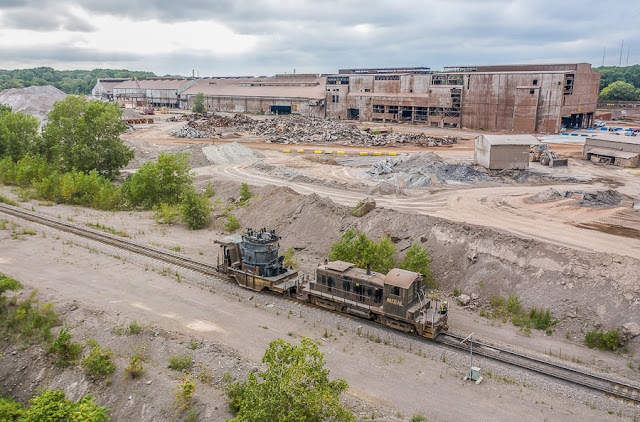
Shortly after departing the oxygen furnace in Riverdale, a filthy Mittal SW1 (Cleveland Cliffs) makes its way to the plant with a single ladle transfer car. July 28th, 2021
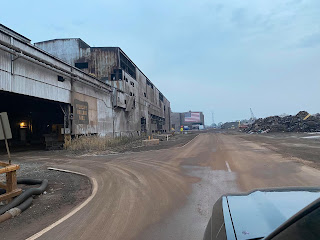
Scott Malec: What the hell is that post-apocalyptic mess in the background?
Bill Smotrilla: Scott Malec The old interlake steel plant.
Josh Davis: Scott Malec looks like a little bit of slag processing, a little bit of scrap metal, a little bit of slag, and an old building that is empty or is storage at this point.
Seth Lakin: The destination for NS’s bottle trains. That SW1 is the one that usually runs the ladle car up front, but there’s at least two other locomotives back in the plant. Public access to the back fence of the plant but it’s a little bit of a hike.
Sam Combs: Ladle, was working the IHB 520 job Tuesday night and we came to Acme, watched that thing run back and forth for probably 5 hours.
Chuck Mager: That ACME run was always good for OT $$'s!!

Thomas Cook posted three photos without comment.
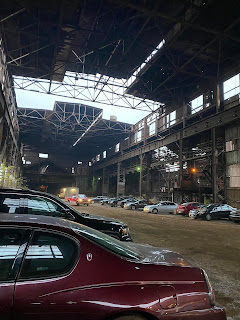
Ricky Daniel: The old primary rolling mill after shut down because of the new caster taking over at Interlake / Acme Steel , Riverdale,IL.
And they gutted the mill took cranes out and let the melt shop employees park in there .
1

2

3
Linda D Christensen: This looks like our old blooming mill....the bosses have us store material in there even though it rains in there harder than outside ! Lol

Thomas Boenne posted
This is the Tundish deck at the new thin slab caster at Acme Steel in Riverdale Illinois like 20 years ago. Now it is Cleveland Cliffs!
Jeff La Belle: Thomas Boenne we commissioned in 1996.
Paul M Trembacki: I forgot what it looked like before all the “safety equipment “ LOL

Michael Brandt posted
James Humbert really nailed the very Northside of Acme Steel, notice in the upper right the famous Christmas Star that was up there for many many years.

Joe Zeller posted 10 photos of Mittal 1400. Some comments indicate it is a SW1 and there may be 2 or 3 still running around in the works.
John Kostecka: A ladle car. In Riverdale Works, it take molten steel from the Basic Oxygen Furnace and is transported over to the thin strip caster/HSM to make coils.
Seth Lakin: It’s a molten steel ladle on a car being moved from the furnace to a caster.
1

2, cropped

3

Jeff Toppen posted three photos with the question: "Anyone know what this is?"

May 2025:
Brian Olson posted
So Cleveland Cliffs is closing a modern CSP in Riverdale, Illinois?  The only investment Riversdale needs is a new EAF.  This mill will run again, if not in Riverdale then somewhere else.

Cleveland-Cliffs indefinitely idled plants in Riverdale, Steelton and Conshohocken in 2025. It also idled a plant in Rouge. [ChicagoTribune, May 9, 2025]

Joseph Tuch Santucci posted
Last year I posted some photos and storyline about the molten iron bottle trains that operated between an integrated steel mill in Northwest Indiana and a plant in south suburban Chicago that takes this iron and finishes it into specialty steels. The plant receiving the molten iron, Cleveland Cliffs’ Acme Steel plant is temporarily shutting down. Hopefully this really is only temporary and comes back into production before year’s end. 
Despite the threats and alerts of bad weather, I went out and braved the elements today to get video of what could possibly be the last bottle train to run. I was told by John Eagan the conductor on the train was holding up a sign stating this was the last train. Hers hoping that’s not prophetic. 
Here is the video of that train in the rain. While I got wet, I didn’t get drenched and the worst of the rain came down only after I was done filming and had put all my gear away. It was worth it to get rained on in order to obtain this video. I may never have another chance.

Sam Foster posted
I just finished up my video covering the final days of operations at the Riverdale mill. My video also features a run of the NS bottle train, which was, to my knowledge, the only place where you could see subs/torpedos on the main line!
[The YouTube video is 25:27 long.]
Bob Hamilton: I love this! FYI mixer cars/bottle cars on interchange rail service was more common than you might think. I worked at Wm B. Pollock in the engineering department and designed many Pollock mixer cars cars to be used in interchange service. I could watch the Republic Steel Youngstown cars passing my office window on their way to Republic Warren plant.