Monday, January 22, 2018

SS Edward L. Ryerson, a Great Lakes Steamer

I came across links for this boat twice within hours of each other. As is my policy, when I see a topic twice in a short period of time, I consider that an omen to write about the topic. It did set several milestones in shipping history: "The Ryerson was the last American-flagged new ship built on the Great Lakes until the launch of the Stewart J. Cort in 1972. She was the last U.S. laker to be built as a steamer, the last to be built without a self-unloader, the last lake boat to be constructed at the Manitowoc, WI shipyards, and the last and only to be built with such aesthetically pleasing lines." [BoatNerd]

I found that BoatNerd page when I was researching the introduction of self-unloaders. About four hours later, I saw this posting. See Old Lakers for some other "bridge on the bow" boats that I have seen.

Wisconsin Maritime Museum posted six photos with the comment:
January 21, 1960: The EDWARD L. RYERSON was launched into the ice-filled river at Manitowoc Shipbuilding Company. She marked the end of a shipbuilding era as the last freighter built in Manitowoc, Wisconsin. The Ryerson was also the last U.S.-flagged laker built as a steamer and the last to be built as a straight-decker (without a self-unloading boom). Built for Inland Steel, she was constructed specifically to carry iron ore pellets.
The Ryerson is beloved by many for her unique streamlined design and distinctive steam whistles. She has been laid up periodically over the years due to downturns in the steel market, but she has amazingly managed to avoid the scrapper's torch. The Edward L. Ryerson has been in long-term layup in Superior, Wisconsin since 2009.

1
The bulk carrier EDWARD L. RYERSON, nicknamed "Fast Eddie," doing her sea trials on Lake Michigan in August 1960.

2
The hull of the bulk carrier EDWARD L. RYERSON ready to be launched at Manitowoc Shipbuilding Company on January 21, 1960.

3
The EDWARD L. RYERSON splashing into the Manitowoc River at 12:00 pm on January 21, 1960. The local newspaper reported "“The hull of the ship rode majestically down the launching way as the ropes were cut. It hit the water with a resounding roar and the ice jammed river swelled into a mountainous wave, grinding ice cakes together with the sound of breaking glass.”

4
Cover of launching luncheon program for the EDWARD L. RYERSON.

5
Inside of launching program for the EDWARD L. RYERSON.

6
Launching schedule for EDWARD L. RYERSON at Manitowoc Shipbuilding Company on January 21, 1960.

Notice the capacity of around 26,000 tons. If I'm remembering correctly, modern 1000-foot Lakers can carry 58,000 to 68,000 [interlake-steamship]. Maybe someone can convert the cargo hold into casino rooms.

Wisconsin Maritime Museum posted
On this date [Jan 21] in 1960, the Manitowoc Shipbuilding Company launched SS EDWARD L. RYERSON!
Affectionately nicknamed "Fast Eddie," the eight million dollar (about $57.7 million in today's dollars) boat was not only the last steam-powered freighter built on the Great Lakes, but also was the last one built that was not a self-unloader. Built to transport iron ore, RYERSON served steelyards across the region until entering long-term layup in Superior, Wisconsin in 2009.
(P71-4-3, Wisconsin Maritime Museum Collections)
[image description: black and white historical image taken from the riverbank of the freighter splashing sideways into the river. There is snow on the ground. A smoking smokestack and cranes can be seen in the background. The WMM watermark is overlain across the middle of the image.]
Jacky Pierce-Breech shared
Alan Ross: If I remember correctly, that was also the last freighter like that which was launched in the river by the Manitowoc Shipyards. They had to dig out part of the opposite shoreline so the boat could make the bend in the river. [That is why Manitowoc moved their shipbuilding to Sturgeon Bay and they started specializing in building cranes here.]

Update:
Ben Stalvey posted
Blast from the past. From Manitowoc WI back in 1960. This slide might bring back memories for some of the locals. Checkout the Edward L Ryerson being constructed back in 1960. Look at the custom tip on the 4600. Looks to be a hammerhead tip even.

Ben Stalvey posted two photos with the comment: "Here are a few shots of the construction of Edward Ryerson in Manitowoc WI at Manitowoc Shipbuilding. Checkout the tip on that 3900."
1

2
Mark Goodrich commented on Ben's posting

Wisconsin Maritime Museum posted
It's been a few days since Ever Given got unstuck from the Suez Canal. Did you know the Manitowoc river also got blocked up by a ship once?
The SS Edward L. Ryerson was launched in July 1960, but was too large to turn the bend in the river! Crews had to dredge the river and cut away part of the bank to get the ship out to Lake Michigan. According to sources, it was a lot faster of an unsticking operation than Ever Given and thankfully didn't plug up one of the busiest shipping lanes in the world!
Tove Alecksen: The jackknife bridge was removed to make room for Big Blue when it gets shipped out. Call the Mayor and ask him if you don't believe me! [I assume that Big Blue are the Kronecranes that will go do a naval shipyard.]
Randy Wallander: The notch is still visible in the river Bank.

Paul Rabenhorst shared
James Torgeson: She was the last ship built there. [Manitowoc built a new shipyard in Sturgeon Bay where they had plenty of room and then they could dedicate this location to building cranes.]

Jeff Rueckert posted three photos with the comment: "Flash Back ! Edward L Ryerson in Manitowoc."
1

2
Deborah Wiegand commented on a post
This is the Edward L Ryerson( 730') being towed out by the tug Green Bay from the Manitowoc shipyard for her shake-down cruise. (Aug 1960) My dad Les Gamble was the captain on the Green Bay. Also inches on each side to clear each of three bridges. (Photo by Jeff Rueckert)

3
Chuck Bornemann Amazed she ever got out of Manty.
 
Wisconsin Maritime Museum posted
#OnThisDay [Jan 21] in 1960, the Manitowoc Shipbuilding Company launched SS EDWARD L. RYERSON!
Affectionately nicknamed "Fast Eddie," the eight million dollar ship was not only the last steam-powered freighter built on the Great Lakes, but also was the last one built that was not a self-unloader AND the last "laker" constructed at the Manitowoc Shipbuilding Company shipyard. Built to transport iron ore, RYERSON served steelyards across the Great Lakes region until entering long-term layup in Superior, Wisconsin in 2009.
[It is in layup in the Fraser Shipyard, and those notes have a lot of photos of this freighter since it has been setting there so long.]
This image was taken in August 1960 as the vessel was leaving the upper Manitowoc River harbor under tow.
📸: P97-17-5, Wisconsin Maritime Museum Collection
(image description: black and white historical aerial view of EDWARD L RYERSON navigating the Manitowoc River. There are people walking alongside and on the deck. The WMM watermark is overlain across the middle of the image.)
Connor Siemers shared

Satellite
Skip Heckel posted the question: "Anybody know where the Ryerson is moored?"
Skip Heckel Ben Stalvey I was talking with a friend, Jim Derusha, whose Dad owned Marinette Marine back in the day, he said they had to cut some of the land back because the RYERSON was too long to make it around a bend.
Ben Stalvey Skip Heckel very true it is called the Ryerson bend.
Gen SterenbergGen and 2 others manage the membership, moderators, settings, and posts for Great Lakes Ship Watchers. I found a cool website with great Ryerson info including 2 MP3 files with salutes at the end. http://dlund.20m.com/photo6.html
Ben Stalvey Been sitting in the same place for years

It was not only the last ship launched at Manitowoc, WI, at 730' it was the longest laker at that time. It was also fast, 19mph; thus its nickname of Fast Eddie. [DuluthHarborCam]
(new window) If you about to quit because of boredom, at least skip to 7:21 for a few seconds. And 8:05 is worth a look.


Jan 6: 2023:
David Schauer posted
It is a new year so why not stoke the old Ryerson rumor mill for the heck of it. On my way back from the Superior entry this morning I noticed on AIS that Helen H was in Howards Pocket (Fraser Shipyards). I checked as I drove back to Duluth and surprise, surprise, they were shifting the Edward L. Ryerson from the "back 40" (Frog Pond) to a more accessible position by the main yard. Wren Works was also assisting in ice removal and handling the bow with Wren I (aka Fraser II).  This year might be very special for boat fans...1/6/2023
[According to some comments, it might be used to haul steel planks. Freighters that have not been converted to self-unloading are better for hauling steel.]
Marcel Buchholz: Ryerson is steam powered, isn’t she?
James Torgeson: Marcel Buchholz Yes.

David Schauer commented on his post


Lost/ComEd 1951 600mw Ridgeland Generating Station

(Satellite, most of the land is now container storage. But ComEd does store some transformers next to its switchyard.)

See below for source details

I knew ComEd had the Fisk and Crawford Generating Stations along the South Branch and Canal. The comments on the following photo taught me that ComEd had a third generating station along the waterway --- Ridgeland.

Jerry Jackson posted
I'll bet the guy in the 76' AMC Hornet could care less about this train and wonders if his spare is any good. I, on the other hand, wore a glove. Driving up the Stevenson Expressway, just past Harlem Ave. I saw this cool lash-up just after it had crossed the DesPlaines River, rolled the winder down and took as many as I safely could. This one was the best of the grab shots. The train is headed towards Nerska/Corwith. January 1988.
Mark Bilecki Sr. No thats not Ridgeland station , thats the Metro Water Reclaimation plant in the background. Ridgeland was directly north of where the photo was taken.

The plant existed in 1938: (Jun 2025 Update: a comment below says the plant did not exist in 1938. I've learned that this aerial is a mistake. (I left it in so that some of the comments make sense. Since I wrote these notes, I have learned how to get aerial photos between WWII and the 21st Century.) The Ridgeland Plant was west of this 1938 aerial view. So now I wonder what this building was. (Jul 2025 Update: per a comment below, the plant was the Brisch Brick Company.))
1938 Aerial Photo from ILHAP

Apr 20, 1962 @ 24,000; AR1VAHU00020151

The first four units were done in 1951. (I included the roundhouse because I didn't know about this one. Only the foundation of the roundhouse is visible in the above 1962 photo.)
Dec 4, 1951 @ 23,600; AR1SA0000020056

Three sources say it was built in the early 1950s:
  • JohnnyBigboy1425: "It was the most Modern Power plant in the world when it came on line in the 50's. People from all over the world would come and see it's operation."
  • IEEE: "Newest addition to the Commonwealth Edison Company is the Ridgeland Station with an ultimate capacity of 600,000 kw. The result of long-range planning, the station has many modern features including centralized control, cyclone-fired furnaces, and hydrogen-cooled generators." (This was published in 1951.)
  • Chicago Tribune: "The first completely new electric generating station built in the Chicago area since 1929"
So why do I see the same buildings with the same smokestacks exist in the 1938 aerial??? My current working assumption is that it was built as a coal plant and converted to an oil-burning plant in the early 1950s. JohnnyBigboy1425 also stated: "When I worked there, in the operating department it was an oil burning plant, it had been converted from coal some years before I started working there." Because OPEC very successfully increased the price of petroleum products in the 1970s, JohnnyBigboy1425 says it was dismantled piece by piece and reassembled in Florida. It must be the Florida plant that rmurwin is referring to with his 2014 comment: "This power plant is still in operation, albeit heavily modified. It now burns biofuel (wood). 
Ferndog confirms it was closed in 1982 due to high oil costs. (Update: see the comment below about it being closed because of "high maintenance costs on tube leaks from burning gas.")

Alan Medsker provided the following three images from a Sargent & Lundy book. The last paragraph on page 53 starts the description of this plant. The "Reheat Returns To Use" puts the 1800 psig design for Ridgeland into perspective. The state of art had been 1250 psig.
1

2

3, the source for the image at the top of these notes

AE&FR: Aurora, Elgin & Fox River Interurban Overview

Wikipedia
(Update: content concerning the Fox River Trolley Museum has been moved to these notes.)

I normally don't pay attention to interurban because learning the regular railroads is challenging enough. But this route had an interesting freight remnant. And that remnant had an even more interesting remnant that supports the Fox River Trolley Museum. Plus the route has provided bridges across the Fox River for the Fox River Trail.

The freight remnant went from Coleman Junction with the CN/IC north along the Fox River until it curved west to run parallel along La Fox Street. Where La Fox Street becomes State Street, the tracks became part of the streetcar system in Elgin. That is, the AE&FR did street running. The remnant of the remnant runs south from the Fox River Trolley Museum to Blackhawk Station Fox River Trolley.

David Wilson Flickr 1966 Photo, License: CC BY

Mark Llanuza posted
One the second to the last coal empties going back to the IC Railroad interchange at Coleman Jct at South Elgin IL 1973 heads south coming back from the ILLinois State Hospital going past the Fox River Museum in South Elgin IL.
Dennis DeBruler I learned a lot while researching your photo and caption such as the Aurora, Elgin & Fox River. Thanks for the glimpse into our past. This photo is looking north where the AE&FR quit paralleling La Fox Street and headed towards the river. https://www.google.com/.../@41.9910099,-88.../data=!3m1!1e3

Rotwang Manteuffel posted
The Aurora Elgin & Fox River Electric was abandoned in the mid 1930s, except for a few miles of track between the Illinois Central interchange in Coleman, Illinois and the Elgin State Mental Hospital. Flat motors were used to deliver coal to the hospital and service the Kerber Packing Company. The freight service was dieselized after WW2 and continued to 1974. Today, the Fox River Trolley Museum operates over these tracks.
Scott Greig: Fox River = tracks in foreground. The IC's Iowa Division is overhead.
Edward Kwiatkowski shared


Sunday, January 21, 2018

Self-Unloading Boats (Self-Unloaders)

Any big bulk-carrier boat that you look at today on the Great Lakes will have a conveyor boom near the bridge to unload its cargo. (Some freighters have the boom at the bow instead of the stern.)

AmericanSteamship
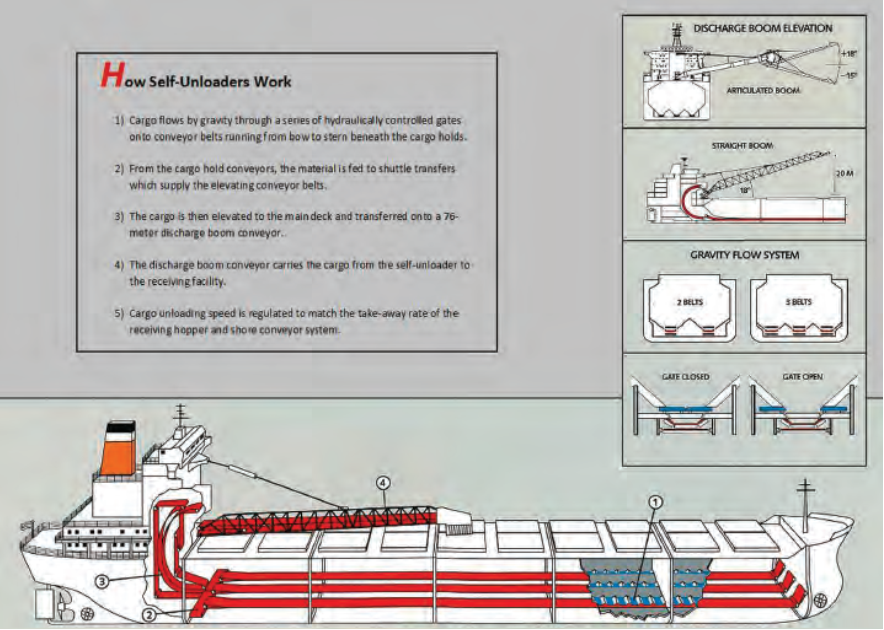
The graphic above demonstrates a self-unloader in action. The cargo is unloaded using a system of conveyors built into the ship. The cargo holds are "hopper-sloped", or slanted on their sides, so that the cargo will flow down through gates located at the bottom of the holds. The cargo drops onto a tunnel conveyor belt, which carries the cargo to one end of the ship and transfers it onto a loop or incline conveyor belt system. This system carries the cargo up to the main deck of the ship where it is then transferred onto the boom conveyor belt. The boom conveyor can be lifted and swung hydraulically left or right to position the cargo on the dock or into a receiving hopper as specifically desired by our customer.

jenish, p18

jenish, p53

CSLships

Troy Greatens commented on Ben Ziemendorf's post

David B Seehafer commented on Ben Ziemendorf's post

Here is a different view of the boom.
Michael Eskelin posted
Burns Harbor, back in the saddle again.
 
Andrew Dean Detroit posted
Take a load off - Dorothy Ann unloading on the Rouge River.


(new window)

An early example of a self-unloading ship.
Photo from LC-USF33-016147-M3 from LOT 1073, Jul 1941
Drawbridge, Chicago, Illinois

Philip Wizenick provided a better exposure in a comment on a post

One of ten photos posted by Brian Wroblewski
Here’s H. Lee White on her first grain run to Buffalo & the first new grain boat for the Frontier Elevator in about 10 years. 
250’ boom.
[Fontier Elevator is part of the General Mills cereal plant.]

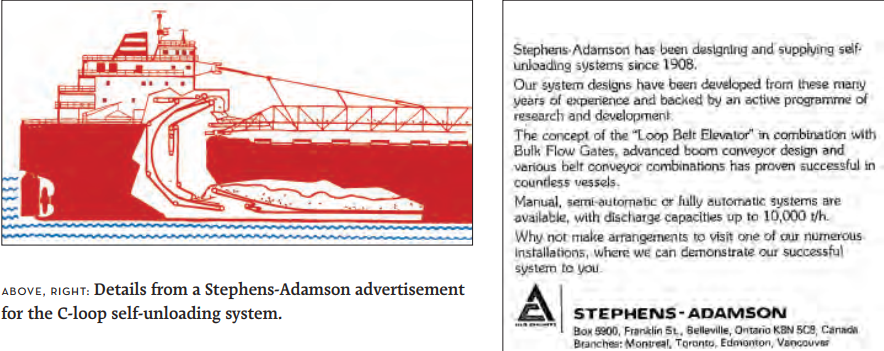
CSLships has a video that provides more detail as to how the self-unloaders work. Their video describe a C-Loop conveyor that lifts the material to the deck. This is different than the inclined conveyors that American Steamship describes. The boom can typically be raised 18 degrees, and it can swing 90 degrees to either side.

When I saw the white piles in the photo below, I wondered if it was salt or limestone for a construction project. They were obviously made by a self-unloader from a boat on the Chicago River. But then the age of this photo (older than 1987) made me wonder when self-unloader technology was developed. Since the last bulk carrier built without a self-unloader (Edward L. Ryerson) was built in 1959, the technology would have been available to build those piles.
Chicago History posted
Update: while checking out the industries in the background of the EJ&E Waukegan Freight House, I discovered an image of a boat unloading. You can also see the hopper where boats carrying cement would unload at Lafarge North American.
3D Satellite
The history of this boat indicates that boats were converted to self-unloading. The Saginaw River Marine Historical Society posted two photos with the comment:
The J. F. SCHOELLKOPF JR. is seen in this fine picture taken on June 9, 1960 in the St. Clair River by historian and photographer, Peter J. Van der Linden. It was built in 1907 as the straight deck bulk freighter, HUGH KENNEDY for the Buffalo Steamship Company, managed by the John Mitchell shipping fleet. American Shipbuilding constructed this 557 foot boat at its yard in Lorain, Ohio.
In 1922 the Mitchell shipping interests sold this and other ships, with the American Steamship Co., Boland & Cornelius, purchasing it. In 1930 it was renamed with its only other name, J. F. SCHOELLKOPF JR. In 1933 it was converted to a self-unloader, likely giving workers at the American Shipbuilding yard in Lorain much needed employment during the Great Depression.
Over the years the SCHOELLKOPF would get improvements, including repowering in 1950, but remaining as a coal fired steamship. However, its claim to fame occurred in the Saginaw River on October 5, 1967. It had just unloaded cargo in Saginaw, Mich., then as it made its way down the river, it lost power and collided with the I-75 Zilwaukee Bridge. This bridge then was a draw bridge, and often opened for ships, blocking traffic for miles. It struck the southbound lane of the bridge knocking it out of commission for sometime. The SCHOELLKOPF suffered little damage, but the incident helped bring about the present Zilwaukee Bridge high over the river.
In 1973 the SCHOELLKOPF was sold to the Erie Sand Steamship Co., but not renamed. On November 9, 1974 I photographed it at Port Huron, Mich. after it had unloaded a short distance away. I am not sure why the unloading boom was so far out, but its smoke was spectacular!
In 1975 its boilers were converted to oil burning, but just four years after it last sailed, laying up in Dec., 1979. It had put in 72 years, and that as a steamer, which is itself quite a record for service! One last trip under tow took the J. F. SCHOELLKOPF JR. to far away Italy for scrapping in 1980.
(Text by Richard Wicklund. Photos by Peter J. Van der Linden and Richard Wicklund.)
1
Photo of the J. F. SCHOELLKOPF JR., taken on June 9, 1960, in the St. Clair River by Peter J. Van der Linden. (It was built in 1907, as the straight deck bulk freighter HUGH KENNEDY, by the American Shipbuilding Company in Lorain, Ohio.)

2
The J. F. SCHOELLKOPF JR., was photographed by Richard Wicklund on November 9, 1974, at Port Huron, Michigan. (It was built in 1907, as the straight deck bulk freighter HUGH KENNEDY, by the American Shipbuilding Company in Lorain, Ohio.)
Carl Mottern Why is the boom being swung underway as they near a potential bridge/boom collision?
Mark Gilson They couldn't hit any part of the Blue Water Bridge if they tried, can't get close enough. As they just left the unloading dock, it looks like the Captain was in a hurry to leave (maybe other river traffic?) and departed before the ballast was pumped in fully to compensate for the weight of the boom as it's brought inboard and secured for sea. I'm sure the boom was inboard even before they reached the vicinity of the bridge and it would've been interesting to see in a sequence of photos as she headed upbound. Hindsight is always 20/20...
Carl Mottern Mark Gilson thanks for the clarification. I once saw an Algoma Boat swing its boom
Between lock 3 and the Skyway. I was wondering why risk that?
John Clark Most interesting photo, smoke is awesome sight. Looks like securing the boom would be correct, two crewmen looking at it and the operator window/door is open, odd but logical. I'll settle for that
Sean Whelan They may have been putting on the hatch tarps.

This posting taught me that you can't tell if a boat is a self-unloader just by looking.
Dan Drella posted the question: "They had a big section of the Blough open on both sides at the stern. Any idea what Work is being done there?"
David Seehafer commented on Dan's posting
The opening in the stern of the Roger Blough is where the unloading boom is stored when not in use. Here is a picture of the unloading boom extended. In short, Blough has always had a hole in her hinder.

Robert Campbell posted
This photo of the Roger Blough by the late John Vournakis shows the ship at Gary Indiana on January 10, 1973.
Dennis DeBruler: In the left background, you can see the unloading boom extended from its stern.
 
David Seehafer commented on Dan's posting
Stewart J Cort is the same way

David Seehafer commented on Dan's posting
Edgar B Speer has a short boom as well but hers is stored on deck rather than in the hull


Speaking of the Roger Blough
Mark Duskey posted
Mong Rockey I didn't know the Roger Blough was an M/VMong Rockey M/V MEANS motor vessel

 This illustrates the labor and dock-side capital that self-unloaders save.
Ben Stalvey posted
Who says you need a self unloading ship. LOL just use a fleet of Manitowocs
Ron Nadeau Salem mass. Power plant the 4000w in the middle only one still running.
Ben StalveyGroup Admin Ron Nadeau the other cranes are gone?
David Guarino Ben Stalvey No idea if the cranes are gone but the power plant is.  Was replaced by a gas cogen.
Ron Nadeau Early 8os
[This is a demonstration of why the industry is moving to big barges with big towboats. It allows the expensive machinery part (towboat) to make money somewhere else while the barge is being unloaded. And because the cost of wasted assets during docking for a barge is a lot less than for a boat, they don't have to go to the expense of having a self-unloader in the cargo bay.]
Carl Burkett commented on a posting
 I was pretty amazed with the self unloading equipment parked in her big fat arse.
[I can't determine exactly which boat he is referring to. (Update: I noticed this photo in his Roger Blough posting.)]

Dale Pohto posted
The Irvin L. Clymer unloading at the Diamond stone dock in Fairport. The A. E. Staley grain complex is visible in the background, across the river.
Vincent Minello: What year is that ?
Dale Pohto: Vincent Minello The ship was renamed Irvin L. Clymer in 1951 but she has no radar yet, so it's very close to that date...

I saved this photo because the unloader on the bow is rather rare. It is unloading at Shelly Materials.
Paul Hodson posted
Cuyahoga River in Cleveland. View from the plane.

David Schauer posted
Another entry in the unusual category is this image of the Paul R. Tregurtha doing some spring cleaning of its holds prior to its first trip of the season (coal at Midwest Energy). 4/2/2022
Dave Wagner: Running off the belt , cleaning up the tunnel.

This made me wonder how many motors are needed by the unloader.
Adam Stromquist posted
I forgot I took this. From atop of the unloading boom structure of the Presque isle. We took out one of the 500 hp electric belt motors of the unloading system for a rebuild. She looks even longer from this vantage point. June 5th, 2022. Duluth MN
Dan McCusker: That’s a big motor! I am a construction electrician and I think the biggest motor I’ve wired is a 50 HP 480V 3 phase unit. What supply voltage do they run on?
Adam Stromquist: Dan McCusker that I do not know. I believe the guys run 480 3 phase to the ship for winter layup so it's probably in that range.

Adam Stromquist commented on his post
It weighed roughly 9400 lbs. Old school Westinghouse motor that has been in there since she was built. Talk about longevity.
Dan Mackey: Adam Stromquist obviously not routine work seeing they had to torch open an access to remove it. Neat shot.
 
4:14 video @ 0:32 (source)
Mike Rezabek: Our gates are quite different from this video. Instead of side to side opening clamshells, we have fore and aft opening slide gates. Same concept, but different tech. Many of our ships have a single belt system, where the footers have a three belts system.

A term for older boats that haven't been converted to self-unloading is "gearless." [Carl Burkett comments in a posting] (Facebooked, 61) In that same posting Carl Burkett found the first self unloader on the Great Lakes. It was way back in 1908 with a triple expansion steam piston engine.

In 1932, W. E. Fitzgerald was the first U.S. self-unloader to go through the (fourth) Welland Canal. [BoatNerd]

A video of a clamshell crane in operation (source)

Hulett unloaders are no longer needed to unload ore boats. The tall black structures on the side of the big grain elevators in Buffalo are also unloaders that have been made obsolete by the conversion to self-unloading boats. Fortunately for industry history enthusiasts, it costs too much to tear down these obsolete structures.

Danny Thompson shared twelve annotated photos of the construction of the Mark W. Barker at Sturgeon Bay.The photos have some good views of the unloading tunnel. The boom salvaged from the Middletown/American Victory is currently stored next to the ship.

It took about five hours to unload road salt.


Ozinga's dock on the Calumet River has several aggregate piles made by self-unloading freighters.

Bonus: self-unloading significantly reduced the labor of unloading freighters. Now they have developed "single point loading" to reduce the labor for loading a freighter.
Todd Shorkey posted