CWR stands for Continuous Welded Rail. It replaced 39' jointed rails with quarter-mile rails that are welded together.
Flickr photos of a rail train coming and going.
Mark Hinsdale posted three photos with the comment:
Dennis DeBruler And you can see in the background that the train is still curving around the Jefferson Connection: http://industrialscenery.blogspot.com/.../jefferson...
Mark Hinsdale posted again
Another view that shows how the rail can bend through crossovers.
Mark Hinsdale posted three photos with the comment:
"Bending the Iron"Paul Schlichting This is Union ave. you have to be one your "A" game when running though here, you deal with 3 different dispatchers and there are 5 absolute signals in less than a mile
A loaded Norfolk Southern to BNSF welded rail train eases past "MH" Tower in Chicago on its way to Western Avenue Yard. In the six years I have lived here, this is first rail train to take this path that I have seen. Those of you that tend to think of heavy steel rail as not being particularly flexible might have a little different perspective after viewing these pics! Kind thanks to all that helped me keep track of this one through the afternoon today.
Dennis DeBruler And you can see in the background that the train is still curving around the Jefferson Connection: http://industrialscenery.blogspot.com/.../jefferson...
Mark Hinsdale posted again
 |
| 1 |
 |
| 2 |
 |
| 3 |
Another view that shows how the rail can bend through crossovers.
 |
| Charles Geletzke Jr. posted Here is another shot of the Welded Rail Train, Extra 4917 West heading into the Siding at Richmond, Michigan on June 26, 1998. This rail would soon be installed in the "new" Haven Siding. (C. H. Geletzke, Jr. photo) |
 |
| Jim Pearson Photography posted CSX rail train W471 rounds the curve leading to the Red River bridge at Adams, Tennessee, as it heads south on the Henderson Subdivision on July 31st, 2023. The train and its crew were bound for Cedar Hill, TN where they spent the afternoon picking up used rail along the right of way there. Tech Info: DJI Mavic 3 Classic Drone, RAW, 24mm, f/2.8, 1/1250, ISO 100. https://fineartamerica.com/featured/csx-rail-train-w471-approaching-adams-tennessee-jim-pearson.html Jim Pearson Photography shared |
 |
| Willie O. Thigpen posted Rail train tied down at the CSX Thomasville Ga yard, rail replacement scheduled between Quitman and Valdosta Ga, slowly eliminating joint rail spots throughout the CSX Bowline. |
 |
| Dave Blaze Rail Photography posted Threading Out A CSXT/Pan Am Rigby yard crew is pulling a loaded welded rail train out of track 6 at the east end of Rigby Yard to. The train had arrived here after coming up on M426 from Worcester and would continue east on the rear of that manifest to Waterville the next morning. It is ultimately destined for the track upgrades going on between Northern Maine Junction and Mattawamkeag as CSXT rebuilds the old Maine Central mainline they purchased last year. Needing to turn the train to orient it properly for unloading they ran a couple miles east up District 1 to CPF 197 where they pulled down the Yard 8 lead. They then shoved back out the mainline through the crossovers at CPF 196 and brought the train back here. By this late hour the yard is bathed in shadows in this view looking down off the US Route 1 overpass above CPF 199 at the pair of geeps in the form of MEC 514 and CSXT 2548 threading gingerly out of the big ex Portland Terminal Co. facility. The former is a GP40-2W blt. Apr. 1976 as CN 9655 and the latter is a GP38-2 blt. Nov. 1973 as SCL 548 and delivered in black and yellow. South Portland, Maine Saturday February 18, 2023 |
 |
| Dave Blaze Rail Photography posted Snaking Thru The Crossover A CSXT/Pan Am Rigby yard crew is in the process of turning a loaded welded rail train to orient it properly for unloading. The train had arrived in Rigby after coming up on M426 from Worcester and would continue east on the rear of that manifest to Waterville the next morning. It is ultimately destined for the track upgrades going on between Northern Maine Junction and Mattawamkeag as CSXT rebuilds the old Maine Central mainline they purchased last year. After pulling out of Rigby they ran a couple miles east up District 1 to CPF 197 where they pulled down the Yard 8 lead. Today that lead only extends about a mile to serve the Merrill Marine Terminal and the relatively new intermodal facility serving Eimskip. However, until the early 80s this Portland Terminal company line headed straight down the center of Commercial Street serving the wharfs and interchanging with the Grand Trunk (CN) at their India Street Terminal. Alas all that is gone now and Commercial Street has been transformed into a popular tourist and nightlife destination known as The Old Port with pubs, shops, and fine dining. The GT is gone too replaced by a trail and the Maine Narrow Gauge museum. Having completed turning the train they are shoving east through the crossover from Main 2 to 1 at CPF 196 before heading back west from where they came with their merger pair of geeps in the form of MEC 514 and CSXT 2548 leading the way. The former is a GP40-2W blt. Apr. 1976 as CN 9655 and the latter is a GP38-2 blt. Nov. 1973 as SCL 548 and delivered in black and yellow. The last time I photographed at this spot the historic brick Maine Central Railroad headquarters building was visible in the background. Thought it still stands up on St. John St. it is no longer visible here thanks to the building of the big new parking garage seen here. Even sadder, the garage led to the destruction the historic Portland Terminal Tower X that stood for more than a half century after Portland Union Station was lost to the wrecking ball. But everything changes and it won't be too far in the future that Guilford gray and orange and the classic searchlight signals both still serving here are also but memories... Portland, Maine Saturday February 18, 2023 P.S. - if you haven't already, please like or follow this page so you don't miss any new photos and history....and give it a share to your network. I would greatly appreciate it! Randall Hampton shared |
 |
| River Rail Photo posted MNR Rail Train: It’s welded rail delivery season on MTA Metro-North Railroad! MNCW GP35Rs 103 and 102 handle the assignment of moving the train on Sunday, April 6, 2025. It is seen here at CP 5 in the Mott Haven section of the Bronx, New York, heading towards the Park Avenue Viaduct, where it would drop seven “sticks” of rail today. Ultimately , the train will visit just about every part of the railroad, delivering these sections of rail for planned work projects or to be held in reserve for emergency use. Notable in this scene are the Freedom Tower and 432 Park Avenue, landmarks of the Manhattan skyline. Perhaps as noticeable is the disappearing view of the rest of the city as construction continues to boom in this area |
A video of a track laying machine that does a good job of showing how it works. A video of a CSX rail train in transport. Another video of a rail train on the Chicago, Fort Wayne & Eastern RR. I hope the rail is for their track because I have read that they had been skimping on maintenance. At least skip forward to the end of the train to see the cars that lay the track. Notice that the rail simply flexes as the train goes around curves. Herzog's Rail Unloading machine includes a video of it in action.
A video by UP showing their Track Renewal Train 909 in operation. (I could not find a direct link to the video. Hopefully, I can always get to it by going to the Video section of their media center.)
If you can sit through the "yah rah UP" narratives, you do get quite a bit of interesting information. Unfortunately all the shots except for the gantry cars are closeups. (And there is too much time devoted to the gantry cars.) It would have been nice to provide some context for the closeups.
Fortunately, Amtrak has an overview picture of the part of the train where both the old and new rails are on the outside and the ties are being replaced. Note that they are replacing jointed rail with continuous welded rail. They load the jointed rail on a rail train rather than take it apart. What surprised me is that this train is rather old technology, 1978. I also found an Amtrak video. The Amtrak video makes me wonder how many times the UP train came to a stop. Since the UP video was heavily edited, there could have easily been video of glitches that were left on the editing floor. Wow, the next video I happened to look at also had some "down time." It looks like the machine in this third video is just replacing ties, not rail.
Donald Haskel posted seven images with the comment:
Brendan J Dock Old CN Canac P8-11 iirc
40 years old now
Ian Wall Old Canron split plow regulator as well.
Then when I was studying a UP branch that is now a stub, I noticed a train that is almost 4000-feet long setting on that stub. I'm pretty sure it is a Maintenance of Way train because of all of the empty flats that look like they have rails on them. There were many more of the "green cars" in the consist. The question is what are the different looking cars at the top.
I noticed that both Amtrak and UP are using concrete ties. BNSF did a lot of tie replacement work this summer in the CB&Q "racetrack" between Aurora and Chicago, and they still use wood. I didn't come across too many piles of ballast. But they all had granite. I wonder where they import it from. All the quarries around here are probably dolostone. Certainly not granite. I'm sure that granite wears much better than dolostone. At least BNSF can ship granite at wholesale prices.
Update: Scott Hoof posted nine photos with the comment: "J022-25 railtrain Nappanee,IN 3-25-15."
I wasn't going to include a picture of the engines until I discovered from The Diesel Shop that 2267 was a "Road Slug." I emailed Craig a question about "Road Slug," and this is his explanation:
A consist of a CSX rail train from a Facebook posting by Hank Stephens. The train was picking up old rails from along side the tracks so the consist gives names to the various cars that help guide the rails into the racks.
SD40-2 #8089
GP15T #1534
CSXT ex FGE 50ft RBL boxcar converted to tool car
CR threader car
CR feeder car
CR RAPU puller car
CR feeder car
CSX ex C&O end tie down car
CSX ex C&O intermediate rack cars (total of 15 cars)
CSX ex C&O middle tie down car
CSX ex C&O intermediate rack cars (total of 12 cars)
CSX ex C&O end tie down car
CSX ex Chessie bay window caboose
A video by UP showing their Track Renewal Train 909 in operation. (I could not find a direct link to the video. Hopefully, I can always get to it by going to the Video section of their media center.)
If you can sit through the "yah rah UP" narratives, you do get quite a bit of interesting information. Unfortunately all the shots except for the gantry cars are closeups. (And there is too much time devoted to the gantry cars.) It would have been nice to provide some context for the closeups.
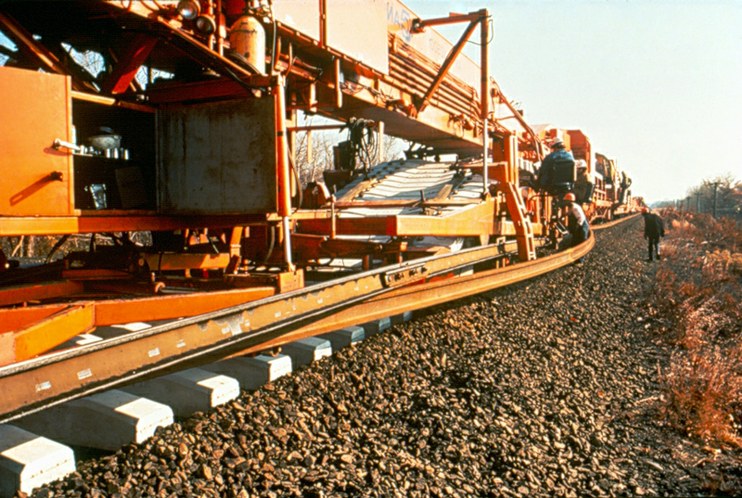 |
| Amtrak |
Donald Haskel posted seven images with the comment:
Amtrak rail and tie replacement. at the front a machine picks pulls the spikes holding the rail to the ties. This pictured machine lifts the rail and shoves it to the side then pushes the old ties off to the side.Then new ties are planted and new rail placed and spiked in place with screw in bolts. other machines bolt the lengths of ribbon rail.(every 1200 feet). A trail party follows picking up ties plates, spikes and various pieces of not need material. the final two major steps are tamping the ballast to assure track is level and ties soundly embedded. The final step to assure track is in gauge and properly leveled and super elevated. This track has to hold up to the forces of 120 miles per hour Acela trains Regional trains commuter rail and freights trains. thousand of trains per month.It looks simple but really is not. A relative asked me to post this story and pictures. My pleasure. If anyone can add correct this, I would appreciated it.. Photos from Donald Haskel Collection, Ted Moxham Photographer.Steve LaBonte shared
Brendan J Dock
Old CN Canac P8-11 iirc40 years old now
Ian Wall Old Canron split plow regulator as well.
 |
| 1 |
 |
| 2 |
 |
| 3 |
 |
| 4 |
 |
| 5 |
 |
| 6 |
 |
| 7 |
 |
| Satellite |
I noticed that both Amtrak and UP are using concrete ties. BNSF did a lot of tie replacement work this summer in the CB&Q "racetrack" between Aurora and Chicago, and they still use wood. I didn't come across too many piles of ballast. But they all had granite. I wonder where they import it from. All the quarries around here are probably dolostone. Certainly not granite. I'm sure that granite wears much better than dolostone. At least BNSF can ship granite at wholesale prices.
Update: Scott Hoof posted nine photos with the comment: "J022-25 railtrain Nappanee,IN 3-25-15."
 |
| 1 |
 |
| 2 |
 |
| 3 |
 |
| 4 |
 |
| 5 |
 |
| 6 |
 |
| 7 |
 |
| 8 |
 |
| 9 |
I wasn't going to include a picture of the engines until I discovered from The Diesel Shop that 2267 was a "Road Slug." I emailed Craig a question about "Road Slug," and this is his explanation:
- A “slug” places greater pulling power (tractive force) at the control of the locomotive engineer. In the past, a slug was not cheap to build, because of all of the work, and time required to convert an existing old locomotive. It entailed the removal of the cab, control stand, engine and support equipment. The carboy profile was often reduced for better visibility from the controlling unit, and new ballast added. The traction motors remained intact and were wired directly to the “mother” unit. This approach reduced fuel costs substantially, without a significant sacrifice in pulling power. The concept was well suited to yard duties and conditions.
- CSX re-thought the concept and created the road slug. The new approach eliminated the need for extensive carbody changes. Moreover, the engine (which was disconnected from the traction motors and fuel system) was left in place to help achieve the needed ballast. The locomotive controls were mu’d allowing the engineer to operate the train from either the locomotive cab or road slug cab, depending upon which one was leading. Additionally, the cab of a road slug was far less noisy, and thus more comfortable.
 |
| Indiana Railroads shared Indiana has at least a couple major railroad suppliers. SDI in Whitley County is one of them. Whitley County Economic Development Corporation posted
MANUFACTURING MONTH FACT: Did you know that local company, SDI is the only rail supplier in the Western Hemisphere that rolls its rail to a finished length of 320 ft.?! That's FOUR TIMES longer than all other domestic suppliers!
Photo shared from Steel Dynamics.
|
A consist of a CSX rail train from a Facebook posting by Hank Stephens. The train was picking up old rails from along side the tracks so the consist gives names to the various cars that help guide the rails into the racks.
SD40-2 #8089
GP15T #1534
CSXT ex FGE 50ft RBL boxcar converted to tool car
CR threader car
CR feeder car
CR RAPU puller car
CR feeder car
CSX ex C&O end tie down car
CSX ex C&O intermediate rack cars (total of 15 cars)
CSX ex C&O middle tie down car
CSX ex C&O intermediate rack cars (total of 12 cars)
CSX ex C&O end tie down car
CSX ex Chessie bay window caboose
 |
| Joe Dockrill posted |
 | |
| Joe Dockrill posted rail unloading is easier by far, drag it off by backing up
Justin Driver: Offloading rail on a nice summer day is one of the best jobs on the railroad. Especially if you're just riding the A-frame and cracking bottle necks. I'll race for railtrain duty any day. The spectrum of good to shitty track maintenance jobs basically starts at rail train and runs to ballast train. Everything else is just somewhere in between, haha. Evan Mitch: Justin Driver class 1 mainline ballast trains these days is a gravy job. Patrol behind the herzog GPS train and as long as the operator isn’t willfully negligent, you have like a 5% chance you may have to shovel a tiny amount of ballast off a crossing. Kenny Bullock: Dangerous job, if you don’t know what you are doing. It’s important to have good job briefings and a competent crew, with experience. Also, the right roller adjustments and maintained rollers are a must, to avoid rail damage. Robert Steele: Kenny Bullock we had a Div. Engineer that thought you could back the rail train back under rail that was unloaded. It buckled ripping off the spreader box and and putting the rail car up off the rail. Fortunately no one was injured. Kenny Bullock: Robert Steele , an idiot ,with power, is a dangerous combination. I’ve seen it firsthand, just like you. Gerald Karger: Was very dangerous back in the 70’s. No hydraulic needle car to position rail while unloading. Had to run behind and bar the rail in position and try to keep the rail from sliding down the ditch. Broken legs and sprained backs! 🤪 |
 |
| Matt Combs commented on Joe's post |
 |
| Tim Parrott posted EJ&E 657 west leads a wb rail train on the CN Freeport sub in Rockford il !! [A reminder that CN now owns both IC and EJ&E. Its nice to see that the east/west IC route, not just the north/south "mainline," is getting upgrades.] |
 |
| Jdoc Jdoc posted |
 |
| Joe Dockrill shared wow, heard of this but never saw it, the rail train blues Joe DockrillGroup Admin broken knuckle=ouchie Donald Klecan Ron...how does one go about putting this back together? Still kinda new in the track department. Ron Pienig Donald Klecan. You don’t. You torch cut the rail at both cars and drag the pieces into the ditch. The pieces were picked up later with rail pickup unit. Terry Clark Touchwood and we laid it later in 300 to 700 ft pieces after we cut out the bent parts. Fernando Pereira I was ther out of this got lots new rail to fix rough spots arround Nokomis. |
 |
| Steve Fluck posted Greg Largent Gonna have to hike the torch setup and water in to this, looks pretty remote. Steve Fluck shared Rex Vint Got to get the main line open , looks like the tie-down car about a car or two away . Depending on direction of movement, pull the rail cars and let the rail fall to the ground . Torch the rail and move the rail clear of the track . Open the railroad to traffic and make arrangements for a set of power cars to reload the rail on another rail train . Tough job either way it’s done . Rail’s laying on it’s side and upside down on the train , gotta handle it one piece at a time . And I wouldn’t want to be the man doing the cutting of the rail . Allen Pierson Rex Vint I’ve been that man. 132 lb. rail 32 strings blocking the Pittsburgh main line at Conway. Pa 1979. Rex Vint Dangerous work . J.B. Rail Photog posted There is a bit of a mess on the CSX Indianapolis Subdivision in Hamilton, OH. Per a reliable source they hooked about 25 loaded ballast cars on the end of this CMR (continuous welded rail) train. These cars are probably 40 years old or more and a knuckle was the weakest link literally. They also were on a slow order of around 25 MPH on an upward grade with 3 wide body GEs on the front. Russell Marks: Those ribbon rail cars are rear end only cars where I work. Frank Culkin: How would they clean that mess up? Cut each rail at both ends of the cars & then re-weld in the field? I never saw anything like that! What a mess!! Get the Crane Jeffery!!! Dale Collins: Frank Culkin I was a superintendent for derailment contractors, we would ease a cat side boom on top of the rails get under the cat and torch rail, that way the weight of the cat held rail in place, we would use block so not to damage rail ,then get every one back in the clear,then move cat, rail has a mind of it's own. At 132lb a foot, It's nothing to mess with. Chuck Kulesa: Frank the rail is cut between the cars and removed, then the knuckle is repaired, the rails are secured (tied down) at the ends of both cuts where the knuckle broke, the train is reassembled, and a 5/10 mph speed restriction is applied to the train to the next siding that could hold the train and the rail is unloaded ... David Wood: Shunter in Ilford car sheds set the points for a CWR train that had a hot wheel bearings with load of rail though the bypass track. But instead of setting a straight route he didn't the first set of short points derailed the train as the reverse curve was to much for the wagons to cope with. To uncouple the derailed wagons they had to cut all the new CWR in half.!! Harry Holman: I worked a mess like that at Perth in Ky I sharpened all rails on one end , they put 3 engines on one end with brakes locked down 2 engines one front end and cramped the rail back on the rail train, took all night but got it loaded back, it was on double track ,trains ran on the siding after we got it loaded back ,the train was put in the hole at Livingston, most Dangerous thang I was ever around Saftey was not there, you never heard such sounds of rail banging and rattling in the night on the side of a river nowhere to go or get out of the way. No one had the Ass to stop until daylight . Still have night mares. Amazing how much crazy stuff over my career as a welder. Good luck with that one . Rob Conway: Didn't read all the comments, so this may have been mentioned already, but here goes. Any experienced railroader knows that ribbon rail trains have blocks on the couplers for the sole purpose of eliminating slack, which of course is a big problem for welded rail trains. It is total ignorance or outright stupidity to add anything to a ribbon rail train! I recently saw an empty ribbon rail train on the miserable slimy CN a few weeks ago on Byron Hill. There were 153 general freight cars behind it!!! It boggles my mind how inexperienced modern railroaders are these days, whether it be Management or labor. [One comment said their railroad won't allow any cars to be behind a CWR cut.] Steve Lucas shared "That's a fine mess you've gotten us into." |
 |
| James R Hansen posted Herzog Rail Unloading Machine CN Wisconsin |
Brian Heather Butler posted two photos with the comment: "Turning a 10 minute job into 10 hours."
Brian Heather Butler Mark Erps we were actually not loading or unloading, just getting in position to unload. Went around a sharp curve, rail fell out of cradle so when back on straight track it had to go somewhere. Made for interesting day.
Jimmy Owens Out of 39 years I ran a rail train for 35 seen Lot that look like that.
Arthur Mitchell I've had worse. We were unloading ribbon rail on a steep grade. When the anchor car pulled the last rail clamp the rail took off like it was shot from a cannon. When the end of the rail stuck in the ground the rest of the rail continued to run. We got two sharp double bends on both sides of the train. We had to reanchor the rail and cut off the bent up rail.
John Potts First picture looks like it was fouling the main.
Brian Heather Butler John Potts it was. Luckily no trains lined up before we got dispatcher to lock out tracks beside us.
Dick Pahls Can happen on high degree curve or wye, end of string pulls beyond cradle in last car and upon return to tangent string must go somewhere.
Brian Heather Butler Dick Pahls exactly what happened. Rail should have been loaded beyond cradle or short of cradle to prevent this but your exactly right.
John Ratigan Last time I seen that a guy lost his leg. His retirement paperwork was in and 3 weeks to go.
[Comments indicate the rail will be cut out with torches and scrapped.]
 |
| 1 |
 |
| 2 |
 |
| Ronald Boles posted Rail Train uncoupled on Tunnel Hill MP37,1987. Red Heis: What am I seeing here ??? George Ronn: Red Heis you’re familiar with entire trains of continuous welded rail on racks, right? Well in this instance the coupler broke/failed and one section of the train stopped faster than the rest and as the train split in two, the welded rail pulled off the racks and onto the ground. Craig Garver: Somewhere, the guy in charge of cleaning that up has to be still sobbing quietly into his pillow each night. What a mess! Gerald Gupton: Craig Garver No sir. I cleaned it up. Just another day. Thomas Becher: Could that rail be still used or would it have to been scrapped? Chris Murphy: It can be used, no problem- if you can get it back onto the cars to take it somewhere. Doug Roberts: Muldraugh hill looking south. Just south of Colesburg, Kentucky. Raymond Barr: Could they have put locomotives on each end and pushed it back together, slowly? *** (Gerald Gupton's explanation of the cleanup is below) *** Gerald Gupton Raymond Barr: No Sir, I cleaned it up. We thought for a second about trying that. Pulled rear of train out from under rail. Cut the other end about a foot off of last car and threaded it all to ditch line. Came back two weeks later and loaded with a pick up unit. Of course it happened on a Friday afternoon about 4:45. I was 20 minutes from house when dispatcher hollered at me. Gerald Gupton: They were always placed on the rear of trains. Shortly after this incident, operating rules changed an rail trains were made a special. Chad Stone: That's why you ALWAYS keep a rail-train stretched out. Ernie Trask: Had that happen in Oklahoma back in the 80s on the KCS. Took one sideboom. Retreaded all back in place one at a time. Took awhile but we did it. Worked for Hulcher at the time. Mike Lusher: Maintenance on those rail trains was very poor back then. And being maintenance of way cars they were exempt from FRA 49 CFR Part 215 (Freight Car Safety Standards). Richard Fiedler shared |
 |
| Philippe Trudeau commented on Ronald's post It's a lot of cutting. |
 |
| Mark Llanuza posted
Dennis DeBruler I knew rail was rather flexible, but the tight radius of the southeast connector demonstrates how flexible it is. https://www.google.com/maps/@42.0025289,-88.2344206,255m/data=!3m1!1e3
|
 |
| Leandro Ribeiro posted
“But how do you transport rails that are 240 meters (262yd) long? Do you shape them into curves beforehand?”
Those are two of the first questions that people asked me when I ~try~ to explain what I used to do and/or when we received visitors that were not used to this specific process of the Rail industry. So, I use this picture to show how some 240 meters Long Welded Rails are loaded into special railcars and how they “shape” themselves up whenever needed. It may seem tough but they can handle deformation with ease. This picture was taken in Anápolis (Brazil) while the train was switching tracks inside a crossing yard.
Bill Guthrie One of my jobs was walking the rail through the cars to make sure it was threading through right. VERY DANGEROUS JOB.David L. Holmes Billy Carter yes I had close friend get caught with rail while walking it through. Hand was crushed.Jan Niemann Before I put an 240m in track (curve with a radius of 500m or more) I bend 10m at the points. If the radius is less than 500m I bend the full length (240m)Lou Thelen A rail train my employer was using to deliver rail had a couple rails come loose on a 15 degree curve on a wye.Jesse David Ellison Love it when the yard master says "Pull in and cut the crossing."Vernon Davidson Jesse David Ellison A loaded rail train was sent out with only 2 units going west. One unit went belly-up in the river canyon just before the line exited that canyon that had a steep grade, too much for only the one remaining unit. The engineer called the dispatcher to tell him when he couldn't pull the grade, and the dispatcher couldn't understand why the engineer told him they couldn't just cut the train in half and take the first half to the next siding, then return for the second half of the train. |
Barry Sprofera posted two photos with the comment: "Rail replacements on the Transcon. Work train and Herzog crew wb at Darling AZ."
[My first impression was that HyRail trucks must be getting pretty strong to pull that load. But then I noticed there is another rubber+steel wheeled vehicle behind it.]
 |
| 1 |
 |
| 2 |
 |
| John W Chamberlain posted The end of the ribbon was left in the wrong place. To close to a part of the vertical superstructure. Going around multiple curves and the little slack action in the train caused the end of the rail ran up to the upright and as the pressure built and caused the ribbon to jump out of the pocket . Cut 14 ft off the end to keep the rail from running into the superstructure for the rest of the trip. all the anchors held and had nothing to do with heat. Ron Seidner Had a loaded rail train break a knuckle in the middle. Pretty much scrapped the whole train. Had to cut every piece twice. |
 |
| Brendan J Dock posted when you break a knuckle on a rail train, get the torches out Daryl Statome  This happened in the little town I live in Va. NS railtrain split apart in the middle and went down the track for about a mile. Allen Pierson I had to cut one apart one time 36 strings of 132 lb. rail. Cars split switch and pulled apart . Thank god for 4 ft. Torches. Started on bottom row and worked up. Last row was a bitch. Robert Burke Allen Pierson been there done that. ..aarrgghh Allen Pierson Robert Burke Takes lots of nerves and telling white hat I charge if you want to go faster here is the torch. He always walked away. Richard Tucker Allen Pierson Rail steel breaks so easy and can do crazy things. Steve Villalovoz Hate to be the welder that has to cut that twisted stuff. Robert Shannon Steve Villalovoz right I hate to be that welder too! But when train full of brand new vehicles hit the ground they smash all them up for recycle but when Railroads hits the ground with Rail they try to save every square inch of it. LOL Steve Loving UP derailed a rail train, pulled all the rail out brought out an empty one loaded it back up and used it. I was the lucky SOB that got to relay it, welding gang stay busy after we cut all the bends out!!! [I think they should have put the red flag on the rail sticking out to the side. That is what is out of clearance. I wonder how close the ends are to rail side equipment such as crossing gates and signal masts. But the letter of the rule probably says put the flag on the maximum overhang. As if that flag is going to help anything.] |
 |
| Sean William commented on Bredan's post Remember this one? |
 |
| Sean William commented on Bredan's post Terry Clark Touchwood. We had to sort that junk out after. It was custom welded. We relayed all the 3hb off the east switch in lengths of 100 to 400 ft. |
Marty Bernard posted six photos of rail handling back in when 39' rail was still being used.
NS Rail Yard Photos
Daune Hall took this interesting series of shots in August 1985.
Marty Bernard shared
 |
| 1 |
 |
| 2 |
 |
| 3 |
 |
| 4 |
 |
| 5 In these last two photos they are making panel turnout. |
 |
| 6 |
 |
| 1 of 8 photos posted by Dave Ritter of R. J. Corman changing the wheels on a CWR train while it is loaded with rail |
"CWR" CONTINUOUS WELDED RAIL BENDING LIKE SPAGHETTI ON THE SW WYE, Deshler, OH. August 6, 2020
Randy Szucs: Rail is secured to the center car only. It free floats throughout the rest of the train allowing it to move through curves.
Dion Chandler: Randy Szucs odd that it is secured at all. When I've been running trains of CWR, over 12 wagons, the rail is contained by removable bulkheads on each end wagon. Even though between the bulkheads is longer than the rail by 4m, I've yet to see any move.
Randy Szucs: Dion Chandler .... rail is 1/4 mile sticks 402 meters. Ck the center tie down car. The bulkheads are insurance.
Butch Grant: I'm sure they thought the process through before they built the cars and loaded the rail. The hard part is dropping the rail for the Roadmaster. He gives you move aheads of 1/4 of an inch.
James Gilchrist: I had one of those leaving Roanoke heading east and it was cool and sunny and we had the windows open go around a curve hear a little screeching and around another curve in the opposite way and it sounded like thunder I asked the conducter what was that he shrugs and looks bewildered next curve in that direction and thunder again and we finally figured out that 1 rail had turned over and it would bend 1 way but would whip around in the rack the other way.
Richard Haave: Often speed restrictions on sharper curves or short crossovers to give rail more time to adjust.
Matt Borutski: The GOI calls for slow orders with more than sixteen strings, and slows on certain curves and turnouts. I have always recommended that the Conductor go stand out of the way on the threader car to watch how they lay the rail out. That gives you an appreciation for what they are doing and how dangerous it can be when it's your turn in the Engineer's seat. With a good crew on the threader car and an attentive hogger the work goes pretty quick.
[There is an extensive discussion in the comments about how to convince modern (computer controlled) locomotives to go slow and smooth enough for rail unloading and loading. A comment indicates a train carries 10.9 miles of rail.]
NS 3325 leads a rail train (L48) back from SDI in Ft Wayne Indiana on the CF&E
A video of BNSF rail train rolling through Blue Island Junction.
Jeff Lewis Where would the rail be coming from?
Larry Amaloo Steel Dynamics Incorporated in Columbia City Indiana. CF&E delivers the trains to IHB Blue Island Yard.
A video of how they used to lay rail when all of the machines were still steam driven.
31 photos of CSX MoW equipment starting with a rail train.
The comments of this post have several photos.
YouTube video of the rails on a runaway train piercing a locomotive. (source)





