Showing posts with label energyEthanol. Show all posts

Tuesday, February 18, 2020

Distillers Dried Grains (DDGS) importance is increasing, Port of Milwaukee

Korey Garceau posted
Le Bellot moored at the City Heavy Lift Dock at Port Milwaukee this afternoon. This was her last visit of the season, and she will soon be departing on her outbound trip from the Great Lakes. 10/9/23
Steve Horton: The best place Milwaukee could find to dock a cruise ship was next to the sewage treatment plant??
Korey Garceau: Steve Horton This vessel usually calls on the Pier Wisconsin dock. This is the only inner harbor facility that can accommodate the necessary shoreside services.
[I'd like the scenery here, but I don't think most passengers would like it. I hope the water reclamation plant doesn't smell.]

The ethanol fuel industry was evidently built on a federal regulation requiring that ethanol be added to gasoline. As the Trump administration is relaxing that regulation, the price of ethanol is going down. A new plant based on a new technology to convert cellulosic waste (e.g. corn stalks) has already shut down.  Traditionally, distiller grains were a waste byproduct of producing ethanol. It is basically those part of the corn kernel that the yeast could not eat. That is, it is the corn kernel without the sugars. DDGS are high in protein so the ethanol plants would dry them and sell them to help make animal feed. In fact, some plants ship the waste while it is still wet because they can quickly get it to a feedlot.

DDGS has become valuable enough that Green Plains Inc plans to spend $400m to convert its 13 plants to make high-protein animal feeds and marketing the ethanol as the waste product. Another driving economic factor is that "global demand for meat is surging as the deadly African swine fever culls herds in China, Southeast Asia and parts of Europe." Normal DDGS is 30% protein. Green Plains plans to enhance their plants to use enzymes and microbial technologies developed by Novozymes A/S to boost the protein to 50-60%. Even at just 50%, it has more protein than soymeal, which sells for about double the price of DDGS. The initial market is expected to be fish farms and pet food companies. [reuters]

In addition to shipping meat to foreign countries, some ethanol plants plan to export DDGS. The Port of Milwaukee is spending $31m to build an agriculture products export facility on the west side of Jones Island. $16m is federal money granted by the U.S. Department of Transportation. DDGS is explicitly mentioned as one of the products to be exported in Seawaymax ships. [jsonline]
PortMilwaukee
I'm saving a current view of Jones Island so that later I can compare to a new view that shows the new facility.
The DeLong Co., Inc. intends to lease a parcel of property at Port Milwaukee's Jones Island facility. As a PIDP grantee, Port Milwaukee will develop an agricultural commodity transload facility for bulk shipments in Milwaukee's inner harbor. This facility is expected to be the first on the Great Lakes - St. Lawrence Seaway (GLSLS) system specifically for the transload and export of Dry Distillers Grain with Solubles (DDGs). Supplemental service is also envisioned for the export of soybeans, corn and grain via deep-draft, Seawaymax vessels. [PortMilwaukee-AgExport]
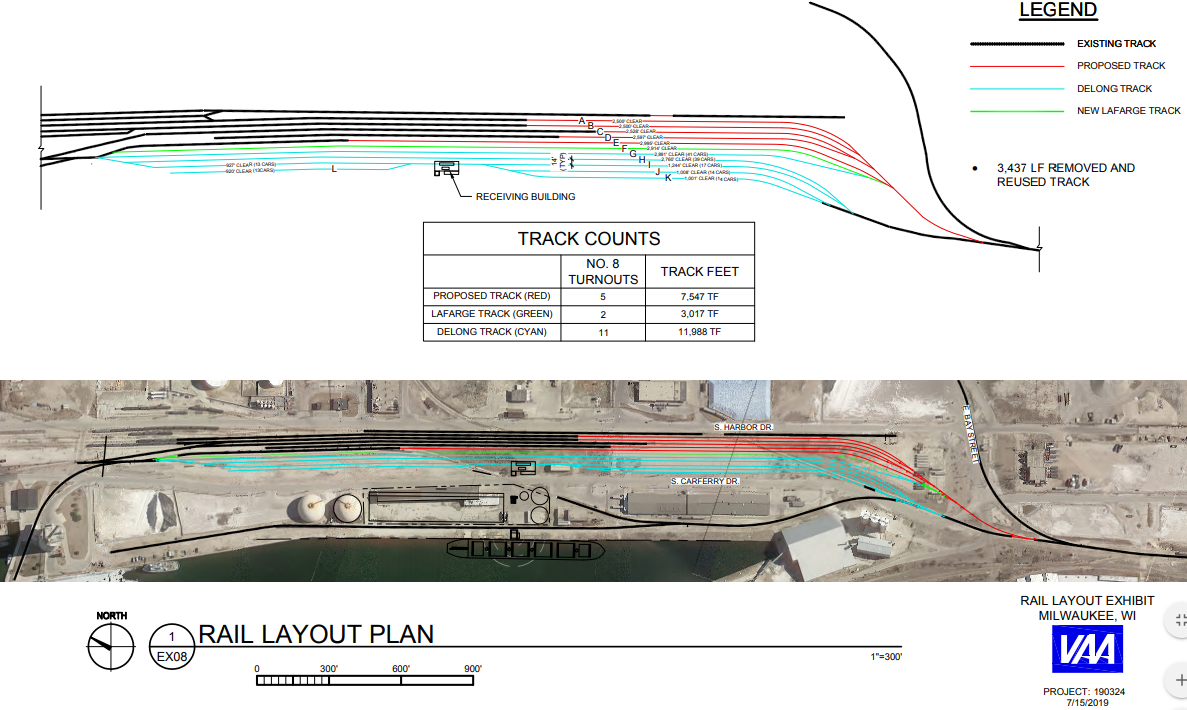
DesignPlans

WISN (source)
Less than a month after Port Milwaukee sustained flood damage, it's getting $31 million for new improvements.
The U.S. Army Corps of Engineers said Lake Michigan was at the highest it has ever been in the month of January.
More than $15 million of the funding was awarded by the U.S. Department of Transportation's $280 million infrastructure plan.

Wednesday, December 5, 2018

1.1 Gigawatt Coal Creek Station and Blue Flint Ethanol near Underwood, ND

Power Station: (Satellite)
Ethanol Plant: (Satellite)

I was going to just post this photo as another tandem crane lift. But when I discovered that Coal Creek Station is a mine-mouth plant using lignite, uses a 436 mile DC transmission line to Minnesota, and uses the steam to make ethanol and corn oil; I decided it was worth further research.

Branden Kuck posted
2250s setting conveyer section. Lighting came out good so figured I would share. Local #49
Gerald Duysen Is this at Coal Creek Station?
Branden Kuck Gerald Duysen yes sir it is
lignite.com
The cranes above are building a conveyor that takes the coal from the Falkirk Mine to the power plant. This photo makes it obvious that it is a surface mine. More surprising, large draglines are still being used for mining. I wonder if they are still made
in America.

SWCE
My 1928 RR Atlas shows that SOO ran through here, thus the rrWC label. The SWCE PDF file indicates the plants are now served by the Dakota, Missouri Valley & Western Railroad, thus the rrNew label.

services via dmvwrr

This photo shows the conveyor belt with storage silos that goes from the Falkirk Mine to the power plant.
Bojidar93, Aug 2010
In 2009 they added a facility that uses waste heat to dry the lignite. This process also removes some of the impurities from the lignite creating a product they call DryFine. They burn this in their own two 550 Mw boilers and also ship it in covered hoppers to another combined heat and power plant. Waste heat is also used to dry corn from the fall harvest so that it can be stored in bins. Commercial grain elevators generally burn a lot of natural gas to dry grain for storage. Farmers generally burn propane in their grain dryers.
Coal Creek scrubs mercury and other toxins as well as sulfur dioxide. Their scrubbing technique allows them to sell the fly ash to reduce the amount of cement needed to make concrete. So fly ash reduces the significant carbon footprint of making cement.

(new window) (source)


This is obviously the video they show before plant tours.
(new window)


(new window starting at 0:45) This video has talking heads, but the scenes of mining equipment in action makes listening to the "we take care of safety and the environment" worth tolerating. (source)


Wednesday, July 13, 2016

Big Chem vs. Big Oil

Satellite
Evidently DuPont has found the "secret sauce" to convert cellulose to simple sugars to make 30 million gallons of ethanol each year from plant material instead of corn. They have built a $200+ million (by-the-numbers) plant next to a traditional corn ethanol plant so the farmers who store and sell their corn to Lincolnway Energy can also store and sell baled stover to DuPont. (Stover is the part of the corn plant left over after the corn is removed from the field and includes the husks, cobs, and stalks.) Removing some of the stover also helps the farmer practice no-till conservation practices by removing the excess organic material generated by high-producing corn plants, which are big. In other areas of the world, the process can be used to turn other farming waste such as wheat and sugarcane straws into transportation fuel. (cellulosic-ethanol + stover-management)

Screenshot form Video
The process also creates lignin pellets. Lignin is the polymer molecules in plant cell walls that provide the "stiffness" of the plant. "It is the chief noncarbohydrate constituent of wood." (FreeDictionary) These pellets can be burned in a biomass boiler to create steam or "sold to coal-burning facilities to offset the use of fossel fuel" (video@3:20).

The plant is closed-loop because it recycles its water and energy.

DuPont has bought Pioneer, which would explain why they have so much expertise with agriculture products.

Update: this video teaches me about the "shredder" for preparing the windrow for the baler. I've discovered several videos by POET-DSM which has their own Project Liberty plant. This one struck me as the best one.

But a "second-generation" cellulosic ethanol plant has gone bankrupt already!

A video of a new corn head that chops up the corn stems because since the 1990s corn plants produce more biomass than will otherwise decompose in a year. It does seem better to sell the excess biomass rather than increase the rot rate.

Video of "The Farmer" mowing, raking and bailing their corn stalks for bedding for their Black Angus.  They have already used the harvested corn field as pasture. I wonder if cattle can lick the lost corn kernels off the corn. The Farmer prefers corn fodder to straw for bedding because the cattle eat about 75% of the bale, and that provides good roughage.

Update:

BP and DuPont’s bio-isobutanol joint venture, Butamax, acquires ethanol facility in Kansas I guess BP decided to join Big Chem rather than fight it. It sounds like DuPont has found/created yeast that poops isobutanol instead of ethanol.

Wednesday, July 6, 2016

Some ethanol plants now produce four times the energy they consume

100 Truckloads a Day
It takes a lot of energy to create ethanol. In addition to the energy consumed by the plant itself, energy is consumed to grow the corn. The diesel fuel to power a tractor for a few passes over the fields and the combine and maybe a sprayer is obvious. But there are other energy consumption issues such as the plant and oil stock that makes the fertilizer and the rail and truck diesel fuel needed to ship that fertilizer. This article indicates that initially ethanol consumed more energy than it provided. Now the most efficient plants produce four times the energy they consume.

Part of that efficiency is to build the plants near the farms that grow their special corn and near the livestock farms that consume their dried distillers grain. In fact other farmers want a plant built in their area so that they do not have to pay railroads to export their crop or to import feed stock. Actually, it is probably more the unreliability than cost of the rail service that they want to avoid.

The article did not mention another improvement of co-locating a carbon dioxide plant to recover (monetize) the CO2 waste.


Monday, February 22, 2016

ADM Ethanol Assets

I've read several articles that ADM is considering selling "two of the country’s largest ethanol plants in Cedar Rapids and Columbus, Neb., [which were built] six years ago. (Gazette)" They are dry-mill plants, which produce ethanol more efficiently than wet-mill plants. But they are less flexible. Wet mills can be converted to other corn products such as corn syrup. ADM has another dry-mill plant in Peoria, IL. "The three dry-mill ethanol plants, some of the largest in the country, represent just under half of ADM’s 1.8-billion-gallon-per-year U.S. ethanol capacity." The plants are still making money, but they are not as profitable as they used to be.

I can't find the reference again, but I remember reading that ADM paid $6-billion to build the two new dry mill plants. And they are now worth a half-billion (Gazette). But even that is probably too much for another company to afford. "The most likely investors may be oil refiners, which have moved into the renewable fuels business in recent years, positioning themselves around policy, sources said. Oil companies such as Valero and Flint Hills Resources, owned by the Koch brothers, have become industry heavyweights through acquisitions in recent years." (Gazette) I wonder what the total U.S. ethanol capacity is. And how heavily it is still supported by federal tax money.

At least ethanol production does not cut into our food supply. It just reduces the amount of corn that spoils. Our global economy does not feed the poor in other countries.

The end of the Gazette article was particularly informative:
These are ADM’s corn mills, with capacities estimates from the Renewable Fuels Association.
• Cedar Rapids: ADM began producing ethanol at a wet mill in Cedar Rapids in 1981. In 2010, the company built a dry mill nearby and can now churn out 420 million gallons at the facilities annually.
• Clinton: ADM scooped up the wet mill in Clinton in 1982, and has expanded its capacity since to nearly 240 million gallons annually.
• Decatur, Ill.: ADM began production at its Decatur wet mill in 1978, making it among the first major entrants in the fledgling biofuels business. The site now can produce about 400 million gallons of ethanol annually.
• Peoria, Ill.: ADM scooped up the Peoria dry mill, estimated at about 200 million gallons of capacity, in 1980.
• Walhalla, N.D.: The company bought the dry mill in Walhalla in 1991. It closed the 45-million-gallon-per-year plant in 2012.
• Marshall, Minn.: ADM acquired Minnesota Corn Processors LLC in 2002, bringing into the fold a 40-million-gallon wet mill in Marshall. The plant now can produce 45 million gallons per year.
• Columbus, Neb.: A Columbus wet mill was the second plant ADM scooped up with its acquisition of Minnesota Corn Processors in 2002. The plant can pump out 100 million gallons of ethanol each year. ADM opened a dry mill nearby in 2010, with a capacity of about 300 million gallons.
Update: export of ethanol to Brazil has increased becaues Brazil is using its sugar cane crop to make more sugar instead of ethanol. But it does sound like ADM still wants to dump its dry mills.

Wednesday, February 10, 2016

Ethanol plants are also hurting. (Kinder Morgan terminal)

I assume E85 is a small fraction of the market for ethanol compared to adding it to regular gas as a anti-pollution additive. I figure E85 has to be 80% of the price of gas to offset the reduced miles/gallon. I used to see a difference of up to a dollar. Now I'm not even looking at E85 prices because they can't compete with cheap gas. It is interesting that ADM is trying to dump what sounds like its newest, biggest plants because they should be the most efficient. It also flags another company's management that probably got suckered into a boom-and-bust cycle at the wrong time.

Google Photo
Closing ethanol plants has to further hurt the price of corn. Consecutive years of bumper corn crops have filled the grain elevators, and they are already offering low prices to farmers because they really don't need much corn this year.

Update in Dec 2016:
The margin for ethanol is going back up. I can't find the article I saw that said our exports have increased to northern Brazil because southern Brazil is keeping its sugar cane to make more sugar. US ethanol crush margin reaches nearly two-year high. An interesting fact in that article is that one bushel of corn makes 2.8 gallons of ethanol. This also reinforces my theory that the price of ethanol follows the price of gasoline, not the price of corn.


2/20/2019:  Kinder Morgan to expand Chicago ethanol hub to calm glut concerns    barge terminal
"Currently, Argo can unload roughly 120 to 150 tank cars of ethanol each week, or roughly 4 million gallons, and can load two barges, or roughly 1.2 million gallons, at a time." ADM is sending a bunch of ethanol there to drive prices down. "ADM can produce roughly 1.6 billion gallons of ethanol annually, about 10 percent of U.S. capacity. Despite its massive production, it has often been a buyer on the cash market to supplement its long-term supply deals or to support a market view, dealers said. The Illinois-based global commodities powerhouse accounted for roughly 70 percent of the ethanol sold at the Chicago hub late last year, according to the data reviewed by Reuters."

Wednesday, December 30, 2015

EVWR: Evansville & Western Railway Overview

System Map with Coal Facilities and Grain Elevators selected
CSX sold the Evansville to (almost) St. Louis route of the old Louisville and Nashville to Evansville Western Railway (EVWR). From their map we can see that it serves three sources of coal and the Mt. Vernon Transfer Terminal, a consumer of coal. Their business is growing well enough that they are not keeping the map up to date. I see from a satellite image that they serve another transloading facility, a coal power plant, and an ethanol plant with a new spur they built south towards the Ohio River west of Evansville.

They allow the grain elevators along their route to pay a premium price to the farmers by consolidating cuts as small as 15-cars into 65-car trains for delivery to CSX in Evansville, which then hauls them to large chicken feeding operations in the Southeast. There are also other ethanol plants built or planned along the line. (csx-sucks, you may have to search for "Evansville Western on Right Track")

Satellite
Update: 9 photos by Bart Hileman. I include a couple from Mt. Vernon, IN in case there is an issue accessing a closed group.

A Bart Hileman photo
Tom Barrows posted two photos with the comment:
A couple of shots from back in 2010 when the EVWR would load at Alliance in Princeton. The sound of those SD's growling up the hill out of Evansville towards Belknap with a full load and some helpers was amazing!!!

1

2


Richard Roberts posted photos of two trains working in Mt. Vernon.

Dalton Flowers posted the question: "How does the EVWR operate?"
James Coleman Hope this helps, or isn't rhetorical, but I believe EVWR operates the line/owns the line west between Evansville, IN and Mt. Vernon, IL , and they service various industries inbetween. I know they unload coal at the Port of Indiana in Mt. Vernon, IN, service Abegoa in West Franklin, IN with tank cars of ethanol and hoppers, Sabic in Mt. Vernon, IN, and various mines (that aren't closed) in Illinois. They also have a MVL that runs daily that interchanges with CSX at Howell Yard in Evansville and takes cars back west. I'm unsure where the local originates and goes after leaving Howell Yard. That's all I know. Hope it helps/answers your question and or isn't rhetorical in what you already know.


Wednesday, January 21, 2015

100 Truckloads a Day


Great Plains, select Shenandoah tab
The Jan. 18, 2015 issue of Evansville Courier & Press had a Business article on the impact of lower gas prices on the ethanol market by Josh Funk of the Associated Press. (After listing reasons why it could go up and reasons why it could go down, I guess the market is not supposed to change significantly.)


The newspaper had pictures of trucks unloading at the Great Plains Shenandoah, IA, plant. What caught my eye in the article was that they were unloading 100 trucks of corn a day. Is this because they have no rail service? Their web page indicates they have 12000+ feet of paired track.
Satellite
A satellite image indicates that one track is for unloading corn from covered hoppers and the other is for loading ethanol into tank cars. There were also a lot of tank cars parked on the railroad itself (below).

The railroad serving the plant is a remnant of the Burlington and Missouri River Railroad, and it is now owned by the BNSF. Even though it is owned by a Class I railroad, the branch is now more of an industrial spur because many tank cars were parked on the "mainline" in a satellite image. To show all of the cars, I have to use a low resolution so the tank cars are not much more than a "black line" in this image. Note the break in the line at the road so that the crossing is not blocked.

Satellite: tank cars parked on the "mainline"


Sunday, January 18, 2015

More Plumes and Smokestacks

When I viewed the industries along the Sanitary and Ship Canal a few days ago, I did not notice any plumes. But on Jan 17, 2015, while driving south on I-355, I noticed that there were several plumes. My wife was able to get the camera out, learn how to use it, and get some pictures while we were still on the Veterans Memorial Bridge. And fortunately we were in the minivan so that we could better see over the bridge's side barrier.

20150116 0002
The engine head lights caught my eye. The picture of the engines is at camera resolution. One can verify it is BNSF/Santa Fe (i.e. orange) and determine that the train had five engines. I believe the plumes flatten out at a "ceiling," but it is hard to verify because the plumes are blowing towards the camera. In the next view, you can see the CN/GM&O/Alton tracks.

I need to do more research, but I suspect that some of these plumes are just water vapor out of cooling towers. Note that several of the stacks don't have visible output. Is that because the plants are "clean" or because they are idle? According to Google, the I&M canal is someplace among the trees in the below. I need to start exercising so that I can traverse the I&MC Trail Passage, which is probably on the towpath of the I&M canal.


On the same trip while traveling south on IL-130, I spotted plumes to the east. I believe this is the Gibson Generating Plant. On some monitors you can spot a blackish spot in the upper-left corner of this heavily cropped picture. Once the water vapor dissipates, there does seem to be some "smoke."

Then while driving south on University Parkway near Evansville, IN, I saw another plume. Note that there is two layers of sky, a blue layer over a yellowish layer. And the plume hits a ceiling at the boundary of the layers.


That generating plant has been on my "todo" list, and I have studied the map and knew about Green Valley Drive that parallels the railroad stub that supplies the coal trains. So I drove there to check out the plant. Fortunately, I stopped at the entrance to take a picture of the sign or I might have missed the PRIVATE ROAD WARNING. So we ended up taking some side roads. We got another "capped plume" shot. The plume is a little "dirty" after the white water vapor dissipates.

Fortunately, there was no traffic on the side roads so that I could stop and take pictures. This coal train was parked. I included the close up of the engines to show how much exhaust they were generating even though the train was not moving.


Unfortunately, the picture is not good enough to catch the logo or number. But it is not EVWR green. My dad said the plant receives coal from a mine that is south of Petersburg, IN. The Big Four owned the track that goes from Evansville to Petersburg, and it is now owned by Norfolk Southern. He mentioned that there used to be a parade of coal trucks up and down IN-62 and 57  until the railroad spur was built.

One reason I wanted to go down Green Valley Drive was to see what was on the west side of the railroad with their own unit-train loop of track. But a satellite image lets me identify the types of industry, if not the plant names.

The loop on the far west serves a coal transloading facility. So coal carried by the railroad can either be burned or loaded onto a barge.

After studying a known ethanol plant, the loop in the middle serves an ethanol plant. It has grain trucks unloading, grain bins on the right, fermentation tanks in the lower left, and both covered hopper cars (to unload corn) and many tank cars (to load ethanol) on the loop tracks.

Google
I'm learning that different levels of zooming in Bing uses different satellite images. By panning the zoom level of this image, I counted 16 trucks in various stages of unloading. But other zoom levels had no trucks.

Bing