Saturday, January 5, 2019

Trail+Aban/UP/C&NW Bridge over Milwaukee River in Milwaukee, WI

(Bridge Hunter, Historic Bridges, Forgotten Places Blog3D Satellite)

Bryan Krejcarek posted then and now pictures. His comment is wrong because this is not the KK River bridge. According to the 2005 SPV Map, the KK Bridge is down south where a UP/C&NW connector joins CP+Amtrak/Milw. C&NW used to have a branch that was a half-block west of CP/Milw with its own swing bridge over the Kinnickinnic River.

FlyerScope, last photo

Greg Mross posted
CNW 4333 is crossing the Milwaukee River after finishing switching chores in the 3rd Ward near downtown Milwaukee in April of 1984. The bridge used to host the famous "400" fleet in passenger days when CNW's Lakefront depot was located just north of here. Today, the bridge remains in the open position as there hasn't been any business in the 3rd Ward for many years. The bridge and the land on the east side of the river and now part of a park in this revitalized area of Milwaukee.

Street View
AJ Grigg reports that the right-of-way has been developed as Trestle Park
posted
Eric Jahnke UP owns the swing bridge currently.
This route used to be the mainline of C&NW and it carried 100 trains a day including the Twin Cities 400 passenger trains. The C&NW passenger station served by this mainline is now gone. [Bridge Hunter]

According to DonsDepot, the tower is well maintained because it is now used as an office by another business.

While looking at Google and Bing street views to confirm I have the bridge that Bryan took photos of, I noticed that there are incredibly big (expensive) crossing signals for tracks that no longer exist. Bridge Hunter took a photo of those signals. And I don't see any "exempt" signs on those signals. That means that school buses still have to stop and open their door before proceeding across what is now a concrete strip.

Satellite
The last train that used this bridge was in March, 2006. [Historic Bridges] But I noticed that one set of tracks is still maintained on either side of the bridge and on the bridge. I assume this is so UP can close the bridge and run a Hy-Rail truck over it once a year to maintain an active status. I know UP does this for their Kinzie Street bridge in Chicago. But I have yet to see an explanation as to why UP maintains an active status for a bridge on an abandoned route.
Alex Sansone posted
Cnw bridge over the Milwaukee River from the new park that has been built on the east end.

Gary Lenz posted
C&NW Milwaukee River Swing Bridge. This Truss Bridge was built in 1915. The Bridge is not used anymore and is in the open position for river traffic.

Brandon Steinback commented on Gary's post
Same one? Milwaukee 2018
Gary Lenz Yes - Your picture is looking north, mine is looking south . Nice photo Brandon.

Gary Lenz posted
Circus World Museum Car was spotted near the C&NW Milwaukee River Swing Bridge. Museum Railway Cars were staged here for the Great Circus Parade. Milwaukee , Wisconsin .Photo - 1980's.

Bing Owens posted five images with the comment: "Adventure to Milwaukee, WI today...found this old/abandoned swing bridge that carried the Chicago & Northwestern Railway from Chicago to the C&NW depot in Milwaukee.  Line has long been abandoned and most of the tracks have been torn up.."
1

2

3

4

5


Thursday, January 3, 2019

Lampson Transi-lifts

The First One


Matthew Mackay posted
Lampson's first ltl trans-lift
4600 and 3900 truck mount
Peter Jeffries This is a great photo of history being made in so many ways eg structural engineering , metallurgy , and applied physics love Lampson or hate them there's no denying that they were at the forefront of lifting technology back in the day .
Riley Anderson Peter Jeffries sad thing is, I don’t they have really evolved or changed their technology in the last 20-30 years. Still building outdated transi-lifts when newer designs are MUCH more user friendly.

Ben Stalvey shared
I guess Manitowoc didn't listen. Lampson developed cranes and attachments for themselves. The rest is history......
Derik Wolfe Wonder if it had 2 operators. Bet this was pretty tough to maneuver


Jim Reyers posted
Chase Larson This was the very first transi lift. It was 1000 ton capacity. That is a 4600 on the hook for it's first test pick. You can see that there are hardly any counterweights stacked up.
[Mathew's post must have been a prototype and this was the first production model.]
Joe Leonard I’m pretty sure Manitowoc Engineering said the concept wouldn’t work so Neil Lampson sent this picture to them with their 4600 on the hook. Pretty sure that’s the jest of this photo.
Joe Leonard Darrell Couch hoist on this rig is behind the ctwt frame. Has been moved to top of stinger on current rigs.
Chase Larson The biggest we make is the LTL-3000 and we've only made one.....so far.
David Wood Big Blue set the bar for all to achieve. Well done.
Matt Mohd Ji Amazing radius with the cwt is not yet full load.
Cary Degelos Look at the size of the pendants.

Aaron Payne commented on Jim's post
We used that rig in 1992 in Detroit in a steel mill. Back then these were the big boys of the crane world.
Aaron Payne Frank Keeney yep Zug Island. We unloaded the Larry cars and pusher cars for # 5 Coke Battery.
Aaron Payne Frank Keeney Zug Island was Great Lakes before USS bought them.


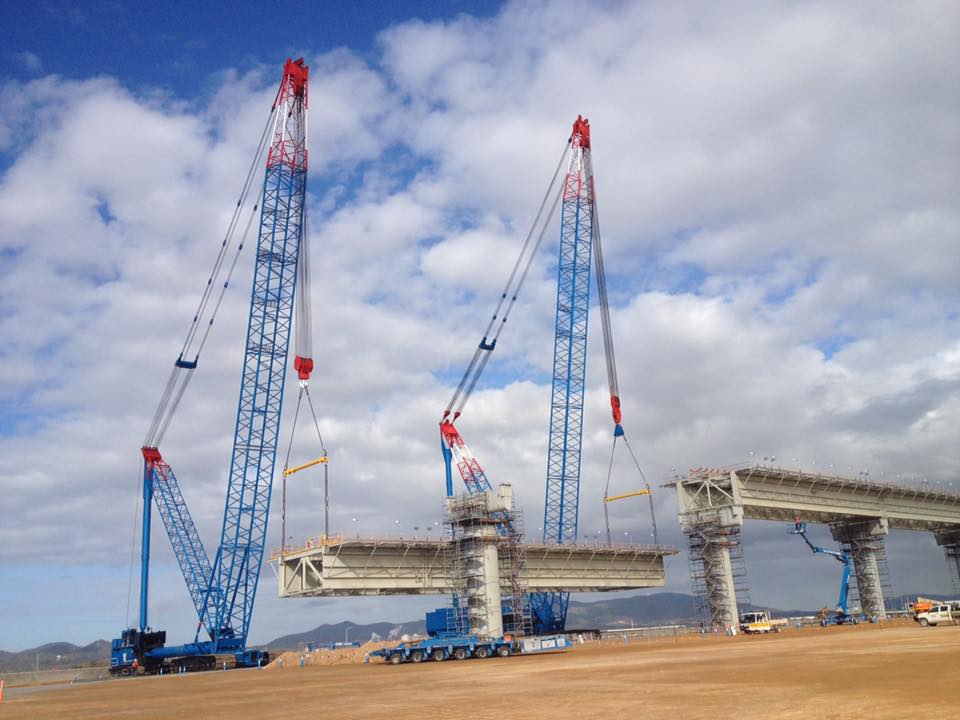
Two of them building a coal handling facility


It takes a lot of land and handling equipment to store coal. In contrast, natural gas can be stored in an underground geologic structure with some wells and pumps.

The following photos are from a posting by David Guarino.
Ben Stalvey 4600 series 4
Anthony Sophios Wiggins island coal terminal, just north of Gladstone. The sections being lifted in these images are the conveyor galleries, then the stackers run on them and across the stockpile pad.


1

2

3

4

5

6

Building two pressure vessels


Lampson International, LLC posted
Lampson Transi-lift making a lift in Bayway, NJ
[The comments indicate this was done in 1998 or 2000.]
I think it is building the two tall towers in this view.
3D Satellite


Miscellaneous

 
Philip Slow posted
I believe world record pick and carry at the time..approx 1500 t. Port Kembla. NSW. Pete Abdoo being one pilot.
Pete Abdoo: They were both purpose built for the ExxonMobil job mate. They only ever done 2 other jobs in Oz one at Stadium Australia for Olympics. 400 ft boom 200ft jib. The other was Vic at Mobil Altona installed a new cracker. Then sat around at Toronto for years. The crawlers were used for dragline relocations mostly Qld mines.
Frank Favaro: The preparation of the areas and the pads cost about 7 million dollars.
[A comment said that one of these was the Big Blue crane that collapsed while building Miller Park Stadium in Milwaukee, WI. But other comments nullified that statement.]

Christopher Winston posted
Here's A Better Picture . I Found This Picture On The Robert D. Marple Our Town Website.
Christopher Winston Is It True, That It Takes A 3 Man Crew To Operate These Cranes ? 1 For Each Set Of Crawlers And 1 For The Crane.
John Golden Christopher Winston yes
Tim Gann You are correct. John I put the 1200 ton together 3 times in Port Arthur Texas. We were using it to lift the domes off the car crackers. It takes 143 tractor trailers to bring it onsite. We ran a 32 part block with a collection ring with 24 2 and 1/2 inch chokes on it. The first time we put it together it took about 5 and a half weeks. The last time we had it together in 3 and a half weeks. Same people putting it together each time. Milo Bingston was the head operator on it.
Gerry Celia You walk the rear cats to swing the load. The whole rig is Ingenious for the time and still widely used today. And when you are done, the boom unbolts completely and the pieces store in those containers for shipping to the next job. In fact, the whole crane goes in containers for shipping.

Bob Brickman commented on Christopher's post
Bob Brickman Christopher Winston here’s a LTL3000

Lampson International, LLC posted
Fun facts from the Plant Vogtle job site in Waynesboro, GA where our Lampson Transi-Lift® LTL-2600 Crawler Crane is at work

MCindustrial (Oct 2015)
[Upgrading the NRG Powerton Power Plant. The article indicates this is a 2,500 ton crane.]

Lampson cranes range from 350 to 3000 US tons. This article asked about a huge crane stored at the Port of Pasco.
This crane is owned by Hitachi Transport Limited. They were due to take delivery of it back in 2012, but with the earthquake and tsunami in Japan, they asked us to keep it here in the United States. For now, we are storing it for them at our test facility in Pasco. We continue to exercise it on a regular basis. Hitachi is expected to take delivery in Japan in spring 2020 at its Oma Nuclear Power Plant site.

It took me a while to find where their test yard is.
3D Satellite
Before I found the test facility, I found their headquarters and shop on the south side of the Columbia River. I found that the street view car had gone down Crane Street. But when I tried using it to find the Hitachi crane, it was not there. So I checked the street view date. It was 2012. Evidently the car had gone down the street in 2012 before the crane was stored there. And since 2012 Lampson has successfully made Crane Street off limits to the public.

I spent quite a bit of time going up and down that street because this facility is obviously also a storage yard for them. For example, here is one of the movers where they add a cab and low-profile engines to one of their base units.
Street View
When I got out of street view, I noticed the mover is still in its assigned location.
Satellite
These four cranes also appear to be a custom design.
Street View
And eight years later, they are still there.
Satellite


More photos of cranes built with extenders


Wednesday, January 2, 2019

Yellowstone Valley/BNSF/GN 1914 Bridge over the Missouri River near Snowden, MT

(Bridge Hunter; WeeksIII; HAER, has several interior shots of the machinery; BlogSatellite)

Snowden, MT is a railroad ghost town. Specifically, it was built by Great Northern to support steam locomotives; and, since steam is no longer used, the town lost its purpose.

It is owned by BNSF but leased to Yellowstone Valley Railroad. [WeeksIII]

Photo from HAER MONT,42-NOH.V,1--22 (CT) from mt0090
"The vertical lift section of the bridge was the longest in existence when Snowden Bridge was built in 1913. A control house on top of the lift span contained a kerosene-powered engine capable of raising the span in about 30 minutes." [Blog]

"This bridge is unique in that it is designed to have the lift mechanism and counterweight able to be moved to a different span of the bridge in the event that the river channel shifts. The lift span was seldom used." [WeeksIII] Note in the following photo that 1.5 of the spans is now over land.

From Bridge Hunter

Ray Trumpower posted
Snowden bridge north of Fairview Mt


Tuesday, January 1, 2019

Broadway Bridges over Arkansas River in Little Rock, AR

(Bridge Hunter; no Historic Bridges)
3D Satellite
This crossing had three generations of arch designs. The 1923 bridge originally had five spans of open-spandrel concrete arches.
Bridge Hunter
In 1974, the US Army Corps of Engineers replaced two of the concrete arches with one steel arch as part of the McClellan-Kerr navigation system project. [CultureVulture]
lll
Bridges Now and Then posted
"A postcard postmarked Oct. 4, 1948, shows the Broadway Bridge as it appeared before renovations added an arch above the deck in 1974." (Arkansas Democrat Gazette)

Wayne Kizziar photo from Bridge Hunter
In 2016, the 1923+1974 bridge was removed and replaced with two tied-arch spans. The two arch members in a span slant towards each other, but they don't touch. Even though they don't actually touch each other, I found confirmation that the design is considered a basket-handle arch. [FirstSteel]
GarverUSA
They used "energetic felling" [phrase learned from research of the Kosciusko Bridges] to get rid of the 1974 steel arch.
Screenshot KATV from arkTimes
After making cuts in the steel members to weaken the bridge, they set off charges to cut through other steel members. But the bridge did not fall! Please read the arkTimes article for a pleasant (no popups) description of how they added more lines and tugs and finally pulled it over 5 hours into their 24-hour window of being able to stop river traffic. Below you can see black spots where some of the explosives were used. Someone in a man-bucket inspected all of the spots and confirmed the explosives went off and cut the members. So the arch stood after the explosions as a testament of the intrinsic strength of that shape.
Arkansas Highway and Transportation Department from arkTimes
(new window) I noticed that they had been building the new piers while they were taking down the old bridge.

Arkansas Highway and Transportation Department from arkTimes
Comment on arkTimes by Arbiter of All Things AOAT: "Story aint over. Looks like the steel remain mostly connected. That cannot be lifted and placed on a barge. They are going to have to send divers into the murky Big Arkie and cut that steel and that is going to be a slow and dangerous process. that's just my guess from lookin at this video. I am talking days if not weeks to clear the channel."

David Hobart posted
1st of 2 arches. Still needing suspension cables and will be ready to float onto piers.
The 3D Satellite image is old enough that it still shows the 1923+1974 bridge. But you can see barges on the north shore preparing for the new construction. The following street views are new enough to show the new bridge, but old enough that you can still see the barges with cranes and the yellow scaffolding used to float the arches into place.

Street View
Street View

Massman's project web page contains seven photos with the comment:
Massman constructed the $100MM replacement bridge for the existing Broadway Bridge, carrying US Highway 70, in downtown Little Rock, Arkansas, for the Arkansas Highway and Transportation Department. The new bridge is a double basket network tied arch, constructed on the same alignment as the existing bridge, supported by three bents over the Arkansas River. To minimize disruption to the travelling public, we executed an innovative plan to install the new bridge substructure underneath the existing bridge while it was under traffic; demolish the old bridge and complete construction of the new bridge in only 180 days.
To meet this contract deadline, Massman installed the three bent main span foundations prior to closing the corridor of the existing bridge. This work consisted of constructing 24 each 8-foot 6-inch diameter drilled shafts with 9-foot diameter permanent casings. The shafts were drilled 65 feet into the rock on the floor of the Arkansas River. The project also included 26,000 square feet of retaining walls with 30,000 cubic yards of fill material. The structure contains 25,000 cubic yards of concrete and 13.5 million pounds of structural steel. Prior to the 180-day closure, two tied arches were assembled downstream of the bridge on falsework mounted on barges. Once assembled, the arches were floated into position in the river and set into their location. 
Project Awards:  
2020 American Institute of Steel Construction (AISC) Prize Bridge Award - Major Span Class
2018 AGC of Missouri Keystone Award - Transportation & Infrastructure Project $25 Million or More
2017 American Association of State Highway and Transportation Officials (AASHTO) - America's Transportation Awards Finalist
1

2

3

4

5

6

6

Screenshot
"The appearance of U.S. Department of Defense (DoD) visual information does not imply or constitute DoD endorsement."
[The previous video that he made about three weeks ago]

Massman Construction Co. posted four photos with the comment:
Marking 10 years since the start of the US-70 Broadway Bridge replacement project in Little Rock! In the spring of 2015, Massman Construction kicked off work on this project. The Broadway Bridge is an iconic double basket handle network tied arch designed by Garver and HNTB and situated on the same alignment as the previous bridge.
Massman committed to demolishing the old bridge and constructing the new bridge in less than 180 days. Thanks to the incredible efforts of our team, the bridge reopened to traffic ahead of schedule after only 152 days. To accommodate the tight schedule, foundations and piers were constructed under the existing bridge while both arches were built downstream on falsework. Once the old bridge was demolished, Massman floated in the arches and set them into place.
The replacement bridge opened to the public in March 2017 and serves as a vital transportation link over the Arkansas River.
[The following are hotlinks. Please use the above "posted" hotlink to access them]
Arkansas Department of Transportation
City of Little Rock, AR - Government
Pulaski County Government
City of North Little Rock - Government
1

2

3

4

Massman Construction Co. posted an award announcement. The AISC link has five construction photos.