Columbia River System Overview
Teresa Labrousse posted 17 photos with the comment: "I have 1950 (number, not year) historic Bonneville Dam photos. I can share the link to the album (on Amazon), if anyone is interested."
Andy Michel posted two photos with the comment: "2007 Out with the old and in with the new..."
 |
| USACE Teacher's Guide |
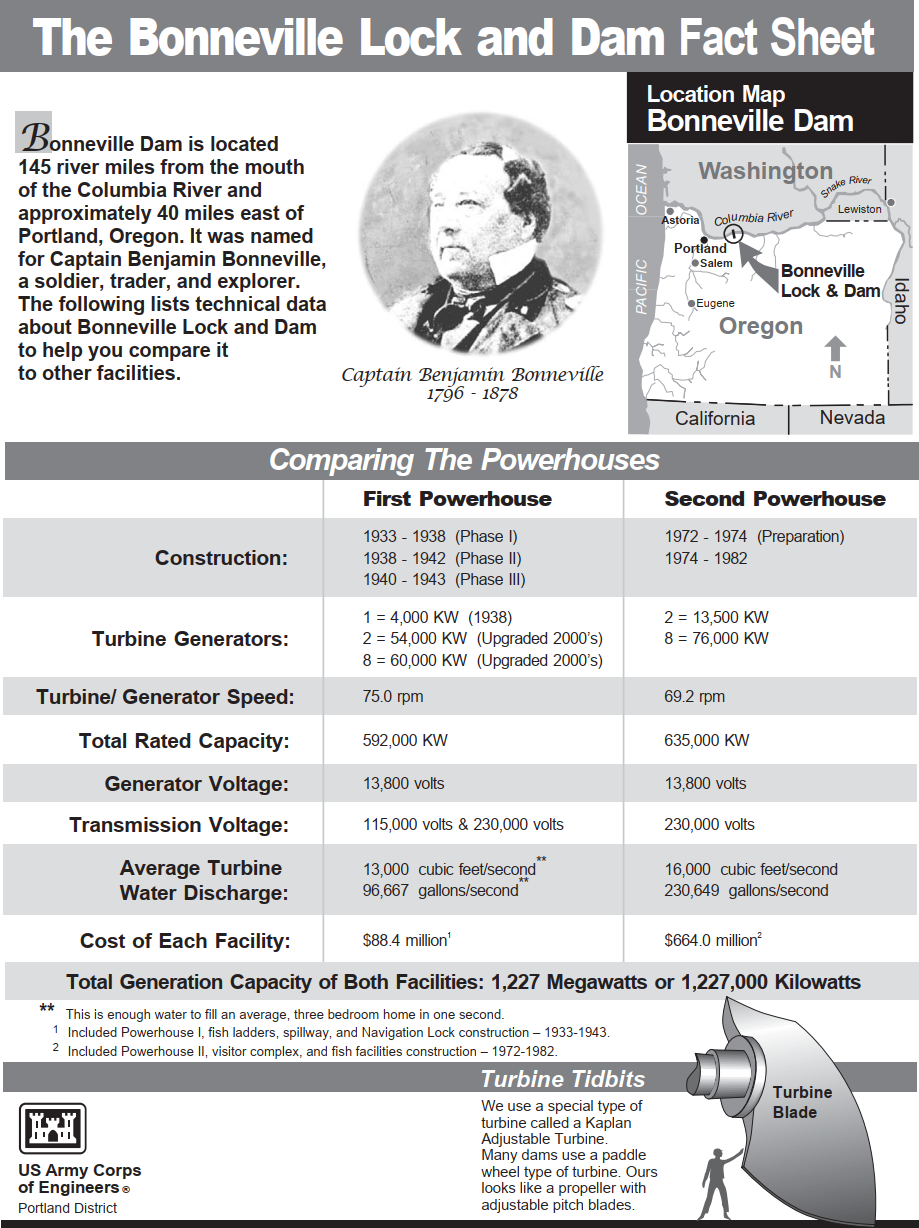
It has two locks and 2.5 fish ladders. But the guide wall of the new lock severely restricts the length of what can use the first lock. The first lock was part of the original 1938 construction. The larger lock was added in 1993 to match the size of the seven other locks on the 465 mile Columbia-Snake River Inland Waterway. A second powerhouse was added in 1981 on the north side. [USACE] The spillway is in the middle.
The 1938 lock is not even used for recreational boats. It has been closed. Even the new lock is small by Midwest standards. Specifically, the width is two barges rather than the three-barge width that we have on the Upper Mississippi, Ohio and Illinois rivers.
 |
| Satellite |
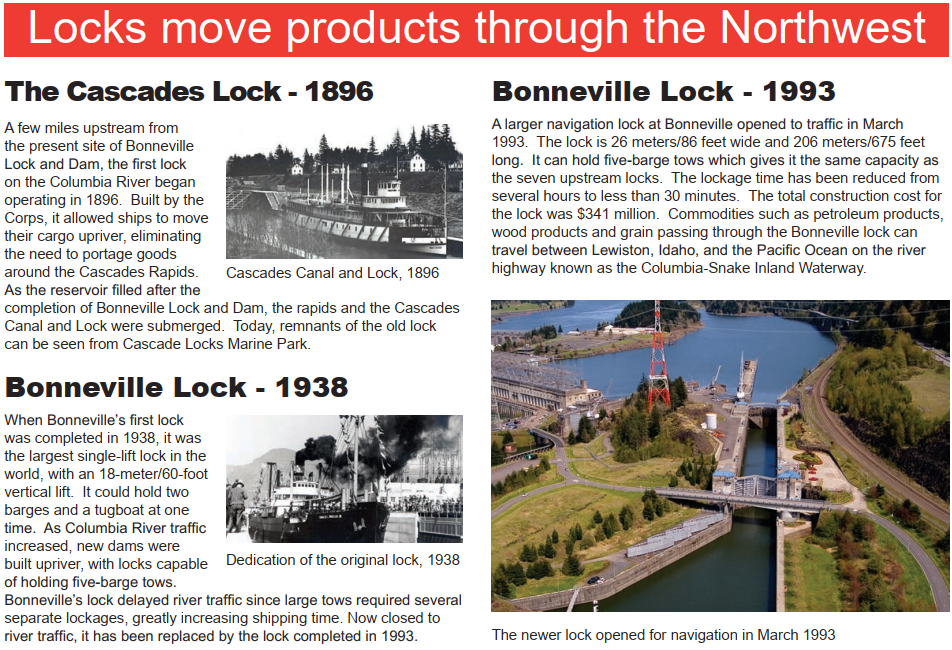 |
| Bonneville Lock and Dam National Historic Landmark Brochure |
 |
| Jeffrey Hunt posted Bonneville 1935 This is an amazing photograph from 1935 — the construction of Bonneville Dam. Just understanding the scale of it for that year is remarkable. You can see that The Dalles is 45 miles east and Vancouver 45 miles downriver to the west, so Bonneville really sits right in the middle. Camas is less than 30 miles away, with Washougal much closer — close enough to feel connected along the river. I remember riding through there as a small child, before sunrise, in my dad’s 1949 Chevrolet — cream, with red and black painted fenders — on the way to salmon fishing, sometimes at Hamilton Island or trout fishing up in Gifford Pinchot. I was barely tall enough to see out the window, watching the neon lights of North Bonneville flicker through the early-morning glass while my dad explained what kind of place it was: a resort town with hot springs, spas, dances, and people coming up from Portland for the night. I didn’t really understand it then, but I remember the feeling of it — and his sense of loss, explaining that the town would soon be gone. You can see part of the old town in the lower right corner of the photo — that main road lined with businesses. It’s all gone now. The entire town was moved when the new dam went in. It’s strange how little has been written about what North Bonneville once looked like. If you have photos or links, please share them in the comments. My dad, Mahlon Hunt, took pictures up there before they tore it down — I haven’t found them yet, but hopefully they still exist somewhere in the boxes, on old tapes or film. Aerial photograph by Brubaker Aerial Surveys, 1935. Courtesy Oregon Historical Society Research Library. Mike Kluth shared1935 Bonneville aerial photo |
 |
| Underestimated Arsenal posted "Too impressive to be told in everyday language," Lois P. Myers of the Portland News-Telegram wrote on November 21, 1935, of Bonneville Dam at night, on the Columbia River in Oregon. The hard part was the river itself. At the main dam the channel was about 900 feet wide and 20 to 50 feet deep, and the water ran at 6 to 9 feet a second. The working season was only eight months, August to March, and every season had to end with the work in a state that could be left alone when the summer flood came. So the Corps of Engineers chose to divert the river from the work site. Its plan, the Corps' own history says, "called for dividing the river in half and unwatering each half successively." First, a horseshoe of timber cribs went around the south half of the spillway site. A crib was a huge timber box with open pockets. Built of 12 by 12 inch timbers bolted together in courses, the cribs generally measured 60 by 60 feet and stood up to 75 feet high, each roughly the size of a six-story apartment building. Crews built the lower part on shore, floated it out, finished it to full height in the river and sank it by dumping rock and watertight fill into the pockets. But the bottom of the Columbia is not flat, and leveling it would have cost too much time and money. Therefore the engineers dredged off the thin cover of boulders and gravel, sounded the rock every two feet, plotted its contours and built each crib's base to match. In a current of 9 feet a second the strain on a crib's holding lines came to about 300,000 pounds, so the middle line was anchored straight onto bedrock near the center of the channel. On August 27, 1935, the emptying of the south half began. Inside the horseshoe crews dug and poured the concrete piers of the spillway. After the 1935-36 low-water season it was time to swap. The upstream cribs of that first cofferdam were removed on March 16, 1936, and the Columbia ran between the piers, over the unfinished crest sections, while a second cofferdam went in for the north half between December 1935 and May 1936. The north half was finished in 1936-37. This photograph, taken on February 16, 1937, caught the work still going. The spillway stands across the channel with the river running through its gates, and the powerhouse nearby is being fitted out: that February and March the first two turbines and generators began going in. George Gerdes, chief engineer for the main dam, designed the cofferdams. They cost $2.5 million and took 8 million board feet of timber, and the Corps' history says that at the time it was "the largest cofferdam job attempted on a United States river." About 3,000 people worked on the project at the peak, most of them from the relief rolls in Oregon and Washington. Before December 1935, over 300,000 visitors came to watch. In September 1937 the Corps closed the spillway dam, the first of eight federal locks and dams on the Columbia and Snake Rivers. It still crosses the Columbia, a National Historic Landmark. Underestimated Arsenal: The contractors, concerned by the unusual size and potential cost of the cofferdams, refused to bid without plans, the Corps of Engineers' history of Bonneville says. The first crib put into the river was number 13, on December 3, 1934, and the south cofferdam was finished on March 3, 1935. It was a U of 21 cribs joined to the shore by earth levees. A Historic American Engineering Record photograph of crib number 13 carries the note: "NOTE CONTOURING TO FIT IRREGULARITIES OF RIVER BOTTOM." The labor on the dam came chiefly from the relief rolls in Oregon and Washington, with a preference for ex-servicemen in Skamania County, Washington, and Multnomah County, Oregon. No source read for this post names a crib builder. The photograph is a United States Army Air Corps picture held by the National Archives in Record Group 18, the Records of the Army Air Forces, in the Airscapes series, as item 18-AA-104-17. The print is captioned "Bonneville Dam, Oregon - Taken February 16, 1937." A typed note says it was copied by the Signal Corps and recopied on May 1, 1959, because its negative had deteriorated. No photographer is named. The honest part. This picture shows what the cofferdams helped build, not the cofferdams, and it cannot tell the viewer which half of the spillway was finished when, so the post does not say which part of the frame is which. The Corps' history puts the second cofferdam between December 1935 and May 1936. The National Park Service's historic district nomination says the north cofferdam was completed in August 1936, and also that by March 1936 it was possible to remove it, which does not fit its own date. The post follows the Corps' history. Where the words on the photo come from. "Six-story" is the Corps' comparison: the cribs were each approximately as large as a six-story apartment building, in a channel 900 feet wide and 20 to 50 feet deep, with the current flowing from 6 to 9 feet per second. The strain on a crib's holding lines in a 9-foot-per-second current approximated 300,000 pounds. "Half a river at a time" is the Corps' plan of "dividing the river in half and unwatering each half successively," which the Oregon Encyclopedia repeats. "Shaped to fit the bedrock" is the Oregon Encyclopedia's phrase, cribs "shaped to fit the contours of the bedrock in the riverbed," and the Corps' word "tailor". The thinnest claim in the post is that this was, at the time, the largest cofferdam job on a United States river. That is the Corps' own history, repeated by the Oregon Encyclopedia, and the post gives it as theirs. The dates of the first half come from the Record's captions: the emptying of the south half began on August 27, 1935, and the upstream cribs of the first cofferdam were removed on March 16, 1936. What was done to the picture: the print's border, its typed header and the burned-in caption strip along the bottom were cropped off, the sepia cast was turned to neutral grey, and about 11 percent was trimmed off the left side and 4 percent off the right to fit the frame. Nothing else was touched. Credit, as the sources give it. The Corps' Portland District directed the job, and its engineers designed the dam. The Columbia Construction Company began the spillway dam in June 1934. The crews came chiefly from the relief rolls, as described above, and the Air Corps made the photograph. Ed Edmo: When this dam was built the German Creek Indians were forced to move with no payment for houses or their fisheries. |
 |
| Screenshot |
 |
| Downloaded Fact Sheet |
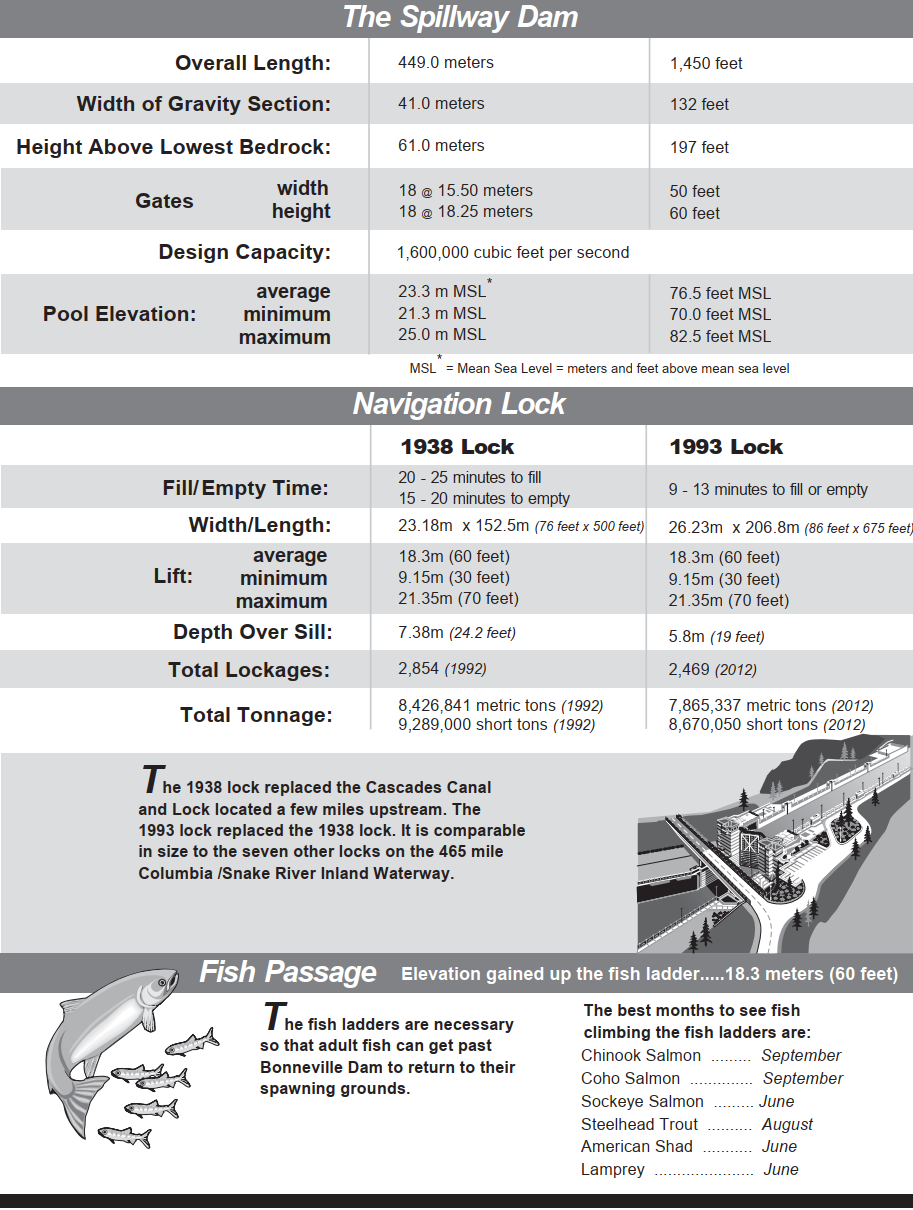 |
| Downloaded Fact Sheet |
 |
| WaterwaysJournal via Advanced-American [An emergency lock closure on Sep 5, 2019. The sill developed a crack, and it had to be torn out and replaced with a new one. It was expected to reopen Sept. 30, 2019. It actually reopened Sep 27. [opb] ] |
 |
| Don Rod Chambers posted In the 1950's, Portland District, US Army Corps of Engineers employed Gustanvus Michelson to create wonderful renderings of Portland District projects. His work would show up in the contract drawings used for construction. Some of the finest table work ever! |
 |
| Portland District, US Army Corps of Engineers posted We dug this cool photo up for you – it’s from the construction of Bonneville Dam in 1937. That means today [Jun 11, 2022], this photo is 85 years old. In recognition of the photo’s anniversary, as it were, we want to share the top 3 reasons we heart it so much: 1. So much to look at! The overalls on these men? Exquisite! Check out those hats! And … those cool-cat poses? So slay. 2. Just look at the size of that turbine. That is a - *checks measurements * - ginormous engineering masterpiece. 3. Our safety office would never let us take a photo like this today – OSHA rules and all, of course. It’s like an entire group simultaneously saying, “Look, ma – no hands! Or hard hats!” Building the Bonneville Dam between Washington and Oregon on the Columbia River. Andy Michel posted The best hydroelectric turbine group photo ever. Richard Conserriere: Where is OSHA when you don't need them. |
Teresa Labrousse posted 17 photos with the comment: "I have 1950 (number, not year) historic Bonneville Dam photos. I can share the link to the album (on Amazon), if anyone is interested."
 |
| 1 |
 |
| 2 |
 |
| 3 |
 |
| 4 |
 |
| 5 |
 |
| 6 |
 |
| 7 |
 |
| 8 |
 |
| 9 |
 |
| 10 |
 |
| 11 |
 |
| 12 |
 |
| 13 |
 |
| 14 |
 |
| 15 |
 |
| 16 |
 |
| 17 |
 |
| Teresa commented on his post "Now" was 2014) |
Matt Cavalier posted two images with the comment: "The generators atop the turbines inside Bonneville Dam along with a basic diagram of the hydroelectric plant."
 |
| 1 |
 |
| 2 |
Andy Michel posted two photos with the comment: "2007 Out with the old and in with the new..."
 |
| 1 |
 |
| 2 |
 |
| Teresa RL commented on Andy's post Unit 10? That was my unit! |
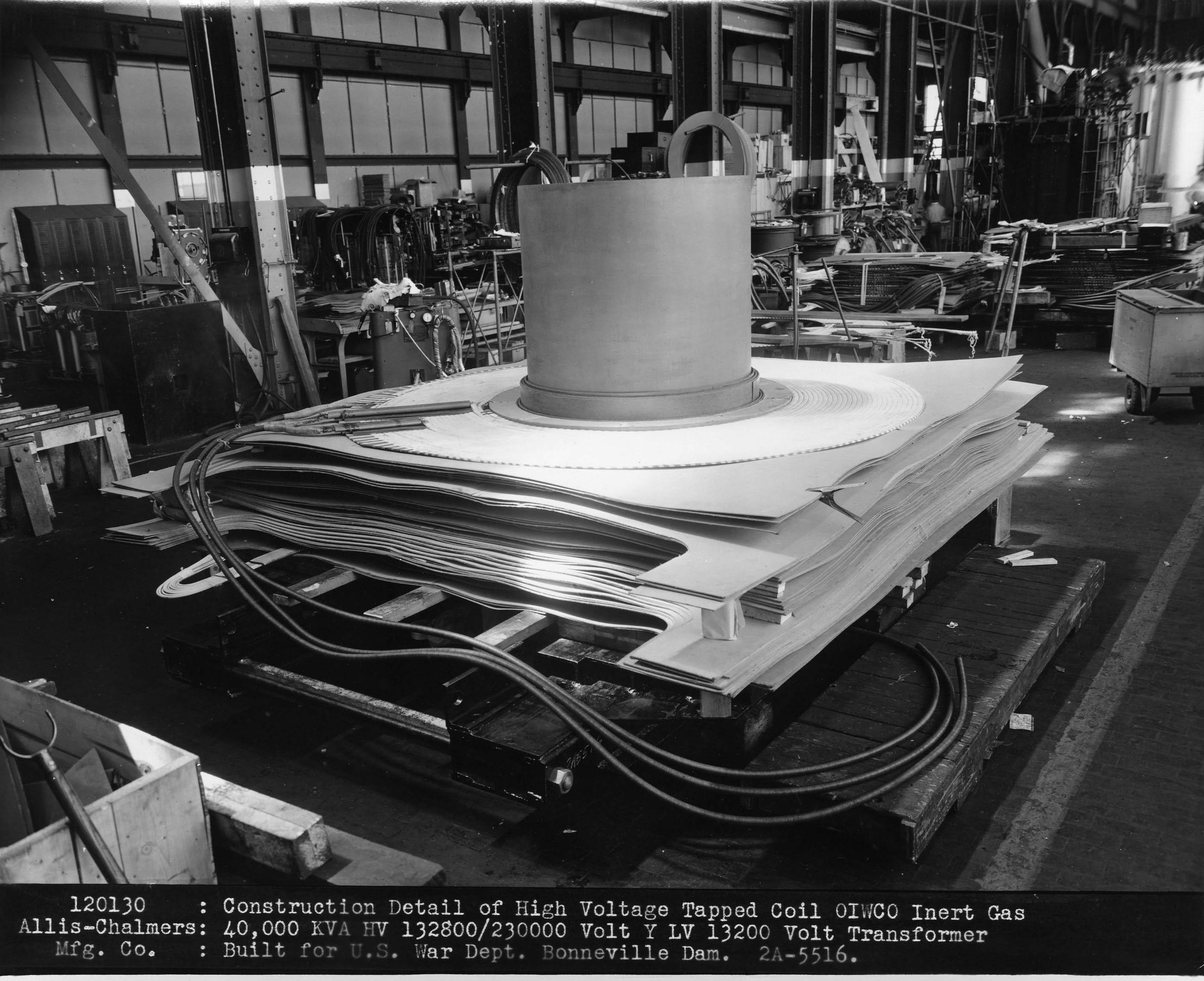
Teresa RL posted nine photos with the comment: "making xfrmrs for Bonneville Dam."
 |
| 1 |
 |
| 2 |
 |
| 3 |
 |
| 4 |
 |
| 5 |
 |
| 6 |
 |
| 7 |
 |
| 8 |
 |
| 9 |
 |
| Andy Michel posted Name it McNary Dam Capital Journal October 2nd, 1933 [About a decade later McNary did get recognized: McNary L&D.] |

No comments:
Post a Comment