Wednesday, April 10, 2019

Catching the MLC300 crane at Microsoft in action

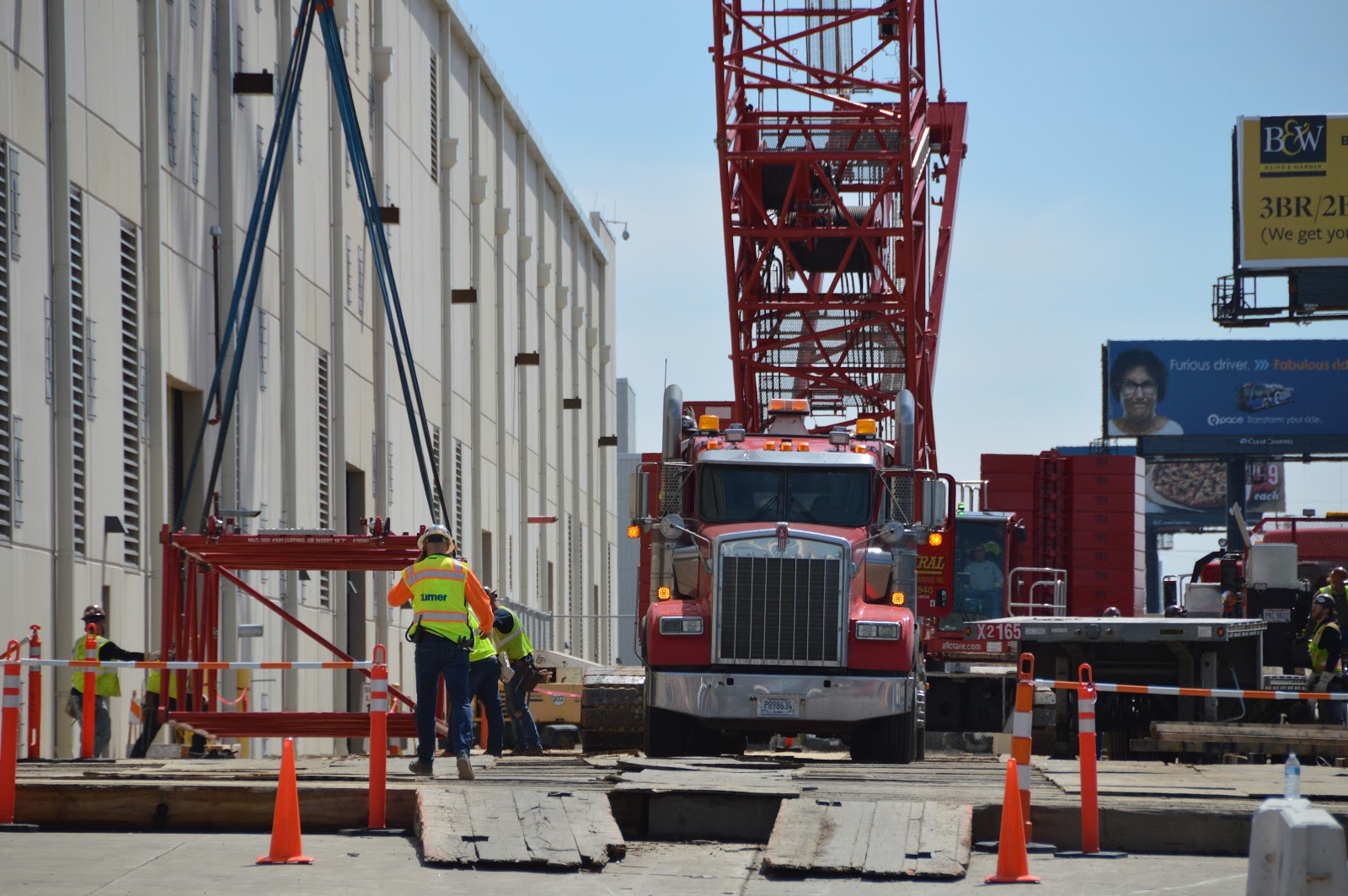
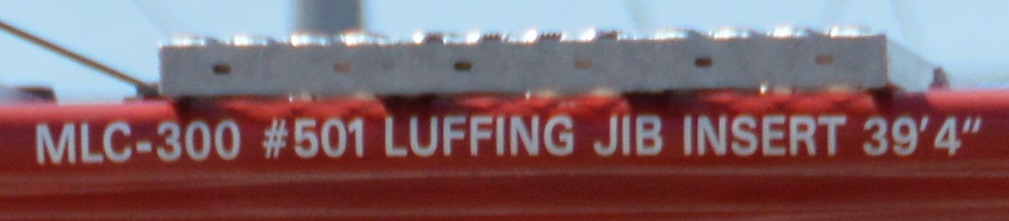
I've already discussed the MLC300 that is helping to expand the Microsoft server farm in Northlake, IL. We had our first day in 2019 when the temperature got into the 70s on April 8, so I celebrated by making another trip to see the crane. In case they eat lunch from 12-1, I timed my arrival for 1pm. When I got there, it was obvious that they had removed some boom segments from the luffer jib that morning, and hopefully they would soon be loading them onto truck trailers. Note in the photo below that the truck is carrying a second flatbed trailer. I've seen that before when I watched a Liebherr crawler crane get disassembled and hauled away between Midnight and 7am one Sunday morning.

20190408 7548c

Once again, I'm going to start with the ending because it is the most interesting action that I saw.
(new window)   (Facebooked)


Since nothing was happening when I arrived, I did my usual walk of first getting photos on the other side of the street, which is right next to the tollroad barrier. Then coming back close to the fence.


You can see the tops of the removed boom segments that they will be loading and hauling away.
These two service trucks and the tractor truck for the flatbed trailers were labeled Central Crane.


How
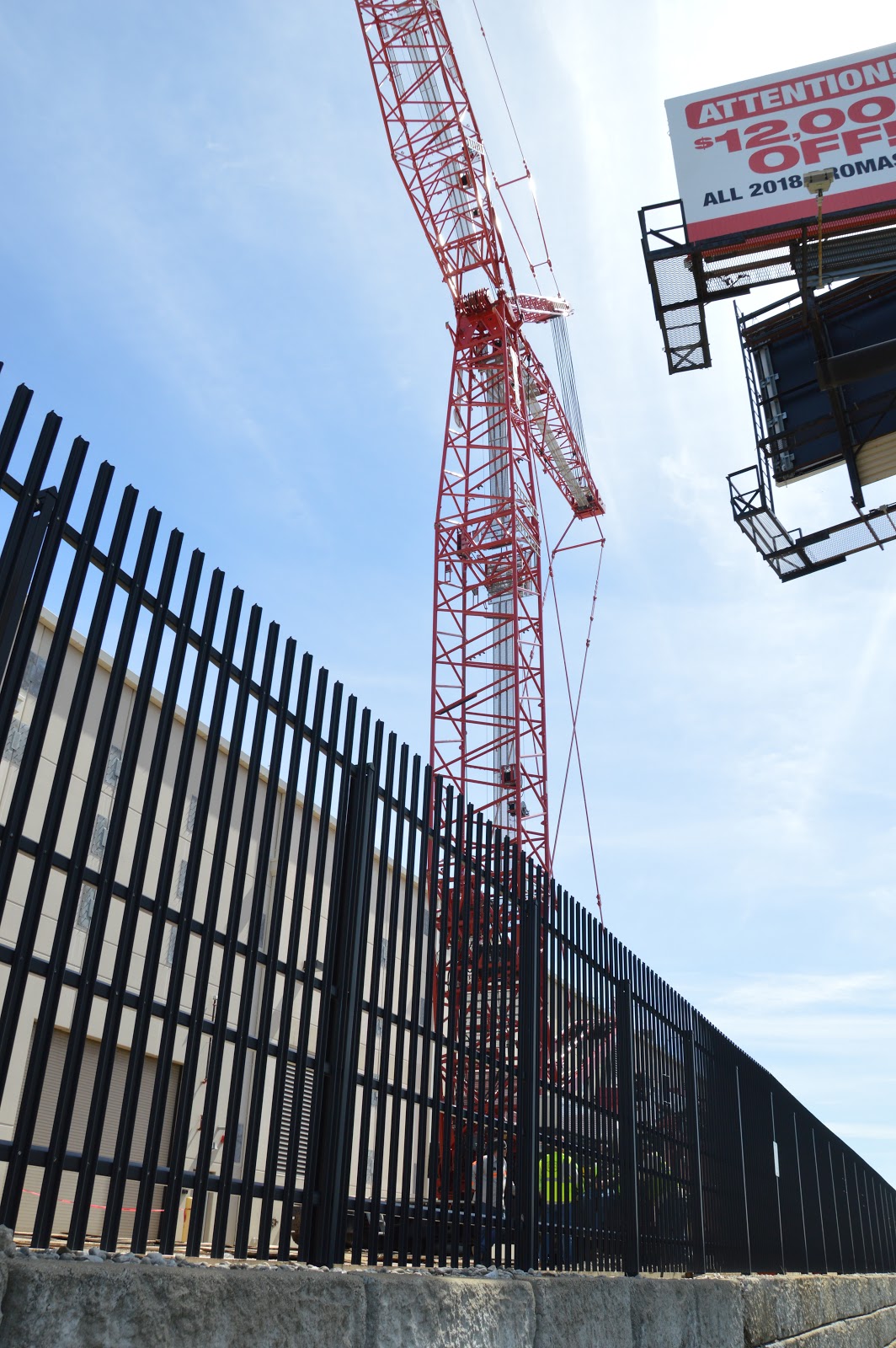
 How is that for a "glint shot?" I don't own Photoshop. If I did, getting rid of that billboard would be an interesting homework problem for Photoshop.

Another "boom in the clouds" shot when I got back to the gate. I wonder if those streaks are airplane cantrails. O'Hare is just north of here. That is, it is behind me. We normally don't see cantrails in the Chicago area because the planes are low for landing. They keep the planes that are going cross country out of this area.
Last Winter, the aperture of my 18-50mm zoom lens broke wide open. I ended up replacing it with an 18-200mm zoom. Here I'm taking advantage of the 200mm setting to get a closer shot of the front of the crane. While they were backing up the trailers onto the mats, I went back to my van to get my tripod.
I had not noticed the mats the first day that I visited. I had assumed that a concrete parking lot was a good enough footing. But I looked around, and they have laid mats over all of the parking lot.

Now that I have video editing software, I took segments of video, cut out the boring parts, and "glued" them together into one video showing the afternoon's action. The segments show:
  • 0:00  I got the camera set up on the tripod in time to catch them lowering the hook. I threw away the video after the hook was below the billboard because it went down very slowly from there. The operator is lowering the hook to the side to pick up the four-strap rigging we see in the subsequent segments. The green fork lift is the source of the beeping. It was carrying loads from the rear of the building to the door in front of the building. And we will see, and hear, it in subsequent segments.
  • 0:29  Lowering the rigging to hook it to the trailer that is on top of the trailer.
  • 0:52  Lifting the trailer and setting it on the ground. One advantage of having the camera on the tripod is that I din't have to worry about my arms getting tired while holding the camera. And I had topped off my battery before I left for this trip. So I just let the camera run. Note the tag lines at the front and rear on the right side of the trailer. After the hook is raised, I decided that the slow descent of the hook is because the luffer jib is being lowered to extend the radius from the trailer that is close to the crane to the boom segment that is further away from the crane. Obviously, a side shot of that action would have been better in theory. But, in practice, because of the billboard and the traffic on the road, it is probably better to use your imagination of the luffer being lowered. Note that the fork lift waits until the major crane motion is done. At 3:33, you can hear a jet overhead that is climbing away from O'Hare. At 3:59 the hook is raised again to provide more room to lower the jib further.
  • 4:12  I resume with the rigging close to the first boom segment. At 4:17, you can see how the boom of the forklift can be extended. Cranes are like draw bridges, the last few inches take much of the time. That is why I let the camera run until the rigging went slack. When the boom segment is close to the trailer, you can see some hand signals just above the boom at the far end. 
  • 8:39  For the second segment, I switched to taking photos except for the last part where they nailed the landing on the trailer.


Here are the photos of the lift of the second segment.
 1:50:55
1:51:06

1:51:20
In the 4:12 segment, you see someone at the office talking to someone. He was the driver of this vehicle that had just pulled in. (The man in the yellow safety vest is the man that walks along with the forklift as an extra set of eyes that can look around corners and let the forklift driver know if the coast is clear.)

After they were done loading the boom segments, I went to the rear of the building to catch another crane in action. They were loading cabinets into the building directly from a truck. I assume these are the cabinets that hold the racks of processors for the server farm.
(new window)


While I was back there, I caught a couple of UP locomotives moving in Proviso Yard. The second unit is #673, a GP38-2/GP38N (EMD) built in January 1980. It was a former Missouri Pacific loco. [The Diesel Shop] And this is a lesson to not delete photos. I deleted the shot I took before this one because it had only part of the first loco. But the number of that loco would have been visible in that photo. It is covered by weeds in this photo.

On my way back to the front of the building, I noticed they had parked a trailer with a segment until the tractor truck can come back for it. According to Google Maps, Central Crane has three sites in the Chicagoland area, all on the south side. It looks like this one is the destination for these boom segments. I noticed the web site provided in Google Maps is allcrane.com.


 Since some of the workers were goving on the bus, and...
...other workers were having a meeting, I knew it was close to quitting time. I wondered, since the luffer was now shorter, if they would park it in the jackknife position. After all, a 570' crane wasn't jackknifed overnight, and bad weather was predicted for the next day. But I waited in case they were going to lower the luffer. I'm glad I did wait because they did lower it. See the video near the top of these notes. I then got another set of photos of it in the jackknifed position. It looks like the luffer has been reduced from about three times the length of the main boom to "only" about twice as long.


Tuesday, April 9, 2019

Civil War Era Aquia Creek & Fredericksburgh Bridge

Current 1923 bridge at this site: (Bridge HunterSatellite)

This railroad became part of Richmond, Fredericksburg & Potomac, which is now part of CSX.

It continues to amaze me what our forefathers could build with wood: grain elevators; coal docks, towers, and tipples; and, of course, bridges.

Bob Freitag shared
Potomac Creek Bridge, Aquia Creek & Fredericksburgh Railroad, perspective view, April 12, 1863 - photo by Andrew Russell
[Library of Congress: LC-DIG-ppmsca-11688]
Photo from LOT 11486-H, no. 8 [P&P]
Huntington, cropped
Potomac Creek Bridge across the Potomac Creek, Stafford County, Virginia.
TourStaffordVA, 2x
“Beanpoles and cornstalks,” is what President Abraham Lincoln called the once 80-foot-high, 400-foot-long Potomac Creek Bridge when he crossed it in 1862.  Although the bridge no longer stands today, you can visit the the stone blocks  of the south abutment and the commemorative marker of this once impressive historic structure.
[The LoC documentation on the handwritten notes below noted that they were signed by HH. Herman Haupt was the engineer that supervised building this first of four bridges built during the Civil War. It was built in nine days during May, 1862.]

Screenshot
I'm old enough to have been taught cursive writing, but I gave up reading this after the first paragraph.

1

2

Monday, April 8, 2019

Previous Van Buren Street Bridges

(1895 Bridge Hunter3D Satellite, the current bridge that has replaced all of these bridges)

The current bridge has its own post.
The Metropolitan Bridge that is behind this one in many of the photos has this post.

According to Chicagology, there was also a tunnel between 1892 and 1952. Chicagology also lists six bridges that were at this site.

Todd Protzman Davis shared
Patrick McBriarty Those two bridges where the first Scherzer rolling-lift bridges in the world ever built. Their inventor William Scherzer received the patent post-humously and his brother Albert started the company. Both were Chicagoans.
Zachary Tailor Davis posted
[Note the Union Station buildings in the background.]
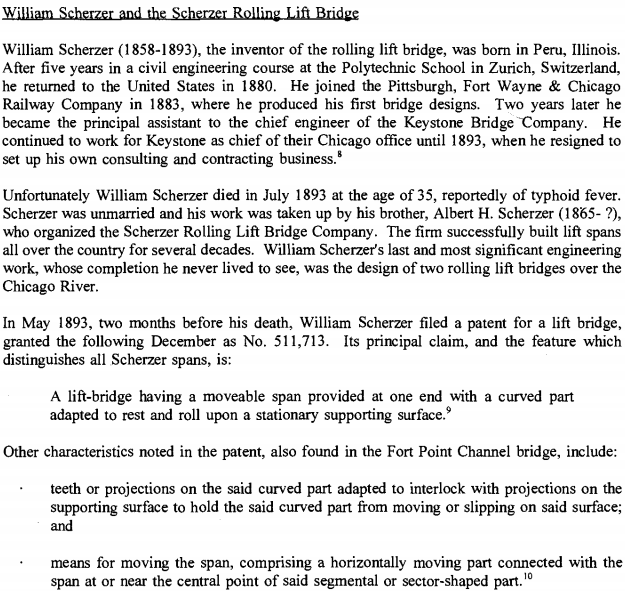
HAER, p7 (source)

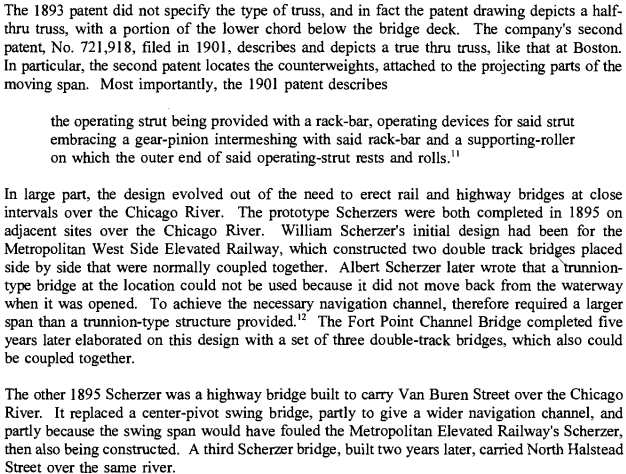
HAER, p8 (source)
In the following decades, a large number of rolling lift bridges were built, both for rail and highway traffic. In a 1902 letter to the Railroad Gazette, Albert Scherzer wrote that more Scherzer rolling lift bridges had been built than all other types of bascules combined.
[1902 is when MWRD had built a lot of rolling bridges along the Chicago River and before Chicago replaced them with trunnion briges.]

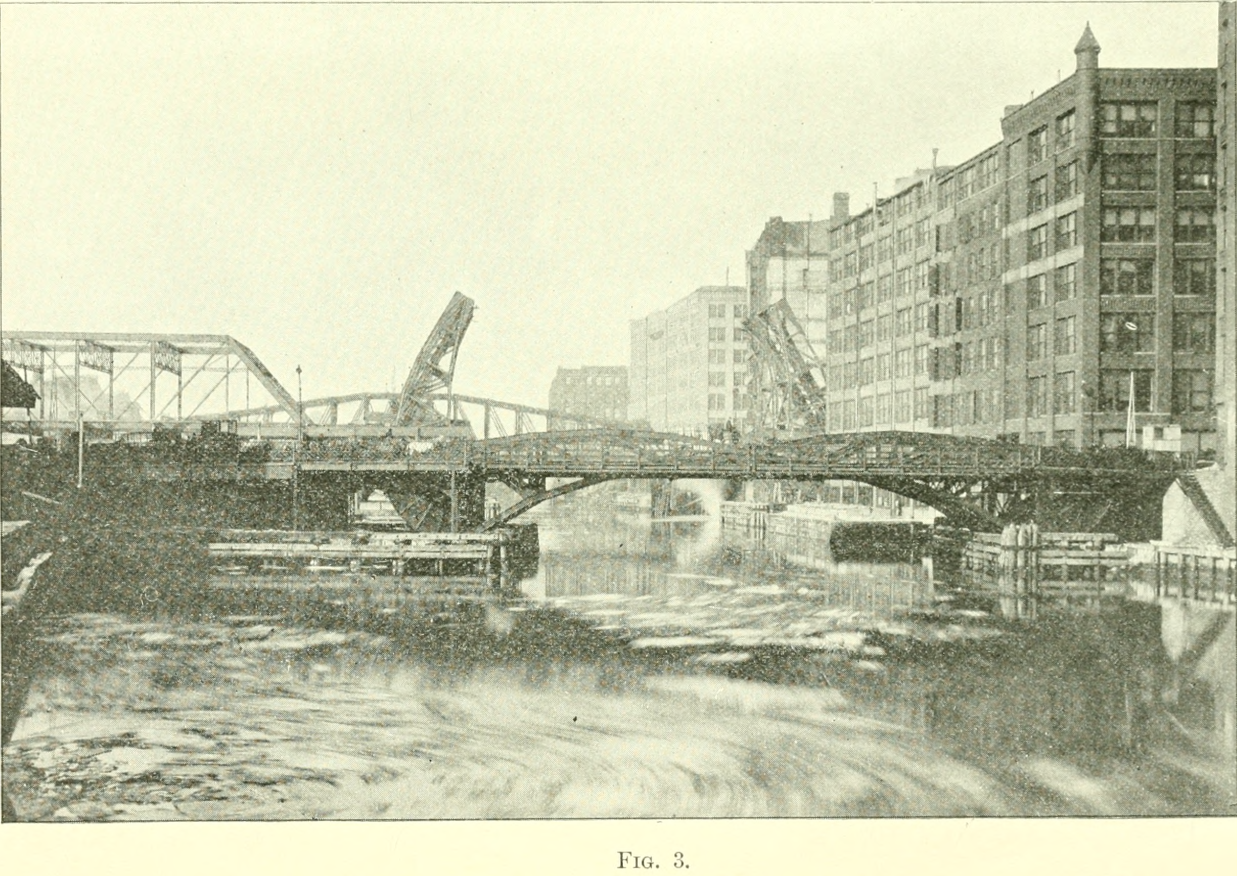
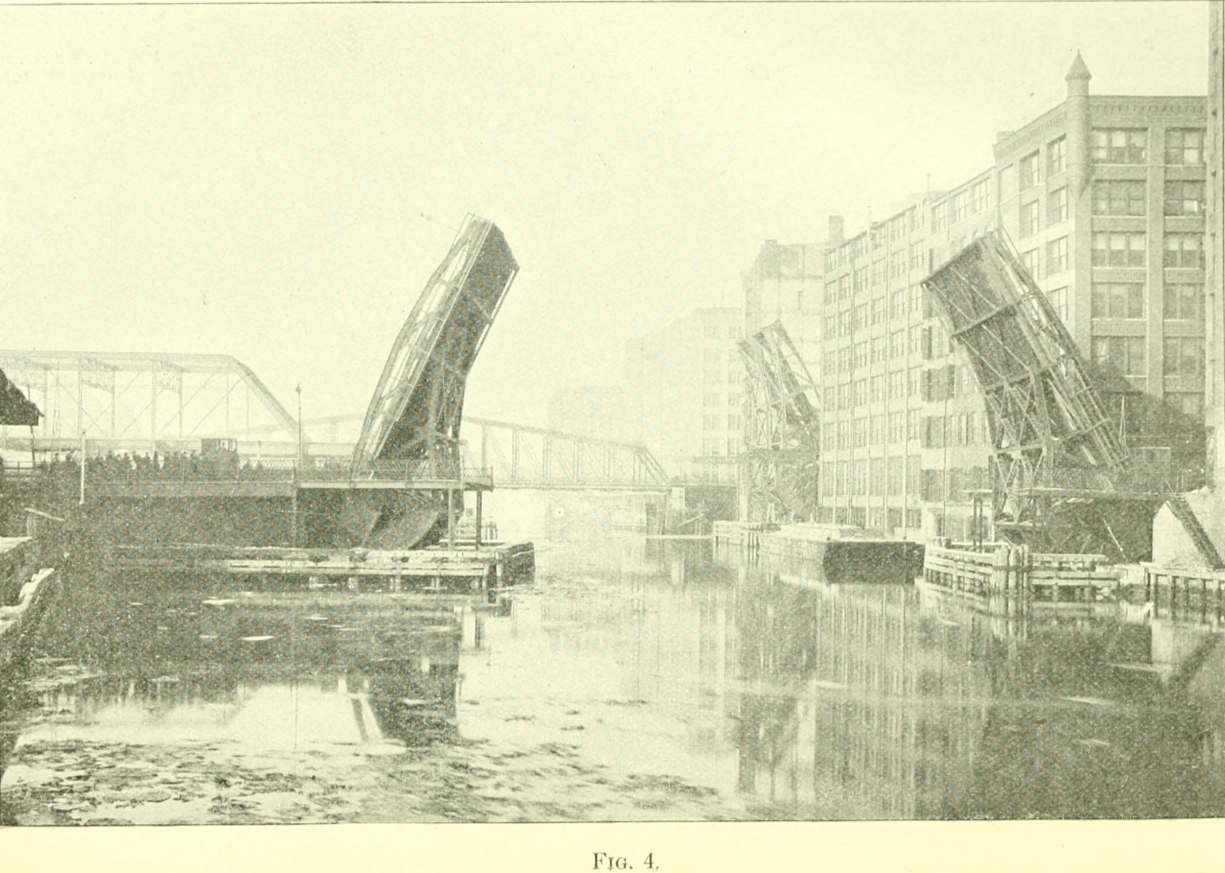
This view shows both of the first two bridges designed by William Scherzer and built by Albert Scherzer.
Darla Zailskas posted
Van Buren Street Bridge 1949, the Scherzer rolling-lift bridge shown here at Van Buren, looking northeast, was replaced by a bascule bridge opened in Dec. 1956. The bridge in the background was the famous Metropolitan West Side Elevated Railway bridge used for rapid transit from 1895 until June 22, 1958, when service began on the Congress Expressway. Always used for electric trains, this bridge was the only 4 track bridge in Chicago's history and also served the Chicago Aurora & Elgin Railway AS TOLD by the Department of Public Works
Published prior to 1923, from Bridge Hunter, 1895
[This shows the west leaf in the raised position and all of the leaves of the Metropolitan "L" Bridge.]

May 11, 1895 Scientific American via Chicagology, Digitized by Google
May 11, 1895 Scientific American, Digitized by Google
May 11, 1895 Scientific American
[Why is there a steam locomotive on Van Buren Street? The elevated trains used steam until electric propulsion was developed. But I thought streetcars used horses before they used electricity.]
Association of Engineering Societies, Vol XV, July to December, 1895

Association of Engineering Societies, Vol XV, July to December, 1895

Association of Engineering Societies, Vol XV, July to December, 1895

Association of Engineering Societies, Vol XV, July to December, 1895
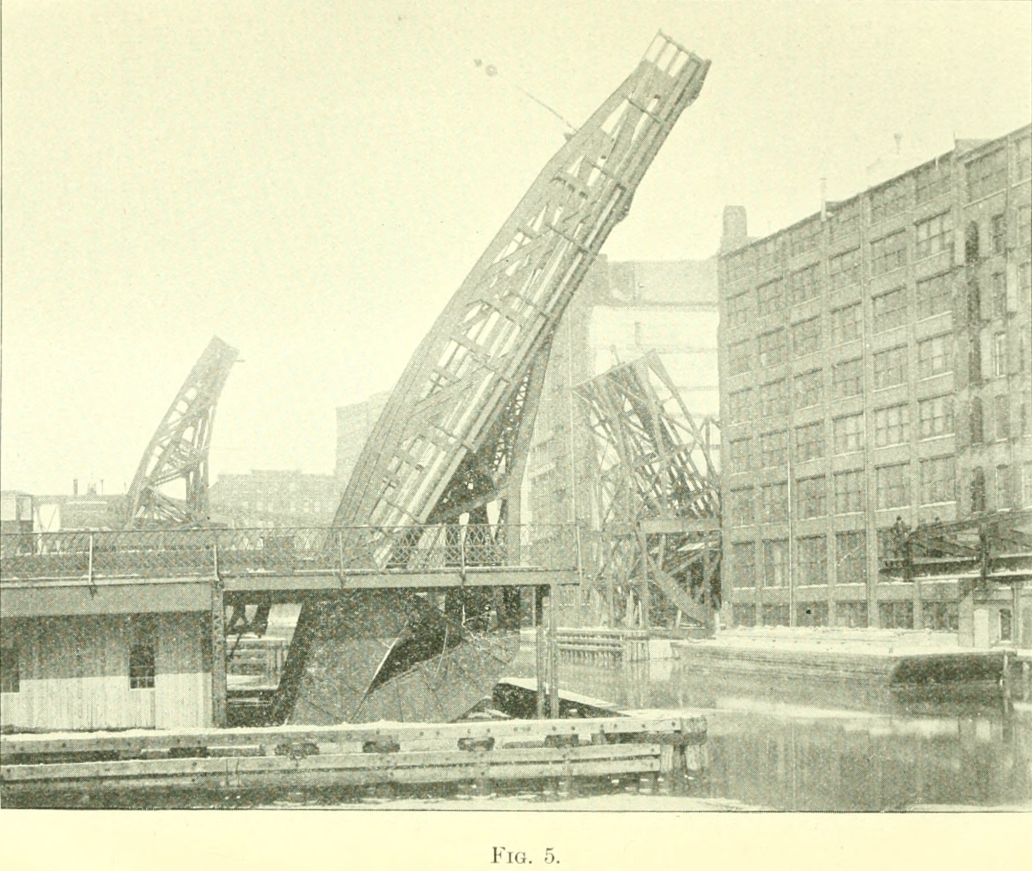
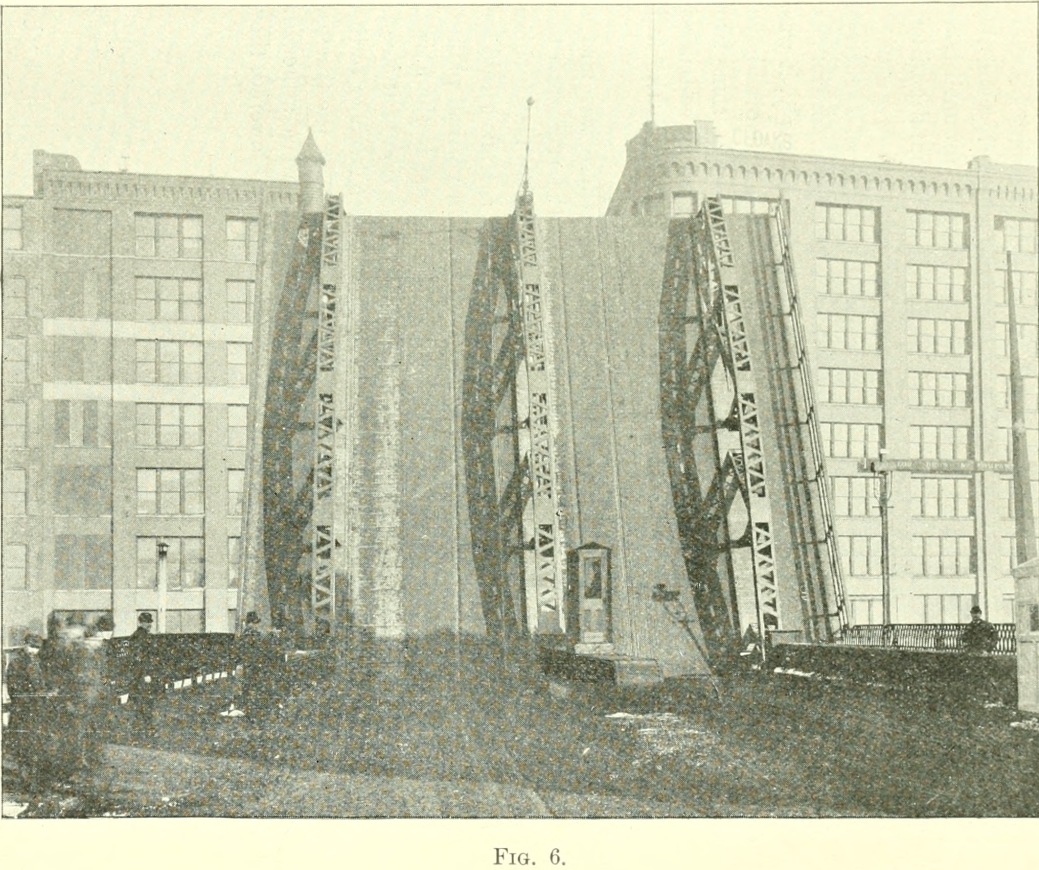
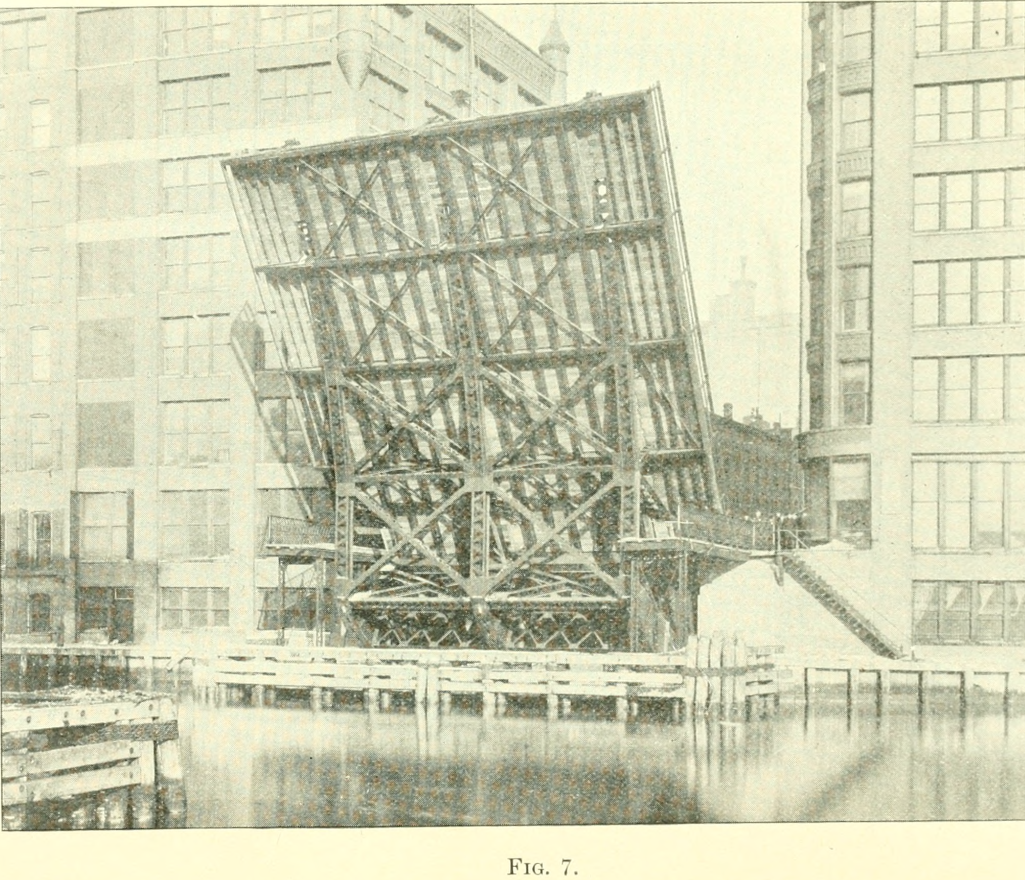
Fig. 6 gives a view looking east upon the west half of the bridge when open. We have here very forcibly presented the amount of wind-surface offered when the bridge is fully opened. The area above the line of the roadway amounts to about 3,300 square feet, and a pressure of 18 pounds per square foot gives a pull in the operating strut of 165,000 pounds.

This is the maximum stress for which the operating strut and the machinery were figured; it being assumed that traffic on the river would stop with a wind which would give 18 lb/sq ft. Mr. Trautwine, in his "pocket-Book," gives 18 lb/sq. ft. as corresponding to a violent storm of 60 miles per hour.

[Each side was operated independently from a control cab mounted on the center approach girder.]

Association of Engineering Societies, Vol XV, July to December, 1895

The third bridge at this site was the first swing bridge, and it was built in 1867 with wood and iron. Below is what was left after the Great Fire of 1871.
Chicagology

The swing bridge in the background should be the Van Buren Street Bridge. 1902 would be before the river was straightened.
MWRD posted
The east abutment for a temporary bridge being built at Harrison Street in Chicago on November 7, 1902, viewed to the north from the east side of the South Branch of the Chicago River.

MWRD posted on Jan 5, 2023
A view from the Jackson Street bridge looking south towards Van Buren on September 5, 1903, showing an area adjacent to and above the bypass channel on the South Branch of the Chicago River.

Steve Lewandowski posted
1909 rebuild

Sunday, April 7, 2019

New Bridge over Ohio River at Wellsburg, WV, Bridge

(Bridge Hunter; B&TSatellite, as of Feb 2023, nothing shows up on the satellite image. Just a label.)

An existing road bridge does not exist so I can't get a satellite image of what was being replaced.

Flatiron
Construction of the $131m design-and-build contract started April, 2018. The contract specified a completion date of March, 2021.
Construct tied-arch bridge offsite and transport it by barge to the project site for installation

Before I get into discussing the years of study that happened before construction started, here is the placement of a rebar cage into a drilled shaft that motivated these notes.
Ben Stalvey shared
888 getting it done
International Union of Operating Engineers, Local 18 posted
Wellsburg-Brilliant Bridge project in District 6 is moving along across the Ohio River!!
1
2

3
4

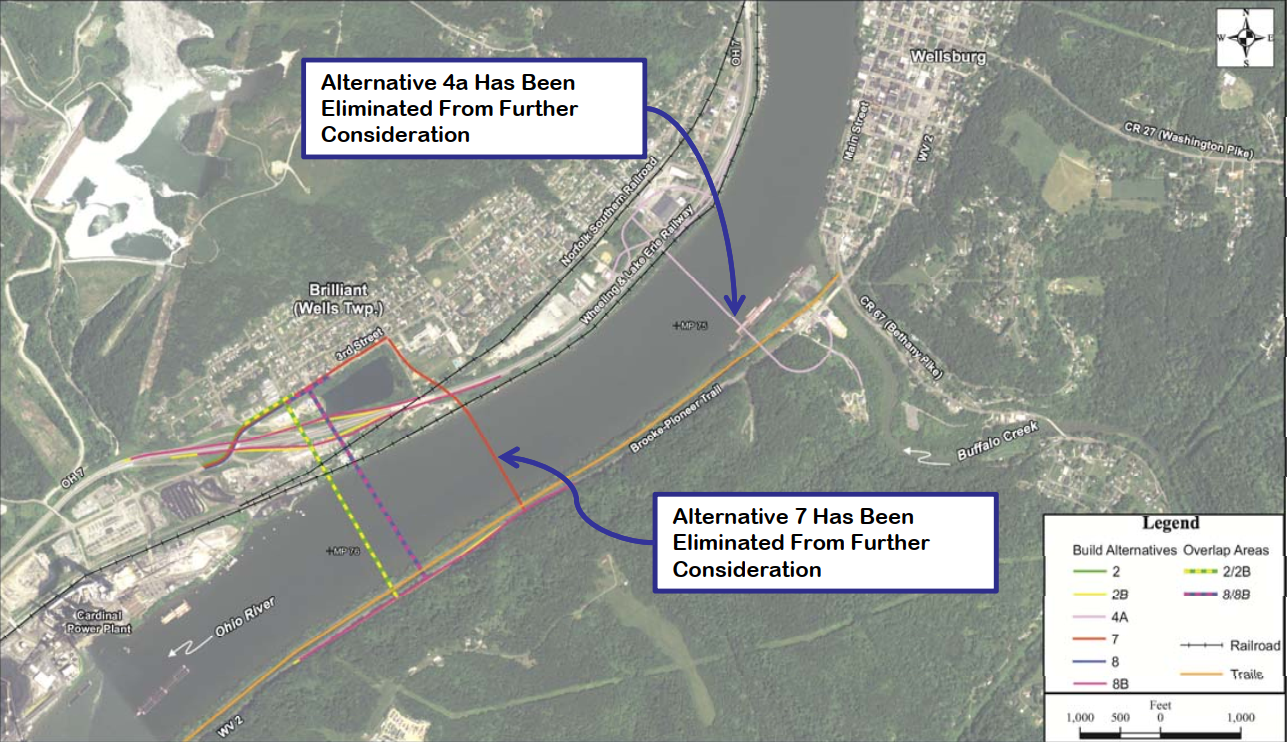
"Separated by the Ohio River, the towns of Brilliant, Ohio and Wellsburg, West Virginia are connected by antiquated spans that have exceeded their design life, with one bridge recently demolished because of the inability to modernize it." [Flatiron] However, I fired up Google Earth and went back to 1995. The closest road bridge I found upstream was at Stubenville and the closest bridge downstream was at Wheeling. And the handout confirmed that the "no-build" alternative was to use the two bridges upstream in Stubenville. Then I discovered that Stubenville had a third bridge that had been closed --- Fort Steuben Bridge. [Phase I Report, 1998]

They spent years doing the usual dance of collecting public input and doing environmental assesments.
The Handout, p2
Siemens Church did a very poor job of explaining what they studied. Fortunately, The Handout explains:
A new technology being performed by Seamen . A new technology, being performed by Seamen s Church ’s Church Institute, allowed computer simulation of barging activities along the river. As part of the simulation, barge industry river pilots were able to navigate through a 3D model of the Ohio River with different bridge crossing locations and various span lengths. These studies were coordinated with United States Coast Guard and resulted in major changes to the bridge span length.
The Phase III Report, Deck Width, was completed in 2014.
According to Flatiron's image at the top of these notes, the tied arch main span design was chosen.

Update:
safe_image for Construction on bridge connecting Wellsburg and Brilliant continues
"
The estimated March 2021 date has been pushed back to November of 2022."
Darren DeMario There is 3 888's and two 2250's on the project. We are doing the caissions on both sides.
[An advantage of a tied arch is that it can be built on shore using regular falsework and then floated into place. This is in contrast to the I-74 bridge across the Mississippi that uses cables for the falsework.]

Jimmy Campbell commented on a share

Pete Wildey posted five photos with the comment: "Wellsburg Bridge is taking shape! Here are some drone shots taken today (May 22, 2020) Feel free to share!"

1

2

3

4

5

safe_image for Mammoet Minds the Gap with Flatiron Construction
"It is the heaviest floating bridge lift ever executed in the USA....Mammoet’s Mega Jack solution provided the least disturbance for ships on the river as the work could be completed in a maximum of two days. An alternative strand jacking method would have the bridge hanging on strand jacks for at least two weeks." Mammoet mounted the jacks on barges in New Orleans, LA, and Flatiron floated them to Wellesburg where Mammoet took control.

The steel was fabricated by Industrial Steel Construction.
ISC-wellsburg
"Working with Flatiron Corporation, ISC is fabricating approx. 4300 tons of steel for the main span and 1500 tons of steel for the approach spans both to be completed in 2020. The tied arch bridge sections consist of 22 tie chords, 31 floor beams, 2 End beams, 18 Arch ribs, 4 knuckles as well as several secondary members such as stringers, lateral braces etc. All pieces except the 4 knuckles will be shipped to site by truck. However, due to the size of the knuckles (137,000 Lbs., 20’ high, 30’ long, 8’ wide), these components were shipped via Barge. ISC performed a full progressive assembly for the tied-arch bridge at its 1.6 million sq. ft. facility under roof located in Gary, In, to ensure a proper fit-up at the site. ISC also played a critical role in the early design stages of this design build project, providing vital information pertaining to steel fabrication, inspection, acceptable tolerances, shipping logistics etc to minimize steel manufacturing and overall project costs."

Feb 2023 Update:
1 of 4 photos posted by Bridges & Tunnels
Construction is ongoing on the new Wellsburg Bridge, which spans the Ohio River and connects Wellsburg, West Virginia, to Brilliant, Ohio. The project, which involves building a tied-arch structure, began in the spring of 2018. Despite progress being made on the bridge, the opening date has been delayed due to weather conditions. The West Virginia Department of Transportation Engineer said the bridge is expected to open in late spring of 2023, as soon as the weather allows for some final touches to be completed.
➤ Additional photos of this bridge can be found at
 http://bridgestunnels.com/location/wellsburg-bridge/
[According to BridgeHunter, B&T took these photos in Sep 2022.]

In addition to the bridge, they have to do some major road building on the WV side.
Street View, Jul 2022

B&T has construction photos from more than one visit.
"In an effort to reduce costs and shave a year off of the construction timeframe, Flatiron opted to build the tied-arch bridge off-site and deliver it by barge to the project site for installation in what was expected to be a two-day operation. 3 On April 26, 2021, the main span was lifted onto two pairs of barges and moved into position in a single 13½-hour operation. 5 The bridge was supported on the bridges by eight sets of sectional pilings. Once in place, the structure was jacked up, and additional pilings were set underneath until it was high enough to rest on its support piers.
"With an estimated weight of 4,000 tons, the tied-arch span was the heaviest structure to be lifted in such a manner in the United States. 4
"Originally scheduled to open in 2022, 4 the new Wellsburg Bridge is estimated open to traffic in spring 2023. 6"
Main Span Length: 845'

Sep 20, 2023: 2 of 6 photos posted  by Ohio Department of Transportation Eastern Ohio District 11 with the comment:
It was certainly a beautiful day for the ribbon cutting ceremony of the Wellsburg Bridge which now connects the communities of Brilliant, Ohio, and Wellsburg, West Virginia! Deputy Director Tom Corey shared "Today is a momentous occasion for our transportation agencies, but most importantly for the communities of Brilliant and Wellsburg. We are honored to have been a part of this remarkable accomplishment and to celebrate with you all today!"
Bridges & Tunnels shared
a
[Note the dedication was held on the bridge and the fire truck is helping to hold up the flag.]

b
[I include this photo of the power plant because I just wrote about it yesterday. And because it has become nice to see a coal-fired power plant still running.]


Anam Jáåñ posted three photos with the comment: "The Bridge they moved down the Ohio River yesterday in Brooke Co."
1
[In this photo, I noticed the extra steel members that they added in the arch to help support it for the move.]

2
[These photos provide a couple more views of the poer plant.]

3