Tuesday, March 9, 2021

1969 Silver Memorial Bridge over Ohio River at Point Pleasant, WV

(Bridge Hunter; Satellite)

Given the built date of 1969, this bridge was built in less than two years to replace the Silver Bridge after it collapsed on Dec 15, 1967.

Angela Scott Stewart Flickr, License: Creative Commons Attribution (CC BY)

Shirley Payne posted
An aerial view of the Silver Bridge across the Ohio River at Point Pleasant.  No date.
Credit: WVSA
Neal Reynolds: 1969 or later. US 35 4-lane hasn't been connected yet so I am guessing this is right after it opened.

Shane’s Snapshots added
Kirby's Retractable Vessel "LEVITICUS" Making Their Way Into The Great Kanawaha River
[The 15 photos include some closeup views of the bridge.]
Shane Michael shared

Shane’s Snapshots added, cropped.
Shane Michael shared
 
Shane’s Snapshots added, cropped.

It is always nice to see a truss bridge with a fresh coat of paint.
Street View


Street View

Street View
Note the fleeting area along the Ohio shore.

There are several dry docks in the fleeting area.
Street View

1928-67 Silver Bridge over Ohio River at Point Pleasant, WV

(Bridge Hunter; no Historic Bridges; Satellite, this would be the replacement. The Silver Bridge was upstream near the railroad bridge.)

This eye-bar suspension bridge is infamous because it collapsed on Dec 15, 1967, killing 46 people. Unlike the eye-bar suspension bridges in Pittsburgh, this bridge did not have redundant eye bars because the designer thought his choice of a new high-strength steel did not require redundancy. The bridge also pioneered aluminum paint, thus its namesake color. One issue with this bridge was that there were stop lights at either end that caused a big load of traffic to regularly set on the bridge.

Given that the bridge was the pride of the community until it collapsed, it was remarkably hard finding photos of the bridge when it was still standing.
Photo via TheMonthman

Is this photo AI generated?
90 S History posted
The Day Everything Changed
The temperature hovered at 28°F that Friday. The river was stiff with floating sheets of ice, and faint snowflakes drifted like ash. Christmas wreaths hung from lampposts, their bulbs glowing through the fog.
At 5:04 p.m., the bridge was packed—over 70 vehicles, bumper-to-bumper, crawling through rush-hour traffic. Families returning from shopping, workers heading home, teenagers ferrying decorations for school events.
Among them was Charlie Boggs, the coal truck driver who had crossed the Silver Bridge nearly every day for years. From his high seat, he could see the taillights stretching ahead in a glowing ribbon. He tapped his fingers on the steering wheel, humming along with Bing Crosby’s “White Christmas” playing on the radio.
Then it happened.
Witnesses described hearing a single, sharp metallic snap—like a gunshot cutting through winter air. Eyebar 330 fractured and tore apart. The load shifted instantly, sending a violent ripple through the entire suspension chain.
In less than 75 seconds, the Silver Bridge gave way.
The deck buckled. Cars slid. The entire structure folded like a collapsing toy, crashing into the dark freezing river. 31 vehicles plunged. 46 souls were lost.
Charlie’s truck dropped with the bridge, vanishing into the churning water. Fighting against the pressure and the icy blackness, he kicked the door open as the cab filled. He surfaced among twisted steel and floating debris—packages, ornaments, children’s toys, even a Christmas tree still glowing with battery-powered lights. The river was silent except for faint cries and the groan of collapsing steel.
Charlie spotted a teenage girl clinging to a piece of bumper. He recognized her—it was his niece visiting for the weekend. Holding her tight, he swam through slush and broken beams until a barge crew pulled them aboard.
George Reichert: It was officially known as the Point Pleasant Bridge. It crossed the Ohio River and connected Point Pleasant, WV and Gallipolis, Ohio. It was called the Silver Bridge because it of the color of its aluminum paint. It collapsed on December 15, 1967 and was replaced in 1969. https://en.wikipedia.org/wiki/Silver_Bridge

wvpublic, E-Wv, The West Virginia Encyclopedia Online
Also TheMothman

A crack in one of the eye-bars started as a result of the joint action of stress corrosion and corrosion fatigue. The crack propagated quickly on that December day because the cold steel had become brittle. (I'm learning that some steels do not require tundra cold to become brittle. Plain old Illinois cold can make some steels transition from ductile to brittle.) A silver lining of this tragedy was the passage of a federal law requiring periodic bridge inspections.

It was replaced in less than two years by the Silver Memorial Bridge.

Pamele Moskie posted
The Silver Bridge collapsed during rush hour traffic on December 17th, 1967.
[There are quite a few comments by people remembering this accident.]

I've looked at a few videos. I like this one because it focuses on the engineering aspects of the collapse. I don't need to watch talking heads tell me that the deaths of 46 people was a tragedy.

This video is about the eyebar suspension bridge at Dresden, OH, which still stands but has been bypassed. This video discusses this bridge because the engineer of the Dresden Bridge was the consulting engineer for this bridge.
Screenshot

PBS Nova 3:15 video

Monday, March 8, 2021

FEC: Florida East Coast Railway, Key West Seven Mile Bridge and 1935 Hurricane

(Bridge Hunter; HAERSatellite)

The Florida Keys Over-Sea Railroad was completed in 1912. The railroad was destroyed by the 1935 hurricane. The right of way was rebuilt as US-1 in 1938. The seven mile bridge and others were replaced in the 1980s.

There are at least 33 railroading photos in Key West Terminal.

Florida Keys History & Discovery Center posted
View of the Over-Sea Railroad chugging across the Seven Mile Bridge on the run back to Miami.
Harvey Patty Hillman: Great picture but that should be the north end of the Long Key Viaduct (bridge) and the train is heading to Key West.
Pat Ground: Years ago I talked with an elderly lady who had been on the train before the hurricane destroyed the railroad. She said that because the train had to go slow on the 7 Mile Bridge, it was like a cruise, no guard rails to block the view and a long time to be over water! I think she said 10 mph, so That would take almost 1 hour. Must have been exciting...
Bill Pearson: The father of someone I knew was on the last train out in 1935. They were just ahead of the hurricane. They were working for the CCC. Their next-door neighbor was on the train that didn’t get out and was turned over by the tidal wave. He survived by tying him self to a tree. I knew them both.
[This bridge survived the 1935 hurricane and still stands today.]

Doug Cowern shared
Paul Nelson: Curious what kind of speeds did they attain going over this route And di a train ever wind up in the water from a derailment?
Doug Cowern: No trains ever fell off any of the the trestles . Their top speed was either 15 to 20 mph across the trestles and normal speed on land.
The first train didn’t run until 1912. There were plenty of deaths in the hurricanes that befell construction (at least 125+ that we know of between the start of construction and the first train). The nail in the coffin was the Labor Day 1935 hurricane that killed off the route.
On Upper Matecumbe Key, near Islamorada, an 11-car evacuation train encountered a powerful storm surge. All 11 cars were swept from the tracks, leaving only the locomotive and tender upright and still on the rails. Remarkably, everyone on the train survived.
....but an 18-20 foot storm surge drowned just about everyone that remained.

History's Mirror posted
The Florida East Coast Railway’s Key West Extension was one of the boldest infrastructure projects in American history. When No. 85 southbound, known as "The Havana Special," sped across the viaduct just a few years after its 1912 completion, it was more than just a train journey—it was a symbol of human ambition pushing through nature’s boundaries. With the Atlantic Ocean on one side and the Gulf of Mexico on the other, the railroad seemed to float across the water. This line, envisioned by Henry Flagler, connected the Florida mainland to Key West and served as a vital link for passengers and freight bound for Cuba and the Caribbean. It was also a scenic marvel, drawing awe from all who crossed it. But the dream came to an end in 1935 when a catastrophic Labor Day hurricane destroyed long stretches of the track, stranding trains and washing away entire sections. The damage was too costly to repair, and by 1936, the railroad was abandoned. In a twist of fate, the old railbed was repurposed into the Overseas Highway, allowing cars to follow the path once taken by locomotives. Though the trains are gone, the route still carries travelers into the sea-swept horizon.

Patrick Crump comemnted on Doug's share
1935 Labor Day Hurricane, Long Key, Florida.....Category 5 (185mph +++ winds) See Wikipedia...https://en.wikipedia.org/wiki/1935_Labor_Day_hurricane and read "Last Train to Paradise" by Les Standiford (2002) .

Doug Cowern commented on his post
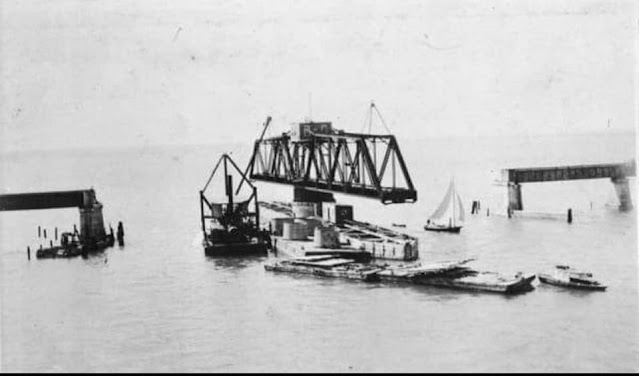
The FEC installed this 250' swing bridge across the moser channel ( the deepest passage , located on the seven mile bridge ) . It was located a little bit south of Pigeon Key.

MiamiHerald, includes a couple of videos
Depending on the years. I’d have to look them up from my timetables, but I’ve seen a few at 25 and others 15 mph.
In the twenties there was a boiler explosion on the Seven Mile Bridge that happened about a mile short of Pigeon Key. Was supposedly a hundred car pineapple train that was underpowered and believe the engineer purposely ran low water to build more steam to get across the bridge. He was to get water at Marathon.
The boiler originally was unretrievable or said the FEC, but was found later about a quarter mile out in the ocean.
"The Labor Day Hurricane of 1935 blasted into Islamorada late at night on Sept. 2. A giant tidal surge, 18 or more feet high, swept across the Keys, and 408 people were killed — 256 of them military veterans who were building the Overseas Highway beside the Overseas Railway."
[This article says Islamorada got hit with 250 mph winds and the barometers plunged to the lowest reading, 36.35, that the US Weather Service ever recorded. "A tidal surge 50 miles wide and 18 feet high, with 10-foot waves breaking on top, scoured the islands for an hour. It was the highest tidal surge in Florida history." The Miami weather bureau kept insisting that the storm was somewhere east of Cuba and no threat even while Miami was getting pounded. They never warned the Keys about the storm.]

Bridges Now and Then posted
The Third Annual 7-Mile Bridge Run, Florida, 1984. (Wright Langley Collection)

Henry Flagler made a fortune as a co-founder of Standard Oil along with Rockefeller and Andrews. Starting in 1885, he used that fortune to build hotels in Florida and a railroad to provide transportation to those hotels. He reached Daytona by 1889 by purchasing existing railroads and modernizing them. Beginning in 1892, he got a charter and extended his railroad south. He reached West Palm Beach by 1894. There he built Whitehall, a 75-room, 100,000 sq ft winter home. He had another home in his wife's home town of Bellevue, OH. Other wealthy members of America's Gilded age also spent their winters in Palm Beach. In 1895, the railroad system was incorporated as the Florida East Coast Railway Co. and it was extended to Fort Dallas by 1896. "Flagler dredged a channel, built streets, instituted the first water and power systems, and financed the town's first newspaper, the Metropolis." The town was incorporated in 1896 as Miami. "When the United States announced in 1905 its intention to build the Panama Canal, Flagler embarked on perhaps his greatest challenge: the extension of the Florida East Coast Railway to Key West, a city of almost 20,000 inhabitants located 128 miles beyond the end of the Florida peninsula....The construction employed up to four thousand men. During the seven years of construction, five hurricanes threatened to halt the project with three causing major damage. Despite the hardships, and the engineering challenges, the Over-Sea Railroad, the final link of the Florida East Coast Railway, was completed on January 22, 1912, just weeks after Flagler’s 82nd birthday." Flagler was instrumental in turning a big swamp into an economy based on agriculture and tourism [FlaglerMuseum-history] . (The invention of air conditioning was also another important enabler of today's Florida.)

StreamlinerMemories, 1950s

LoC
Mr. Henry M. Flagler and Party Leaving First Train to Arrive at Key West, Fla. Oversea Florida East Coast R.R. Harris Co., c1912. Panoramic Photographs. Prints & Photographs Division

FlaglerMuseum
Whitehall is now the home of the Flagler Museum.

FlaglerMuseum-history
Aerial of FEC railroad through Pigeon Key. ©Flagler Museum Archives. [There is a photo gallery at the bottom of that web page.]

This building in St. Augustine was built as Hotel Ponce de Leon, Flagler's first hotel.
3D Satellite

They used a travelling derrick to place the steel girders on the piers.
eBook

eBook

Some of the bridges were closed spandrel bridges.
Bridge Hunter

HAER FLA,44-KNIKE,1--52

John Chantry posted
Interesting photo and text
[This post has lots of informative comments. And so far the group is public.]
Jerry Schlozz shared
Dan McClary: Strange track alignment with the "S" curve crossing over to the right side of the carferry. Very different than the standard design slip approach trackage used by the Great Lakes carferries that allowed interchangeably so if one railroad needed another carferry while it's was being serviced, that railroad could lease one from another railroad and it would connect to the slip. The standardization also allowed all the Lake Michigan carferries to jointly use slips on the west side of Lake Michigan. The only exception was at the Straits of Mackinaw, where the two carferries there were three track carferries, while the others had four tracks. Four track carferry railroads included AARR, GTW, C&O, and one more.
Michael Douglas: Those cable wheels adjusted the ferry & tracks for the tides.

William Robinson commented on John's post
[Satellite]

Peter W. Cross for VisitFlorida

Ian Grove posted seven photos with the comment: "I borrowed these pictures. This is the swing span on the 7 mile bridge to Key West. First it was the Overseas Railroad ...then converted into the Overseas Highway."
1

2

3

4

5

6

7


Sunday, March 7, 2021

1964 Markland Locks, Dam, Bridge and 81mw Hydropower on Ohio River near Warsaw, KY

(Bridge HunterSatellite)

This dam replaced dams #35-39. The locks are the standard 1,200' and 600' locks.

USACE
 
USACE, Louisville District
Photo of the week!
Check out this absolutely beautiful aerial view over Markland Locks and Dam in Warsaw, Kentucky! 
📸 Gary Grunwald

Eugene Griffith, Jul 2018

Street View

J.B. Good posted
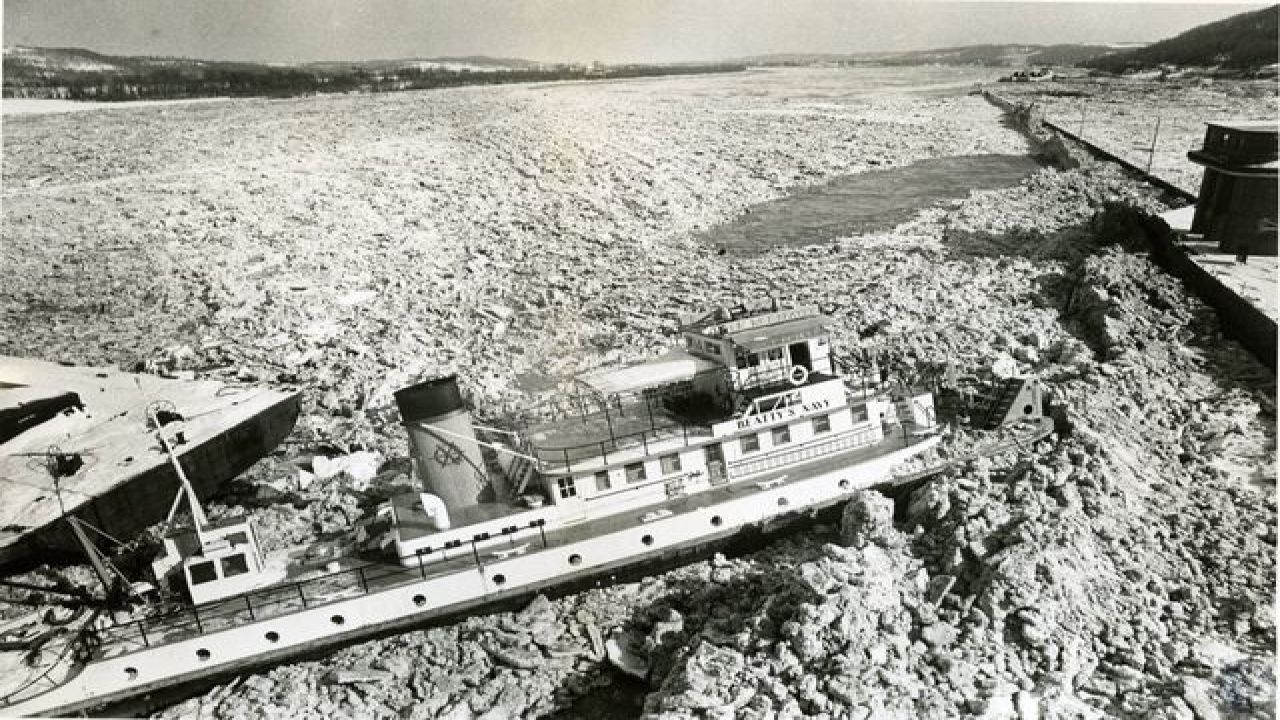
The photo is the upper forebay at Markland Lock, Feb. 3rd, 1978.
[1978 was one of those bad winters at the end of the 1970s. According to the comments, the lock was shutdown for three weeks.]

Some comments on Good's post talk about the Clare E Beatty sinking at the lock.
Update: a comment by Gary George on a post provides the best clue I've found as to how this boat got into trouble (I added some punctuation): "Hey I was there and assisted through the lock by the old Daytona, now the Whosier State. I think any only more boat got through after me before the gorge broke lose carrying the Beaty fleet and boats down on the dam." [Beaty was a recovery and salvage company.]
WCPO

nkyviews

David Norris posted
Our tax dollars at work   Markland
 
Justin Carlisle posted
Ingram's James L Hamilton locking down at Markland.
Originally was the Ralph E Plagge, built in 1976. One of my favorite SLS boats.

LouisvilleUSACE Flickr
Downstream miter gate leaf installed at Markland Locks and Dam
Warsaw, Ky. - Henry M. Shreve Gatelifter installs new downstream miter gate leaf at Markland Locks and Dam today. The gate is lowered into the dewatered lock chamber.
(US Army Corps of Engineers photo by Carol Labashosky)
 
We Work the Waterways posted
A photo of Markland Lock’s big chamber in the dewatered state down for repairs. Bulkheads, as you can see, have been set so that the chamber could be completely in the dry for repairs. 
This lock is on the Ohio River about half way between Cincinnati, Ohio and Louisville, Kentucky. These locks are well over 50 years old and use our tax dollars responsibly so that the U.S. Army Corps of Engineers can keep them maintained and operational. This keeps traffic moving efficiently. 
While this main chamber is down, tows use the small auxiliary chamber, which can result in significant delays. 
Courtesy of Captain Charlie Neal from Amherst Madison's M/V AMHERST, while pulling cuts from the small chamber last night.
 
Inland Waters River People Page posted
Good morning y’all. I’ve been MIA this month. The Ohio River has been flooding [2025 TVA Flood] and I’ve been focusing my attention on safe navigation. BUT the river has subsided and is calming down and is falling. We are waiting lock turn at Markland. They are running 63’ of dam, with a 26.7’ lower gage. Hope everyone has been doing well. I’ll be going home next week. Ms. Liz and I have traveling on our agenda. 
Have a wonderful Wednesday 
I am Jamie
Ron Newton: South bound, it looks like. I have a great story about northbound through Markland in very high water back in the mid 90's. Greenhorn deckhand kept giving Capt. Jerry Trahan (Chotin) the WRONG over-under distance from the lock wall as Jerry pushed with all his might to overcome dam current. Never saw a capt. sweat or curse so much in my life! Obviously, we made it. [This comment is more evidence that north/south directions, instead of east/west directions, are used on the Ohio River.]

Wayne Rassman posted
Belle of Louisville & Mary M. Miller locking northbound to River Roots in Cincy


Timelapse video of a normal operation followed by regular speed.
1:24:56 drone video @ 5:10

The turbulent water to the left of the lock is the water coming out of the lock.
@ 8:10