(Satellite, part of the footprint is still visible)
This was part of the Inland Steel Mill.
 |
| 1 of 28 Inland railroading photos posted by Christopher Lohse-Gutierrez James Torgeson shared |
 |
| Bing, South |
 |
| Bing, West |
 |
| railroad_journal posted Indiana Harbor Canal The first bridge over the industrial canal in East Chicago, Indiana was built by the Elgin, Joliet and Eastern Railway (now CN) in 1880. It was a double track Scherzer Rolling Lift Bridge designated No. 728. Crossing the Indiana Harbor Canal created a unique partnership with three railroads in 1909. Lake Shore and Michigan Southern (NYC), the Pittsburgh, Fort Wayne, and Chicago Railway (PRR) and The Baltimore and Ohio contracted one bridge builder to construct four identical double track lift bridges. Two for the NYC four track mainline, one for the Pennsy and one for the B&O. The Pittsburgh, Fort Wayne, and Chicago Railway (PRR) was the southernmost of the bridges and has been removed, although the foundation is still visible. In 2008, ArcelorMittal’s built a bright blue Pony plate girder bascule rail bridge over Indiana Harbor Canal. Today only three bridges remain in operation: ArcelorMittal’s blue bridge, the former EJ&E (CN) Scherzer and the Norfolk Southern (NYC) Chicago Line bridge. The remaining bridges are “in the upright and locked position” (non-operable). Hick tower is still in operation to oversee the movable bridges. Bridges from south to north: ex-NYC pipeline bridge (out of service) ex-NYC main bridge (out of service) ex-NYC - NS Chicago Line bridge (active) B&O passenger line bridge (Lake sub, out of service) EJ&E Lakefront Branch bridge (active) CLIFFS (ArcelorMittal) “Blue” bridge(active) [In the lower-left corner is the foundation for the this roundhouse.] |
 |
| Frank Newton shared his post Here's a cool 8x10 picture out of my Inland collection . My guess 1970's . Love these black and white photo's . Don't know who the folks are and notice one guy in engine compartment . Photo credit to Dennis Erdelac . Daniel Perez: It's the Round House for sure. Did a lot of piping maintenance work there. Those wheels were machined and pressed in the CMM Machine shop. They actually called the outer rings tires. This was at Inland Steel , East Chicago Indiana in the Plant 1 Round House . Long gone building . Thomas Flynn: Old friction bearing axles. |
 |
| Dennis DeBruler commented on Frank's share I presume it was this roundhouse. 41°39'28.0"N 87°27'14.6"W 41.657764, -87.454048 (Facebook has been deleting most of my comments that contain a Google Maps URL. It declares them a violation of Community Standards. But you can use Google Maps if you copy&paste the GPS coordinates into the search field.) Frank liked the comment, so evidently the presumption is correct. |
LTV on the left, Inland on the right. Note the roundhouse on the right shore of the canal.
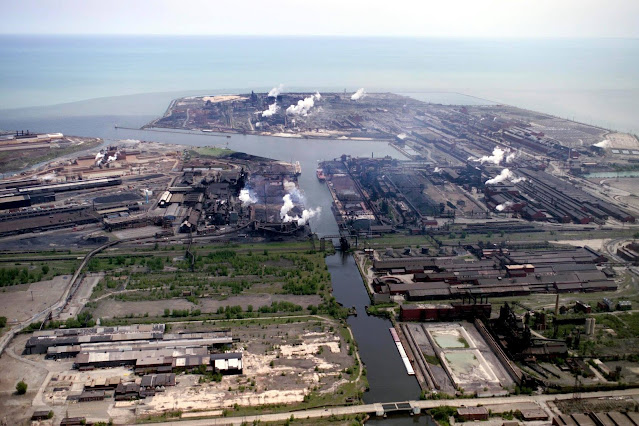 |
| Kevin A Heggi posted Indiana Harbor Works, circa 2005? |
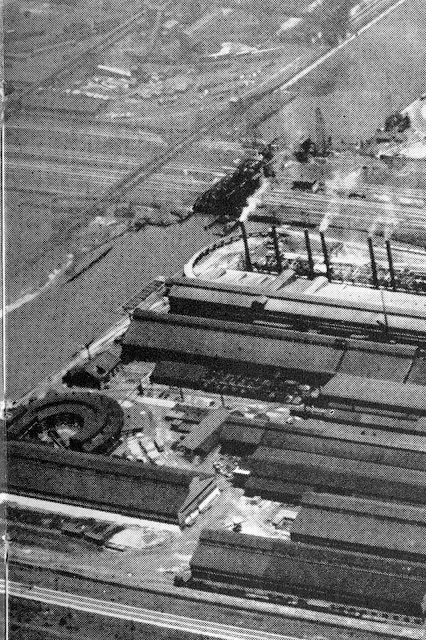 |
| Kevin A Heggi posted Bob Lalich: An unusual roundhouse on the left. The lead to the turntable passed through the structure. |
 |
| Dennis DeBruler commented on Bob's comment Bob Lalich I had concluded that they were in a hurry to build the long building so they tore down just enough of the roundhouse to clear the land that they needed. A contemporary satellite view shows that there is no door in the side of the new building for a lead track. I fired up Google Earth and determined that the remainder of the roundhouse was removed between Mar 2012 and Apr 2013. |
More comments after Dennis' comment on Bob's comment. Higher resolution copies of the images are included after the comments.
 |
Comments on Kevin's post |
 |
| Comments on Kevin's post |
 |
| 1 |
 |
| 2 |
 |
| 3 |
 |
| 4 |
Sam Foster identified a different portal than I found on the south side.
Sam Foster posted two photos with the comment: "Was reviewing some footage I shot on Monday at Indiana Harbor and was curious about this tunnel that connects two of the mills on the Inland side of the plant. Any idea what trains traversed this tunnel and when it was last used?"
There are several interesting responses. Of note is:
Frank Newton: Inlands Rail Transportation department used that tunnel . Went from Plant #2 to Plant #1 . Plant #1 at one time had a roundhouse and large repair area . It was also home of an early large Open Hearth department operation and the rope driven 100" Plate Mill and a few other production facilities . Plant #2 had many of the early Merchant Mills requiring materials and products produced at Plant #1 . Eventually more Open Hearth Departments and a Bloomer were built in Plant #2 as the older departments in Plant#1 were becoming obsolete and eventually closing making the need of the tunnel less important . Both train and vehicle tunnel were very high maintenance often flooding . Plant #3 just to the other side had two Blast Furnaces and several Coke batteries . I don't know if any of the production facilities there also used the tunnel to transport material thru Plant #1 to Plant #2 mills during any outages or breakdowns in Plant #2 production departments . I imagine they could .
A lot more tunnels are in Plant #2 . They are narrow mostly for placement of 660 volt power lines . There was also a narrow gauge tunnel with tracks running along the Blast furnace row in Plant #2 ( Madaline #1 thru #6 ) . Workers could move materials by pushing carts on the tracks to different furnaces underground .Where the final destinations were I don't know I was in it twice only going about 150 feet each time before turning around in my best interest . Kinda scary . There was also a underground tunnel from Plant #2 Coke Plant to the Blast Furnaces , Lol , that was really scary .
[It seems the portal I found by the canal is a vehicle tunnel.]
Scott Walker: There is a vehicle tunnel just north of their by the canal also.
 |
| 1 |
 |
| 2 |

No comments:
Post a Comment