Saturday, January 2, 2016

Rail Post Office Car (RPO)

A Philo, IL, posting ended up describing RPO operations. Post office service was by no means unique to Philo. In fact, towns that were too small for passenger service still had postal service because the mail could be delivered and received without stopping the train. The Illinois Railway Museum did a demo of this that someone videoed.

Jason Jordan shared Larry Eastwood's photo
Update: Larry's comment:
Was working with some photos today, and came across this one taken on June 13, 1963 at Port Kennedy, PA of the Railway Post Office on Train #6, King Coal between Shamokin and Philadelphia, catching the mail sack off the hook at that location.
You can see the step ladder the agent used to lift the bag high enough to mount it on the rack.

A video (no sound) showing a car on a Rock Island train snatching a mail pouch. The incoming mail is supposed to be tossed just before the pouch is snatched, but the train is moving so fast that I don't see it. Edward Hoover posted this link.
John H Nelson More interesting is the Alco on the front end! Nice
Jim Richardson The 'IMPERIAL" was NOT a " ROCKET"! It was a secondary train, A local that was carded for conditional stops at almost every station and rarely missed more than a few. Over time it lost it's diner and sleepers and even it's name.....It was just 39 & 40. Toward the end it didn't even carry passengers east of Kansas City. It was an interesting train in that it was where a lot of old, beat up heavyweight equipment ran of it's last miles.
Bill Pollard Jim Richardson could you elaborate on the detail that 39-40 didn't carry passengers east of Kansas City? Did it operate east of KC as a mail and express train? I thought that the train itself was discontinued east of KC, about the time that RPO and mail contracts began to be canceled.

A 1956 RPO video produced by the U.S. Postal Service. Service for a non-stop station starts at -4:05.

Francis Otterbein posted
Inside a Railway Post Office, pre-1912
Railway mail clerks sort mail in a traveling Railway Post Office. Railway mail clerks had one of the toughest jobs in the Post Office Department, sorting mail on swaying and lurching trains from 1864 to 1977. Although electric lighting was installed in some cars beginning in the 1890s, oil lamps continued to be used for decades. Coal and wood stoves were also sometimes used, posing another hazard. Many clerks survived crashes and derailments only to die in fires that engulfed the cars afterward from overturned stoves. (collection of United States Postal Service)

Francis Otterbein posted
Shown is a side view of Railway Post Office No. 71 on the Burlington and Missouri River Railroad in Nebraska, with its catcher arm grabbing a pouch of mail “on the fly” from a crane and a pouch of mail for local delivery being tossed out for pick-up by a local mail messenger or postal employee. Exchanging mail at small towns without stopping speeded delivery to those communities without disrupting mail schedules between major terminals.
collection of United States Postal Service

Jordan F. Klink posted
The Railway Post Office Car (RPO) was still in wide use in the 60's. These RPO's one or more per train would be assigned to varnish or special mail trains and was the high speed mail link for many small towns. A sack of sorted mail would be droped out the door or picked up with a mail hook as shown in this shot.
Balducci B. Richard shared

KevandSus Dickman posted
Mail car interior, Southeastern Railway Museum Atlanta, GA, 6/19/21

Paul W. Faust posted two photos with the comment: Two views of the interior of a PRR Postal Car that is in the collection of the Railroad Museum of Pennsylvania in Strasburg
© Paul W. Faust""
1

2


Metrotrails posted
Historic mail car on display at Steamtown National Historic Site in Scranton PA. Postal workers within our group claims the car is set up not unlike post offices still are today.

Metrotrails added
Historic 1910 post office rail car, which originally belonged the Pennsylvania Railroad, now on display at the Danbury Railway Museum of Danbury Connecticut
M'ke Helbing shared

Carl Venzke posted
Restored interior of a railway post office (RPO), NRM York
Bill Molony posted
SEVENTY YEARS OF PROGRESS IN THE RAILWAY POST OFFICE
In a ;little car like this, enroute from West Quincy to St. Joseph, Missouri, over what is now a part of the Burlington main line from Chicago to Kansas City and St. Joseph, United States Mail was first sorted while in transit. The purpose was to speed the departure of the overland stage coach from St. Joseph to California. 
At the right is the modern standard Railway Post Office, in several of which the California and other western mail is now sorted nightly on the Burlington fast mail trains between Chicago and Omaha.
The old and the new mail cars for a part of the Burlington's exhibit at A Century of Progress Exposition in 1934.
 
Marty Bernard posted
1. A Railway Mail Service clerk on a Great Northern Railway Post Office car sorts mail for individual towns at the St. Paul Union Depot. March 23, 1949
Photographs and captions from the Minnesota Historical Society

Eric Larsen posted three photos with the comment: "A tour of R.P.O AT&SF 60. At the orange empire railway museum Perris California."
1

2

3

Frank Reeder Scheer posted
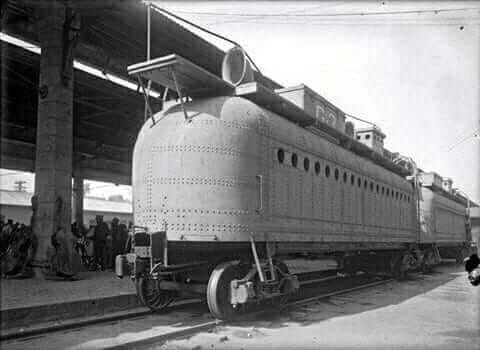
If anyone sees a photograph or other information from the 1920s about the "Bandit Proof Railway Mail Car," I would like to see it. 
John Young: I'm looking at the wages. This is shortly after Ford made big news by paying his factory workers $5 a day. That is about $1000 a year. These were high paying jobs for the time at $2700 a year.
Frank Reeder Scheer: Yes, the wages were high, John. A person had to have a high score on the Civil Service Exam to be appointed. Many people who planned to be teachers or even doctors and lawyers worked for the Railway Mail Service during the Depression because of "steady work and good pay."

Andrew Lawson Carranco commented on Frank's post
That’s not a mail car. That is a armored military car built by the Mexican government late in the Mexican revolution (after 1915). The photo is of my great grandfather who lived in Veracruz in 1920 when the car was in the yard as part of a celebration of Mexican advancements that year.

Mark Locke commented on Frank's post
Found this photo on the Internet about two years ago.

Marty Bernard posted
4 and 5. Mail car, possibly on the Milwaukee Railroad from Minneapolis to Chicago circa 1900. [Both photos have the same caption.]
Photographs and captions from the Minnesota Historical Society
Robert Wanner: Would have loved to work on that one. Peach baskets unusual.

Marty Bernard posted
4 and 5. Mail car, possibly on the Milwaukee Railroad from Minneapolis to Chicago circa 1900. [Both photos have the same caption.]
Photographs and captions from the Minnesota Historical Society
Robert Wanner: Good employment when mail moved by rail. Baskets held tied bundles of letter mail.

George Oswald, Nov 2022
This photo was taken at the Virginia Museum of Transportation.

John W. Barriger III National Railroad Library Flickr
[If you click to the left, I think John took photos of some other RPOs.]


Skip to about -0:30 in this video (alternative link) of an Illinois Railway Museum RPO weekend special complete with a steam locomotive pulling the train.

Friday, January 1, 2016

Bart Tower: Pennsy vs. EJ&E

(no CRJ; John Haynes Track Diagram; SignalBox; Satellite)
NorthAmericanInterlockings:  1968
Chicago and Northern Indiana Railroad Interlocking Towers (click the marker for the correct information)

Kevin Piper has posted histories and photos of the town and this junction. In 1985 this tower also controlled the HO Junction.

Tim Shanahan posted
Hobart Indiana ©1977
Wayne Hudak's photo.
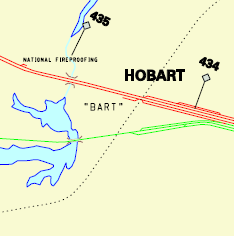
According to the B&OCT map, this tower protected the crossing of the Pennsy and Elgin, Joliet & Eastern.
B&OCT Map
The route of the EJ&E Porter Branch:
DeBruler
I used my 7-railroads posting to determine that Conrail was created in 1976. So it appears Penn Central had not torn out the second track through Hobart. Penn Central made the decision to use NYC's track instead of Pennsy's track after the merger because NYC management was putting their earnings into track maintenance and signal modernization whereas Pennsy management was putting their earnings into non-railroad related real estate because they thought railroads were dead. Conrail continued letting the Pennsy mainline deteriorate so when CSX got it as part of the Conrail split-up, they dumped it on Chicago, Fort Wayne & Eastern. I have heard that Norfolk Southern has been helping CF&E improve the track so that NS can run some of their trains on it. Given that NS already has the NYC and NKP routes and CSX only has the B&O route, I would think CSX would want to use this route again. And I'll bet NS now regrets tearing up the old Wabash route across northern Indiana.

Satellite plus Paint
I added a red line to a satellite image to indicate where the EJ&E used to go through Hobart. When I zoomed in on the image, I noticed that there were two tracks on the CF&E/CSX/Pennsy RoW. But scanning up and down the line on Google quickly revealed that the north track is just a passing siding.

The RoW parallel to the bottom of the image is the NS/NW/NKP RoW and that crossing was HO Tower.
Ken Durkel posted
Although not a "J" train, taken at Bart crossing the "J" so this picture should qualify. Amtrak 40 crossing the Porter branch at Bart Interlocking. The corner of the tower is on the right. Taken in '83 or '84, I would guess.
[Since Ken posted in an EJ&E group, that is why his comment is explaining why he is posting a train on Pennsy tracks.]
Ken Durkel Tower by this time was mostly unmanned, except when the "J" did on occasion run a train through. Then an operator would be out to knock down the Conrail signals. Otherwise, the signals here were fleeted and cleared for Conrail automatically at this crossing by the time I took this.
Daniel Kopack In 1984 I would watch the signal progression.

Ken Durkel posted
Amtrak 40, the eastbound combined Broadway/Capital Ltd., bangs across the EJ&E Porter Branch at Bart Interlocking in Hobart, Indiana. Taken circa 1984, this scene was about to change forever. Conrail was in the process of single tracking the old Pennsy across Indiana, eliminating the old westward main, and in 1985, the EJ&E took up the Porter branch rails.
At the far right is the corner of Bart Tower, the bent rods tell the story, there is no more interchange here and the tower by this time was only manned when the "J" had a train to run to Porter, which was not often by this time. The signals were fleeted to clear up automatically on the Conrail side. If the "J" had a train to run an operator would come out to knock down the Conrail signals and line the EJ&E side.
Mark Egebrecht Capitol Limited began running as a separate train west of Pittsburgh in 1986, so this is a later date or only The Broadway.
Ken Durkel This was in 1984 or so, as I posted. This is the combined train.

George M Stupar posted
 An EJ&E freight is seen rolling past BART tower on the "J" Porter Line, as it bangs across the former PRR Chicago-Fort Wayne double track main. Circa 1981.
Ken Durkel Nice one! And a scene that would change very shortly and not for the better.
Adam St Germain at least the poor commuters finally got a platform on the south side!
Dennis DeBruler https://www.google.com/maps/d/viewer...

George M Stupar posted
An EJ&E SD38 is seen heading east on the Porter Line, crossing the former PRR at Bart tower. Hobart IN, circa 1982.
Jeff Stupar: Excellent photograph of the "J" crossing the diamond. Neat track configuration too. Looks like the Amtrak platform sign posts were recently installed. No sign yet.

Ken Durkel posted
Ken's comment:
Before and after, Bart Tower, on the Porter Branch, Hobart, Indiana. 1st picture, I took in 1983. By this time, all through freight had been pulled off the ex Pennsy Ft. Wayne main. The EJ&E ran trains through here only sporadically, in 1983, so the tower was active, but usually unmanned.
Ken Durkel poste
The signals on the Pennsy side were fleeted, and cleared automatically. When the occasional "J" train was run to Porter, an operator would be called out to Bart to knock down the Conrail signals and line the EJ&E route.Looking timetable west, but more southerly by compass, Conrail usually kept a MOW vehicle parked here, seen in this picture, probably just to give would be vandals the impression someone was home (they were not).The 2nd picture was taken in the same spot back on November 26, 2010. A building was under construction at the time directly on top of the "J" ROW south of the ex Pennsy, now CF&E tracks.
So they no longer have the option of putting the EJ&E Porter branch back in to help bypass the Chicago congestion.


Ken Durkel posted
Looking timetable east, Bart Tower shortly before the Porter Branch was ripped up in 1985. The tower actually stood for at least a year, maybe two, after the tracks were removed. The P10 at the far right shows we are exactly 10 miles from Porter.
Ken Durkel posted
Looking east down the former PRR at Hobart, Indiana. Taken in the summer of 1983. All through freight had been pulled off the line by this time, but single tracking would not reach this point until 1986. 
In the distance is EJ&E's Bart Tower and the Porter Branch crossing. in 1985 the Porter Branch would be torn up, with the tower coming down a couple of years after that. 
At the far left is the old PRR maintainer's shack.Joe Zeller Ain't it something that the CF&E would reinstall a switch here for a passing track. Nice shot Ken.
Ken Durkel posted
Eastbound Amtrak 40, The combined Broadway/Capital Ltd. Seen here in Hobart, Indiana, banging across the EJ&E Porter Branch at Bart Tower. At the time of this photo, the Broadway and the Capital ran combined west of Pittsburgh. Beginning in the fall of 1986 they ran as separate trains the entire way.
I will say I took this around 1984, or spring of 1985, because the "J" Porter Branch tracks were torn up in the summer of 1985, though Bart Tower stood for a couple of years after the tracks were removed. The corner of the tower can be seen to the extreme right. By 1986 the old PRR Ft. Wayne main double track here was reduced to one. Today this is the CF&E.
Mike Dlabay posted
[Ken Durkel added pictures and information in the comments. My incognito test of the link indicates Facebook keeps a "login or signup" window at the bottom, but you can scroll through and read the comments anyhow.]


Ken Durkel posted an eastbound Amtrak train on Conrail's ex Pennsy Fort Wayne line slaming the EJ&E track in 1983 or '84. Amtrak trains were moved to the former B&O line and then to the former NYC line. And the "J" Porter Branch was removed in the summer of 1985.

George M Stupar posted
1976, Hobart IN, An EJ&E speeder is seen on the J Porter Line adjacent BART tower, at the former PRR crossing. View northeast.
Mike W Schattl: It is sad that both lines are no longer used and have been abandoned.

2 photos, Dennis DeBruler shared


CR&I Leavitt St. Yard then GTW Railport then A Warehouse

(Satellite)
 
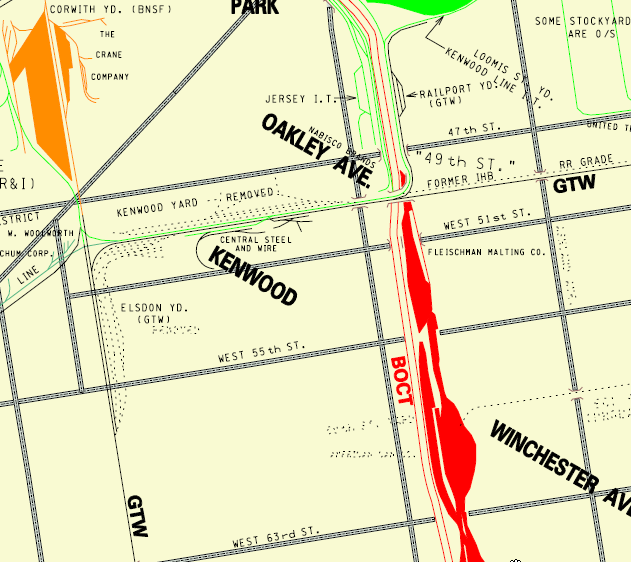
Chicago & Indiana State Line Railway built this yard as the Leavitt Street Yard. The C&ISL was acquired by the Chicago River & Indiana Railroad. Then CR&I became part of the NYC empire in Chicagoland.

Bob Lalich commented on a post

Since the CR&I tracks paralleled the GTW tracks, it was easy for GTW to acquire and access this yard. GTW turned it into their intermodal facility and called it Railport Yard. 
After CN acquired GTW, the railyard was no longer needed. Today the land is used for a warehouse building. Trucks have become so dominate that the warehouse has no rail service.

The Railport Yard Days


Chuck Roth posted two photos with the comment: "A couple shots I took of GTs Chicago terminus Railport in late 1993 from the CTA inaugural run of the Orange line."
1

2

Chuck Roth posted three photos with the comment: "I shot these February of 1992 I think? But I do know the location is GT RAILPORT near 43rd & Damen, end of the line for the Grand Trunk in Chicago."
1

2

3

Note the container gantry in the left background.
John DeWit Woodlock II posted
CN 9414,9400,9413 @ Railport-Chicago,IL 00 AUG 88.
Richard W. Elleby Good Ole Railport. I miss CN Having that yard. Used to watch CN/ GTW #144 Blast across the Belt Railway Diamonds at Hayford Junction on Summer Afternoons back in the 80's and 90's. I sure miss those days.
Chuck Guzik Back in the day railport was wide open. Every track had lines of bad order nyc/prr/pc rail cars .... one day they were gone. Literally overnight. Gtw orange trucks everywhere then a work train came in to rebuild the trestle and place a switch up on the old passenger main. It was great to see the facilty vibrant again. Multiple switch jobs a day would run down from Elsdon. The crews would stop on the trestle and watch us at the baseball field. Great times!

Chuck Guzik commented on John's posting
One thing that was always very cool. Across 43rd st from Railport was an old stock yard cattle pen still in use during the mid to late 1970s. Large 86ft stock cars. Green sides.... would come in ... not sure who brought them in...... and when reloaded would be run either to 55th st intermodal or the pig facility in Englewood.
From the Conrail archives a Doug Davidson photo.

Today


Satellite
You can still see some of the tracks left over from its intermodal yard days.

20171122 8168
Railport was originally a NYC intermodal yard. But PennCentral or Conrail closed it because they choose to use their 47th Street Yard. GTW then bought this yard because they could easily access it via a connecting track from their old passenger line. As the photo to the right shows, that connecting track still goes over a wood trestle.

Judging from the label and photos on Google Map, Marina Railport now owns the warehouse building north of 43rd and uses this yard to store containers. Note the faded "Rail Port" and "CN" signs at the entrance to the yard from 43rd Street.
Street View
I'm glad I saved the above street view because it is now (Jan 2020) shows yet another pre-cast box.
Street View


B&OCT's Robey Street Yard

Scott Griffith posted
Robey Street yard near 14th place and South Ruby Street
Damen Avenue used to be called Robey Street.

Per KTL53's comment:
The C&NW Railroad purchased B&OCT land back in 1983 (12 years prior to the C&NW/UPRR merger) to combine with the existing C&NW Wood St Yard facility. The Global One Terminal opened in 1984.
Lou Gerard posted
Soo Line 2-8-0 at B&O Roby St. engine terminal. From My collection.
Jon Roma Auto-correct failed here: the street was spelled "Robey", and was changed to Damen Ave. on 6/15/1927. Damen lies at 2000W.

1938 Aerial Photo from ILHAP
David Daruszka comment
Sanborn map
Scott Griffith posted
Update: Henry Freeman Looks like they are building the lead to Robey engine facilities. Lincoln Street yard is on the right.

Bob Lalich Lincoln St is now Wolcott Avenue. Photo looks north.
Henry Freeman posted
[This is a valuation map] showing the west end of Robey Yard and Lincoln St. Coach Yard.
Henry Freeman comment on the above posting.
 
Historic Chicago posted
Aerial view of Chicago. (1958)
[We can see the Robey and Lincoln yards in the lower-right corner. Also the I-290/Eisenhower/congress Expressway exists, but the Dan Ryan didn't open until Dec 1961. We can clearly see the Prudential Building, the tallest in Chicago at this time.]

Scott Griffith posted two photos with the comment "Was told these were inside Roby Street shops":

1

2
Scott Griffith posted two photos with the comment "Roby Street":

2

3

1
Henry Freeman shared
Robey Yard can be seen in the background of this photo.
[1963]

1960 Photo by James B. Redmond, cropped, Cornell (source)
[In the "source," Bob Lalich and Les Wuollett discuss a signalling detail that is beyond my understanding.]

Additional Cornell photos are available in this search result.


Evie N Bob Bruns posted
B&OCT 2446 a class K-14 2-6-0 built by Lima on the turntable at Chicago on 7/6/1933
Brian Morgan Robey Street Yard
Bill Molony posted
Baltimore & Ohio class V-4 4-6-4 Hudson-type #5360 with the Capital Limited at Roby Street in Chicago in July of 1937.
Bob Lalich Not many photos at this location turn up. It was fairly inaccessible, except to RR employees.
Richard Mead Odd firebox, looks like a watertube boiler.
Dennis DeBrulerYou and 1 other manage the membership, moderators, settings, and posts for Chicago Railroad Historians. So the truss bridge in the background was for what has become part of today's Pink Line?
Dennis DeBrulerYou and 1 other manage the membership, moderators, settings, and posts for Chicago Railroad Historians. Robey Street is now Damen Avenue. This yard, along with B&OCT's Lincoln Yard, was bought by C&NW and became part of what is today's UP Global 1 Yard, https://www.google.com/.../@41.8620239,-87.../data=!3m1!1e3

Larry Retzl posted
Store room dept. truck parked Wood st.circa 1950
[Railroads owned some things other than locomotives.]