These are notes that I am writing to help me learn our industrial history. They are my best understanding, but that does not mean they are a correct understanding.
The US-6 Bridge is one of my more regular stops when I make a photo trip to Joliet. South of the bridge, I've noticed there are almost always some barges parked on the east side and some barges being unloaded on the west side by Ozinga. If you look at a satellite image, this is where the river widens into the pool behind Brandon Dam.
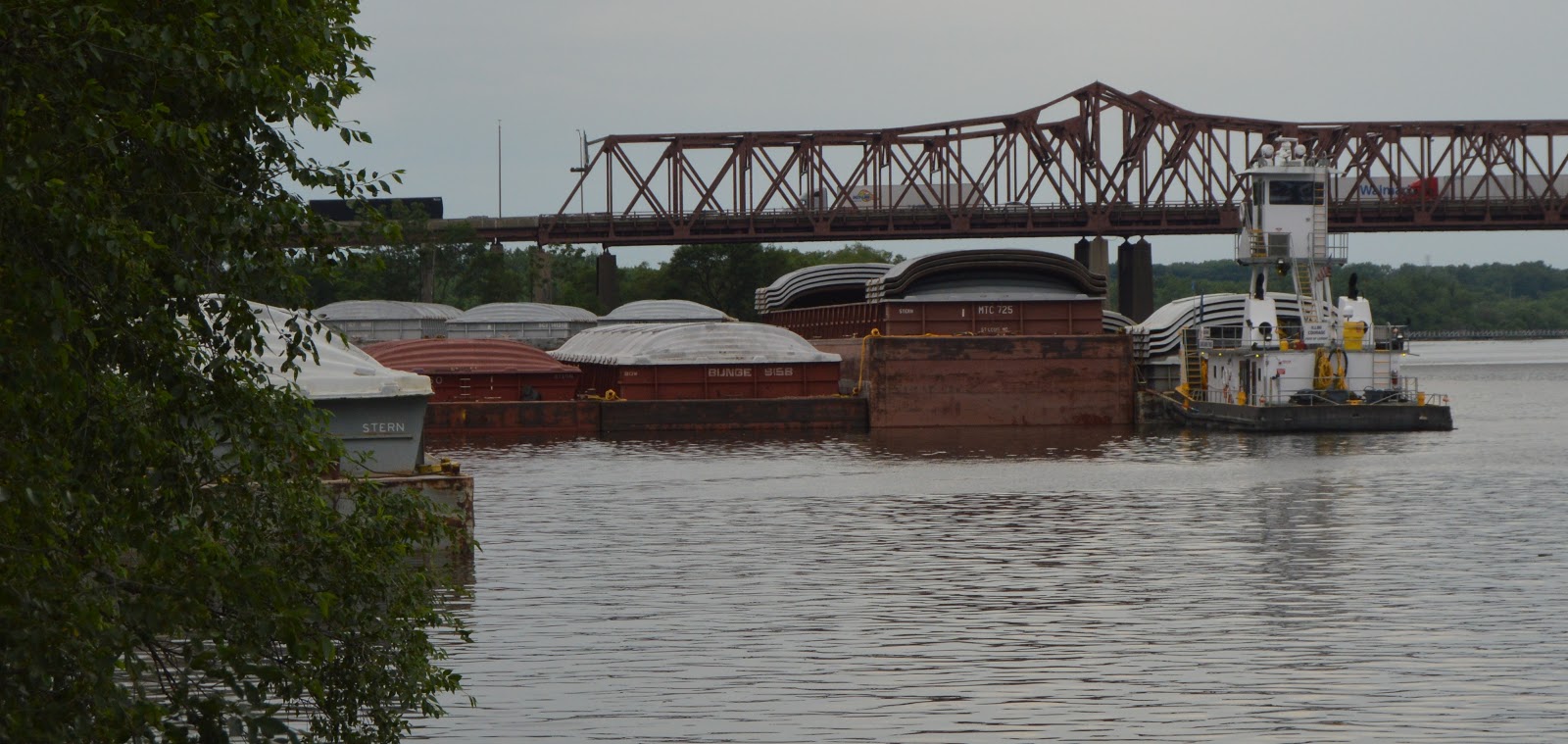
Below is an example of several barges parked on the east side of the river. It looks like 11 barges are parked there. The bridges in the right background are for I-80. The blue handrail in the foreground is part of the US-6 Bridge.
This satellite image catches a 3x2 tow parked there. I have learned that this is a fleeting area for Illinois Marine Towing (IMT). I put a red rectangle around their office building. Their headquarters is in Lemont.
During a trip to Brandon Dam, I caught a big pushboat and several barges at Ozinga's Materials and Logistics from the I-80 bridge. Fortunately, I was getting off so I was in the exit lane. And considering that I was taking the photos without looking at the camera, they came out rather level.
In addition to a local pushboat that has a retractable pilothouse, we see a big pushboat.
20150702 2251
There are several barges in front of the big pushboat.
20150702 2252
Including at least a couple of coal (or pet coke) barges.
Zooming in on the first photo, I could read the name of the pushboat --- Leo G. Lutgring. It is 160'x35' and built in 1978. It is a reminder that Alco, formerly a steam locomotive manufacturer, still makes diesels because it is a twin screw with 12-251F engines with 4370 hp. [TowBoatGallery] (Actually, I think Fairbanks-Morse bought that brand and makes the diesels. But since Google's blog search function broke April 3, 2018, I can't find my posting about Fairbanks-Morse making Alcos.)
Digitally Zoomed
A Google search quickly verifies that this pushboat operates on the Mississippi as well as this part of the Des Plaines River. It has docked a 15-barge tow here so that it can be taken apart and smaller pushboats deliver the barges to their destination industries upbound from here. (I have learned that I should use the terms upbound and downbound instead of upstream and downstream.) Likewise, the smaller pushboats will be returning with barges that have a downbound destination, and they will assemble them into a new 15-barge tow for this big pushboat to transport down the Illinois River and, perhaps, the Mississippi River.
These videos confirm that the Leo G. Lutgring can handle a full 15-barge tow on the Mississippi River.
(new window)
This video makes it look like a triple-screw towboat. But it does have just two exhaust stacks. I wonder if the engines drive alternators and electric motors are used on the prop shafts. That would allow two engines to easily power three propellers.
(new window)
I've learned that disassembling and assembling large tows is called fleeting. Each of the local marine services such as Ozinga's Middle River Marine and Illinois Marine Towing have fleeting areas, including this Joliet area south of the US-6 Bridge. These fleeting areas are similar to local freight switch yards for railroads such as Eola and GM Yard. Specifically, they are big enough that they can hold a long tow/train and have enough area that the towboat/locomotive can store barges/cars while it sorts out what goes where along the river/track.
The analogy continues with big pushboats/road locomotives being used for long distance travel, and smaller pushboats/switching locomotives being used for the local movements. In the case of the Chicago area, local pushboats must have retractable pilothouses because, except for the South Branch Bridge, none of the movable bridges are operated for barge traffic. The barge traffic is expected to fit under the 16.5' clearance of the bridges. Since the level of the Chicago River, the Cal Sag Channel, and the CS&SC are controlled by locks, a powerhouse, and a gate structure; rain storms should not reduce the 16.5' clearance.
Continuing the analogy, fleeting/railyard capacity is used to store empty barges/cars until another customer needs one. And there may provide additional services such as cleaning and/or repairing barges/cars.
A retired professional brown water mariner from tugster
Since there are no locks downstream of St. Louis, that area has fleeting operations that build huge tows from the 15-barge tows that come down the Missouri, Upper Mississippi, and Illinois Waterway. There would be more fleeting areas around the confluence of the Ohio River to build large tows for the Lower Mississippi River. Tows on the Lower Mississippi are normally 42 barges. 7x6 when going downbound, and 6x7 when going upbound. The challenge going downbound is control so a shorter tow is preferred and the challenge going upbound is fuel consumption so a skinny tow is preferred.
Looking back through my Joliet visits, I found that I had seen the Leo G. Lutgring before. It was pushing this 11-barge tow that included a bow-steering pushboat upbound through Joliet.
At the time I saw this tow, I wondered where this 3x3+2 tow was going because the canal is the width of four barges, but many places have two adjacent barges docked along the canal.
While researching where this tow may be headed, I discovered the ACL Transportation Services shipyards. (ACL owns Leo G. Lutgring) Lemont is one of their three terminals. The other two are in Memphis and St. Louis. The capabilities that they list for their Lemont terminal are:
- Bulk, non-bulk, and break-bulk warehousing and stevedoring services- 70,000 square feet of indoor warehouse space- Temperature-controlled warehousing- 7 acres of outside storage- Electronic inventory system- Transloading from truck to barge and from barge to truck
Looking at the information for the pushboat on the bow, Mike Planche, I see that it is also owned by ACL Transportation. That is a large pushboat (2000hp, 85' long) to have a retractable pilothouse. My current theory as to the destination of this tow is that thye will use their shipyards as a fleeting area to build a tow that the Mike Planche delivers to the Calumet River area via the Cal Sag Channel and Thomas J O'Brien Lock.
I wonder what the protocol is for using the Chicago Ship & Sanitary Canal (CS&SC) for docking vs. shipping. To get to their shipyards, the tow would have to go through this stretch that has barges "double parked."
That allows only double-wide tows on the canal, but this tow is triple-wide as we see in this view taken from the Jackson Street Bridge of the tow headed to the Ruby Street Bridge. Furthermore, when this tow is headed upbound in the canal, only small tows can travel downbound, if at all. The complexity of using the skinny canal to get to their shipyards is probably why they are fleeting a tow at Ozinga's dock as we saw above. Or all 15 barges are for delivery to Ozinga.
Illinois Marine Towing almost always has some barges parked on the east side of the river when I visit, but Ozinga normally only has the barges that they are unloading. But on this day I noticed there are three abreast south of the I-80 bridges (see below). I wonder if they are barges to be unloaded by Ozinga or if they are a fleeting operation.
Note in the closeup that there is a shuttle pushboat next to the barge. I don't have enough resolution to read the name.
Digitally Zoomed
20170621 9330
3:07:51 During another visit to the US-6 Bridge, I noticed a little pushboat was upbound under the I-80 bridges. So I moved to the south side of the bridge and stuck around to see where it was going.
3:10:11 It is almost easier to see the white plume than the boat itself down near the end of the third tier of barges.
3:10:39 The boat is really leaning into its turn.
Digitally Zoomed
15:11:19 I recognize Alivia Faith as one of pushboats in Ozinga's Middle River Marine. So Ozinga and Illinois Marine Towing share this fleeting area. It looks like this pushboat always leans to port.
In the closeup above, I can see there is a deckhand at the base of the port knee. In this photo, I see that the captain is leaving the pilothouse...
3:12:02 ...to climb the starboard knee. I find it interesting that the crew member was wearing a life preserver, but the captain does not have one.
3:12:24 The captain is back in the pilothouse, so he evidently got on the knee, not because he was going to help tie up, but because he was just verifying that he positioned the pushboat at the middle of the barge. Since he did not get on the barge, that would explain why he didn't have a life preserver.
3:12:42 This next sequence of photos shows the pilothouse being raised. Note the pilothouse was retracted when it was running light because there was nothing to see over.
3:13:05
3:13:25 But even a loaded barge blocks the view of the pilothouse unless it is raised.
In the meantime, the deckhand has tied the pushboat to the barge and untied the barge from the other barges in the fleeting area because the barge is moving.
3:13:43
3:14:04 Between the pilothouse going up and the barge moving, there is enough action that I was probably thinking of switching to video.
3:14:15 But instead, I have found a photo viewer app/program that will display seconds in the timestamp. Even though there is a lot of action as far as pushboats go, the action is still slow as far as video action goes since we have become accustomed to skyscrapers being destroyed every few seconds by superheroes. Furthermore, it is much more effective digitally zooming a 6000x4000 photo.
3:14:46 I wonder if this is full height for the pilothouse because it would be hard to see over an empty barge with covers.
3:15:02 Note the unloading area at Ozinga is currently empty.
15:15:14 There is propwash behind only the starboard propeller. That is because the port propeller is in reverse. This is why pushboats have two engines and the two propellers are near the edges of the stern. By running the propellers in opposite directions, it allows them to twist the barge around.
Digitally Zoomed
3:16:21 Here we can clearly see he is running the port propeller in reverse.
Digitally Zoomed
3:16:30 Even at full power, the propwash is small compared to what we have seen in some photos of line-haul pushboats because the Alivia Faith is just 650hp.
3:18:47
3:19:34 I noticed a downbound tow is coming from the north. This creates a race --- will I see this barge docked at Ozinga's unloader before I have to get off the bridge because it is going to be raised for this downbound tow?
3:19;55
3:20:23 So they position the front of the barge at the dock first.
3:20:36 The other tow is getting closer. Also note on the left that they have just started loading a barge with grain. And the barge behind it has already been loaded. I've never seen a shuttle pushboat there. I wonder if they use the excavator to push (or pull) a barge as well as handle the covers.
3:22:07 The rear of the barge is swung over to the dock. (Does one talk about the bow and stern of a barge? I have not seen examples to read about handling individual barges.)
3:22:25
3:23:06 I saw the barge docked before I had to get off the bridge.
3:24:04 I now have to get off the bridge. Both downbound tows look small. I wonder if they will be able to lock through the Brandon Lock at the same time. (We will see shortly that they are not going to the lock.)
After I watch the bridge go up and down for IMT's Illini Courage shoving a 2x1 tow, I saw...
(new window)
...that it is delivering its two barges to the fleeting area:
I included the Ozinga barge that we had just seen moved to show that the pushboat is no longer attached to the barge and that they have removed some covers from the barge.
3:31:19
The gates are going down for the next downbound tow, so I have had to get off the bridge, but we can see these two barges, one empty and one loaded, are almost "parked."
3:35:53
Again I cheated and went back just to the land rather than to the gates so that I could see the tow as well as the bridge.
(new window)
Because the bridge goes up long before the tow has approached the bridge, it backs up traffic on US-6 as far as I could see.
With its fixed bridge, the Lemont Trader is obviously a line-haul pushboat. It is 90'x30' and 3200hp and has Cummins generators as well as QSK50 engines. I was not aware that Cummins made generators as well as diesel engines. That shows how big the market is for backup electricity and electric transmissions. I wonder whose motors are used on the propeller shafts. Since this was built in 1974, I also wonder if it uses DC instead of AC. [IMT-boat-position]
As I leave the bridge, traffic is still tied up. I used side streets to go south to checkout the Brandon Lock and Dam so that I could avoid that mess.
It is obvious that they will be assembling a 15-barge downbound tow for the Lemont Trader.
LMT Towing-Fleeting
Southbound "Lemont Trader" Joliet Harbor with 15 barge tow
In fact, here is an example of the Lemont Trader heading downbound from this area.
When the current is strong on the Mississippi River, adding barges to the upstream part of a tow can be dangerous.
(new window) You may want to mute this video. The captain that is making the video makes quite a few worried sounds. The first words spoken are at 4:35: "There she goes." And you don't want to hear the next words he says. (It doesn't go under.) I have no idea how they managed to tie the ropes to the hitching posts that were under water. The other towboat must have delivered the guy we see running into the second story door at 8:10.
While trying to find where a new port is supposed to be built in Cairo, IL, I noticed a couple of weird looking tows on the Ohio river. Zooming in revealed that the tows were being built by a fleeting operation. I wonder how they anchor those tows in the river while they are being built.
Two harbor tugs that do fleeting operations on the west bank of the Illinois river at Havana, IL.
Jack Tanner Towing posted River may be up, but we keep on going.... (Photo credit: Dave Huber)
Note that the doors on the first floor are under water because the current has pushed the towboat so far under the barges. That is why they are watertight and why the crew should keep them shut. I've seen videos of twoboats sinking because the crew had not shut the doors.
1:37 timelapse video @ 0:25 Training Day. Steersman Lessons
I've noticed that the inland waterway industry is replacing "towboat" with "pushboat." Since pushboat is a much more accurate description of what the boat does, I'm going to start using the "pushboat" terminology. But, since I already have 30 postings labeled "towboat," I'm not going to change the label. (Update: it finally occurred to me that "towboat" describes what they push, not how they move it. So I'm switching back to towboat in new posts.)
John W. Coke posted Dennis DeBrulerA nice view of two Z-drives. They can be turned to produce thrust in any direction.
When I saw a pushboat at the front of an 11-barge tow on the Des Plaines River in Joliet, IL, I wondered if it had Z-drive because it was facing the wrong way for bow steering. But the Mike Planchewas built in 1975, and Z-drives were not tried on pushboats until 2008. [MarineLog]
20150603
Z-drives have been used a while now on tugboats that handle ships, so they have proven that they can handle the output of high-horsepower engines. I found this video to illustrate what a Z-drive looks like.
One of the advantages of a Z-drive is that they can apply full thrust in any direction, including sideways. So when used as a bow thruster, a lot smaller (cheaper) pushboat can be used. The video below illustrates that a Z-drive is as efficient in reverse as it is in a normal direction. I assume they are pulling backwards because it allows the captains in the bridge to more easily watch what is happening with the ship. (They are trying to pull a ship off of a submerged bank in the St. Lawrence Seaway. (The ship lost steering control.) They ended up bringing in a third tugboat that has ocean towing power. They still could not free it. So they used the downstream dam to raise the water level a little, and that allowed the horsepower of the ship plus three big tugs to free the ship. It was a tanker ship, but nothing leaked. In fact, I think it passed its hull inspection without needing any repairs.)
A retired professional brown water mariner from tugster
Maneuvering the large tows that are used on the Lower Mississippi around tight bends requires skill and horsepower. If you search for "RE:" in tugster, you will find an explanation of flanking Wilkerson Point. To summarize, as we can see from the plume in this photo, the pushboat is in full reverse with the plume directed to port to stop the pushboat at the inside shore of the bend. Then the river current that flows along the outside shore will push the front of the tow around the bend. It may need a little nudge to help the current, that is why the little pushboat is headed towards the front of the tow. Note that the tow occupies the entire width of the river when making a sharp turn, so it must use the radio to notify downstream traffic that is headed upbound that they will have to stop until this tow makes it pass these river bends.
If the pushboat has enough power and maneuverability, it can drive the bend rather than flank it. That is, it doesn't need to come to a stop because it has enough thrust to shove the front of the tow around the bend before it runs into the outside shore.
Making a bend while heading downstream is an everyday occurrence on the rivers. Flanking and driving a bend are two common techniques used to navigate a bend. Both maneuvers require the pilot to position the stern of the towboat so that the pilot can overcome the tendency of the current to sweep the tow down on the outside of the turn. In the case of driving the bend, the pilot has to have enough steering power to swing the tow and power out of the bend before the towboat ends up on the outside bank. In the case of flanking, the pilot holds the stern more or less stationary over the ground while the current pushes the head end of the tow around. Flanking requires long periods of time and large amounts of power to navigate through relatively short stretches of the river. This is less efficient and uses more fuel but is required if the towboat doesn’t have enough power and maneuverability to drive the bend. A Z-drive towboat with its superior omni-directional thrust may be able to drive the bend in cases where a conventionally propelled towboat would have to flank. [MarineLog]
Max Wolf posted [I noticed that it was riding awfully low. Other commented about almost no freeboard. The comments indicate that this is a triple screw Z drive. I've learned that it is rather typical for a towboat working on the lower Mississippi River to have three engines. If I understand a comment correctly, it has 6600 hp. Max Wolf comments that he was told it can handle 42 S/B and 35 N/B. Barry Bequeret commented that "Jerry Jarrett has taken 46 s/b from lake providence to Nola."] Christian Townsend: Ken Stiltz Jr. I designed this boat... Marquette runs these z’s about 4” deeper than we designed her for. They like that ass deep in the water. Ken Stiltz Jr.: Christian Townsend I understand that for different reasons. But she can get swapped real easy. U would have added a little more length to her.
Update: Brandon Hayes posted two images with the comment:
Down time in Natchez this morning, trying to help the new steersmen grasp the concept of a flank I drew these up. Figured I'd share them for those of you that are curious about why we flank vs steer some bends, and what a flank actually is.
To steer a turn in moving current is the pilot betting himself that he will have the tow pointed in the correct orientation at the bottom of a turn with enough room left over to out run his slide with out colliding with the bank.
That are many sure bets. When the odds are in the pilots favor a steer is pain less and quick.
When the odds are not in the pilots favor, flanks are performed. For me personally, there are several turns that depending on the river stage and quanity of barges in my tow I will flank no matter what. Others I use the #2 pencil trick in the radar, ( thats more in depth, if you are a pilot and don't understand what I mean by that send me a message I'll explain it to you) Finally there's the I thought about it 3 times. Any turn on the river that I have thought maybe should be flanked more than 3 times before I get to it I will flank. It cheap insurance.
So what is a flank?
In short a flank is allowing the river to do the work.
By flanking you bring the tow down to the speed of the current ( how fast the water is moving) and allowing the river to safely bring your barges around the turn.
On the flank photo
#1- the tow is moving at normal operating speed, maybe slightly slower.
#- 2 the pilot begins to back up. His goal is to get the tow down to the speed of the current. Some times it's nessary to get the tow below current speed for the tow to get into the flank, but not always.
#3 with the tow down to current speed, the boat and stern of the tow are positioned into the slacker water while the bow goes down into the bend. The faster water is down into the bend will start to push the bow of the tow around the turn.
#4 very similar to #3 but this is where all the magic happens. The faster water in the bend pushes the forward half of the tow around, the stern beling in slacker water acts as a pivot.
When the tow is between photo 4 &5 the pilot straightens all the rudders and begins to push ahead.
#5 the pilot is shoving out of the flank. The shove out is critical as waiting to long the tow will go into the sand bar, not waiting long enough and you might as well have steered it because you just done alot of work to race the bank anyways. When shoving out the tow needs to get above the current speed as quickly as possible to obtain steerage. When done correctly, althow it takes a considerable amount of time longer than to just steer a turn, it's 100% less stressful and the chances of collision with the bank are dramatically decreased.
Hope this helps some of you out. If nothing more, it gave me something to do while waiting tug service.
The upstream guard pier was destroyed when two of the barges of this tow allided with the pier in March, 2017. The Steve Plummer had twin 350hp engines. 700hp could push the tow at only 3.5mph against the 3mph current, and it did not have enough additional power to maneuver past the bridge. Even though the towboat could handle four loaded barges in slack water and three barges in a normal current, the company has reduced the tow size to a maximum of two barges under this bridge. [MarineLog] Given that one barge is still tied to the towboat, it appears that he was pushing a 1x3 tow.
If you look at this photo by Calvin Sneed, you will see that both guard piers and the pivot pier were made with cut stone. But if you look at the 3D Satellite image, it is clear that the upstream guard pier is now made with concrete. I'm very impressed that Google's 3D imaging is up to date enough to catch the new pier.
"CSX Railroad Bridge over the Cumberland at Nashville, 2010, MNA" from Nashville History
Joe Tessmer shared
Railroad Bridge on Cumberland River at Clarksville. Flood of 1937.
From USACE collection.
Francis Otterbein posted
RJ Corman, Clarksville TN
Francis Otterbein posted
Swing through truss bridge over Cumberland River on R.J. Corman Railroad Line at Clarksville, TN
Marty Bernard shared 5 and 6. CSX SW1500 1117 built as L&N 5017 in Nov. 1971, retired sold to Larry's Truck and Electric Service 2021 in Nashville, TN in 1990, Karl Miller photos. Jon Marsh: Must of been more bridge,s seeing the pillars
20180624 2368rc+15+0
I played a lot with brightness and contrast, but I could not improve the visibility of the trail bridge built through the arches of the piers.
Here you can see where the river trail branches and goes across a trail bridge built inside the piers:
I had made a trip along the Fox River the previous week, but I made this additional trip because the area had over six more inches of rain. This view looking upstream (North) from the bridge shows how high the water is with respect to the Island Park and the IL-38 bridge.
You can see where parts of the original stone abutment wall was replaced with concrete and three concrete ribs were added to strengthen the old wall.
The above view looking north along the river shows that the city maintains a lawn along the riverside so one has clear views of the bridge. But downstream, there is a treeline between the trail and the river. I had trouble finding gaps in the treeline that allowed a view of the bridge.
In this view, I can't get a decent view of the bridge, but I can catch some of the water turbulence.
Kevin S. Hoover posted
Metra Union Pacific West line headed over the Fox River to the Geneva Station. Kevin S. HooverIt came from a DJI Phantom 3. Kevin S. HooverJohn Dalman, I was in communication with DuPage Tower during this flight. I got approval for flight below 150 AGL. I also consulted FAA Regional safety director Mark Foise, unmanned aircraft specialist, (Great Lakes region). Thanks for your concern. I was also following the criteria of being within 400 feet of any structure. That pertains to the see and avoid rule. In addition, this flight was done well before the part 107 regulations we're in place.
Chris Roberts posted
Taken at the Fox River Bridge at Geneva IL on 5/15/2018.
Keith Pokorny posted
UP 6965 leads an Eastbound stack train over the Fox River in Geneva, IL. 5/15/2018
[Keith overexposed the sky so that he could get a good exposure of the bridge and train.]
Keith Pokorny posted
The Westbound Troy Grove train LPG-04 crosses over the Fox River in Geneva, IL. 5/15/2018
The fill of the arches in Keight's photos was about the same as when I took pictures, which was when the river was running high.
The above location is where I thought of taking a video of Big Boy when it crossed the Fox river. Fortunately, I got good enough video when it came to town that I passed getting a couple of seconds of video here. And Jacob Fischer took a better photo from this spot than I would have taken.
Another photo from the vantage point I was thinking of. It seems that it was more crowded than I imagined.
Marvin Smith posted
Big boy crossing the Fox River In Geneva - my photo
Jack Anderson got a view from the bridge, which is another shot I was thinking about.
Jack Anderson posted
UP 4014 sets out on its long journey on the Geneva sub to Clinton IA crossing the fox river in Geneva IL. This was my first shot of it on my chase from Geneva to Sterling. Taken 7/30/19 Dennis DeBruler The smoke shows that the train was up to speed by the time it got here. That has to be some mighty fine shutter work to catch that framing.
One of nine photos posted by Don Dieckmann
Union Pacific "Big Boy" #4014 begins his journey home to Wyoming. Here crossing the Fox River in Geneva, IL, July 30, 2019. Dennis DeBruler A couple of years ago I walked downstream of that bridge using the Fox River Trail looking for a break in the trees. I was defeated. Fortunately, you found a way to get past the trees. https://www.google.com/.../@41.8814437,-88.../data=!3m1!1e3
A third rail is going to be added across the Fox River. This article mentions that the Chicago Protocol hours are 6-9 and 4-7. Dennis DeBrulerI found Peck Road, but it is parallel to and a couple blocks south of the railroad. So I can't figure out where in Geneva the third track will stop. Where is the overnight commuter storage yard for this line? It is interesting that the former Milwaukee line in Elgin and this line are getting another track over the Fox River next year. Dennis DeBrulerI have heard the rule about no freights between 6-9 and 4-7 called "the Chicago Protocol." BNSF does honor it. But once I was in Glen Ellyn between 5 and 6pm, and I saw two westbound freights along with six commuters during that hour --- a grain train and an intermodal+TOFC. Later (6:29) on my way home, I found the intermodal parked just west of I-355. As I was leaving on Glen Oak Road, Lombard, another westbound intermodal caught me by surprise at 6:38. David DaruszkaWhen the UP took over the C&NW the first thing they did was hold the AM Suburban rush so they could run freights. After they cleared the poop off the fan they found out that there were protocols for running freights in suburban territory. As long as they don't interfere with the trains I imagine they'll try to get away with whatever they can. I worked for both the C&NW and the WC and can attest to the "embargo" of freight trains during the rush hours.
I'm saving a satellite image since it is supposed to change.
A video of an eastbound coal train rolling along pretty fast. It has a DPU. Soon as the Metras cleared, here comes the black gold. This bridge is scheduled to be triple tracked soon. 140-150 trains a day Note this is one of the few reverse track operations in the US, leftover from C&NW days Geneva, IL Fox River C&NW heritage
Big Boy 2026: Wow, it has been a while since I've been here. They have added a third track since my last visit.
I highlighted the town that was next to it --- South Chicago Heights. By not allowing themselves to be annexed by either town, they probably reduced their property tax bill.
I found this yard when I tried to determine the destination of this train that was on the connector at Jay Tower and that was heading south.
EJE 657,654 @ Jay Tower-South Chicago Heights,IL 28 MAR 05.
When MoPac allowed L&N to have the eastern part of C&EI to satisfy the railroad regulators, this "main stem" between Dolton and Woodland Junction was shared by both. So now both UP and CSX share this "main stem." (North of Dolton, C&EI used C&WI to access Dearborn. CSX traded their share of the C&WI rights to UP in exchange for something else. But I can't remember what the "something else" was.)
I posted the question of who uses this yard now. Aaron GraceI think both, but I believe it's run by the Chicago Heights Transfer Terminal Company. John DeWit Woodlock III was going to say the same thing Aaron said. If the CHTT is running it , then it is a UP operation. Denis JohnstonAt one time it was filled with sparkly new freight cars from Thrall car. EJ&E would do daily transfers also. David BrandesCSX doesn't use it, maybe to setout a bad order on a rare occasion. Doesn't get much use these days even by the UP. Mostly used for storage purposes now, maintenance equipment, yard center plugged etc. Those tracks used to extend north of 26st at one time and crews used to report to 26st....before my time 2001. During my time it was mainly used for interchange with the "J", pickup and setouts by both, now that doesn't happen anymore either. CHTT is all UP jobs and employees and they don't use this yard for much of anything either. They used to store excess Ford autopart cars here for the plant but that pool of cars is getting very small now.
John DeWit Woodlock II commented on my posting
Here is a different set of power with a different angle.
Joe Usselman posted
Old SD40's and SD45's were sold to scrap and were waiting out their fate in a small yard in South Chicago Heights in 2013.
[I'll bet the "small yard" was this one.]