Friday, January 8, 2021

1834+1867+1890+1904 Amtrak/Pennsy High Bridges over the Brandywine River in Coatesville, PA

1904 Stone Arch Bridge: (Flickr; Bridge Hunter; Historic Bridges; Satellite)

This was the fourth bridge at this location. See below for the previous two bridges.


""The Penn Central Railroad Bridge at Coatesville is a ten-arch bridge spanning the west branch of the Brandywine Creek. Each arch is ninety-six feet high, and has stone voussoirs over its entire length. Regularly coursed rusticated stonework fills the spaces between arches; the bridge has nine piers. The bridge carries four tracks." [Historic Places Inventory via Historic Bridges]

Metrotrails posted
Historic mid 1903 image of the base of the Coates High Bridge going up, the final step of the quadruple tracking of Pennsylvania Railroad on the old main line. From Lukens Inc negatives, Library of Congress

Metrotrails posted
Historic 1904 image of the completed construction of the Coatesville High Bridge with a locomotive passing over, while the 1890 deck truss predecessor [see near the bottom of these notes] is being dismantled, from Eugene DiOrio collection. 
The 1000 ft long, 100 ft tall Viaduct over the West Branch of the Brandywine Creek took only a little over one year to build, completed in 1904.
Highly skilled Italian Stone masons, Masters of their art, were brought in by the Pennsylvania Railroad to undertake this incredible task.
The first railroad bridge to spend this Valley was that of the Philadelphia and colombia, completed here in 1834. That first Bridge was a single track, and it was rebuilt as a double track bridge in 1854.
The Pennsylvania Railroad acquired the Philadelphia and Columbia in 1857. Among the many improvements made were the replacement of this bridge with an iron deck truss structure in 1867. It was partially rebuilt with wrought iron in 1883, and then replace entirely with another metal truss bridge in 1890.
The magnificent stone arches carry trains over them daily to this day.
Dave Pember shared
 
Metrotrails
Historic 1870s W. T. Purviance stereoscopic photos of the second Coatesville High Bridge, on the Pennsylvania Railroad, over the West Branch of the Brandywine Creek. 
The Philadelphia and Columbia Railroad came through first in 1834 and constructed a wooden, single track trestle. This was rebuilt in 1854 as a double track wooden trestle.
The Pennsylvania Railroad purchased P&C in 1857, and replaced the wooden structure with the iron structure seen here a decade later. This bridge was upgraded with new wrought iron in 1883, but then replaced entirely with another similar deck truss iron bridge in 1890.
The current bridge at this site is a nearly 1,000 ft long, 8 arch stone viaduct completed in 1904. It still carries passenger trains daily.

𝗥𝗲𝗺𝗲𝗺𝗯𝗲𝗿 𝗪𝗵𝗲𝗻: 𝗣𝗲𝗻𝗻𝘀𝘆𝗹𝘃𝗮𝗻𝗶𝗮 and Ohio posted
Standing on the Coatesville Bridge • circa 1870s!
Art Suckewer: The bridge in the photo is a cast iron and wrought iron Whipple deck truss. The piers are interesting, were they raised or was the a prior, wooden truss?
Matt-Jackie Matter: Yeah, it appears as though the piers were added to.

Metrotrails posted
Historic 1904 image of the near completed construction of the Coatesville High Bridge, from Eugene DiOrio collection. 
[The rest of the description is a repeat of the above post.]
 
Metrotrails posted
Historic early 1900s image of the Coatesville High Bridge, from Railroad Museum of Pennsylvania, showing a locomotive crossing the eight arch stone viaduct completed in 1904 by the Pennsylvania Railroad. 
[The rest of the description is similar to the above.]
Dave Vollmer: That's a B60b behind that K4 so the very earliest this could have been photographed was 1925. More likely to be the 30s though.


Ed Hollowell commented on Bridge Hunter:
It occurs to me that this must have been very near the end of the era of stone construction and the start of concrete. I can name some structures in Indiana that were built in the 1905 period that were all concrete and the most remarkable part of that was the fact that the railroad they were built for was owned by a man who owned stone quarrys not far away. (Kitton Ditch Bridge)

Photo via Auntie LuAnnie

Robert Wanner commented on a post

Sixth of 80 stories after filtering out "People" on a timeline
1834: High Bridge Across the Brandywine
The High Bridge across the Brandywine River is built for the Philadelphia & Columbia Railroad, expanding marketing opportunities for Rebecca's mill
 
Fred Lannert commented on a post
Equally impressive is where the picture [of the steel mill] was taken from.
The Coatesville High Bridge is an engineering marvel.

I include the retaining wall along Lumber Street because this is the first time I have seen buttresses for a retaining wall.
Street View
.

The 1867 and 1890 Bridges


There were three predecessor bridges. The first was built in 1834 for the Philadelphia & Columbia Railroad (P&CRR) (a photo further below). The second was a cast iron truss bridge built in 1867. The third bridge was built in 1890, and the railroad was still the P&CRR. The 1904 bridge was built by Pennsy.

The description for this post also documents the bridges.
Metrotrails posted
A view west on Lumber Street in Coatesville Pa, where a coaling trestle used to cross, with the Coatesville High Bridge in view ahead.
The 1000 ft [305m] long, 100 ft [30.5m] tall Viaduct over the West Branch of the Brandywine Creek took only a little over one year to build, completed in 1904.
Highly skilled Italian Stone masons, Masters of their art, were brought in by the Pennsylvania Railroad to undertake this incredible task.
The first railroad bridge to [span] this Valley was that of the Philadelphia and colombia, completed here in 1834. That first Bridge was a single track, and it was rebuilt as a double track bridge in 1854.
The Pennsylvania Railroad acquired the Philadelphia and Columbia in 1857. Among the many improvements made were the replacement of this bridge with an iron deck truss structure in 1867. It was partially rebuilt with wrought iron in 1883, and then replace entirely with another metal truss bridge in 1890.
The magnificent stone arches carry trains over them daily to this day.

1867 Bridge (Second)


History's Mirror posted
The Coatesville Bridge, circa 1870s, is a remarkable piece of Pennsylvania's history, standing as a testament to the engineering and architectural skills of the time. Located in Coatesville, Pennsylvania, this bridge, captured in an image by WT Purviance, was part of the region’s early infrastructure that supported both transportation and commerce.
[The rest of the description is just platitudes.]
 
Metrotrails posted
Historic 1880s view of the second Pennsylvania Railroad bridge to cross the West Branch of the Brandywine Creek in Coatesville Pennsylvania, built in 1867, seen here after the Pratt deck truss was upgraded in 1883.
 
Metrotrails posted
Historic late 1870s or early 1880s view of the second Pennsylvania Railroad bridge to cross the West Branch of the Brandywine Creek in Coatesville Pennsylvania, built in 1867. From Greystone Society. 

1890 Bridge (Third)


Metrotrails posted
Historic circa 1900 view of the third Pennsylvania Railroad bridge to cross the West Branch of the Brandywine Creek in Coatesville Pennsylvania, from Greystone Society. 


Thursday, January 7, 2021

CSX/C&O Fort Springs Tunnel in Greenbrier County, WV

(Bridge Hunter; Satellite)

Marty Bernard posted three photos with the comment: "C&O 7602 Exits Fort Springs Tunnel
Roger Puta captured this sequence at Fort Springs Tunnel in Greenbrier County, West Virginia in October 1981. These really look good full screen."
1

2

3

The tunnel is nothing special. C&O had a lot of them in West Virginia. In fact there are tunnels just a few hundred feet to the West and a few hundred feet to the East. But the Chessie Cat livery is worth saving an least once in this blog. 

Wednesday, January 6, 2021

Illinois Central's Riverside & Harlem Railroad (Forest Park Branch)

The information for these notes comes from two Facebook postings: Chicago Railroad History and B&OCT.

William Shapotkin asked about the "Forest Park Branch" of the Illinois Central:
The Illinois Central once operated a line, which I understand was  known as the "Forest Park Branch." The line began at "Parkway" (26th St  west of Harlem Ave in North Riverside, IL) and headed north connecting  with the   present-day CSX (of course, we know it as B&OCT) just  north of Harrison St in Forest Park, IL. The IC referred to the north  end-of-line as "Harlem Jct," the rest-of-the-world referred to it as  "Great  Western Jct."
The line is now abandoned -- but some eight  years ago, I was able to follow and photograph the line from Parkway  north to 15th St (where the track ended). Does anyone know when the line  was removed north of 15th St? Courtesy of a fellow (Bob Lalich), we  know the line was still intact as of 1942 (see track chart below). If  anyone can shed some light (and even better a few photographs) of that  line north from 15th St -- MORE ESPECIALLY the at-grade xing of the IC  and the Chicago & West Towns streetcar line at Roosevelt Rd (aka  "12th St"), it would be greatly appreciated.
Many thanks.
Provided by Bob Lalich

David J. Leider explained:
The original name for the line was the Riverside & Harlem Railroad. It was used by the Wisconsin Central to get to the IC's lakefront station. The WC was going to build the line, but the IC insisted as they wanted to gain access to the Harlem Racetrack, which was just west of the Right-of-way. The line was incorporated April 10, 1901. Capital stock $200,000. The Village of Harlem granted them an ordinance to build the line on July 5, 1901. It was open August 30 after a skirmish with the Chicago Terminal & Transfer about crossing its tracks. The IC purchased the line October 1902.
This 1953 topo map shows what the branch looked like when it was intact.
1953 Berwyn Quadrangle @ 1:24,000
Provided by Dennis DeBruler

By 1963 it had been cut back so that it no longer crossed Roosevelt Road.
1963 Berwyn Quadrangle @ 1:24,000
Provided by Dennis DeBruler

By 1972, a spur had been added for an industrial park north of Woodlawn Cemetery. The track configuration was the same in the 1980 map, but there were more buildings in the industrial park.
1972 Berwyn Quadrangle @ 1:24,000
Provided by Dennis DeBruler

By 1993, the tracks had been removed by the Forest Park Mall.
1993 Berwyn Quadrangle @ 1:24,000
Provided by Dennis DeBruler

The last map available is 1998, and it still shows the track going north of 15th Street. I noticed that today none of the buildings in the industrial park have rail service because the track south of 15th Street has been removed. Today there is more track on this branch north of 15th Street than there is south of it.
Provided by Dennis DeBruler

The guy that drove the Google street car in this area must have been a railfan.
Provided by Dennis DeBruler

Matthews and Mann provide some insight into the industry that used to be along that branch.
Facebook

Andre Kristopans explained that when SOO (one of the many corporate names for this Wisconsin Central route) moved from Central Station to Grand Central Station, it no longer used this route. "When they went back to Central again (early 60s?) they used IHB down to Broadview."

I've lived in the western suburbs of Chicago for over four decades and never heard of Broadview. Looking at a map, I see I drive by it every time I'm willing to test the severity of the traffic jams on I-290. I highlighted in red the IHB route used to connect WC/CP/SOO/WC with IC.
Satellite plus Paint


Tuesday, January 5, 2021

MQT/CSX/C&O/PM 1903 Bridge over Grand River in Grand Rapids, MI

(Bridge Hunter; Historic Bridges; Satellite)

"Along with the few other truss bridges in the Grand Rapids area, the bridge is among the longest truss bridges in Michigan. Very few rivers in Michigan reach the size of the Grand River in this area." Originally, the bridge carried two tracks.  [Historic Bridges]

Street View
 
Photo taken by Brent Tindall in Apr 2014 via Bridge Hunter, License: Released into public domain
Upstream side from West end
[The first span was completed in 1922 and the next span was one of the original spans and it was built in 1901. We can barely see the tie rods in the pin-connected Pratt Truss of the second span. The Warren Truss span is old enough that it is still using V-lattice for the compression members.]

Brian Caswell posted
MQT 3389 (Z151) Leads a four unit short manifest North over the Grand River in downtown Grand Rapids Michigan , on its way North to Grant / 12-29-20

Tim Shannahan shared
Theodore Garofolo: Does the swing still open?
Tim Shannahan: Theodore Garofolo Nope.
Theodore Garofolo
 The requirement to accommodate navigation on the Grand River was dropped in 1907, just four years after the bridge was finished!

Dennis DeBruler commented on Tim's share
MQT is Marquette Rail that operates former Pere Marquette routes.

Dennis DeBruler commented on Tim's share
I checked the gwrr web site. It states the capacity of the MQT is 286k. That is the current standard. I'm rather surprised this bridge supports that load. I got curious as to how ubiquitous the 286k standard has become and extracted this CSX capacity map. I wonder if the little red dots are bridges. The red routes are limited to 263k with 4-axles.

Satellite plus Paint
The date information comes from Historic Bridges. I think Bridge Hunter has the 1908 and 1922 spans reversed.
 
Jonathon Leese posted
NS job B49, running as Z739 on CSX, crosses the Grand River northbound with a former Conrail GP40-2 and GP38-2 for power. On the head end of the train are gondolas full of wire for Michigan Wire in Lowell on the Grand Rapids Eastern, which burned down a few years later. Norfolk Southern's presence in Grand Rapids would disappear 2 years later when they leased their line to Watco's Grand Elk. Grand Rapids 3/29/07
Roger Riblett posted

Historic Bridges observes that the original spans do not have overhead lateral bracing, only portal bracing and struts (sway bracing). The satellite image and the following photo teach me that "lateral bracing" must mean the diagonal members in the top chord.
Photo taken by Brent Tindall in Apr 2014 via Bridge Hunter, License: Released into public domain
Looking Southeast

Historic Bridges also explains: "At first glance, the 1908 fixed span also appears identical to the 1901 fixed span. However a few minor detail differences are present. The 1901 span features vertical members with v-lacing that is a heavy-duty style common on railroad bridges where each lacing bar has no rounded ends, each end of the bar is fastened with two rivets, and lacing bars do not overlap. The 1908 span in contrast has v-lacing style that was used frequently on both highway and railroad bridges. These lacing bars feature rounded ends with a single rivet at each end, and the ends of the lacing bars overlap with their neighbor, sharing each rivet. Also, the 1908 span has overhead lateral bracing, giving it a more traditional appearance." None of Brent's photos have enough detail to show the lacing in the older spans. But it is easy to see that the 1922 span uses the "heavy-duty style" of lacing.
An excerpt from the above photo at photo resolution

As an example of the other style of lacing, here is one of my detail photos of the 1880s Old Renwick Road Truss Bridge that shows a single rivet through the ends of rounded lattice bars.
20200317 1644


Monday, January 4, 2021

Larry Cars in Steel Mills


On the morning of Jan 2, 2021, I saw "larry" used as part of the description of how a Huelett iron ore unloader works. Then that afternoon I saw the term "Larry Car" in some comments about a coke oven. (More on coke ovens below.) So this exceeds my "same topic mentioned twice in two days" rule. Then the next day I saw the following post. "Transfer car" is another term used for "larry car."
Steel Plant Museum of Western New York posted
An image of a blast furnace transfer car at the Republic Steel Buffalo Plant.

Another view of a transfer car on the high-line. It appears that they could also dump directly from railroad hopper cars into the storage bins.
Steel Plant Museum of Western New York posted
An image of the blast furnaces at the Republic Steel Buffalo Plant in 1978.

A photo of a Larry Car dumping its load.
Jeff Arthur Knorek posted
Pennsylvania R.R. iron ore docks, Cleveland. "After the ore is weighed in the Hulett unloader it is dropped in the waiting hopper cars below." 4x5 Kodachrome transparency by Jack Delano for the OWI. May 1943.
Jeff Knorek note: Those Hulett unloaders were massive machines like everything else in the Steel industry.
Dennis DeBruler: This is the best view that I have seen of the Larry Car on a Hulett.

I found an explanation that a larry is a self-propelled car for transferring materials. 

Please follow this link to a photo. It shows that they could be quite big. robertjohndavis called those big cars "charging larries." and Mike Piersa explains. [rypn]
The cars still exist, and might run again. The cars are seven foot, ten and a half inch gauge. In company literature, they are referred to as ore transfer cars and there are two types, side dump and bottom dump. The side dump cars were used near the ore bridges, underneath the furthest working position of the bucket, on tracks running parallel to the bridge tracks (the 574 foot long bridges, one of which survives, ran on standard gauge tracks 247 feet away from each other, from the center of each track). The other cars were bottom dump cars (pictured at the link on the 1st post) that took loads of iron pellets on the highline (also referred to as the Hoover-Mason trestle for its designers), and dumped them into the Hoover-Mason system of stock bins. The bins fed Atlas Car & Manufacturing Company built electric (trolley) powered scale cars that moved, weighed, and dropped the material into skip buckets that were hoisted to the top of the blast furnaces. All of these items still exist.

The broad gauge transfer cars are parked atop the trestle and can be seen from one spot on Daly Avenue between buildings just west of the Minsi Trail Bridge. The sidewalk on the bridge itself also offers views of the equipment. Under Bethlehem Steel, who originally planned the redevelopment of the historic steel mill, the transfer cars were intended to be restored to transport passengers from a parking area to the retail/entertainment/museum area of BethWorks. The new owners, BethWorks Now, intend to preserve the trestle as it is in very good condition.
We can see at the bottom of this image that at least five of those larries have been preserved at the preserved Bethlehem site.
Satellite

The term seems to have been coined by the coke industry back when they were still using bee hive ovens. Back then, they were not self-propelled.  The larries were shoved across the top of the ovens and dumped coal into the ovens.
LegacyStation

In the bottom image of this blog extract, we see that the length of the car was the same as the spacing between the ovens so that multiple ovens could be loaded at the same time. 
DeBruler

I found several descriptions of how to make coke, and they all said that a larry car was used to charge the ovens. For example:
This pulverized coal mixture is introduced into coke ovens, or “charged,” by a “larry car.” The larry car is akin to a railcar that moves across a track that runs along the top of a coke oven battery. Each individual oven has a “charging port,” a door with a lid, that is removed when the larry car is positioned above the oven in order for the pulverized coal to be charged. [PaCokeOvens]
And Walthers shows us what a modern coke oven larry looks like. However: "BTW - some people on the above forums (who have worked in steel mills) say that the Walthers HO model doesn't resemble any known prototype..." [CSX_road_slug comment in trains]
Walthers

Note the man in front of the larry car in this photo to provide scale as to how big the car is. 

Anthony Wheeler posted, cropped to Facebook resolution
[Some comments indicate an oven at Burns Harbor can hold 32 metric tons, which is 35.274 US tons. Below are the comments I read during the afternoon of Jan 2.]
Comments on Anthony's post

Thomas Boswell posted
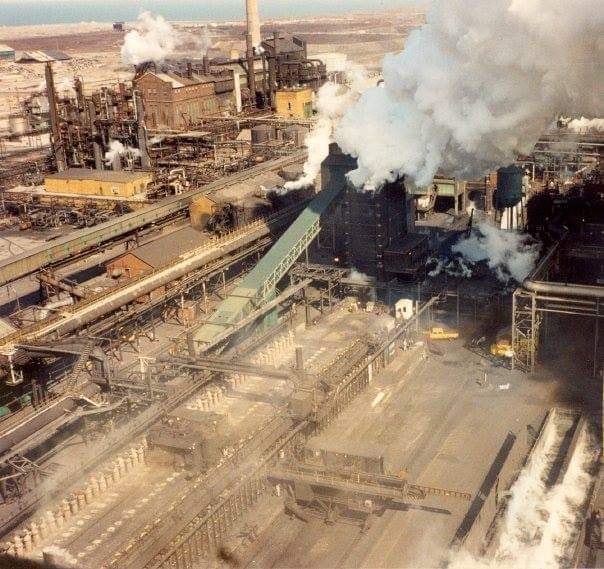
Late 1980's view of Gary Works #7 three-meter coke battery. Seen is top side and pusher side. Bi-products dept. In the background.
Coal was loaded into the Larry Car shown topside, from the coal bunker, and then the Larry Car would charge the oven through several charging holes.
  
David Holoweiko posted via Dennis DeBruler

Jordan Harmon commented on David's post above
2024 burns harbor
 
Stelco Rod and Bar Hamilton posted via Dennis DeBruler
1948 - Stelco Coke Ovens > Larry Car on #3 Battery > Hamilton, Ontario, Canada. (There's actually 3 men in this photo - can you find the 3rd??)
Peggie Popowich: The 3rd Man on the right side, where clothes are.
D Eric Davis shared
Larry Haynes: Standing facing the Sandpipe, been there done that years ago ...

Stelco Rod and Bar Hamilton posted via Dennis DeBruler
1930's Steel Company of Canada, Hamilton, Ontario > Larry Car on Stelco's #2 Coke Oven Battery. Of the seven Coke Oven Batteries that Stelco had in operation over the years, only one is left today (#7 Battery.)
D Eric Davis shared
Tom Ray shared
Daniel Lajambe: First battery I’ve seen with 4 charge holes!!

Most material transfer applications of larries have been replaced by conveyor belts, but they are still used to charge coke ovens because of the additional functions of unsealing, removing, replacing and resealing the lid. In fact, judging by Anthony's photo, each oven has four lids.

One function of a larry car is to be able to accurately dump its contents. Another function in some applications is to be able to weigh the contents so that it can dump an accurate amount of material. Both of these functions is why a larry was added to the design of Hulett iron ore unloaders. In this diagram
we cans see the larry hanging from inclined rails at the bottom of the gantry.
ASME, p11

Here I cropped the diagram to get the full available resolution and highlighted the larry in red and a hopper in blue. The rails are inclined because the larry used a rope hoist to pull itself to the right and gravity to pull it to the left.
Digitally Zoomed plus Paint


BGSU
View underneath 17 ton unloaders

The travelling bucket would dump its load into the hopper. Since the hopper is on the ship's end of the gantry, this minimized the distance that the bucket had to travel. And it gave a bigger target for the bucket operator to dump into than a railroad ore hopper would provide. The hopper could hold about three bucket loads. The larry operator would then load his car from the hopper, travel over to the correct ore car and deposit the correct amount of ore into the ore car using its on-board scale. Since a railroad charges by the carload, you want to get as much into a car as possible. But you do not want to exceed the rating for the route the ore car will take to its destination. For a long time the max weight was 263k pounds for a 4-axle car. The railroads have been upgrading to the new standard of 286k. I was curious about the implementation of that new standard so I found this CSX map. The red routes still have the 263k max rating. But ore cars are short because ore is dense compared to coal, grain, etc. I wonder if those cars have a lower rate because short cars would allow more weight to be placed on a bridge span. 
CSX Map

The Republic Steel Buffalo Plant photo at the top of these notes and the Bethelehem photo show a steel mill design that Sloss Furnaces helped pioneer. Specifically, a high-line would be built on a trestle above several storage bins. Larries would transfer iron ore, coke and limestone from the storage yards to these bins. These larries probably did not have to weigh their product. And there was a tunnel under the storage bins that would allow a larry with a scale to unload a specific amount of material from a storage bin and transfer it to the skip hoist pit. Sloss called this car a scale car. Before the use of skip hoists, a blast furnace was charged with wheelbarrows going up an elevator and being shoved over a bridge to the top of the blast furnace where the contents of the wheelbarrow was tipped into the furnace. I remembered when I attended a tour of the Joliet Iron Works Ruins that the guide said the "bridge" wasn't much more than wood planks. They didn't worry about handrails in the 1800s. And sometimes a worker would fall into the blast furnace. Management didn't care because they only had to walk out to the front gate and pick someone from the throng of men that wanted a job. And there was no worker's comp back then.
DeBruler

A good view of the larry car in a Hulett.

So I have found four applications of larries in a steel mill:
  • Part of a Hulett iron ore unloader's design
  • Transferring material from storage yards to storage bins
  • Transferring material from storage bins to skip hoists
  • Transferring coal to coke ovens
It never occurred to me that conveyor belts were disruptive technologies until I wrote these notes. They not only made the first three applications obsolete, they made Huletts themselves obsolete because ore boats were converted to self-unloaders. They also made ore bridges and skip hoists obsolete.