A coal dock on the Illinois River has been repurposed to handle wind turbine parts.)
This is an extraction of the ship transport information from Transporting Windmill Parts. It was getting too big, and I wanted to isolate the info of interest to boat nerds. Transport by barge has been added.
(Update: Tower segments are also carried on the rail deck of the SS Badger ferry and on barges from Broadwind Tower.)
This video taught me why they needed a ground based crane even though the ship had its own cranes. It appears that the ship normally docks with its cranes on the dock side and passes the load between the cranes. But in this case the load was too long to pass between the cranes. So they docked the ship with the ship's cranes out of the way and brought in a land based crane to handle the blades.
Four of the photos posted by John Handley:
Two of the photos posted by BigLift Shipping with the comment: "With the discharge of nacelles for the Merkur offshore wind farm in Eemshaven, The Netherlands, our grand old lady Happy Buccaneer completed her 250th voyage since she was taken into service."
BigLift shared four photos.
The first three photos posted by Don BeVier: "Detroit, 5-18-19."
David Kaye posted three photos with the comment: "Happy River and Alpena meeting in the Soo Harbor. 10-24-19"
Alice Spurgeon also posted photos of Happy River's trip to Duluth with wind tower segments. "Happy River headed to Duluth with windmill parts at the Soo."
There must be something special about the Miena Desgagnes because others also posted photos of it.
David Kaye posted four photos with the comment: "Miena Desgagnes upbound at the West Pier of the Soo Locks, heading for Thunder Bay, ON 5-2-23"
This is an extraction of the ship transport information from Transporting Windmill Parts. It was getting too big, and I wanted to isolate the info of interest to boat nerds. Transport by barge has been added.
(Update: Tower segments are also carried on the rail deck of the SS Badger ferry and on barges from Broadwind Tower.)
 |
| Ports of Indiana [I wonder if these are being imported or exported. I read about a forklift handling the big blades like "toothpicks." Judging from the men standing by the blade, the tires on this forklift are about waist high. Given that the ship has three cranes, it is interesting that a dock side crane is also being used.] |
 |
| Roger Smith posted via Dennis DeBruler |
The same ship on its way to the dock.
 |
| Carl Burkett posted via Dennis DeBruler |
 |
| Photo, Oct 2005 [This is docked in Oswego, NY.] |
 |
| Screenshot from a video posted by Jane Herrick Marshract entering Duluth with wind turbines. [It says "Amsterdam" on the stern so this would be a "salty." (It is small enough to go through the St. Lawrence Seaway.)] |
Paul R Murray posted three photos, one of which is going under the Bluewater Bridges. His comment: "MUNTGRACHT - Upbound Port Huron, Michigan 5-14-2017."
 |
| 1 |
 |
| 2 |
 |
| 3 |
Lynda Crothers posted three photos with the comment: "Palabora downbound passing Cape Vincent, Monday morning 9 am with wind mill blades."
[Downbound is a big deal because it implies USA or Canada is exporting blades.]
[Downbound is a big deal because it implies USA or Canada is exporting blades.]
 |
| 1 |
 |
| 2 |
 |
| 3 |
 |
| Barbara Hutt Phillips posted Interesting! Went by Chippewa Point about ten minutes ago heading downward. Quickly grabbed my camera! |
 |
| Geoff Miller posted Carrying wind turbine parts [I find it very depressing that American can't even build new things anymore. Instead of trying to save underground coal mining, the Feds should have subsidized windmill (and solar panel) plants in West Virginia to create jobs for coal miners.] |
David Kaye posted a couple of photos of windmill blades going through the Soo Lock with the comment: "HHL Amur up bound at the West Pier of the Soo Locks. 6-17-17" Ken Janeczko posted HHL Rhine upbound near Detroit, MI carrying tower segments. I gather from the name "Rhine" that these HHL ships are importing windmill pieces from Germany.
 |
| Screenshot (source) |
 |
| One of three photos posted by Bill Payne More windmill pieces coming into the the Port of Ogdensburg on 7-7-18. Bill Payne http://www.watertowndailytimes.com/.../wind-turbine-parts... [At first I missed all of the blades already unloaded on the land. Tower segments must be a bulky (light) load because the bow bulb is partially out of the water even the ship is loaded.] |
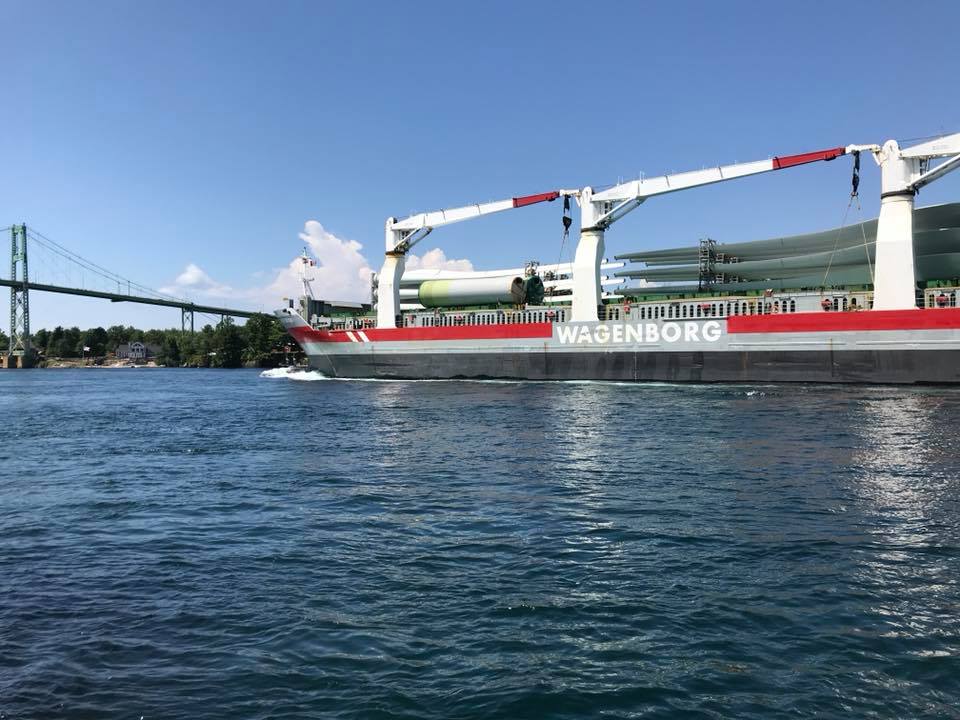
Betsy Cook-Kelly posted two photos with the comment: "How often do you see two ships coming at you side by side at the same time?"
Blackburn Jim Never!!!
Betsy Cook-Kelly That's what I thought! I've never seen that. The funny thing was that the heavier ship with the turbine blades was going much faster than the other ship and giving off HUGE waves!
Christian Burns Was great watching it happen, the one in front pretty much pulled over and let it by!
Helen Cooper I heard the captains taking on the radio. The Amstelborg asked permission to pass around Sister Island (just East of Alex. Bay and the G3 Marquis offered to pull up a bit to let her get by.
Charles T. Low Puzzling. I imagine at least that the location near Singer Castle is a good passing zone. In front of Alexandria Bay might not be! I witnessed a freighter similarly pass a much small, slower Caribbean cruise ship once, but why one would be slower here when the speed limits are generally slower than a modern vessel's capability (aren't they?), I can't guess. On that previous occasion, the request was to "pass on two whistles" which is standard for those familiar with sound signals. The cruise ship captain took a while to figure out what was being asked of him, i.e. he needed to slow if the maneuver were to succeed - the freighter officer was very polite and patient.
Bob Gates The Amstelborg was moving I was running 22 mph took me from Clayton to Cedar point to over take here we we talking at the time how fast she was going.
Thomas LeFaivre I thought the big ships had a 6kt speed limit on the St. Lawrence.
Mark Leet Nope
Charles T. Low Mark Leet But there are speed limits, varying for different zones, clearly marked on nautical charts, sometimes varying for upbound vs. downbound vessels. I had assumed that most modern ships could achieve those speeds (up to 13 knots in some areas?) - there was a day when some of the older lakers could not - in which case why the occasion to overtake?
Mark Leet Speeds are controlled by the seaway based on several variables, some vessels don't have very much fine control, so to not go over they may have to keep 3knts below, so following such a ship for 10-12hrs can add time and $ to the journey.
Betsy Cook-Kelly That makes sense...maybe the Amstelborg wasn't actually going faster but the G3 Marquis was slowing down to let them by.
Pam Rider Rose This year it has been quite often
Brian Cameron windmill parts from Germany...
Blackburn Jim Never!!!
Betsy Cook-Kelly That's what I thought! I've never seen that. The funny thing was that the heavier ship with the turbine blades was going much faster than the other ship and giving off HUGE waves!
Christian Burns Was great watching it happen, the one in front pretty much pulled over and let it by!
Helen Cooper I heard the captains taking on the radio. The Amstelborg asked permission to pass around Sister Island (just East of Alex. Bay and the G3 Marquis offered to pull up a bit to let her get by.
Charles T. Low Puzzling. I imagine at least that the location near Singer Castle is a good passing zone. In front of Alexandria Bay might not be! I witnessed a freighter similarly pass a much small, slower Caribbean cruise ship once, but why one would be slower here when the speed limits are generally slower than a modern vessel's capability (aren't they?), I can't guess. On that previous occasion, the request was to "pass on two whistles" which is standard for those familiar with sound signals. The cruise ship captain took a while to figure out what was being asked of him, i.e. he needed to slow if the maneuver were to succeed - the freighter officer was very polite and patient.
Bob Gates The Amstelborg was moving I was running 22 mph took me from Clayton to Cedar point to over take here we we talking at the time how fast she was going.
Thomas LeFaivre I thought the big ships had a 6kt speed limit on the St. Lawrence.
Mark Leet Nope
Charles T. Low Mark Leet But there are speed limits, varying for different zones, clearly marked on nautical charts, sometimes varying for upbound vs. downbound vessels. I had assumed that most modern ships could achieve those speeds (up to 13 knots in some areas?) - there was a day when some of the older lakers could not - in which case why the occasion to overtake?
Mark Leet Speeds are controlled by the seaway based on several variables, some vessels don't have very much fine control, so to not go over they may have to keep 3knts below, so following such a ship for 10-12hrs can add time and $ to the journey.
Betsy Cook-Kelly That makes sense...maybe the Amstelborg wasn't actually going faster but the G3 Marquis was slowing down to let them by.
Pam Rider Rose This year it has been quite often
Brian Cameron windmill parts from Germany...
 |
| 1 |
 |
| 2 |
 |
| Howard Maxson commented on Betsy's posting, cropped Passing Ogdensburg about 11: 15 am |
 |
| Howard Maxson commented on Betsy's posting, cropped Passing Ogdensburg about 11am, they must have been racing. |
 |
| a |
 |
| b |
 |
| c |
 |
| d |
 |
| 1 |
 |
| 2 |
BigLift shared four photos.
BigLift Shipping's HTV BigLift Barentsz photographed on her way to Germany and Sweden, carrying 87 x V150 Blades on deck. Port of loading: Motril, Spain.
 |
| 1 |
 |
| 2 |
 |
| 3 |
 |
| 2 |
I saw several photos of this salty as it worked its way upbound through the Seaway and Detroit & St. Clair Rivers, but this view is worthy of note.
 |
| David Schauer posted Blade Runner... M/V Ronnie arriving in nice light with wind blades for the port terminal. North Carolina with an assist. Duluth, MN - April 30, 2024 [That is the Aerial Lift Bridge in the background.] |
 |
| GreatLakesSeaway Longshoremen at the port were able to unload three ships within a one-week period, a first, according to OBPA officials. The ships were each carrying wind turbine components. [It is interesting that there is no dockside track so that a ship's crane can load directly onto a railcar. ] |
 |
| Bay Crane posted |
 |
| 1 |
 |
| 2 |
 |
| 3 |
David Kaye posted three photos with the comment: "Happy River and Alpena meeting in the Soo Harbor. 10-24-19"
 |
| 1 |
 |
| 2 |
 |
| 3 |
 |
| 1 |
 |
| 2 |
BNSF Railway posted three photos with the comment:
Dale V Rockwell "Port of Galveston" suggests that they were offloaded from a ship.
Caleb Kemplay I know Vestas ships lots of blades to Galviston, they also have some massive turbines... so I'm putting my money on Denmark, I could be wrong, i think they also have a factory in Germany.
The economies of ship transport are reduced if there is a wreck.
Take a look at the largest wind blades BNSF has ever moved -- 74 meters [243'] long! We hauled these from the Port of Galveston to Wichita Falls, Texas, last month. BNSF has the largest rail-controlled fleet of specialty flat cars for wind component transport in the industry.James Lee Stewart Where were the blades made ???
Dale V Rockwell "Port of Galveston" suggests that they were offloaded from a ship.
Caleb Kemplay I know Vestas ships lots of blades to Galviston, they also have some massive turbines... so I'm putting my money on Denmark, I could be wrong, i think they also have a factory in Germany.
 |
| 1 |
 |
| 2 |
 |
| 3 Claude Conrad Is all that power, in that one shot to be used in service or going to the graveyard? |
 |
| William Coke posted Dean Linic Geelong赵颖 we have special adapters for those wind tower transportation. |
 |
| Michigan Film Photographer Karl Wertanen posted Took a few minutes this morning and ran down to the Port Of Monroe to grab a shot of the Happy River unloading wind tower segments for Ventower Industries. The Happy River made it's trek from Becancour QC through the St Lawrence Seaway down to Monroe with these 40' segments. I've read that the Ventower will receive 14 total shipments this year from the Happy River which will make a total of 560 segments to fulfill a contract with General Electric. I hope to make it down there during sunrise or sunset this season for a better opportunity at light and composition. The wind was moving strong above the River Raisin this morning so had to make it a short and cautious flight. Dale Stringham I think they were loading the segments, not unloading at the Port of Monroe. They are manufactured by Ventower at the Port. Karl Wertanen Actually they were offloading. They arrived roughly an hour before and were dropping these down onto the pad. Michigan Film Photographer Karl Wertanen GE has a partnership with Ventower and the Port to use this port as a distribution hub. Peggy Tupper I think you mean up the St Lawrence Seaway. From Quebec to Michigan is upbound. Michigan Film Photographer Karl Wertanen Lol Yeah i understand the difference between the “bounds”. I just mean down as in from further north (which it is) to south (us). I didn’t mention “down-bound”. If I was going to mention upbound or down bound, I would have specified the correct “bound”. Peggy Tupper Michigan Film Photographer Karl Wertanen No offense but you did refer to the St Lawrence Seaway and navigation in inland waters always specifies up and down based on the current flow. regardless of latitude or whether the word bound is used. If you go up the Welland Canal you are going south. Regardless, it is an interesting photo. |
 |
| Screenshot @ -0:14, cropped, DeBruler |
 |
| Screenshot |
 |
| 1 of 6 photos posted by the Port of Oswego Authority Port unloading the first pieces of the windmill project and placing them in temporary storage to later be trucked to the point of construction. Local jobs! [We can see on the left side of the photo that the dock does have a crawler crane. But it is not needed for this ship.] Janey Anderson shared Melissa unloading at Port of Oswego. Karen Lafave: We have all turbine blades here in Ogdensburg ⚓️ saw this ship passing up River. |
 |
| Janey Anderson responded to Karen's comment That's Ronnie - grabbed a shot of her yesterday passing Ogdensburg. This is her sister ship Melissa. |
A satellite caught nacelles and hubs in Ogdensburg.
 |
| Satellite |
 |
| Gary Watters posted M.V. Charlie, upbound to/up Erie, Pa. Three Rivers. |
Bill Jr. Salton posted nine photos of Charlie with the comment: "Charlie making her first upbound trip through the Seaway on the night of May 4th (be with you). She is still on the Port Colborne Anchorage as of May 7th, awaiting a pilot for the short crossing to Erie, PA with windmill blades." [The photos were taken while the freighter was in Lock #7.]
 |
| 1 of 11 photos posted by Michael Hull ONEGO DUERO (2012 Netherlands) was at Keefer Terminal in the Port of Thunder Bay on May 29, 2022. The Port’s mobile harbour crane offloaded windmill tower sections from the vessel. |
4 of 15 photos posted by Michael Hull with the comment: "NORDIKA DESGAGNES (2010 Canada) and HOUTMANGRACHT (2009 Netherlands) were both at Keefer Terminal in the Port of Thunder Bay on June 17, 2022. Nordika Desgagnes unloaded general cargo while Houtmangracht delivered turbine parts. The Port’s Intermodal Yard was managing to prepare the turbine towers for transport."
 |
| a [Note the number of axels on the truck trailer. This trailer was used for the short trip to the lay-down yard.] |
 |
| b [This photo shows that turning a long trailer with so many axels requires that at least some of the wheels are steerable.] |
 |
| c [Some of the tower segments went on railcars. But most of them went to the intermodal yard in the right background.] |
 |
| d [A close up of the use of the intermodal yard.] |
 |
| David Schauer posted A view of wind power components being unloaded from the Wagenborg vessel Reestborg at the Duluth port terminal this afternoon. 9/17/2022 [Note the use of a spreader bar so that both cranes can help lift the component. It must be really heavy. I wonder what part of the wind turbine this part would be.] |
 |
| David Schauer posted A view I wanted yesterday at Duluth was one of the trucks moving a blade to the laydown area. According to Jeff Thoreson, at 260 feet, these are the longest blades ever moved in North America. I could tell they were super long when that truck pulled away from the Roerborg. 10/11/2022 Zach Macmillan: Vestas v164 blades. Douglas van Doorn: Like to know how they drive them out of town lol David Schauer: Douglas van Doorn Up Piedmont and Highway 53. Jeff Thoreson: Jenner, Alberta. |
(3:01 new window) (source)
3 of 15 photos posted by Karen Limardi with the comment: "The Miena Desgagne upbound below Lock 1 this morning."
 |
| a Brenda Gunn: Fabulous shot! What is she carrying? Karen Limardi: Brenda Gunn I was thinking windmill base but not quite sure ! Dennis DeBruler: Karen Limardi Indeed. They are probably the segments that are used to build the towers for wind turbines. |
 |
| b [I included this one to show how much traffic there is on the Welland Canal. In addition to an articulated tug barge (ATB) moored in the background, another one is downbound. This also shows that ATBs are evidently becoming more common.] |
 |
| c [Lock #1 is in the background.] |
There must be something special about the Miena Desgagnes because others also posted photos of it.
 |
| Jim Lehocky posted MIENA DESGAGNES (closest) and AMERICAN CENTURY coming upbound on the St. Marys River this afternoon. 5/2/23 Jim Lehocky shared |
 |
| Jim Lehocky posted MIENA DESGAGNES unbound at Rotary Park in Sault Ste Marie this afternoon. Showers, drizzle and wind let up just in time for me to get this shot with the drone. 5/2/23 Jim Lehocky shared |
David Kaye posted four photos with the comment: "Miena Desgagnes upbound at the West Pier of the Soo Locks, heading for Thunder Bay, ON 5-2-23"
David Kaye shared
CarlzBoats has photos of tower segments and windmill blades going upbound on the St. Lawrence Seaway. Also a multipurpose cargo ship that includes windmill parts.
Jean Hemond Flickr of a cargo ship hauling blades. (source) Blades must be light and they could not find any cargo to haul in the hull because it is running high out of the water. Normally the bow bulb would be underwater.
 |
| 1 |
 |
| 2 |
 |
| 3 |
 |
| 4 |
 |
| 1 of 11 photos and a video posted by Heidi Schmidt BBC Manila upbound for Thunder Bay carrying wind turbine blades in Marine City, Michigan May 24, 2023. |
That ship caught the eye of more than one fan.
 |
| Jim Lehocky posted BBC Manila at Rotary Park 946am 5/25/23 carrying windmill blades to Thunder Bay Ontario. |
 |
| David Schauer posted Asian Spirit delivering another load of wind blades. The blades from its first trip are in the laydown storage area. Tug Missouri with the press. Duluth, MN - May 13, 2025 |
Jean Hemond Flickr of a cargo ship hauling blades. (source) Blades must be light and they could not find any cargo to haul in the hull because it is running high out of the water. Normally the bow bulb would be underwater.
I generalize "by ship" to "by water transport." I.e. this is barge transport.
 |
| One of six photos posted by Dave Carrier with the comment: "Comming through stlouis." [A comment indicates they will be heading up the Missouri. I wonder if these are imports that were transloaded from a ship down by the Gulf. Dave Carrier posted photos and a video of the tow.] |
 |
| 1 of 5 photos posted by Jan Danielson Crosby Progress. First time for me to see this boat in my area. Interesting to see the "high pilot house." Pushing wind turbine blades up river to Camanche, Iowa from New Orleans. Pictures taken at lock and dam 14 Pleasant Valley, Iowa. 11-21-22. |
 |
| 1 of 5 photos posted by Jan Danielson Interesting to me---Crosby Progress boat heading up river pushing a barge with wind turbine blades. No matter how YOU feel about those it was something to see at lock and dam 14 Pleasant Valley, Iowa. 11-21-22. Kimberly Berlyn Pettigrew: We watched them on the Lock 19 live cam. First tow was Big Eddie and the second one was Crosby Progress. |
Kelly Moeller posted four photos with the comment: "Windmill blades heading north from on Mississippi. Photos taken at Chester IL."
Fort Loudoun Lock shared with the comment: "Wind turbine blades have been something we've seen transported via barge on the river now for several years.... 📸 Credit to Kelly Moeller"
 |
| 1 |
 |
| 2 |
 |
| 3 |
 |
| 4 [Going under the Chester Bridge.] |


2 of 8 photos posted by Jan Danielsen with the comment: "Bernard G heading down river to lock 15 Rock Island, Illinois. Pictures taken from Bettendorf, Iowa 11-7-23."
 |
| a |
 |
| b |
Karen Limardi posted some photos with the comment: "The BBC Tokyo upbound in the Welland Canal at Lock 7 on her maiden voyage through the Seaway....following her sister ship BBC Dubai just a few weeks ago....on her way to Erie !"
 |
| a |
 |
| b |
 |
| c |
 |
| d |
 |
| e |
 |
| f |
 |
| g |
 |
| h |
 |
| i |
 |
| j |
Because it is her maiden voyage, there were a lot of photos of the BBC Tokyo on the web. For example:
2 of 15 drone photos posted by Bobby Dzz.
 |
| a Exiting lock 7 up |
 |
| b |
Look near the end of Erie Docks for photos of the blades being unloaded from this and other BBC Chartering ships.