(
Satellite)
 |
USACE Pittsburgh District posted
USACE contractors didn’t just build a lock— they shaped the river. Once the Montgomery lock was up and running, it replaced three older wooden wicket dams — locks and dams 4, 5, and 6 — structures that had raised the first shallow navigation pool on this stretch of the Ohio River. Those early wickets did their job, but rivers back then were unpredictable. Shallow depths made navigation tough — sometimes impossible — for commercial and recreational boats. That’s why the system we have today matters. Locks and dams turned Pittsburgh’s rivers into year-round transportation corridors by moving goods, supporting the navigation industry, and connecting our region to the world. |
 |
USACE Pittsburgh District posted
Here’s another old postcard! Though this postcard is from long ago, Montgomery Locks and Dam still operates along the Ohio River in Beaver County, Pennsylvania. It is one of the three Upper Ohio projects receiving upgrades in the coming years. |
 |
USACE Pittsburgh District posted
Today's foggy veil may cloak the Ohio River. However, check out this snapshot of a towboat shepherding a caravan of 15 barges, most filled with coal, toward the Montgomery Locks and Dam in Monaca, Pennsylvania, from Jan. 23! 💡 Did you know the Ohio River is a titan of transportation? It shuttles roughly 15 to 20 million tons of goods every year. It's not just about coal; this water highway carries a diverse cargo including steel, petroleum products, and much more. 📊 Fog may obscure our view today, but it can't dim the Ohio River's vital role in our economy and community life. Our locks are in operation 24 hours a day, 7 days a week, in all types of weather. Join us in thanking our lock and dam operators and celebrating the river's might and wish for clear skies ahead! 🌤️🌊 👋 Share your own river tales in the comments. 📷by Michel Sauret |
6 photos of
cjmahan replacing gates 6-8 in 2015 for $7.6m.
 |
| Banner |
.jpg) |
| 1 |
 |
| 2 |
 |
| 3 |
 |
| 4 |
 |
| 5 |
 |
| 6 |
Feb 2023:
 |
USACE Pittsburgh District posted
Imagine a retaining wall made of columns built into the bedrock of the Ohio River. The wall is only 50 feet long, but it pierces 25 to 40 feet into the ground -- completely underwater. It may seem small, but the U.S. Army Corps of Engineers Pittsburgh District recently finished the secant pile wall for massive construction to move forward at Montgomery Locks and Dam in Beaver County, Pennsylvania. Fort Loudoun Lock shared
Here's a terrific post from the Pittsburgh District Corps of Engineers that will be especially interesting for all of you Engineering minded folks out there! Enjoy!
Alan Jones: Very interesting, thanks for posting! By the way, if you are interested in the Corps Nashville district's history beginning in the late 1700's, you might enjoy this read. I bet most folks don't know that the James gang robbed one of their projects back in the 1800's. You can order the book online or read it from the above link on Google Docs. The document is in the Public Domain. |
Apr 2023:
USACE Pittsburgh District
posted five images with the comment:
The Montgomery Locks and Dam will go through major construction in the next decade to build a new, larger lock funded by the
Bipartisan Infrastructure Law.
The #BIL awarded funding of more than $857 million to Montgomery to improve river navigation. 💰
The current 360-foot auxiliary chamber is being replaced with a much wider and longer 600-foot chamber that can fit up to 9 barges at one time. Once it begins, construction is estimated to take approximately eight years. 🚢
The Montgomery Dam has been in place for nearly 100 years. This #megaproject will help ensure that the dam is there for 100 more. 👍
[There are some comments about the new lock being too small and about it being ready just in time for barge traffic to dry up. (Probably because most of the barge traffic is coal.)]
 |
| 1 |
 |
| 2 |
 |
| 3 |
 |
| 4 |
 |
| 5 |
USACE, Pittsburgh District
posted four photos with the comment:
Big machines and bigger innovations are hard at work upgrading one of the smallest locks on the Ohio River.
The U.S. Army Corps of Engineers Pittsburgh District is going big — literally — at Montgomery Locks and Dam, where one of the region’s most ambitious infrastructure projects is underway: building a new primary lock chamber in place of one roughly half its size.
[A couple of comments complain that it will be only 600' instead of 1200'. The contract is for $770m.]
 |
| 1 |
 |
| 2 |
 |
| 3 |
 |
| 4 |
I never noticed before, but the movable gates look like
sluice gates instead of
radial gates.
 |
2:58 video @ 0:52
Montgomery Locks and Dam on the Ohio River a drone video
Montgomery Locks and Dam is a lock and dam on the Ohio River, located 32 miles downstream of Pittsburgh. There are two locks, one for commercial barge traffic that's 600 feet long by 110 feet wide, and the recreational auxiliary lock is 360 feet long by 56 feet wide. History Montgomery Locks and Dam was constructed from 1932 to 1936. The locks opened in June 1936. This facility eliminated the original Locks and Dams 4 (built 1898-1908), 5 (1898-1907) and 6 (1892-1904). These three dams were old-style wooden wicket dams built by the U.S. Army Corps of Engineers to raise the first shallow navigational pool on this stretch of the Ohio. |
Mar 2026:
USACE, Pittsburgh District
posted four photos with the comment: "A few foggy views from Montgomery Locks and Dam to start your Monday."
 |
| 1 |
 |
| 2 |
 |
| 3 |
 |
| 4 |
USACE, Pittsburgh Division
posted four photos with the comment:
STORY: Let’s start with some basics, concrete versus cement. The two terms are often used interchangeably, but they shouldn’t be – and they are definitely NOT the same thing.
Cement is a powder made from limestone and clay, used as a binder. Concrete is a mixture of cement, water, sand, and aggregates such as gravel, forming a strong construction material. In short, cement is a key ingredient in concrete.
Concrete is a key ingredient in the construction of a new lock chamber at Montgomery Locks and Dam on the Ohio River.
[The full story is that they built their own lab as well as batch plant.]
.jpg) |
| 1 |
 |
| 2 |
 |
| 3 |
 |
| 4 |
Apr 29, 2026:
.jpg) |
USACE, Pittsburgh District posted
If you've ever looked at Montgomery Locks and Dam, you may have wondered what the facility's giant, mysterious concrete piers running across the Ohio River actually do. First, they look cool. Second, they house huge chains to move huge river gates up and down, similar to medieval drawbridges, so Montgomery Locks and Dam can provide sustainable, reliable river navigation. It's no small task and it requires a few things: 1) A river (very important) 2) A lock chamber (because river depths are inconsistent and some areas necessitate a water elevator to get boats from one elevation to another) 3) High enough pool levels (so vessels don't scrape the riverbed) The Montgomery facility currently has a new lock chamber on the way so larger river traffic can navigate up and down the Ohio River, but the dams in between the piers play a crucial role by regulating the upstream pool level. The dams don't play a role in flood mitigation, but the dam gates are adjustable as needed so hundreds of vessels can lock through every month. The Corps of Engineers' Medium Capacity Fleet replaced one of the giant chains in a pier last week - pictured here. |
Beaver County Historical Research and Landmarks Foundation
posted 14 photos with the comment:
So, a postcard of the Montgomery Dam located at Industry, PA...
Though this postcard is from long ago, Montgomery Locks and Dam still operates along the Ohio River in Beaver County, Pennsylvania. It is one of the three Upper Ohio projects receiving upgrades in the coming years.
This postcard was just added to the archives at BCHR&LF...
Some interesting facts about this dam...
If you've ever looked at Montgomery Locks and Dam, you may have wondered what the facility's giant, concrete piers running across the Ohio River actually do.
First, they look interesting!
Second, they house huge chains to move the river gates up and down, similar to medieval drawbridges, so Montgomery Locks and Dam can provide effective, reliable river navigation. It's no small task and it requires a few things:
1) A river ( important)
2) A lock chamber (because river depths are inconsistent and some areas necessitate a water elevator to get boats from one elevation to another)
3) High enough pool levels (so vessels don't scrape the riverbed...) this happened in the early days of the Vicary House... the river was not deep enough at times...
The Montgomery facility currently has a new lock chamber on the way so larger river traffic can navigate up and down the Ohio River, but the dams in between the piers play a critical role by regulating the upstream pool level. The dams don't play a role in flood mitigation, but the dam gates are adjustable as needed so hundreds of vessels can tracel through every month.
The Corps of Engineers' Medium Capacity Fleet replaced one of the giant chains in a pier just in April this year... I had the privilege to drive along the Ohio River while passing through the town of
Indystry, PA and see firsthand some of the updating work being done... the first photo is a close-up, the rest of the photos in this post were taken by me from the Industry side of the river... taken on April 20, 2026 this past spring...
Shawn Pinkerton: The chamber will not allow for larger tows, instead of a large and small chamber both will be the same size
 |
| 14 |
 |
| 1 |
 |
| 2 |
 |
| 3 |
 |
| 4 |
 |
| 6 |
 |
| 6 |
 |
| 7 |
 |
| 8 |
 |
| 9 |
 |
| 10 |
 |
| 11 |
 |
| 12 |
 |
| 13 |
USACE, Pittsburgh District
posted four photos with the comment:
This is what it looks like to build infrastructure, not paperwork about 60 feet below the Ohio River.
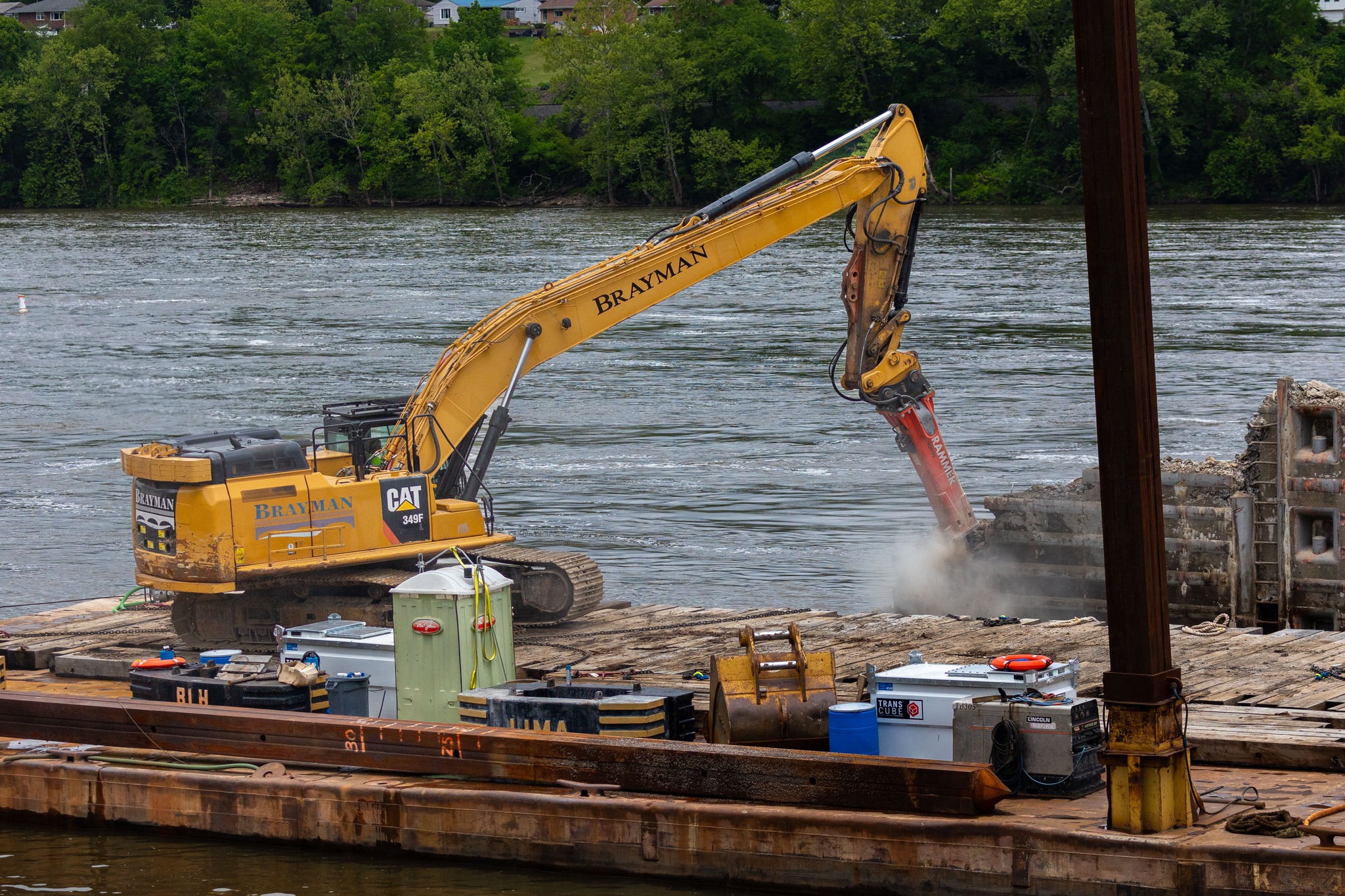
At Montgomery Locks and Dam, contractors are drilling 6.5-foot-wide rock sockets as deep as 40 feet into bedrock to support the new lock walls. Nearby, a long-reach excavator is demolishing part of the dam apron underwater to clear the way for the new river wall.
Then comes the concrete: during one placement, crews sent 1,200 cubic yards of concrete from the on-site batch plant, across conveyors and down a tremie pipe to where it was needed — up to 60 feet below the surface.
The work is part of the Upper Ohio Navigation Project, which will replace Montgomery’s smaller auxiliary chamber with a new 110-by-600-foot lock chamber built for the future of navigation on the upper Ohio River.
 |
| 1 |
 |
| 2 |
 |
| 3 |
 |
| 4 |


.jpg)




.jpg)


.jpg)


No comments:
Post a Comment